
86,500 Pixel Points on a Singapore Wheel
How an 86,500-point pixel LED installation on a Singapore observation wheel was engineered: point lights, Art-Net control, power distribution, and factory QC.
The Project in Numbers: 86,500 Pixel Points on a Singapore Observation Wheel
86,500 pixel points on a Singapore observation wheel — that is the headline number of the largest single deployment in Pileds' documented portfolio, and it sits in a different engineering class from a club ceiling or a sign fascia. The wheel was outfitted with individually addressable pixel point lights driven by our LED controllers, with every node mapped into a single synchronized show surface, as with any deployment of this class. The published case record (Singapore · observation wheel · 86,500 pixel points · point-light and led-controller) carries no venue name, timeline, or bill of materials — this article is the engineering walkthrough of what a project of this class demands, drawn from the delivered facts we can document and from the practice that gets a large-scale pixel LED installation to open night without field failures. For context: the same factory delivered a 46,000-point globe field in France and 3,600 m of pixel string for a US holiday plaza, so the wheel is not an outlier — it is the top end of a pattern. If you are planning a landmark install, the question is not whether 86,500 points can be done; it is what has to be engineered around them.
Why an Observation Wheel Is a Demanding Lighting Surface
An observation wheel is closer to a giant curved billboard that also moves than to a building facade. Four properties drive every downstream decision:
- No flat canvas. The wheel's lattice is a three-dimensional structure: spokes, rim, hub, and cabin ring all sit at different angles and distances from the viewer. Each pixel point light node has to be aimed and mapped in 3D space, not dropped onto a grid.
- It moves. The wheel rotates continuously. Power and data have to cross rotating interfaces, and the pixel map has to stay correct as nodes travel around the rim.
- It is read from far away. Viewers see the wheel from hundreds of meters across the bay. That changes the trade-offs: node size and spacing matter less than brightness and color consistency across the whole surface on camera.
- It lives outdoors, in the tropics. Singapore's climate means rain, high humidity, thunderstorms, and sustained heat. Everything on the wheel has to hold an outdoor rating and survive for years, because the alternative is a service call to a structure that does not stop for maintenance.
None of these are solved by "more LEDs." They are solved at specification time — which is exactly where the next three sections sit.
Hardware That Scales: Point Lights and Controllers
For a wheel, point lights are the natural pixel element: small nodes that mount cleanly on steelwork, each one an addressable color source. Our point-light range spans 26+ models from 12 mm to 100 mm nodes in coin, half-ball, globe, pineapple, and ring forms, with DC5–48 V input, IP20–68 ratings, and SPI or DMX control. On a project like the wheel, the relevant representatives are the 50 mm coin point light (7 LEDs, DC24 V, SPI/DMX, IP67, 1.68 W per node) for dense coverage, the 80 mm globe point light (360° emission, IP65) where light has to be seen from every angle, and the 12 mm square node (WS2811/UCS1903, 0.3 W) for accent detail.
What makes the wheel manageable is not any single node but the pairing of nodes with the right control hardware — and in our case, both come from the same factory. The LED controller range covers 8-, 12-, and 16-port Art-Net controllers, DMX-to-SPI decoders, and a DMX address writer. When fixture and controller are matched at the source, addressing behavior is known before anything ships, there is one QC chain instead of three suppliers pointing at each other, and the integrator carries fewer unknowns onto the structure.
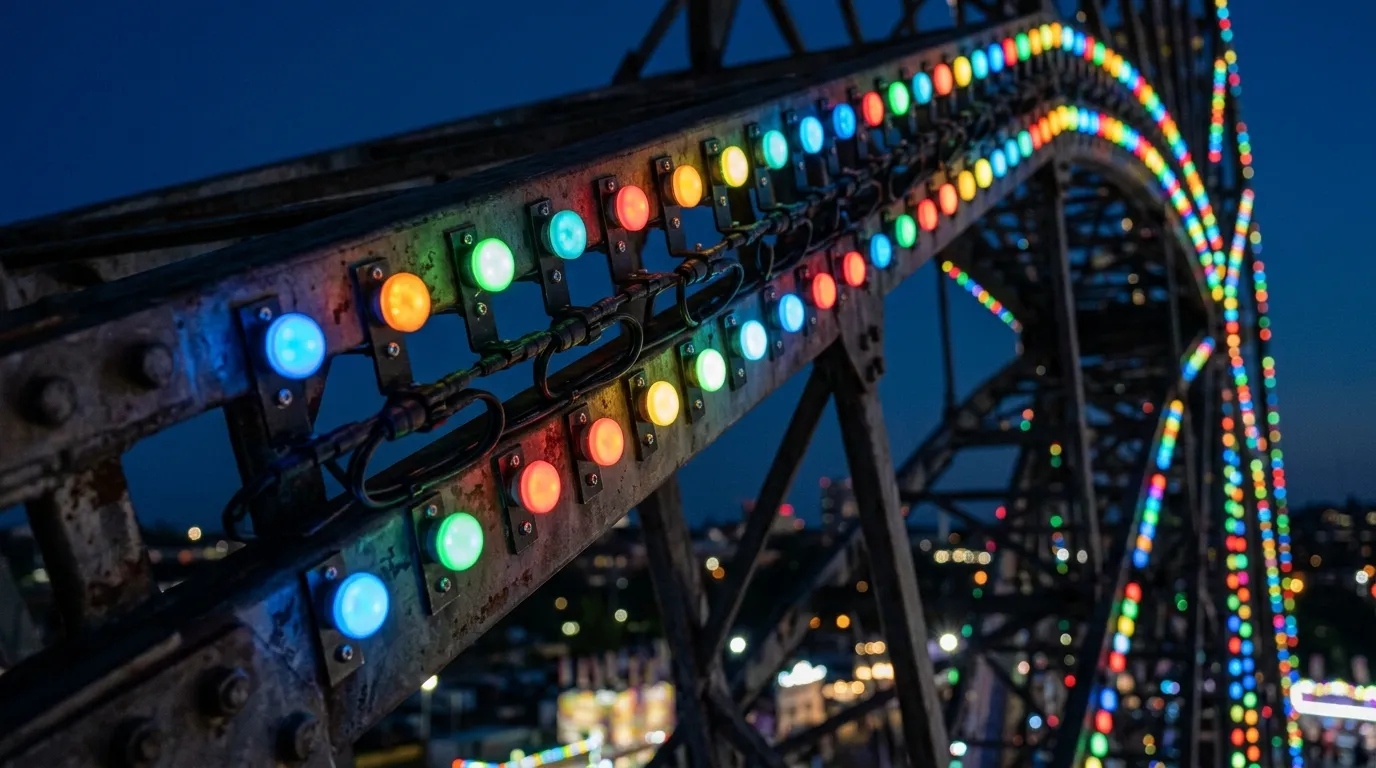
Pixel point lights mounted in rows on steelwork: each node is an individually addressable color source, so coverage density is a layout decision, not a fixture limit. (Illustrative rendering — not a photograph of the site.)
Control: Addressing and Mapping 86,500 Points
The word "addressable" is doing real work at this scale. Each of the 86,500 points is an individual pixel — not a zone — which means the control system has to carry a unique address per node and refresh them all in sync, continuously.
Do the arithmetic on DMX512, the classic lighting control protocol: 512 channels per universe, three channels per RGB pixel — about 170 pixels per universe. 86,500 pixels therefore means on the order of 500 DMX universes if every channel were driven directly. That is why large pixel installations move to Art-Net, an Ethernet-based protocol that carries multiple universes over standard network infrastructure. The wheel project's control architecture follows this pattern: an Art-Net backbone from the media server to distributed controller racks, then short DMX/SPI legs out to the nodes.
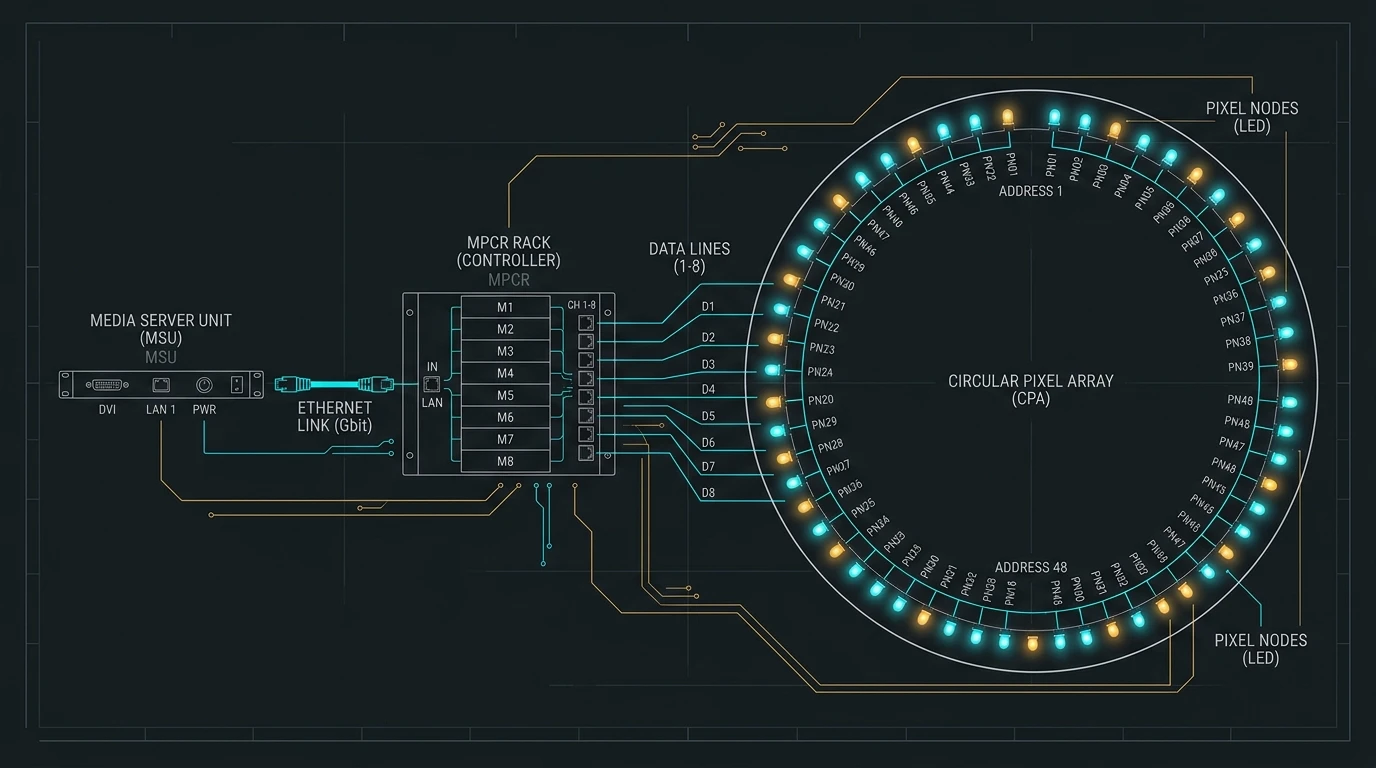
Control topology at wheel scale: one Art-Net backbone from the media server, distributed controller racks, and short DMX/SPI legs to the nodes — the pattern that keeps 86,500 points in sync.
Mapping is the second half. The wheel's geometry is mapped in pixel-mapping software such as MADRIX, which takes video and effect content and routes it to the right pixel coordinates — so a graphic that scrolls around the rim is authored once and played back against the 3D surface model, not hand-programmed point by point.
Two operational details matter for a venue that runs every night. First, content playback should not depend on a laptop: our 8-port Art-Net SD card controller supports online and offline modes, so the full show can run from stored content with the network down. Second, commissioning 86,500 nodes needs an address-writing workflow, which is what the DMX address writer is for — field technicians set node addresses without opening each housing.
Power and Data Distribution on a Moving Structure
Individual point lights draw little — the 50 mm coin node is rated 1.68 W — but multiply that by tens of thousands of nodes and a full-white scene is a serious electrical load. The design response is distributed power, not one oversized supply: power injection points are spaced along the runs so no feeder carries current across a long voltage drop, and the DC distribution is sized for the worst-case color mix, not the average.
Data distribution follows the same logic. DMX/SPI legs are kept short; decoders and repeaters sit close to the loads; the topology is a star from the controller racks rather than one long daisy chain. On a rotating structure this adds a mechanical dimension: cabling has to cross the rotating interface between the stationary base and the turning wheel, with strain relief, service loops, and routing that survives years of rotation without chafing. These are the details that do not show up in a render and the ones that decide whether the show is still running in year three.
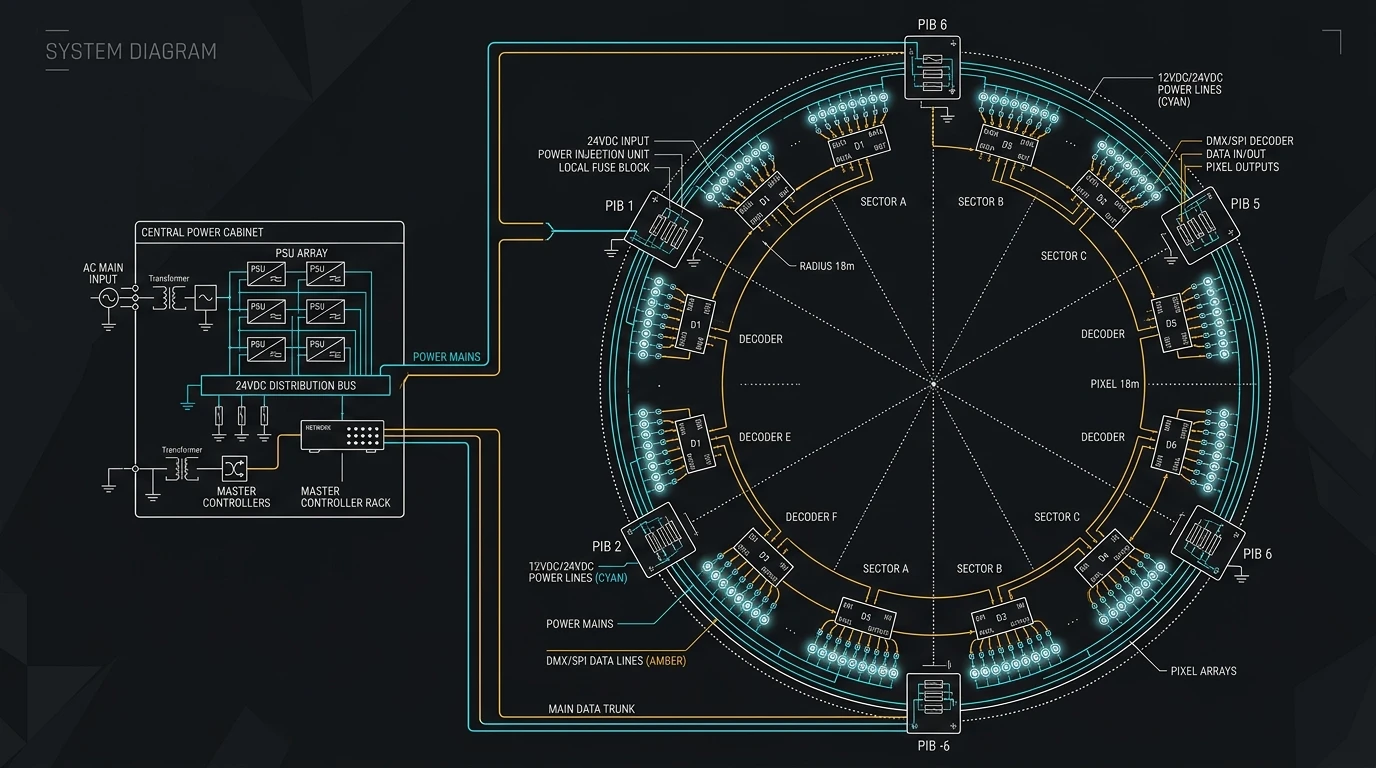
Power and data topology for a wheel-scale install: distributed injection points and decoders close to the load keep voltage drop and data runs short on a structure that never stops moving.
Installation and the Singapore Climate
Outdoor node selection is governed by IP ratings — the IP code (IEC 60529) classifies protection against solids and water. For permanently mounted outdoor pixel installations, IP65–IP68 is the working range; the representative node mix for a wheel sits in that band (the 50 mm coin node is IP67, the 80 mm globe IP65). The rating is only half the story: in a tropical climate, sealed connectors, cable glands, and UV-stable housings decide the actual service life, and high humidity makes the sealing test at the factory more than a formality.
Installation logistics shape the hardware too. On a structure where most work happens at height, pre-assembled and pre-tested subassemblies reduce time on the wheel, and nodes are mounted with replacement in mind — a failed node at 100 m up should be a 20-minute swap with a spare, not a project. The site side also gets a maintenance plan before commissioning: spare stock, access planning, and a defined path for swapping a node without disturbing its neighbors.
Quality Control: What Ships Before the Wheel Lights Up
A project with 86,500 failure points cannot be quality-assured by spot checks. Our factory in Shenzhen Bao'an (1,500 m², in-house SMT, reflow, QC, and aging lines, 5,000,000+ pcs/year capacity) runs six checkpoints on every production batch:
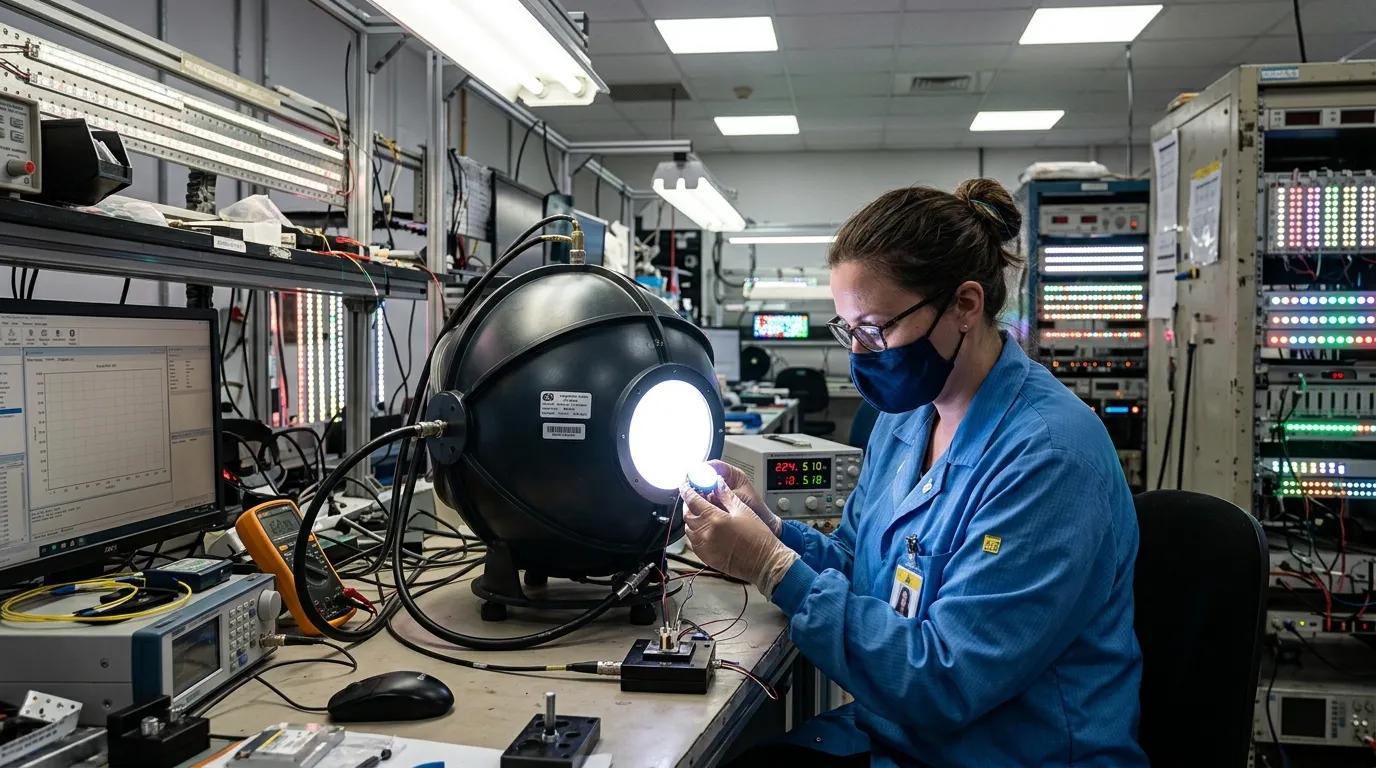
Per-batch QC at the factory: integral-sphere color measurement and temperature/humidity aging are the checkpoints that keep 86,500 nodes uniform on camera. (Illustrative rendering — not a photograph of the site.)
- Incoming QC — every LED, IC, and PCB batch verified before the line
- In-line AOI — automated optical inspection during SMT and reflow
- Integral-sphere test — color point and lumen output verified per batch
- Aging test — constant temperature/humidity burn-in
- IP/waterproof test — sealing verified to the rated IP grade
- Pre-ship QC — full function and control test before packing
The integral-sphere step is the one that matters most on a wheel: 86,500 nodes have to look like one continuous surface on camera, and per-batch color measurement is what stops a subtle binning drift from becoming a visible band across the rim. Supporting this are the documented certificates — CE (EMC 2014/30/EU), RoHS ((EU) 2015/863), EMC (EN 55015/61547), IP66 (EN 60529:2013), and BIS (IS 10322) — and 26 CN + EU patents held by the company, which is a useful bar when you are comparing overseas factories on a marquee job.
What This Project Proves for Your Large-Scale Pixel Install
Three lessons transfer directly to any landmark-scale pixel project:
- Choose the node and the control system as one decision. The wheel works because fixture addressing and controller capability were matched at the source. When you spec a large-scale pixel LED installation, ask for the control architecture up front — Art-Net capacity, decoder placement, offline playback — not just IP ratings and lumen figures.
- Engineer power and data distribution before the structure is on site. Distributed power injection, short DMX/SPI legs, star topology, and mechanical routing across moving parts are what make the difference between a show that opens and one that fails in year one.
- Audit the factory's QC evidence, not its promises. Per-batch integral-sphere color testing, aging burn-in, IP verification, and certificates with numbers are the deliverable evidence that 86,500 points will stay uniform and alive for the life of the install.
If you are planning a comparable project — a pixel LED observation wheel, a pixel point light facade, or any large-scale addressable pixel LED installation — the full set of pixel LED projects delivered in nine countries sits in our case archive. Specs, lead times, and engineering support for a pixel point light installation at your scale — including OEM/ODM builds — are one inquiry away, with replies within 8 business hours.
Specifying pixel LED for a real project?
Send the spec — pitch, IC, IP class, run length, voltage — and you get an engineer's answer, not a catalogue. Samples and OEM/ODM quotes from the Shenzhen factory floor.