
Exporting LED Strip to the EU: CE, RoHS & EMC
Exporting LED strips to the EU means CE marking under the LVD, EMC and RoHS directives. Here are the documents you need and how to verify supplier compliance.
Short version: CE marking is not one certificate — it is a bundle of EU directives that apply to the product in the box: the Low Voltage Directive (2014/35/EU), the EMC Directive (2014/30/EU) and the RoHS Directive (2011/65/EU, amended by (EU) 2015/863), with WEEE and ecodesign obligations on top. That splits the work into two very different jobs. The manufacturer runs the tests and signs the EU Declaration of Conformity; the importer verifies that those documents exist, are technically correct, and travel with the shipment. Almost every customs hold or market-surveillance fine in this industry traces back to paperwork, not to a product that failed a test.
If you are a lighting distributor, an integrator or an OEM sourcing pixel LED strips from outside the EU, this article is your process map. We export addressable LED strip from our factory in Shenzhen to customers across Europe, and the questions below are the ones every EU buyer asks us before the first container moves: which directives apply, what tests actually matter, which documents you are legally entitled to request, and how to tell real compliance from a sticker. If you need the wider picture first, our LED lighting export certification guide covers the full certification landscape for this product category.
CE marking for LED strips: what it actually covers
CE marking is a declaration by the manufacturer — not a certificate issued by an EU authority — that the product meets every EU directive that applies to it. For an LED strip, that bundle is:
- Low Voltage Directive (LVD), 2014/35/EU — electrical safety
- EMC Directive, 2014/30/EU — electromagnetic emissions and immunity
- RoHS Directive, 2011/65/EU — restriction of hazardous substances
- WEEE Directive, 2012/19/EU — e-waste take-back obligations
- Ecodesign Regulation (EU) 2019/2020 — energy-efficiency requirements for light sources
The reason buyers get confused is that the mark itself tells you nothing about which directives were applied. Two strips can both carry a CE mark: one was tested to the right standards with a proper technical file behind it, the other has a mark printed on the label by the trader who imported it. That is why "CE marked" is a starting point, not a conclusion — and why the rest of this article is about the evidence behind the mark.
One vocabulary note before the details: it is a CE marking, not "CE certification". There is no EU body that "certifies" a product as CE-compliant; the mark is self-declared. When a supplier talks about "CE certification", treat it as a signal to ask for the actual documents.
Which EU directives apply to an LED strip
Directive / Regulation | What it regulates | What it means for an LED strip |
|---|---|---|
LVD 2014/35/EU | Electrical safety of equipment rated 50–1000 V AC | A bare 12 V or 24 V strip sits below the threshold, but the mains-driven power supply in the box is in scope, and a complete mains-operated product is assessed as a whole |
EMC 2014/30/EU | Electromagnetic emissions and immunity | Applies to nearly all electrical equipment regardless of voltage — strips and drivers alike; tested to EN 55015 (emissions) and EN 61547 (immunity) |
RoHS 2011/65/EU + (EU) 2015/863 | Restriction of 10 hazardous substances in total — the original six plus the four phthalates added by (EU) 2015/863 | Covers solder, LED dies, PCBs and plastics in the product |
WEEE 2012/19/EU | Collection and recycling of e-waste | Registration and take-back obligations for producers and importers; how they bite depends on the member state you sell into |
Ecodesign (EU) 2019/2020 | Energy efficiency of light sources | Applies to strips sold as light sources; whether a given config falls in scope depends on how the product is placed on the market |
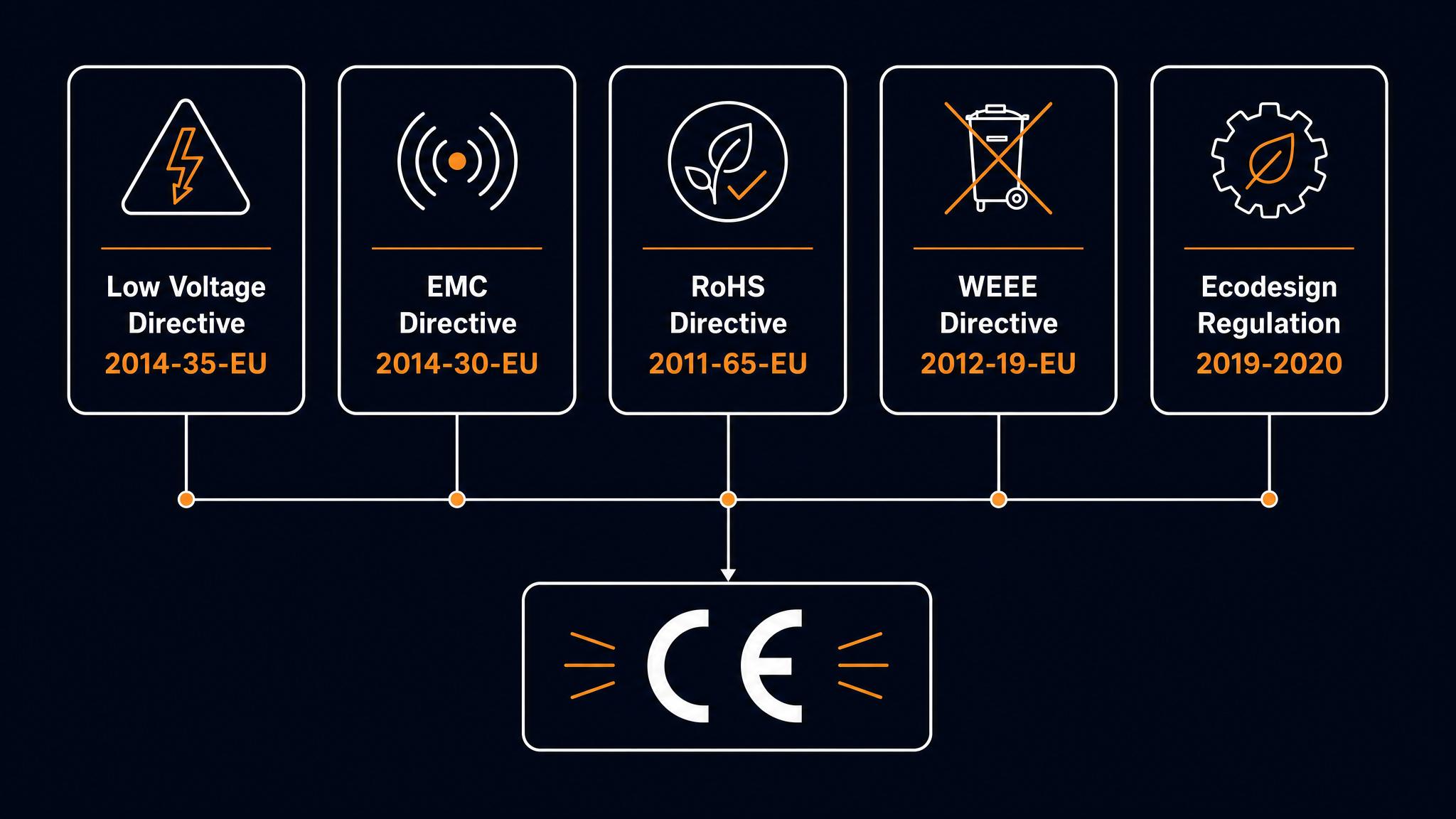
The scope question matters more than most buyers realise: what you sell determines which directives bite. There are three common product shapes, and they are not treated the same:
Which directives apply to an LED strip, and how they converge on CE marking.
- Bare PCB strip (no driver, no casing) — RoHS and EMC apply; LVD largely does not (the strip itself is extra-low voltage). The mains part of the equation is the power supply, and if the supply is a separate component, the compliance picture splits into "strip" and "driver".
- Strip kit with a plug-in driver — now you have a complete mains-operated product. The driver brings LVD into scope, EMC applies to the combination, and the kit as a whole needs one coherent declaration.
- Complete luminaire or mains-operated strip (for example our AC36V mining strips) — assessed as a full lighting product, including the ecodesign and energy-labelling layer.
If you are importing from a manufacturer, ask them which of these shapes their CE marking covers. A DoC that covers a bare 12 V strip does not automatically cover the same strip sold in a box with a 220 V power supply.
The standards behind the tests
Compliance is demonstrated against harmonised standards — the technical language the directives point to. For LED strip products the ones that show up in every test report are:
- EN 60598-1 / EN 60598-2-21 — safety requirements for luminaires, with the specific part for flexible light strips
- EN 55015 — limits for conducted and radiated emissions from lighting equipment
- EN 61547 — immunity of lighting equipment to electromagnetic disturbances
- EN 62493 — human exposure to electromagnetic fields from lighting equipment
- IEC 62384 — performance requirements for DC or AC supplied electronic control gear (the driver)
The structural point for a buyer: the EU system allows self-declaration. The manufacturer does not need a government stamp or a notified body for LED strips; they need a test record, usually from an accredited laboratory, that shows the product meets the standards. A notified body is required only for a short list of high-risk products that LED strips are not on. So when a supplier claims compliance, the meaningful question is not "who certified you?" but "which lab ran the tests, and can I see the report?" An accredited test report is the strongest evidence you can ask for — stronger than a one-page "certificate" from a trade association.
The standards also connect to the physical specs of the product. A strip's IP rating, for example, changes how the safety and testing story plays for outdoor installations — we cover the practical side of that in our IP rating guide for outdoor pixel LEDs.
EU Declaration of Conformity and the technical file
Two documents sit at the centre of every compliant shipment, and both belong to the manufacturer (or the EU importer standing in their place):
The EU Declaration of Conformity (DoC). A signed document that identifies the product, lists the directives applied and the standards used, and names the manufacturer or EU importer taking responsibility. One DoC per product type — a generic "we declare all our products comply" sheet with no model reference is not a DoC.
The technical file. The evidence behind the declaration: the test reports, circuit and construction documentation, risk assessments. EU rules require the manufacturer to keep it and produce it when market-surveillance authorities ask — typically for ten years.
If you are the importer, EU law puts a specific job on you: before placing the product on the market, you must verify the manufacturer has done the conformity assessment, keep a copy of the DoC, and be able to hand it over to authorities. Your name and address also go on the product or its packaging — the authorities need to know who brought it in. Two practical consequences follow for anyone buying from a trading company rather than the factory:
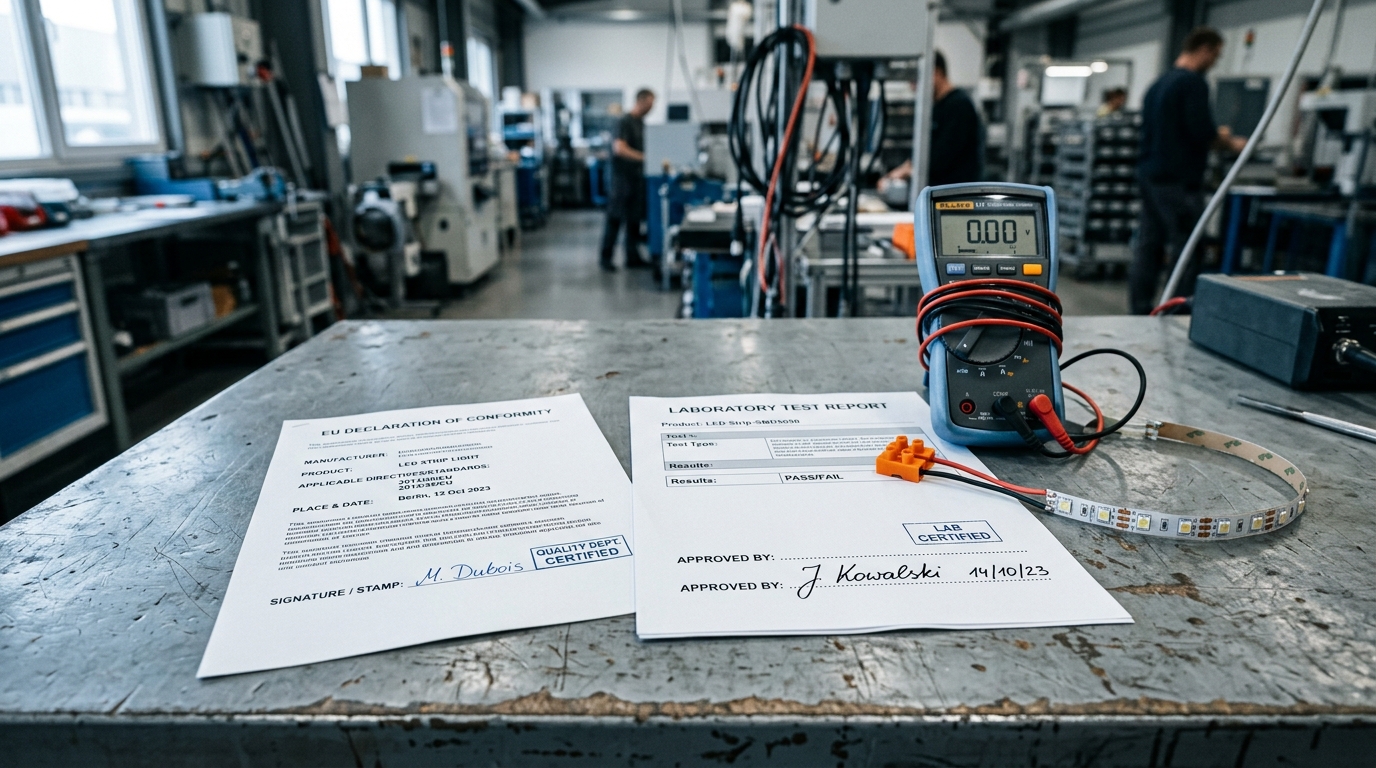
The documents that matter: a signed DoC and the test reports behind it.
- Ask who signs the DoC. It must trace back to the actual manufacturer or a registered EU importer. If the trader cannot name either, the document chain stops at someone who cannot be held accountable.
- Ask where the technical file lives. If the answer is "with the factory, ask them", get it in writing that you can access it — market-surveillance requests do not wait for a phone call to Shenzhen.
The European Commission's Blue Guide — the official Commission notice on implementing EU product rules — is the reference for how the whole conformity-assessment system is meant to work, and it is worth bookmarking when disputes come up.
CE marking rules: size, placement and what not to do
Affixing the mark is the last step, and it has rules of its own:
Rule | Requirement |
|---|---|
Minimum size | At least 5 mm high |
Placement | Visibly, legibly and indelibly on the product, its label or its packaging |
Confusable marks | No other mark that could be confused with the CE marking |
Importer details | Importer name and address on the product or packaging |
You may not add any other mark that could be confused with the CE marking, and you may not mark a product that is not covered by a declaration — importing a strip with a CE mark but no DoC behind it is not a paperwork gap, it is a compliance failure.
Three red flags show up constantly in this industry:
- A sticker that peels. The mark is supposed to be durable. A printed sticker on the polybag is normal for small items; a loose decal you can lift off is not.
- A "certificate" with no number. Real conformity evidence carries traceable references — certificate numbers, lab names, standard versions. A decorative PDF with no test data behind it is a decoration.
- "CE certified by [body]" claims. As noted, nothing in the EU system "certifies" CE. Suppliers who phrase it that way usually mean they paid for a promotional document, not for a test.
If the product also needs the importer's details on the label — and it does — the label should survive the trip: importer name, address and the CE mark belong on the product or packaging before it reaches customs.
HS code for LED strips at EU customs
A question that comes up in every customs conversation is the one Google surfaces as "what is the HS code for LED strips?". The answer, in the EU's Combined Nomenclature: most LED strip products classify under CN 9405.40 (electrical lamps and lighting fittings). The UK's tariff notice on LED strip lights classified a flexible LED tape under 9405 40 99 ("other lighting fittings"), and that 9405.40 family is the right starting point for strips without a built-in driver. Strips with integrated control gear or connectors can land in neighbouring subheadings, so if you ship volume, ask your customs agent for a binding tariff ruling before your first container — the code decides the duty rate and any product-specific measures, and a wrong code is a classic source of customs holds.
A supplier compliance checklist
You now have the full picture, so here is the checklist we hand to every buyer who sources from us or from anyone else. Send it to your supplier and keep the answers on file:

Verifying compliance evidence at the factory before the shipment leaves.
- Ask for the EU Declaration of Conformity — signed, dated, with your exact model or product family named. Reject generic "we comply" sheets.
- Ask for the test report, not a summary: EN 60598-2-21 (safety), EN 55015 and EN 61547 (EMC), from an accredited laboratory, with the lab's name and report number.
- Check the certificate numbers. A RoHS or EMC certificate should carry a traceable number that the issuing lab or body can confirm. A number with no issuing body is a marketing page.
- Confirm the RoHS amendment (EU) 2015/863 — Annex II now restricts 10 substances in total: the original six plus the four phthalates added in 2015. Older certificates covering only the original six substances are out of date.
- Ask who signs the DoC and where the technical file lives — and get both in writing.
- If you buy through a trading company, ask for the factory's name and the importer-of-record on the EU side. A chain you cannot name is a chain you cannot defend.
- Ask which HS code they ship under and keep it consistent with the product in the box.
This is what the evidence looks like in practice. We hold numbered CE, RoHS and EMC certificates for our pixel LED range — CE No. XDH0723574011130418EC to EMC 2014/30/EU, RoHS No. XDH0923574011130419CC to (EU) 2015/863, and EMC No. KEYS240815047001EM-02 to EN 55015 / EN 61547 — and we share the full document pack with every EU customer, not just the certificate page. Our company page lists them. That level of traceability is the bar: a supplier who cannot produce a numbered certificate is a supplier who has not been tested. If you are still weighing factories rather than documents, our OEM and ODM sourcing guide walks through what to compare.
Ship with the right paperwork
Before you commit to a supplier, send them the checklist above and keep their answers. The product will fail a test someday — that is normal and fixable. What is not fixable is discovering, at a customs hold or a market-surveillance visit, that the compliance evidence was never there in the first place. The directive texts are public: LVD 2014/35/EU, EMC 2014/30/EU, RoHS 2011/65/EU and its 2015/863 amendment, the WEEE Directive and the ecodesign regulation (EU) 2019/2020, plus the European Commission's CE marking guidance — so you can verify every claim in this article against the originals.
When you are sourcing pixel LED strips, ask for the compliance pack alongside the quote — certificate numbers, test reports and the DoC, before the samples ship. Our certified LED strip range covers DC5–48V addressable strips across IP20–68, and the documentation comes with the order.
Specifying pixel LED for a real project?
Send the spec — pitch, IC, IP class, run length, voltage — and you get an engineer's answer, not a catalogue. Samples and OEM/ODM quotes from the Shenzhen factory floor.