
Pixel LED Distributor Terms: MOQ, Samples
Pixel LED distributor terms explained: what drives MOQ, how tiered pricing works, what sample programs include, plus payment, lead-time and warranty norms.
What "Distributor Terms" Actually Cover
A terms sheet is the part of a quote nobody enjoys reading, and the part that decides what you actually pay. Unit price gets all the attention, but the conditions around it — minimum order quantity (MOQ), tiered pricing, samples, payment, lead time, warranty — determine your real landed cost, your cash exposure, and how much risk you carry if the product disappoints.
In the pixel LED wholesale market, these terms are not random numbers a salesperson invented. They are outputs of a real cost structure: how the strip is configured, how production runs are batched, and how quality is verified before shipment. Read them through that lens and a quote becomes readable. Skim them and you will discover the costs only after you have committed.
This article walks through each term in the order you will meet it — MOQ, pricing tiers, samples, then payment, lead time and warranty — and closes with a checklist you can put in front of any supplier. If you are earlier in the process, our OEM, ODM and distribution buyer's guide covers the broader decision of how to structure a sourcing relationship in the first place.
Term | What it determines | Why it matters |
|---|---|---|
MOQ (minimum order quantity) | Smallest order a supplier will produce or sell | Sets your entry cost and minimum stock commitment |
Tiered pricing | How unit price drops with volume | Often the difference between budgeted and actual unit cost |
Samples | What you can verify before committing | The only way to de-risk IC, protocol and color decisions |
Payment terms | When money moves and who carries risk | Deposit, balance and dispute exposure |
Lead time | When you can actually ship to your customer | Schedules your installation or resale |
Warranty | Who pays if a batch fails in the field | Your exposure on a large, visible install |
MOQ: What Drives It and How to Lower It
MOQ is the supplier's way of making a production run economically viable. Every order, however small, consumes setup time: SMT machine changeover, IC and PCB procurement, a full QC and aging cycle, and packaging. A factory can absorb those costs across a 500-meter run; it cannot across a 5-meter run. So the MOQ is not a sales tactic — it is the point where your order stops losing the factory money.

Batch size is the real driver behind MOQ — every run carries setup, QC and aging costs.
What pushes MOQ up:
- Custom configuration. A non-standard driver IC, an unusual voltage, or a bespoke IP grade means dedicated procurement and a dedicated line setup. Our guide to addressable driver ICs explains why IC choice drives so much of a strip's behavior and cost — and why a common IC like WS2815 or SK6812 keeps your MOQ and lead time down.
- Special color or finish. RGBWW, RGBCCT, or a custom diffuser run means buying specific LED bins for that order.
- New SKU. A configuration the factory has never made before carries engineering risk, so it gets a higher minimum until it has been run and verified.
What keeps MOQ low:
- Standard SKUs. Strips the factory already produces in volume — the common ICs, voltages and IP ratings — are the cheapest thing to add to a production run.
- Reordering the same configuration. Repeat orders of an identical spec let the factory plan procurement and keep your MOQ at its lowest. If you will reorder the same strip quarterly, say so up front.
- Color type flexibility. If your project does not strictly need RGBW, a standard RGB strip is produced in far larger batches and carries a lower minimum. The trade-offs between RGB, RGBW and RGBIC strip types are worth settling before you negotiate, not after.
- Accepted lead time. A factory with stock or a scheduled production slot can fold your quantity into an existing run — that is often worth a lower MOQ than a rush order.
As a rule of thumb for addressable strip, single-digit to low-hundreds of meters is typical for standard configurations from manufacturer-direct suppliers; custom configurations climb quickly. The question worth asking is not just "what is your MOQ" but "what is your MOQ for this configuration" — a supplier quoting one flat MOQ across all SKUs is often hiding that their standard line is cheap and their custom line is expensive.
On lowering MOQ, treat it as a negotiation with structure, not a plea. A factory that produces 5 million units a year can meet a buyer halfway when the configuration is standard and the reorder is predictable — which is why Pileds quotes low MOQs on standard SKUs and offers free samples for qualified projects, but prices custom engineering separately. The lever is configuration discipline: the closer your spec is to a stock SKU, the lower the minimum you will be offered.
Tiered Pricing: How Volume Breaks Work
Tiered pricing — also called volume price breaks — is the mechanism that rewards larger orders. A typical quotation table looks like this:
Quantity (meters) | Unit price per meter | Effective discount vs base |
|---|---|---|
1–99 | Base price | — |
100–499 | Tier 1 | Several percent |
500–999 | Tier 2 | Larger step |
1,000+ | Tier 3 | Best price |

Volume breaks reward the quantities that let a factory plan runs and fill shipments.
Two things matter more than the exact numbers.
First, the tiers are not arbitrary. Each step corresponds to a real production change: crossing into a full production run, filling a container, or committing a stock SKU to a scheduled slot. If a supplier's tiers have no obvious logic — a 3% drop at 100 meters and nothing until 5,000 — the pricing is a negotiation fiction, not a cost structure.
Second, ask what the tiers are measured against. The most common surprise in the pixel LED wholesale market is the difference between per-order and cumulative (annual) volume. (If you are still getting oriented on what pixel strip is and how it is specified, ENTTEC's guide to understanding LED pixel tape is a solid primer on the product side.) A supplier may quote tier pricing per order, meaning every 500-meter order gets tier-2 pricing — or per year, meaning your third 400-meter order still pays tier-1 because the orders are counted separately. Both are legitimate; only one is predictable. Ask the question before you sign, and get the answer in writing.
A few pricing realities worth knowing:
- Config stability earns more than volume alone. A factory can price a repeatable, standard configuration far more aggressively than a one-off custom build, because the cost of changeover disappears. If you have a stable SKU, negotiate it as a standing item — that is frequently worth more than chasing an extra tier.
- Freight changes the picture. A cheaper unit price with slow or expensive shipping can cost more landed than a higher price with consolidated freight. Compare total cost per meter, including freight and any import handling.
- The tier table is a starting point. Suppliers quote from a table but negotiate within it — especially on standard SKUs, repeat orders, or when you can commit volume across multiple product lines (strip plus controllers, for example).
Samples: What a Serious Sample Program Includes
Samples are the cheapest insurance in the entire pixel LED purchasing process, and the most underused. A 2-meter sample run costs the supplier almost nothing; a 2,000-meter wrong configuration costs you both time and reputation. Before any large order, verify the four things that fail most often in the field:
- Driver IC behavior. Confirm the strip responds to the control protocol you intend to drive it with — SPI, DMX512, or Art-Net — and that addressing behaves as expected across the run. A strip that works with one controller but not the one your customer owns is a different product than the datasheet implies.
- Color consistency. Light two or three samples side by side and look for binning differences. For camera-facing work — stages, facades, broadcast — color variance between batches is the classic failure that samples catch.
- IP sealing. If the product is rated IP65 or IP67, the sample is your chance to check the sealing quality before it spends a season outdoors. Sealing is where budget products cut corners, and it is invisible in a photo.
- Mechanical and dimensional fit. Cut length, connector type, profile fit, bend radius — a sample in hand answers a page of spec-sheet questions in one minute.
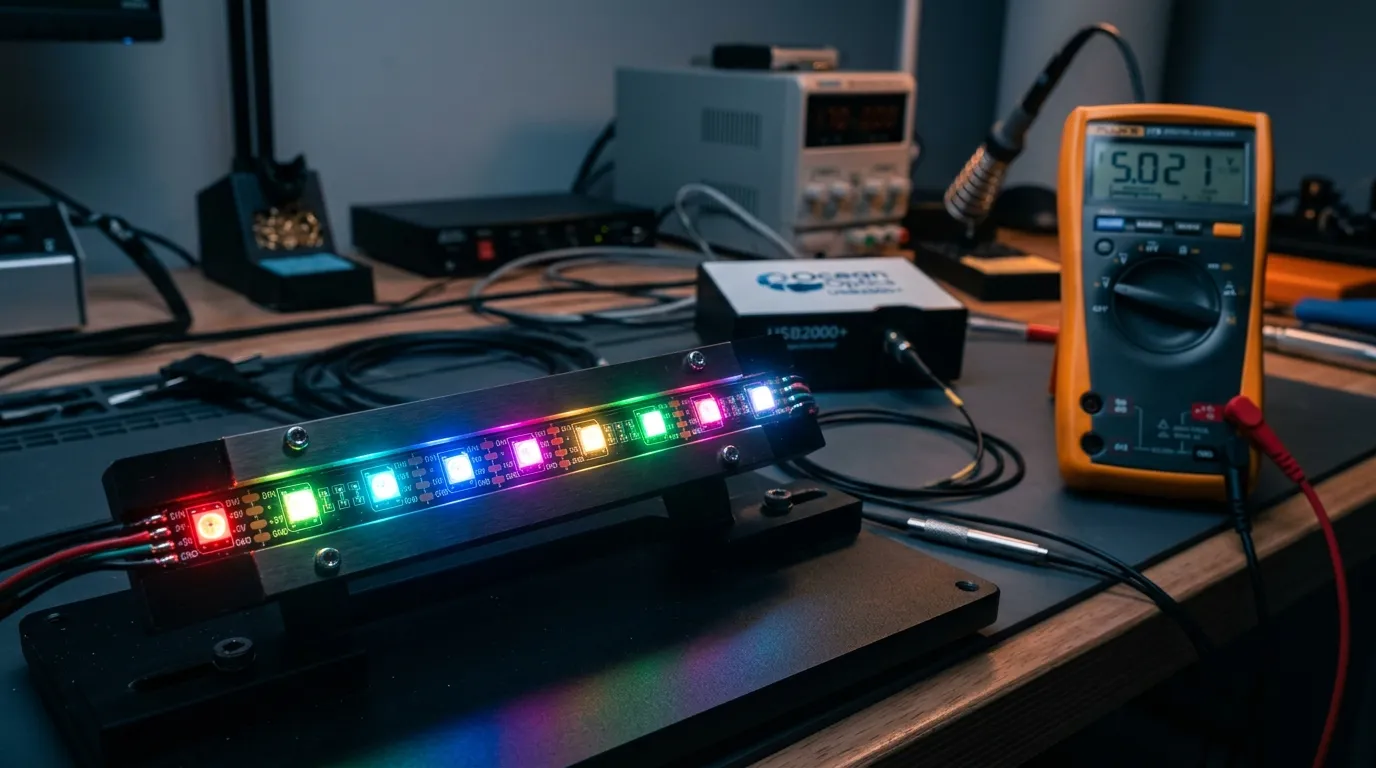
A sample bench test catches IC, protocol and color issues before they become a 2,000-meter problem.
What should a sample program look like? A serious manufacturer-direct supplier will offer free samples for qualified projects — typically a short length of standard strip or one unit of a fixture — with the buyer covering freight. Paid samples are normal for custom configurations or when the supplier carries a real cost for the sample itself. Either way, expect a defined evaluation window, and get the sample's configuration in writing so "sample approval" cannot later be interpreted as approval of a different spec.
Some suppliers charge a nominal sample fee that is credited against the first order. That is a fair structure — it signals intent on your side without costing you money in the end. What is not fair is charging full price for samples, or requiring a purchase order before any sample ships.
When you evaluate samples, compare like for like: an RGBW strip sample tells you nothing about a future RGB order, and a WS2811 sample tells you nothing about a SK6812 RGBW addressable strip that will run RGBW pixels with a white channel. Sample the exact configuration you intend to buy.
Payment Terms, Lead Times and Warranty
The commercial terms — payment, lead time, warranty — are where the risk sits, and where distributor agreements diverge most from manufacturer-direct deals.
Payment. In factory-direct international trade, a deposit–balance structure is the norm: commonly a percentage as a deposit to start production (30–50% is typical), with the balance due before shipment. The two things to check are the split and the trigger for the balance. "Balance before shipment" and "balance after production but before shipment" look similar and behave differently if QC finds a problem. For very large orders, a letter of credit is a reasonable alternative that some suppliers support. Whatever the structure, the deposit is your exposure — size it against the supplier's track record, not just their price.
Lead time. Two numbers exist: lead time for stock items (days) and lead time for production runs (weeks). Custom configurations always sit in the second bucket. A supplier who quotes one number for everything is quoting their best case. When you compare quotes, compare production lead times — the schedule that determines when your customer's install happens — and ask what happens to the schedule if QC fails a batch. Re-runs are where weeks disappear.
Warranty and QC. Addressable strip is an electronic product with thousands of solder joints per meter; warranty is a statement about how the supplier stands behind their QC process, not a marketing phrase. Ask what the warranty covers (dead pixels, color failure, sealing failure), for how long, and what evidence the supplier can produce for their QC — incoming inspection, in-line AOI, integral-sphere color testing, aging tests, and IP sealing verification are the checkpoints a serious factory can document. Export certifications such as CE, RoHS and IP ratings are a separate but related gate — our LED export certification and compliance guide walks through what the marks actually mean for the products you import.
Freight. Finally, the price you compare must include the delivery term — the Incoterms rules published by the ICC define who pays and who carries risk at each stage (EXW, FOB, CIF, DDP, and the rest). "Free shipping" from a factory in Shenzhen means something entirely different from a DDP quote delivered to your door. Convert every quote to the same delivery term before you compare unit prices.
Red Flags in a Pixel LED Quote
Once the terms are familiar, the warning signs become visible. These are the patterns that cost buyers the most:
- Price baiting. An attractively low unit price with a MOQ far above what the project needs, or with the freight, tooling or QC costs quietly moved into a separate line. The tier table exists to hide the real price as much as to reward volume — check the landed cost at your actual quantity, not the headline per-meter price.
- Vague specs. A quote that names no driver IC, no IP rating, no color binning, no voltage — "addressable RGB strip" is not a specification. If the IC is unspecified, so is the product's behavior with your controller. (For pixel terminology that keeps getting misused, the Light-O-Rama pixel and node terminology reference is a useful baseline for what terms like "node" and "pixel" mean in practice.)
- MOQ gymnastics. Quoting a low MOQ per SKU but requiring a minimum order value (MOV) across the order, or setting the MOQ at 1 meter and the minimum billable length at 100. Ask for both numbers in writing.
- Sample bait-and-switch. A free sample of a premium configuration, then production quoting a cheaper one — or samples charged at full retail with no credit against the order. The sample you approve should be the spec you receive.
- No QC evidence. A supplier who cannot describe their QC process, or produces no test documentation, is asking you to absorb their quality risk. On a large install, that risk is the whole game.
How to Compare Distributor Terms Before You Commit
When you hold two or three quotes side by side, compare them on the same grid. This checklist turns the comparison from "who has the lower unit price" into "who has the better overall proposition":
Term | Ask the supplier | A good answer looks like |
|---|---|---|
MOQ | "MOQ for this exact configuration?" | A number tied to the SKU, not one flat figure |
Pricing tiers | "Per order or cumulative? Valid how long?" | Written, predictable, tied to real volume breaks |
Samples | "Free or paid? Credited? Which config?" | Free for standard SKUs, spec documented, credited if paid |
Payment | "Deposit split and balance trigger?" | Sensible deposit, balance trigger clearly defined |
Lead time | "Stock vs production lead time?" | Two numbers, with a re-run contingency |
Warranty | "Covers what, for how long, with what proof?" | Named coverage, defined period, QC documentation |
Delivery term | "Which Incoterm, all-in landed cost?" | Same Incoterm across all quotes before comparing |
The other decision hiding in the terms is who you are buying from: a distributor or a manufacturer-direct. Distributors add value — stock availability, smaller minimums, local support, faster delivery on small orders — and you pay for it in margin and in reduced visibility into the factory. Manufacturer-direct gives you the factory's actual terms, direct QC accountability, and room to negotiate MOQ and customization, in exchange for larger minimums and longer lead times on custom work. Neither is right for every buyer: distributors suit steady small-to-medium volume with fast turnaround; manufacturer-direct suits project buyers and OEM brands who need configuration control and a long-term pricing structure. The distribution-vs-direct trade-off is where the OEM, ODM and distribution buyer's guide goes deeper — this article assumes you already know which lane you are in.
One more comparison tip: put the terms in front of your project timeline, not just your budget. A quote with a slightly higher unit price but a 10-day shorter production lead time can be the cheaper option when your customer's install date is fixed. Terms are a package; evaluate them as one.
Getting a Terms Sheet You Can Actually Plan Around
The terms that matter are the ones you can put in front of your customer. When you request a quote from Pileds, you will get a terms sheet that names the driver IC, voltage, IP rating and color type; a MOQ tied to the specific configuration; tiered pricing in writing; a sample path (free for qualified projects); and a production lead time with QC checkpoints — incoming inspection, in-line AOI, integral-sphere color testing, aging and IP verification — documented before shipment.
If you have a project spec or a configuration list, send it over and ask for the terms before you ask for the price. The contact page is the fastest way to get a terms sheet from a factory that has shipped pixel LED to 90+ countries since 2015 — with a response within 8 business hours, you can have your comparison grid filled in by tomorrow.
Specifying pixel LED for a real project?
Send the spec — pitch, IC, IP class, run length, voltage — and you get an engineer's answer, not a catalogue. Samples and OEM/ODM quotes from the Shenzhen factory floor.