
AC36V Tunnel LED Strip: Why AC, Not DC
Tunnel and mine runs stretch hundreds of meters — too far for 12/24/48V DC strips. Here's why AC36V mains-driven strips win on voltage drop, cabling and safety.
You are lighting a 300 m tunnel at 13 W/m. That is close to 4 kW of strip, fed from one end of a space where every meter of cable is expensive, every splice is a failure point, and the environment is wet, dusty and sometimes classified. The default instinct — reach for the same 24 V DC strip you used on the facade job — is exactly wrong at this scale. On long tunnel and mining runs, mains-driven AC strip architecture (AC36V being the most common low-voltage form) beats low-voltage DC on physics, cost and safety. This article walks through the engineering so you can defend the choice in a spec.
The distance problem: why low-voltage DC strips fail on long runs
Every LED strip is a resistor in series with itself. Feed power at one end and the copper trace carries current all the way down, so voltage falls continuously along the run: voltage drop is simply V = I × R. Two consequences follow, and both scale brutally with distance.
First, the far end dims. A 24 V strip fed from one end at 50 m is already visibly darker at the tail; at 100 m the difference is obvious to the eye. White strips shift color as current drops, and RGB strips drift hue channel by channel. Second, the cable loss is quadratic: power wasted in the feeder is I²R, and since current I = P/V, halving the voltage doubles the current and quadruples the loss for the same power and cable. That is why nobody sizes a tunnel run by "which strip is brighter" — you size it by voltage and cable together.
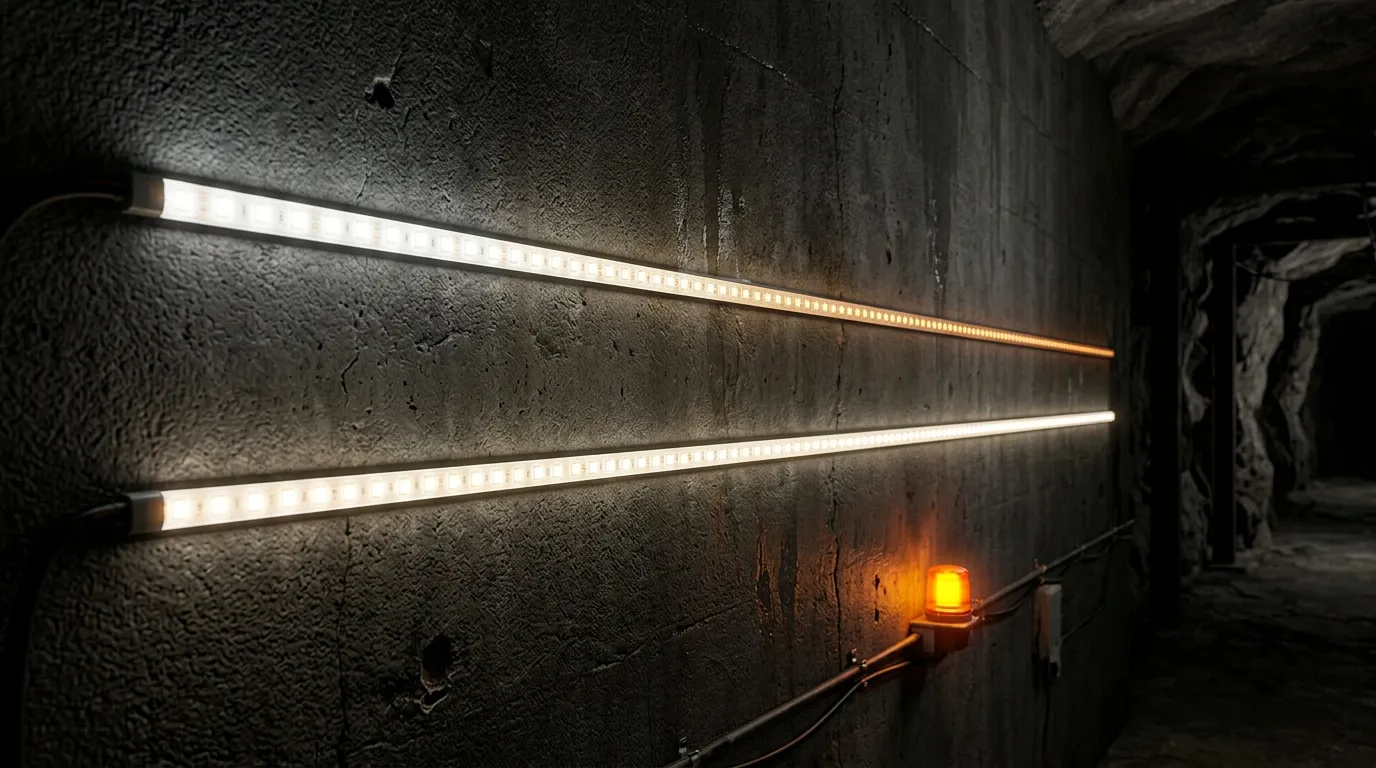
Above: the same strip, two feeding strategies — passive DC voltage sags along the run, while current-regulated AC segments hold brightness to the far end.
The math gets absurd quickly. Take 13 W/m over 300 m: 3.9 kW. Fed from one end at 24 V, that is 162 A. At 48 V, still 81 A. A single 10 AWG feeder (about 3.3 mΩ/m one way) carrying 80 A over a 100 m feeder run drops roughly 26 V before the strip sees anything — more than half the 48 V bus gone in the cable, and double that over the out-and-back pair. No amount of strip quality fixes that; it is Ohm's law. This is why the "long run LED strip" conversation always ends up at voltage: the strip manufacturer can only engineer the LED side, the feeder physics belongs to the distribution designer.
How teams fight DC voltage drop today — and where that breaks down
Since DC cannot be transformed, the industry fights the distance problem with four workarounds, all of which show up in tunnel-lighting product literature:
- Thicker feeders. Fat copper trunk lines every few hundred meters. Works, but copper is one of the most expensive line items in a tunnel install, and termination quality on big cable is a craft skill.
- Power injection every 5–20 m. The standard fix for architectural runs. Each injection point is a splice, a connector and a future failure mode — multiplied across 300 m of tunnel, it stops being "maintenance" and becomes a schedule item. The related search "long run LED strip power injection" is basically the whole industry asking how to avoid this.
- Stepping up to 48 V DC. Higher voltage, lower current, thinner cable, longer segments. Waveform Lighting's voltage selection guide summarizes the general rule: higher DC voltage buys you more distance, which is why 48 V has become the "long run" standard. Some manufacturers now claim 150 m single-feed runs at 48 V with current-regulated segments.
- Specialized long-range systems. Mineglow's tunnel systems push 24/36 V DC "long range" strips to 400 m by pairing them with heavy distribution power supplies and thick trunking — a legitimate engineering solution, but one that ships a power plant for every few hundred meters of light.
All four share the same root: they fight voltage drop at the strip level. The DC voltage is fixed for the whole run, so the current is fixed, and the only free variables left are copper area and injection density. Both are expensive in a tunnel.
Why AC mains distribution wins: transform, don't inject
AC has one property DC does not: it transforms. You can distribute at 110–240 V along thin cable, then step down to a safe low voltage at the point of use. That single fact changes the whole system geometry.
Instead of one fat 48 V feeder carrying tens of amps for hundreds of meters, an AC36V system runs a modest trunk (at 3.9 kW and 220 V, about 18 A — thin cable), and places a small step-down transformer or driver module every 10–20 m where the strip actually hangs. Each segment is fed locally at 36 V AC, so the distance each feeder covers is trivial, and the current on the strip side never travels far. The voltage-drop problem is solved at the distribution layer, not fought at the strip layer.
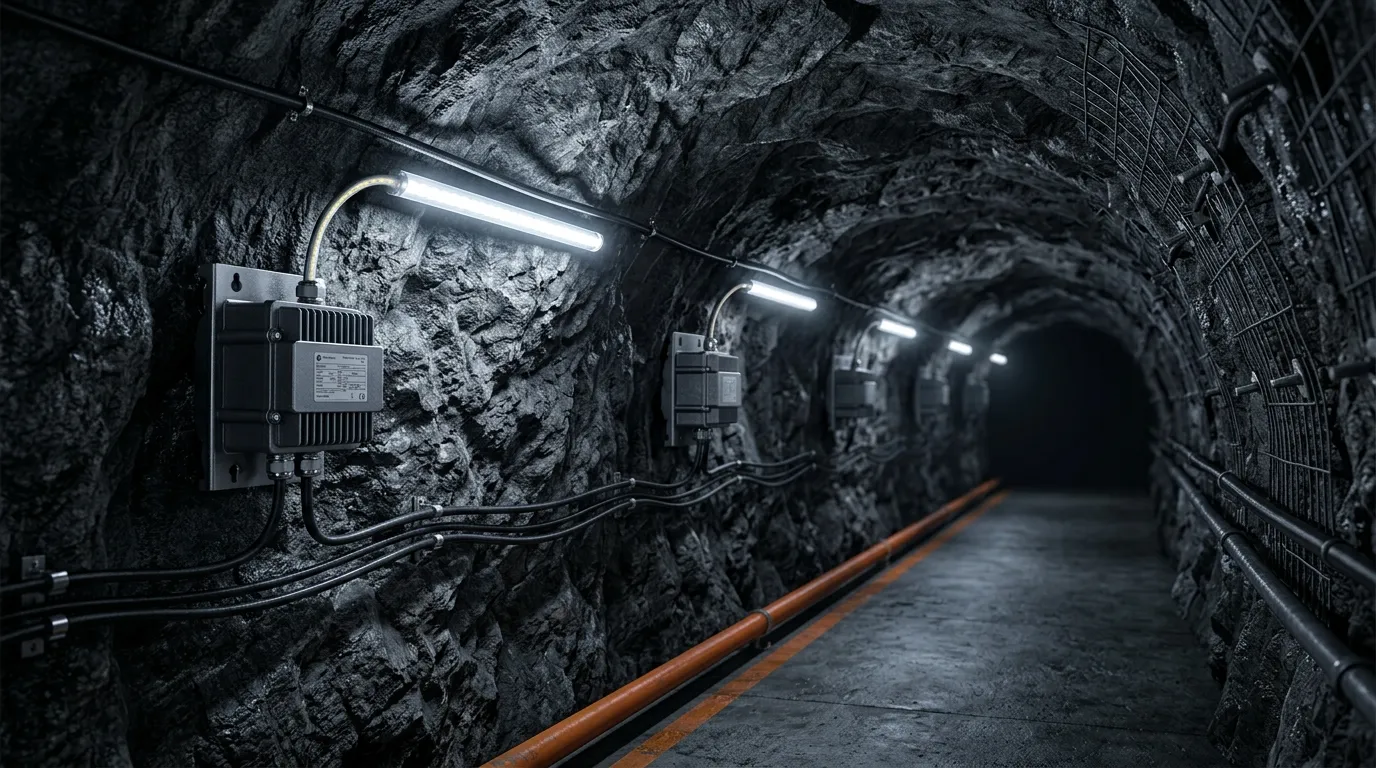
Above: the AC distribution pattern — a thin trunk at mains voltage, converted to 36 V AC at short intervals where the strip runs.
This is also what "AC36V" means in practice. 36 V AC is below the 50 V AC extra-low-voltage ceiling used for touch-safe installations (more on that below), and it is a long-standing low-voltage rail in mining electrical practice — the same reason portable mine lamps and signalling circuits have used it for decades. It is a safe, familiar voltage, delivered by a distribution architecture that scales to kilometers. When we shipped a 10,000 m AC36V run in a South African underground mine, the distribution design was the easy part; the strip had to be engineered for the environment, not for the feed distance.
The comparison in numbers makes the point concrete. The same 3.9 kW tunnel segment fed four different ways:
Feed scheme | Bus current | 100 m round-trip drop (10 AWG) | Practical injection/step-down density |
|---|---|---|---|
24 V DC, one end | 162 A | ~54 V — bus collapses | Injection every 5–15 m |
48 V DC, one end | 81 A | ~27 V — still fails | Injection every 20–50 m, thick feeders |
220 V AC trunk + 36 V AC segments | ~18 A on trunk | ~6 V — negligible | Step-down module every 10–20 m |
110 V AC trunk + 36 V AC segments | ~35 A on trunk | ~12 V — acceptable on trunk | Step-down module every 10–20 m |
The trunk current is what decides cable cost and feeder losses; the step-down modules keep the 36 V side local so the strip never sees a long feeder.
Thin distribution, local conversion — that split is the entire architectural argument.
How an AC36V tunnel LED strip is built — and why it stays uniform
"AC strip" does not mean the LEDs run on AC — LEDs are diodes and need DC. Inside each segment, three things happen:
- A rectifier converts the 36 V AC input to DC.
- A constant-current stage regulates current per LED group, typically every 6–12 LEDs.
- The assembly is encapsulated — silicone extrusion, IP68 sealing, impact-rated housing.
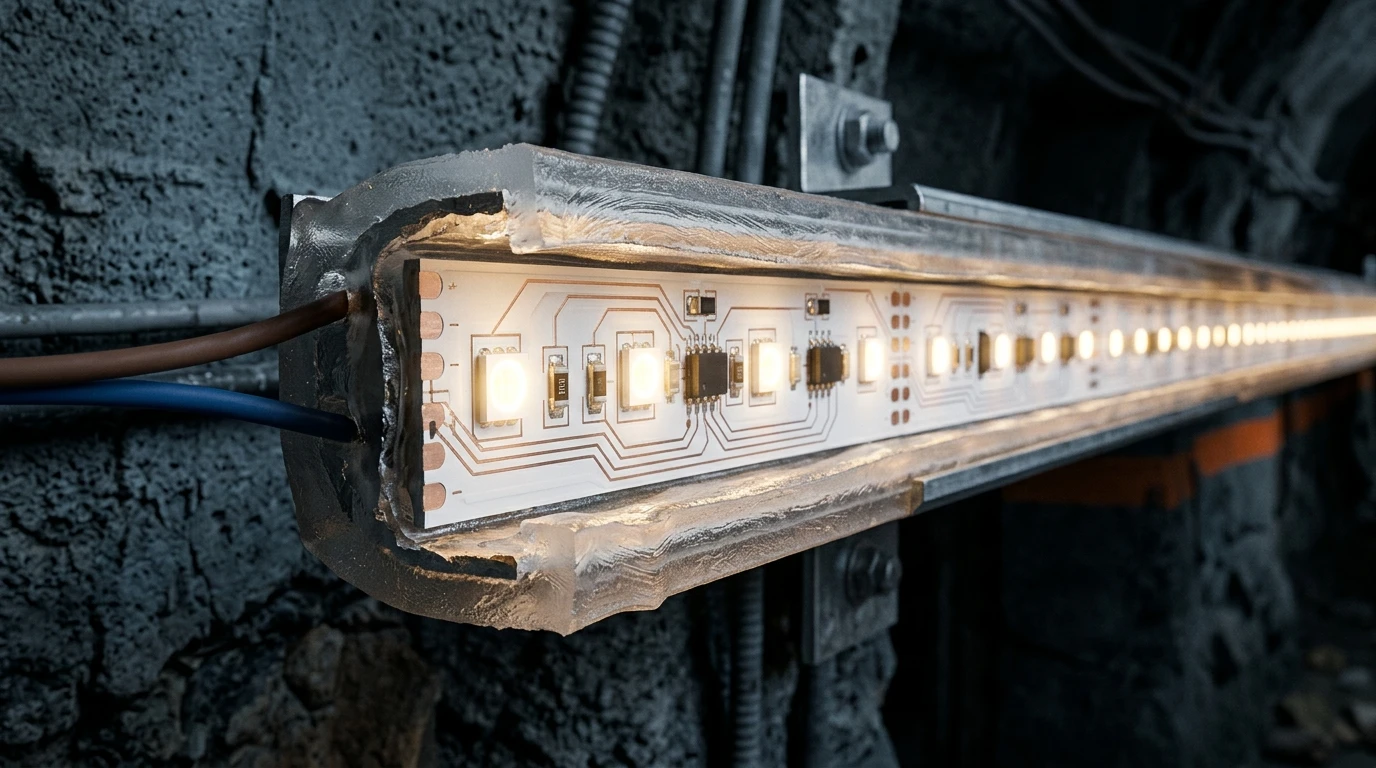
Above: the inside of a tunnel strip — encapsulated LED segments with rectification and current regulation built in, so no external converter is needed per meter.
The constant-current segmentation is the detail that matters. Because each short group regulates its own current, small variations in line voltage along the run do not change brightness. That is why an AC36V strip does not show the far-end gradient that a passive constant-voltage DC strip shows: every meter is independently holding its own current. It is also the answer to the question "how do AC LED strips work?" — rectifier up front, current regulation per segment, no external converter per meter. As a side benefit, current-regulated driving also protects the LEDs themselves: constant-current operation prevents the current creep that shortens LED life as the junction warms, which is why CC-segmented strips age more evenly than voltage-fed ones.
The construction is driven by the environment, not the electronics. A tunnel strip is silicone-extruded for moisture and chemical resistance, IP68-rated for permanent wet contact, and built to absorb impacts — the mining version is often rated to explosion-proof standards for hazardous zones, since a broken lamp in a gassy mine is not a repair issue, it is a safety event. Our AC36V IP68 mine strip is the reference configuration: white or RGB, 24 W/m class power, fully encapsulated. The flexible anti-explosion variant (SMD2835, 100 LEDs/m, 1,100 lm/m) shows how far the form factor stretches when the spec demands it.
AC36V vs 12/24/48V DC vs 110/220V AC: pick the right architecture
12 V DC | 24 V DC | 48 V DC | AC36V | 110/220 V AC | |
|---|---|---|---|---|---|
Typical max segment (single feed) | 5 m | 10–15 m | 30–50 m (up to 150 m with CC segments) | 10–20 m per step-down; distribution runs km | 50–100 m+ per branch |
Distribution current (3.9 kW example) | 325 A | 162 A | 81 A | 18 A on trunk (220 V); 4–7 A per 36 V segment at 10–20 m step-downs | ~18 A |
Injection/splice density | Very high | High | Medium | Low (transformers at intervals) | Low |
Voltage safety class (SELV ≤50 V AC / ≤120 V DC) | Yes | Yes | Yes | Yes (under 50 V AC) | No — mains touch hazard |
Typical fit | Short architectural runs, retail | Facades, signage, pixel | Long architectural runs, stage | Tunnel, mining, industrial long runs | Industrial sheds, retrofit mains runs |
Key components | Cheap PSU, many feeds | PSU + injection | PSU + heavier feeds | Step-down modules + CC segments | Drivers per segment, earth-leakage protection |
Where does DC still win? Honest answer: plenty of places. If the run is under 20–30 m, 24 V DC with a decent PSU is simpler and cheaper than any AC scheme. If the project already has a 48 V distribution or you are retrofitting into an existing DC install, stay DC. And if the strip needs per-LED addressability — pixel strips with WS2811/SK6812-class ICs — DC is mandatory, because the data protocol and the pixel ICs are DC devices. The "AC not DC" argument in this article is scoped to linear, single-color or RGBW tunnel and mine illumination at hundreds of meters, not to pixel effects. Our impact-resistant tunnel strip covers the mains-voltage range (AC36/48/110/220 V variants), precisely because the choice is driven by the project, not the vendor.
If you are still comparing vendors and voltages, the full AC36V mining and tunnel lighting buyer's guide walks through the purchasing decision end to end.
Safety, standards, and what to spec for a tunnel run
The safety argument for 36 V AC is easy to state and hard to argue with. Extra-low-voltage systems under IEC 60364 cap touch-safe AC at 50 V RMS; 36 V AC sits comfortably under it, in the same SELV family as 24 V DC, while keeping the distribution advantages of AC. In wet or conductive environments — which describes every underground tunnel — the difference between "mains touch hazard" and "extra-low voltage" is the difference between an incident and a nuisance. That is why 110/220 V AC strips, while real, belong in dry industrial sheds with proper earth-leakage protection, not on the wall of a dripping tunnel.
Three more things go into a tunnel lighting spec:
- Ingress and impact protection. IEC 60529 IP ratings tell you the dust/water story (IP68 for permanent immersion), and IK ratings tell you the impact story. For tunnels, IP65 is the floor; IP68 is normal; IK08+ or better where vehicles or equipment pass. Our IP rating guide explains the codes in detail.
- Hazardous-zone classification. If the tunnel is in a classified area (gassy mines, fuel storage), the strip and its drivers need explosion-proof or intrinsically-safe certification, and the voltage choice interacts with the zone rules. National mining codes differ — the spec must be checked against the local authority's requirements, not assumed from the product sheet.
- Certification paperwork. CE/RoHS/EMC are baseline; export projects typically add country-specific marks. The export certification guide lists what to ask a supplier for before you commit.
A sane spec looks like this: determine run length and ambient (wet? dusty? classified?), choose the distribution architecture from the table above, demand IP68 + impact rating + constant-current segments, and ask the supplier for the test reports behind every claim — including the voltage-drop claim. If a vendor says "zero voltage drop," ask them to show the distribution schematic that makes it true.
The decision rule
Three lines to take with you: DC strips are for short runs and addressable pixels; mains AC strips are for long linear runs; AC36V is the sweet spot for tunnels and mines because it is SELV-safe, transformable, and proven at kilometer scale. Spec the distribution before you spec the strip, and make the supplier prove the voltage-drop story with a schematic. If you are sourcing for a mine or tunnel project, our AC36V lighting buyer's guide is the next read — and we build these systems in Shenzhen, ship worldwide, and answer technical questions before you buy. Contact us with your run length and ambient conditions and we will send the distribution design with the quote.
Specifying pixel LED for a real project?
Send the spec — pitch, IC, IP class, run length, voltage — and you get an engineer's answer, not a catalogue. Samples and OEM/ODM quotes from the Shenzhen factory floor.