
WS2811 vs WS2812B: Which Driver IC to Spec
WS2811 vs WS2812B for real installations: why the IC is not the voltage, what the 3-LED cut unit costs you, run lengths, repairs, and how to spec each one.
Short version: WS2811 puts the driver IC outside the LED, WS2812B puts it inside. Everything people argue about downstream — 12 V versus 5 V, whether you can cut every 10 mm or every 33 mm, how far a run goes before it browns out, what happens when one pixel dies — falls out of that single structural difference. Spec WS2811 when the run is long, the fixture is not a strip, or a dead pixel has to be repairable. Spec WS2812B when you need per-LED resolution at close viewing distance and the run is short enough to power properly.
One thing to clear up before anything else, because most of the comparisons currently ranking for this question get it wrong: WS2811 is not "the 12 V one." More on that below.
The one difference that drives everything else
WS2811 is a standalone three-channel constant-current LED driver in a SOP-8 package. It sits next to the LEDs and drives them. WS2812B is that same driver logic shrunk onto a die and packaged inside a 5050 LED. Both parts come from WorldSemi, which is why they speak an almost identical protocol and why so much control software treats them as interchangeable.
They are not interchangeable in a fixture.
The WS2811 datasheet describes three constant-current output channels — one for red, one for green, one for blue. They are current sinks: the LED anodes go to the positive rail and each cathode returns to its output pin. The WS2812B datasheet describes the same three channels, except the controller die and the three LED dies share one 5050 package.
Be precise about what is being counted here, because most write-ups are not. A 5050 RGB package contains three dies — one red, one green, one blue. On a 5 V WS2811 strip, one SOP-8 driver sits beside one 5050 package and drives its three dies: one pixel, one package, same as WS2812B. The package count only diverges at higher voltages, and that is a wiring consequence rather than a property of the chip.
So the difference is not how many packages make a pixel. It is where the controller lives — beside the LEDs or inside them. Address granularity, cut granularity, voltage options, failure behavior and repair procedure all follow from that one fact.
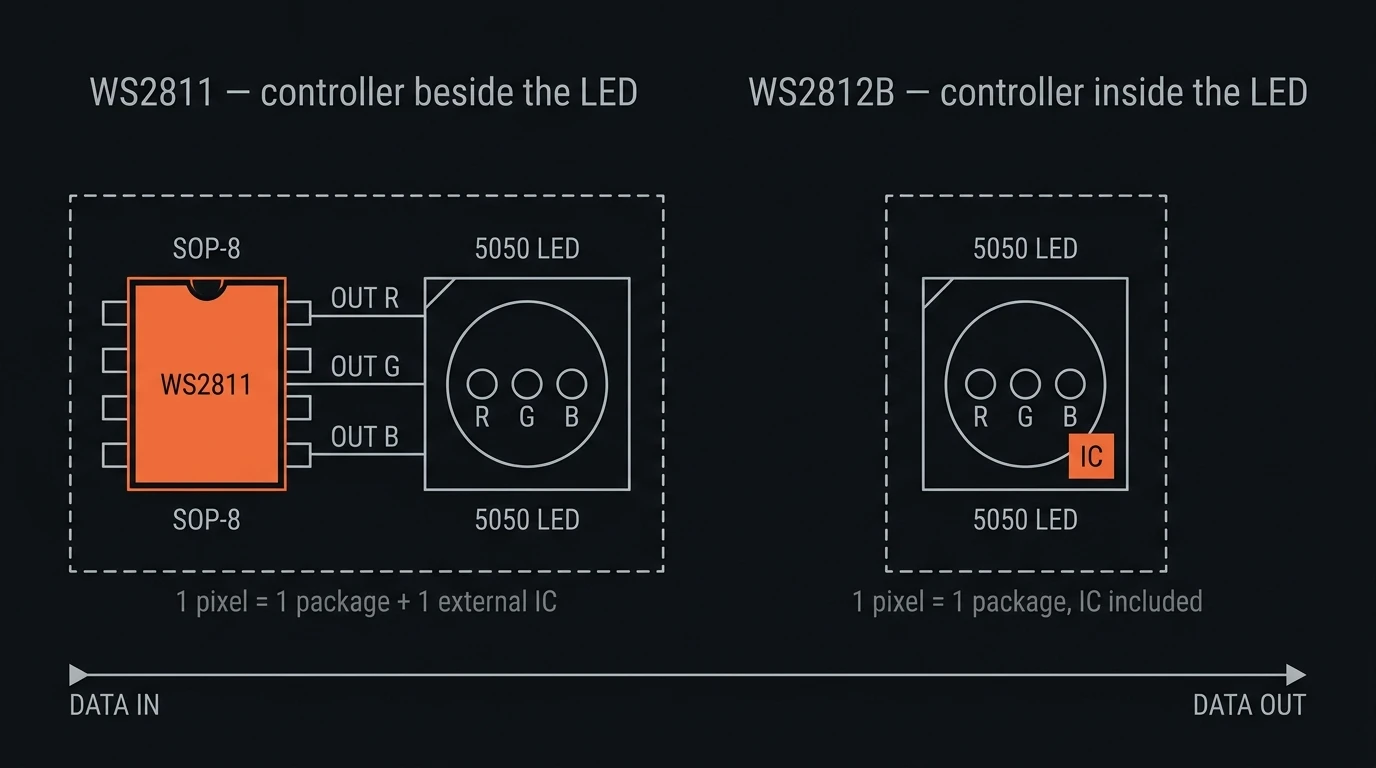
Same package, same three dies. The only difference is whether the controller sits beside them or inside them.
Voltage systems: why "WS2811 = 12 V" is wrong
A claim repeated across most write-ups on this question is simply false: that WS2811 means 12 V and WS2812B means 5 V. WS2812B is genuinely 5 V — the die is inside the package and the package is a 5 V part. But WS2811 is an external driver, and what voltage the strip runs at is a wiring decision made by whoever designs the board, not a property of the chip.
In practice you will find WS2811 fixtures at 5 V, 12 V and 24 V. We build all three. The 12 V and 24 V versions exist precisely because the external IC makes them possible.
The 3-LED cut unit, and why it is three
Everyone writing about 12 V WS2811 strip mentions that you can only cut every three LEDs. Almost nobody says why, which leaves buyers thinking it is an arbitrary manufacturing choice they might be able to negotiate around.
It is not. A single LED die drops roughly 2–3.4 V depending on color, so a 5 V rail has headroom for one die per channel. A 12 V rail has headroom for three dies in series per channel — and that is exactly how the strip is wired.
Follow one channel. The red output sinks current through three red dies in series, and those three dies sit in three different 5050 packages, one from each. The green and blue outputs do the same through their own dies in the same three packages. One WS2811, three RGB packages, nine dies, driven as a single addressable pixel. The smallest electrically complete section is therefore three packages — which is what a spec sheet means when it says the cut unit is three LEDs. Cut into the middle of that series string and the remaining dies have no return path.
At 24 V the same logic stretches to six dies in series per channel, so the cut unit becomes six packages. At 5 V it collapses to one, which is why 5 V WS2811 strip cuts every pixel exactly like WS2812B does.
So the trade is not "12 V is better." It is: higher voltage buys you run length and pays for it in resolution.
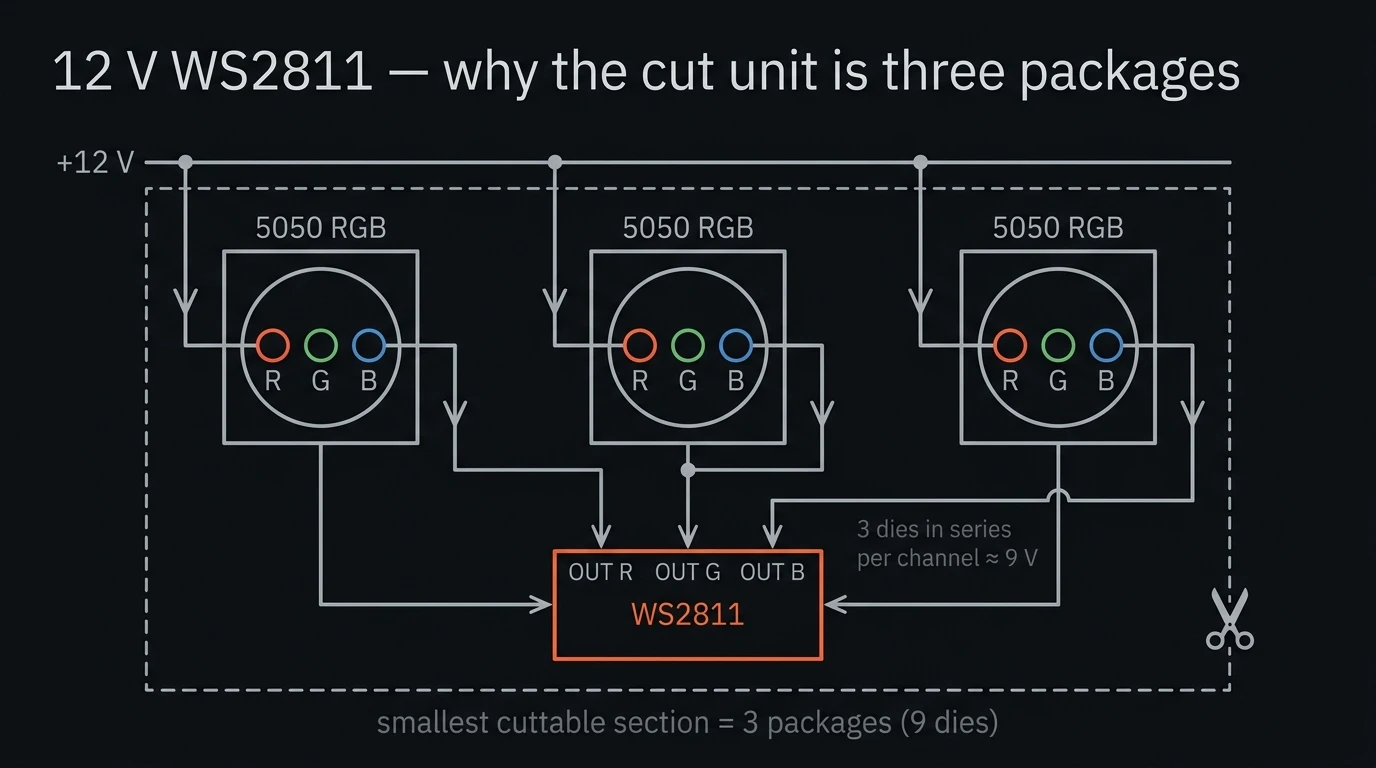
Anodes on the 12 V rail, three same-color dies in series returning into each output. Cut inside a string and the remaining dies lose their return path.
WS2811 @ 5 V | WS2811 @ 12 V | WS2811 @ 24 V | WS2812B @ 5 V | |
|---|---|---|---|---|
IC location | External | External | External | Inside the 5050 |
Smallest cut unit | 1 package | 3 packages | 6 packages | 1 package |
Addressable resolution | Per package | Per 3 packages | Per 6 packages | Per package |
Typical draw at 60 LED/m | ~18 W/m | ~14.4 W/m | ~14.4 W/m | ~18 W/m |
Wiring | V+ / V− / DATA | V+ / V− / DATA | V+ / V− / DATA | V+ / V− / DATA |
Note that both parts use the same three-wire scheme. Neither has a backup data line — that is a different chip and a separate discussion.
Run length, voltage drop and power injection
This is where the voltage decision earns its money, and where most first-time specs go wrong.
Copper has resistance. Current flowing along a strip drops voltage as it goes, so the far end sits at a lower voltage than the injection point. LEDs dim and shift color — the visible symptom is a run that starts white and ends amber. The higher the supply voltage, the smaller that drop is as a proportion of the rail, so the further you get before it shows.
Rough working figures for 60 LED/m strip at full white, no additional injection:
Rail | Practical run before visible drop | Injection interval we design to |
|---|---|---|
5 V | 1–2 m | Every 1–1.5 m |
12 V | 4–5 m | Every 4–5 m |
24 V | 8–10 m | Every 8–10 m |
Treat these as starting points, not guarantees — they move with LED density, copper weight, duty cycle and ambient temperature. A strip run at 30% brightness on pastel colors will go considerably further than the same strip at full white.
Two things follow that the ranking pages skip entirely. First, power injection is a wiring design task, not an afterthought: you are feeding the same rail at intervals with conductor sized for the current, and undersized injection cable simply relocates the voltage drop into the cable. As a rough floor, 18 AWG handles a couple of amps over a short drop and 14 AWG is more realistic once a feed carries 8–10 A across a ceiling void — size it from the actual current at that tap, not from what fits the terminal. Second, data and power have different limits. Data will happily travel further than power on these parts; it is almost always the power rail that fails first on a long run.
If you are choosing strip for a specific run length rather than choosing a chip, the pixel LED strip selection guide covers that decision from the other direction.
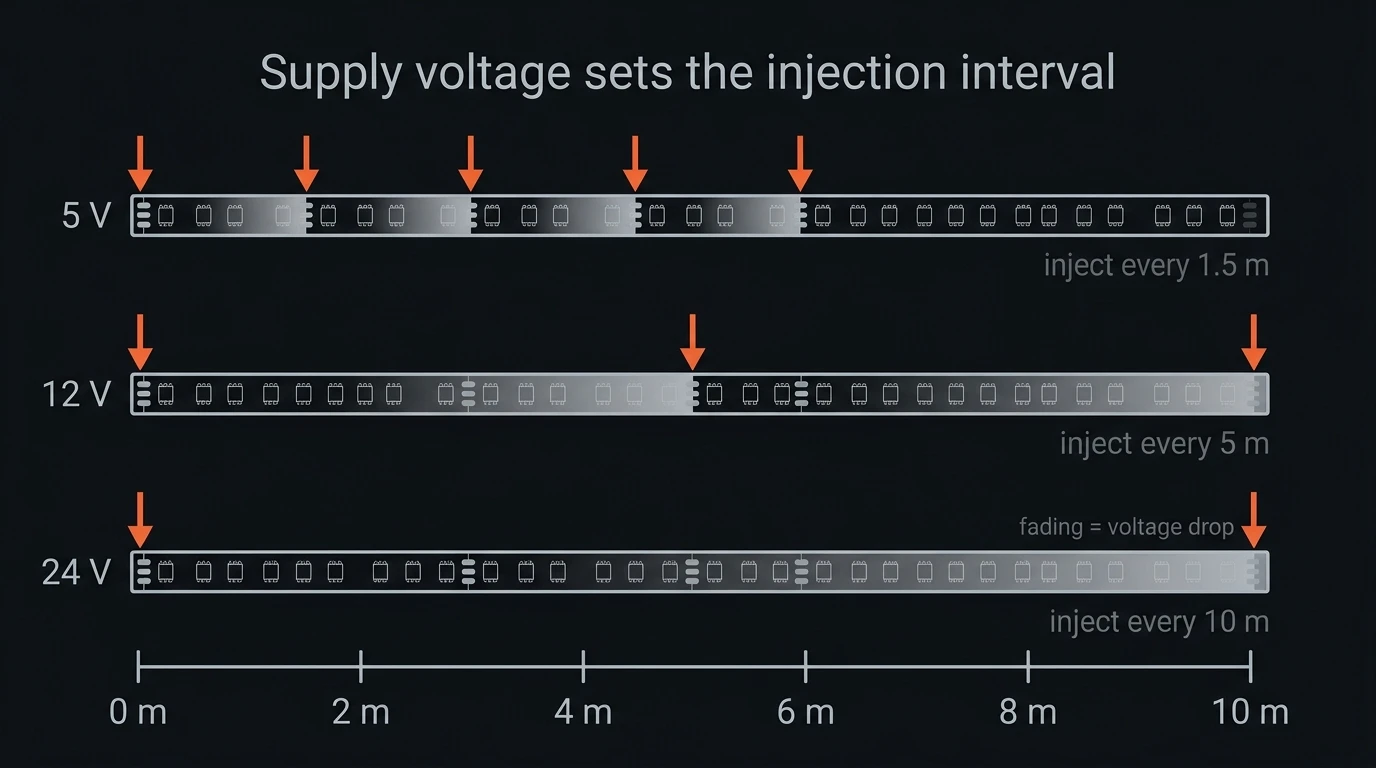
The same LED density on three rails, using the upper end of each range above. Higher voltage buys distance between injection points.
Beyond strip: tubes, bars and point lights
Almost every write-up on this question discusses strip and only strip. That is a reasonable proxy for hobby projects and a poor one for installations, where most of the fixture count is not strip at all.
Once you leave strip, the external IC stops being a compromise and starts being the obvious choice. In a pixel tube, a point light, or an aluminum-housed pixel bar, the LEDs are spaced out across a housing — there is no advantage to putting a controller inside every package, and real disadvantages in heat and cost. Our 40 mm pixel tubes and 12 mm square point lights run WS2811 and UCS1903 for exactly this reason; the IC lives on the board, the LEDs sit where the optics need them.
What to ask a supplier for these, in order: which driver IC the fixture is built on, the pixel pitch, the ingress rating of the assembled fixture, and whether the IC can be changed to match a controller you already own.
If your project is mostly discrete fixtures rather than continuous strip, the WS2811-versus-WS2812B question largely answers itself.
The control layer nobody in the top results explains
Both chips receive the same kind of signal: a single-wire NZR-encoded stream at roughly 800 Kbps, with pixels latching their own slot and passing the rest downstream. That is why a controller that drives one usually drives the other.
Where the two parts differ electrically is smaller than most comparisons imply:
WS2811 | WS2812B | |
|---|---|---|
Data rate | 800 Kbps (NZR) | 800 Kbps (NZR) |
Gray scale | 8-bit, 256 levels per channel | 8-bit, 256 levels per channel |
PWM refresh | ~400 Hz typical | ~400 Hz typical |
Reset / latch time | >50 µs low | >50 µs low |
Backup data line | No | No |
Logic level | Referenced to its own supply rail | Referenced to 5 V |
What the ranking pages leave out is everything upstream of that wire. A microcontroller — an Arduino or a Raspberry Pi — is fine for a bench prototype or a small installation. Anything at venue scale is running a lighting protocol instead: Art-Net or ANSI E1.31 (sACN) over Ethernet, or DMX512 over a serial link, terminating in a decoder that converts to the SPI-style signal these chips actually want.
Above the protocol sits the mapping layer — MADRIX, xLights, Resolume or WLED at the hobby end — which is where a physical fixture layout gets turned into pixel addresses. Getting that map right is usually a bigger schedule risk than picking the chip.
That decoder is the piece buyers forget to budget. Ours takes DMX in and drives WS2811, WS2801, UCS1903 and similar parts at up to 9 A on a 12–24 V rail. Without something in that role, an Art-Net console has no way to talk to a pixel strip at all.
One practical note for the microcontroller case: WS2812B expects a data line near its 5 V supply, and a 3.3 V GPIO from an ESP32 or a Pi is marginal. A level shifter on the first pixel solves a whole category of "the first LED flickers" problems. It is one of the more common field failures on this part.
For how these protocols compare against each other, and which one a given project size calls for, see the addressable LED driver IC and control protocol guide.
What procurement asks that the spec sheet doesn't answer
Neither datasheet addresses the questions that actually decide a purchase order.
Ingress protection. The chip has no IP rating — the fixture does. IEC 60529 defines the two digits, and the second one is where outdoor projects get caught: IP65 (water jets) is not IP67 (temporary immersion) and neither is IP68. A silicone-sleeved strip and a properly potted one both get sold as "waterproof." Sealing method matters more than the chip; the IP rating and handover guide goes through what to ask for.
Batch color consistency. Two reels of the same part number from different production batches can be visibly different whites on a wall. This is an LED binning question, not an IC question, and it is the single most common acceptance dispute on large facade jobs. Specify the bin, and order the whole job in one batch where you can.
Serviceability. Here the structural difference bites. When a WS2812B fails, one pixel goes dark. When a WS2811 fails, the three LEDs it drives go dark together — a bigger visible hole, but one IC to replace rather than a whole LED package. Which is preferable depends on whether your fixtures are field-serviceable at all.
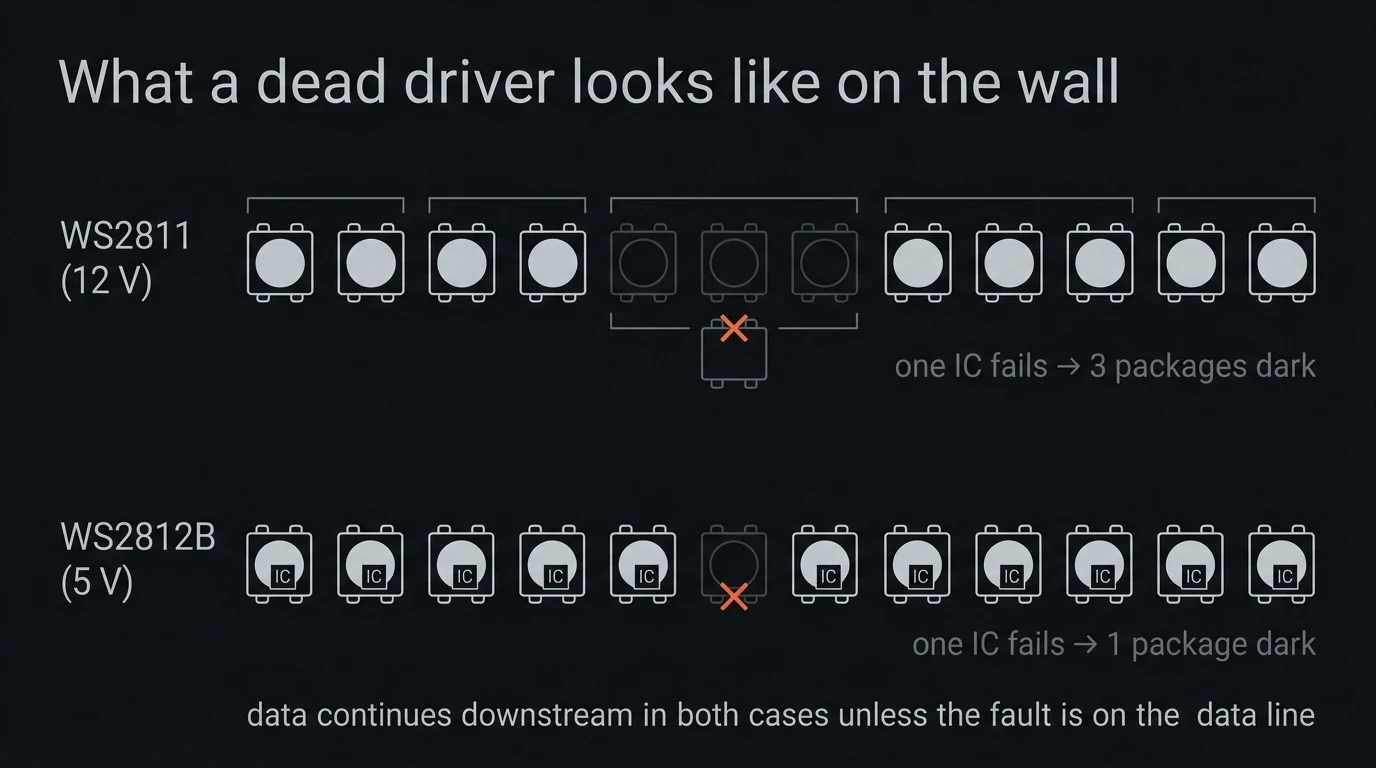
The same single component failure, seen from across the room. Which hole is acceptable is a maintenance decision, not a spec-sheet one.
Certification and counterfeits. CE, RoHS and UL apply to the finished fixture. Ask for certificate numbers you can verify rather than a logo on a PDF. Relabelled and clone driver ICs are common enough at the low end of this market that spec drift between samples and production is a real risk — which is an argument for buying fixtures from whoever assembles them rather than through a chain of traders. Sourcing terms, MOQ and sample policy are covered in the OEM, ODM and distribution guide.
So which one should you spec?
There is no better chip here, only a better fit.
Decision factor | Points to WS2811 | Points to WS2812B |
|---|---|---|
Run length per feed | Longer at 12 V / 24 V | Short — plan injection every 1–1.5 m |
Effect resolution | Coarser (3 or 6 LEDs per pixel at 12/24 V) | Per-LED |
Fixture type | Tubes, bars, point lights, long facade runs | Continuous strip, close viewing |
Repair | Replace the IC; three LEDs dark until then | One dark pixel; replace the package |
Voltage options | 5 V / 12 V / 24 V | 5 V only |
Cabling effort | Fewer injection points | More injection points |
When WS2811 is the right call
Long architectural runs, discrete fixtures, anywhere the cable budget or the injection count is the constraint. At viewing distances above a few meters, the coarser pixel pitch is invisible — nobody standing across a plaza can resolve individual LEDs. A Singapore observation wheel we supplied runs 86,500 pixel points; at that scale, injection intervals and serviceability dominate every other consideration, and per-LED addressing would have bought nothing visible.
When WS2812B is the right call
Close-range work where pixel pitch is the point: signage, props, ceiling features, anything a viewer stands within a couple of meters of. Also the right answer for short runs where the injection overhead of 5 V simply does not matter, and for prototyping, because the ecosystem and library support are broader.
When neither is the answer
If you are weighing a backup data line so a dead pixel does not kill the rest of the run, that is WS2815 and a different comparison. If you need a genuine white channel rather than white mixed from RGB, that is SK6812 or an RGBW part. If the install is mains-voltage — an underground mine or a road tunnel, where we have shipped 10,000 m of AC36V strip — then low-voltage pixel parts are not in the running at all.
Because PILEDS builds fixtures on both chips and configures the driver IC per order, we are not arguing for one here. The specification that matters is written before the purchase order, not after the install.
If you have a run length, a viewing distance and a control system in mind, send us the parameters and we will tell you which of the two we would build it on — including when the answer is neither.
FAQ
Is WS2812B better than WS2811? No. WS2812B gives per-LED resolution; WS2811 gives longer runs, more voltage options and non-strip form factors. The right one depends on run length and viewing distance.
Is WS2812B the same as a NeoPixel? NeoPixel is Adafruit's brand name for individually addressable RGB LEDs, and WS2812B is the part most commonly sold under it. Code written for NeoPixel libraries generally drives WS2812B directly.
Can I use a WS2811 controller with WS2812B strip? Usually yes. Both use the same single-wire NZR signalling at about 800 Kbps, so most controllers list both. Confirm the voltage — a 12 V controller output will destroy 5 V strip.
Why can I only cut 12 V WS2811 strip every three LEDs? Because each output channel sinks current through three same-color dies in series — one die in each of three adjacent RGB packages — to use up the 12 V rail. Cutting inside that series string breaks the return path.
What is the maximum run length for WS2812B? Roughly 1–2 m at 60 LED/m before voltage drop is visible at full white, then power injection every 1–1.5 m. Data will travel further than power.
Does WS2811 come in 5 V? Yes. WS2811 is an external driver, so 5 V, 12 V and 24 V versions all exist. At 5 V the cut unit is a single pixel, same as WS2812B.
What happens when a pixel fails? A failed WS2812B goes dark on its own. A failed WS2811 takes the three LEDs it drives with it. On both parts, data continues downstream unless the failure is on the data path itself.
Do I need a level shifter? For WS2812B driven from a 3.3 V microcontroller, usually yes. The data line is specified relative to the 5 V supply, and 3.3 V logic is marginal enough to cause intermittent first-pixel faults.
Which one is cheaper? Per metre they are close enough that the chip rarely decides the budget. The real cost difference is installation: fewer injection points and less cable on a 12 V or 24 V WS2811 run can outweigh a small difference in strip price on any job of size.
What is the difference between WS2812 and WS2812B? WS2812B is the revised package: four pins instead of six, better heat handling and reverse-polarity protection. For specification purposes treat WS2812B as the current part; plain WS2812 mostly turns up in older stock.
Can I run WS2812B at 12 V? Not directly — the die inside is a 5 V part. Fixtures sold as "12 V WS2812B" are either mislabelled or carry an onboard regulator per segment. If you need 12 V or 24 V with per-package addressing, an external-IC part is the honest answer.
Can I mix both on one project? Yes, and large installations often do — WS2812B for close-range detail, WS2811 for long runs and discrete fixtures. Keep them on separate data universes and match each to its own controller output voltage.
Specifying pixel LED for a real project?
Send the spec — pitch, IC, IP class, run length, voltage — and you get an engineer's answer, not a catalogue. Samples and OEM/ODM quotes from the Shenzhen factory floor.