
3 Things Underground Lighting Must Survive
Water and dust, impact and vibration, heat and dirty power — underground lighting must survive all three. Here is what to demand in a mining LED strip spec.
Walk into a working tunnel or mine drift and you notice two things at once: how dark it is without the lamps, and how hard everything in there is on the equipment that provides the light. Water drips from the back, dust hangs in the air and settles on every surface, ventilation fans and machinery shake the walls, and the power feeding it all was never designed to be clean. Specifiers usually start from brightness — lux levels, lumens per meter, beam angles. That is backwards. The three things underground lighting must survive — water and dust, impact and vibration, and an unforgiving electrical and thermal environment — decide whether any brightness figure is still true in year two. Get those wrong and the lumen count never gets a chance to matter.
What underground lighting must survive: three tests, not a lumen race
Every environment kills lighting in its own way. On a building facade, the enemy is weather and UV. In a theatre, it is rigging and strike cycles. Underground, the killers are more consistent, which is good news: you can test for them, and you can spec against them. What underground lighting must survive breaks down into three survivability tests, each with a measurable spec response.
The test | What it does to ordinary lighting | The spec demand | How you verify it |
|---|---|---|---|
Water and dust | Seepage, condensation and washdown get into unsealed housings; coal dust grinds into optics and connections | Sealed to a real ingress rating — IP67/IP68 for strip, with sealed joints | IP test report behind the claim (IEC 60529) |
Impact, vibration, tension | Rock falls, blast debris and passing equipment dent, crack and shear; vibration fatigues joints and solder | Impact-rated construction, high tensile strength, mounting that survives abuse | IK rating (IEC 62262) plus a mechanical test report |
Heat and the electrical environment | High ambient heat ages LEDs early; voltage swings and unsafe supply practice kill drivers or trip the safety case | Rated operating temperature range, current-regulated segments, low touch voltage, certification for classified zones | Datasheet operating range, certificate numbers you can check |
That table is the article in miniature. What follows is why each row is the way it is — and the questions to put to a supplier so the answers are test reports, not adjectives.
If a strip cannot survive the environment it is installed in, its lumen rating is a number on paper — nothing more.
Test 1 — Water and dust: the ingress assault
Underground is wet. Tunnel walls weep, roof bolts leak, and every washdown — and mines get washed down often — sends a jet of water over fixtures mounted low on the wall. Then there is the air itself: poorly ventilated workings run near saturation, so condensation forms on anything cooler than the air around it, including the inside of a supposedly sealed lamp if the seal is only nominal. The IP code exists precisely because "waterproof" means nothing without a test behind it. Two digits, two questions: the first digit is solid-particle protection (dust-tight is 6), the second is water (7 means temporary immersion up to 1 m, 8 means continuous immersion under conditions the manufacturer specifies — the exact wording matters).
The practical floor for permanent underground strip is IP67, and most mine-spec strip is built to IP68 under IEC 60529. Two details separate a genuine sealed strip from a marketing claim. First, the housing: a full-length silicone extrusion protects the LED side, but water enters through ends and joints, not through the middle — so factory-sealed ends and properly rated connectors between segments are where an IP68 claim is won or lost. Second, the seal has to survive being handled: a rating tested on a pristine sample means little when the same connector gets dragged over rock and unplugged for maintenance. Ask for the ingress test report and check what condition the sample was in.
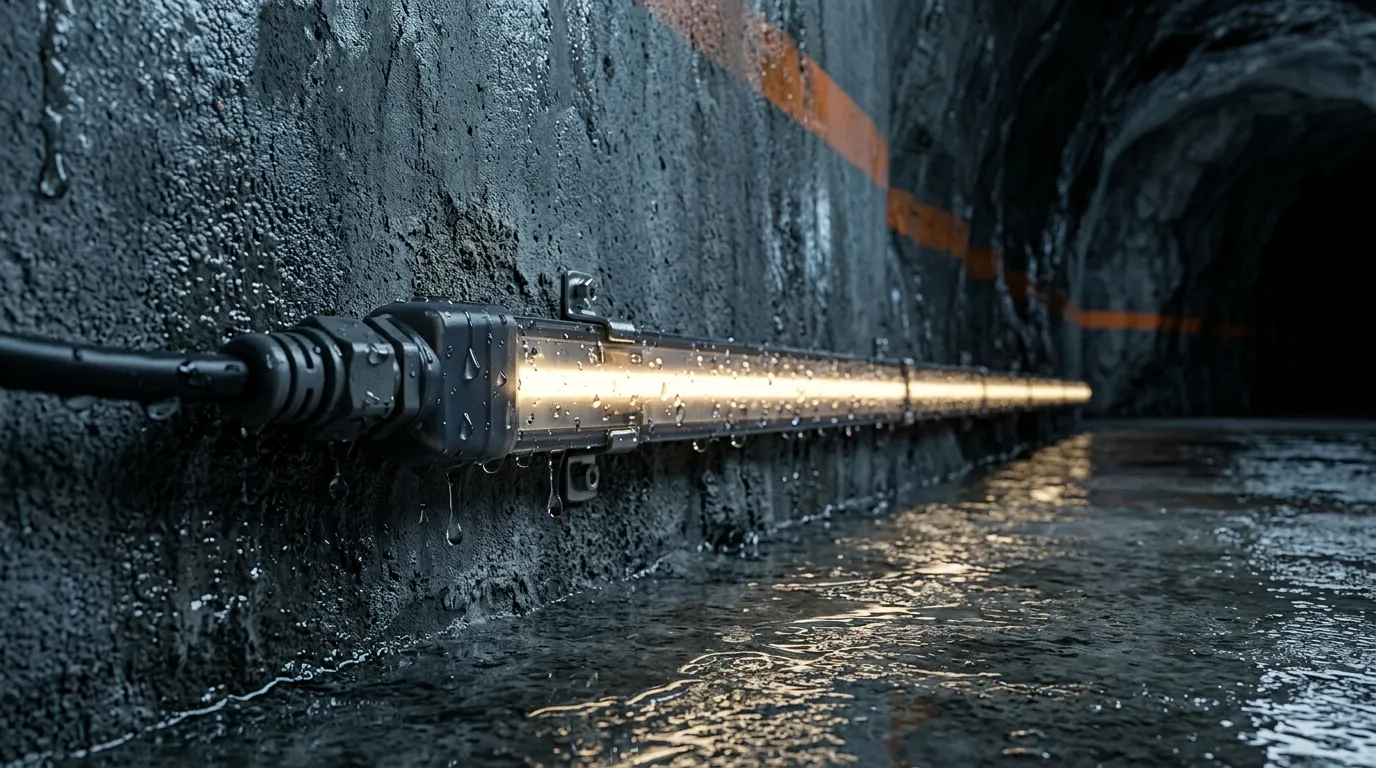
Above: a sealed strip mounted low on a tunnel wall — the housing and joints, not the LEDs, are where an IP68 claim is won or lost.
The dust side deserves equal weight, especially in coal and mineral workings. Dust is not just an annoyance — it abrades optics until output falls, it packs into connectors and wicks moisture in behind them, and in coal mines it is an explosion hazard in its own right. Mine water is rarely clean either: mineral-laden drips corrode contacts over time, which is another reason sealed joints matter more than sealed housings. Dust-tight (the "6" in IP68) plus sealed connectors is the only sensible reading of the requirement. If IP terminology is new to your team, our LED strip IP rating guide walks through what each code actually means before you put one in a tender document.
Test 2 — Impact, vibration and tension: the mechanical assault
If water is the slow killer, mechanics is the fast one. Underground, lighting is mounted where the space is — on ribs, arches and roof, right in the path of everything the mine moves. Rock falls clip fixtures. Blasting debris throws fragments at them. Loaders and shuttle cars pass close enough to knock a rigid housing off its bracket, and ventilation fans, crushers and conveyors put continuous vibration into the structure that strip is strapped to. Vibration is the subtle one: it does not break a lamp on day one, it fatigues solder joints, loosens connectors and turns a lamp that survived a year into one that fails at random.
Impact resistance has its own code. The IK rating under EN 62262 measures what a housing survives in joules — IK08 means a 5 J impact, IK10 means 20 J — and unlike IP it is not routinely quoted on strip products, which should tell you how few manufacturers build for it. For rigid luminaires in vehicle traffic, IK08 or better is a common spec. For linear strip, the physics is different and the spec language should be too: instead of a thick glass or polycarbonate housing, survival comes from a construction that yields instead of shatters, and from a mounting system that keeps the strip attached when it is hit.
That is where tensile strength and mounting flexibility do the work. A mine-rated strip is typically a high-tensile FPC core with a tough PVC or silicone jacket — engineered to resist pulling, crushing and impact rather than to look rigid — and it is strapped in place with cable ties along walls and arches, so a glancing blow deforms the mount instead of snapping the lamp. The flexible mounting is not a compromise; on an irregular tunnel section a rigid channel is the thing most likely to get ripped off by equipment. Our impact-resistant tunnel strip is built this way for a reason: it is rated for the AC36/48/110/220 V mains range and IP68, and survives because nothing about it is brittle. When you compare suppliers, ask what happens to their product when a rock the size of a fist hits the mounting point — the answer separates a design decision from a datasheet line.
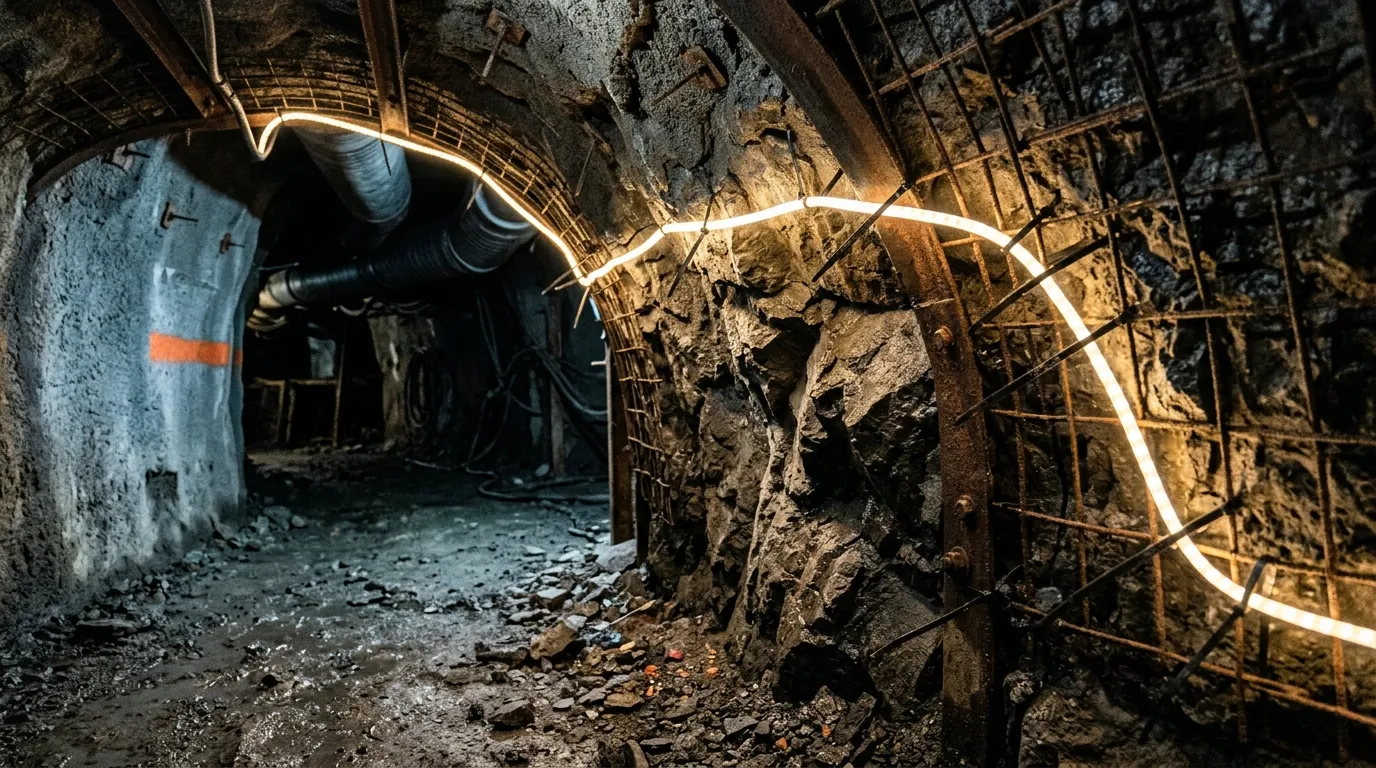
Above: a flexible, high-tensile strip strapped directly to an irregular rock surface — the mounting yields under impact instead of snapping.
Test 3 — Heat, dirty power and the electrical environment
The third test is the one most specifiers underestimate, because it is two problems wearing one coat. The first is heat. Deep and poorly ventilated workings run hot — sustained ambients well above 40 °C are common where airflow is limited — and the strip has to add its own heat on top. LEDs are semiconductors: as junction temperature climbs, light output and rated life fall together, and in a sealed silicone housing the heat has nowhere to go. That is why an honest datasheet states an operating temperature range: the number is the manufacturer admitting where the product stops being predictable.
Heat also feeds the second problem, because underground power is rarely clean. Heavy equipment starting — crushers, hoists, big fans — drags supply voltage down and lets it recover in bursts, and long feeder runs through damp ground add their own impedance. A passive strip fed at constant voltage turns those swings into brightness drift and, worse, lets current creep as the strip warms, accelerating the aging that heat already started. The engineering answer is constant-current regulation in short segments: each segment holds its own current, so line-voltage sags and thermal drift do not translate into visible flicker or premature aging. This is also why tunnel and mine runs are fed on mains AC rather than low-voltage DC — the AC distribution model keeps feeder currents small and local conversion short.
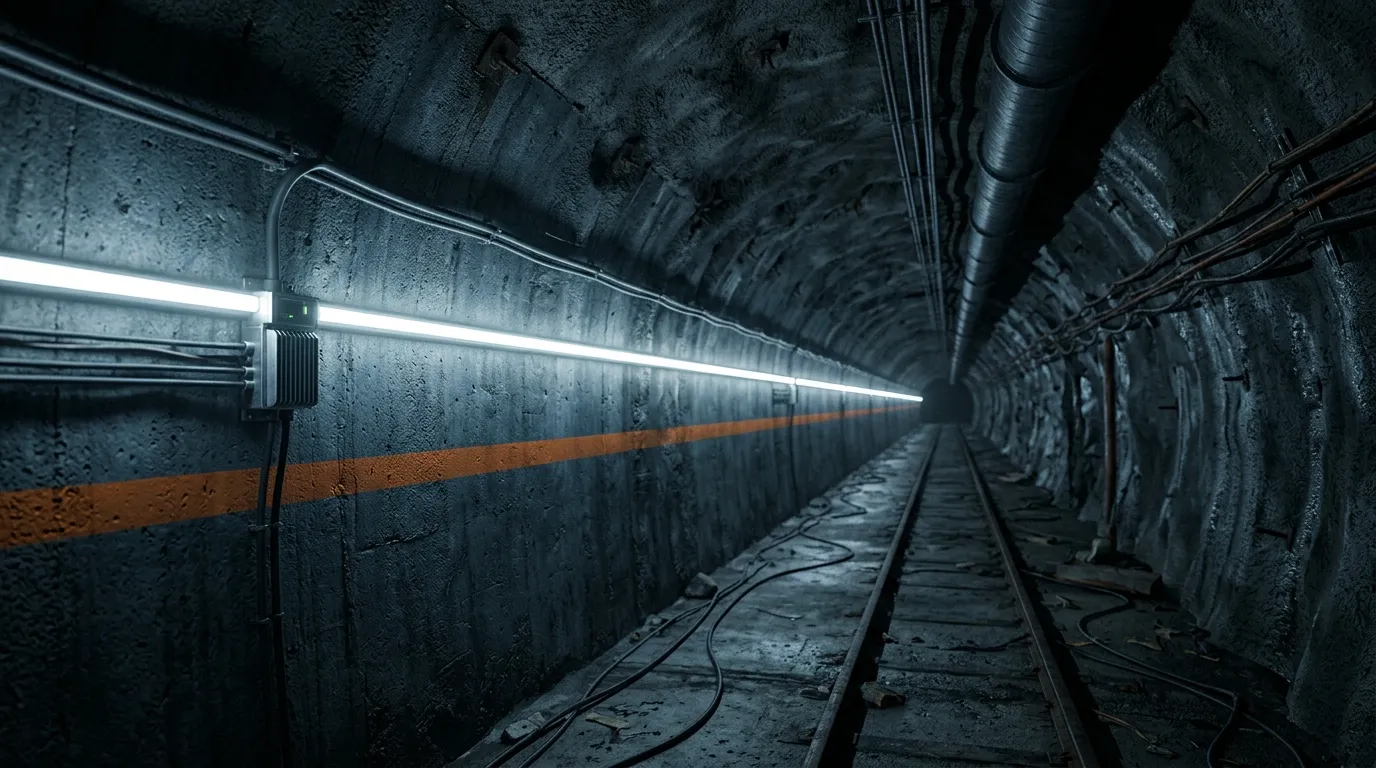
Above: a long strip run with local power modules at intervals — distribution at safe voltage, current regulation at every segment.
Then there is the safety layer, which is not a paperwork afterthought but a design input. Underground electrical rules exist because the environment is wet, conductive and sometimes explosive, and lighting circuits are regulated accordingly. In US underground coal mines, 30 CFR § 75.1719-2 requires lighting fixtures to be permissible, caps stationary lighting circuits at 70 V to ground unless they are fed through a fault-limited, resistance-grounded transformer, and bars DC above 300 V — the rule even treats the cables feeding those fixtures as trailing cables, which brings their jacketing and protection under the same approval regime. These are supply-side limits that shape what kind of strip you can even install. For the rest of the world the same thinking runs through the extra-low-voltage ceiling in IEC 60364: 50 V AC rms is the touch-safe boundary, which is why 36 V AC strip sits in the same SELV family as 24 V DC while keeping AC's distribution advantages. A safe, regulated, current-controlled supply architecture is survivability as much as any seal is — which is why our longest underground reference, a 10,000 m AC36V run in a South African mine, was built around the AC36V IP68 mine strip: direct AC36V feed, IP68 sealing, and a −30 °C to +55 °C operating range — survivability written into the datasheet rather than the brochure.
Certification: how to verify a strip will survive where it's installed
The three tests above only count if you can check them — and that check is where underground mine lighting projects go wrong, because a model name is not a certificate. In classified areas — gassy coal mines, fuel storage, any zone where an explosive atmosphere can form — lighting must carry certification from a recognized scheme: ATEX under EU Directive 2014/34/EU, IECEx internationally, or MSHA permissibility in US coal mines. Each scheme certifies equipment for specific gas groups, zones and temperature classes, so the certificate number must be checked against your actual location classification, not just its existence. "Explosion-proof" in a product name proves nothing; a certificate with a number you can look up proves everything. The same discipline applies to the baseline marks — CE, RoHS and EMC are the entry ticket for any export lighting, and the LED export certification guide lists exactly what to ask for and how to verify each one.
Certification scheme | Where it governs | What to check on the certificate |
|---|---|---|
ATEX (EU Directive 2014/34/EU) | Equipment for explosive atmospheres sold in the EU | Certificate number, category (1/2/3), gas group and temperature class vs. your zone |
IECEx | International scheme, accepted in most mining regions | Certificate number, protection type, gas/dust group, zone suitability |
MSHA permissibility | US underground coal mines — fixtures must be "permissible" (30 CFR § 75.1719-2) | MSHA approval number and the exact equipment it covers — permissibility is a tested status, not a style |
CE / RoHS / EMC | Baseline export marks, EU market | Declaration and test reports behind the mark, plus the certificate number for each |
A survivability spec, assembled, looks like this:
- Ingress: IP67/IP68 with factory-sealed ends and rated connectors; ask for the IEC 60529 test report.
- Mechanics: impact-rated and high-tensile construction, flexible mounting; ask what happens under impact and vibration, and how it is mounted.
- Electrical: SELV-compatible low voltage or mains architecture appropriate to site rules; constant-current segmented regulation; a stated operating temperature range that covers your worst case.
- Safety: for classified zones, the actual certificate number (ATEX, IECEx, MSHA) matched to your gas group and zone — never a product name.
- Proof: a reference installation in a comparable environment, not just a lab photo.
If you are still mapping requirements, the full AC36V mining and tunnel lighting buyer's guide takes the purchasing decision end to end — voltage architecture, sealing, cut lengths and the questions to put to suppliers.
The one-sentence version: spec the survival tests first — water and dust, impact and vibration, heat and the electrical environment — and let brightness follow. If you are sourcing strip for a mine or tunnel project, tell us the environment — run length, water, dust, ambient temperature, whether the zone is classified — and we will send the survivability case with the quote. A strip that survives year three is cheaper than one that is bright in month one.
Specifying pixel LED for a real project?
Send the spec — pitch, IC, IP class, run length, voltage — and you get an engineer's answer, not a catalogue. Samples and OEM/ODM quotes from the Shenzhen factory floor.