
12V vs 24V vs 48V LED Strips: Which Is Right?
12V, 24V, or 48V LED strip? Compare voltage drop, current per meter, and maximum run length, then pick the right LED strip voltage for your long-run project.
There is no single best answer in the 12V vs 24V vs 48V LED strip decision — the right voltage is decided by run length and current budget. For the same wattage, 24V draws half the current of 12V and 48V draws a quarter, which is why higher voltages dominate long commercial runs. Quick split: 12V for short runs and maximum ecosystem compatibility, 24V as the default for most cove, signage, and storefront work up to about 10 m, 48V for facades and long-run installations where voltage drop would otherwise force multiple power supplies. A full disclosure: we manufacture 12V, 24V, and 48V strips at our Shenzhen factory, so we have no voltage to push — the right choice genuinely depends on your run.
12V vs 24V vs 48V at a glance
The table below assumes a typical mid-power strip (14.4 W/m, 60 LEDs/m) and a common design target of keeping voltage drop under roughly 10% of supply voltage.
12V | 24V | 48V | |
|---|---|---|---|
Current per meter (14.4 W/m) | 1.2 A | 0.6 A | 0.3 A |
Typical max run before injection | ~5 m (16 ft) | ~10 m (33 ft) | 20 m+ (65 ft+) |
Power supplies needed for 20 m | 4-5 | 2-3 | 1-2 |
Driver IC ecosystem | WS2811, WS2815, SK6812, UCS1903 | WS2815, pixel ICs, RGBW/RGBCCT | Constant-current pixel ICs |
Typical jobs | Shelf, automotive, small coves, stage accents | Storefronts, signage, office coves, neon | Facades, curtain walls, long architectural runs |
The pattern behind the table is simple physics, and it is worth understanding before you buy, because it determines everything downstream: power supply count, wire gauge, and whether the far end of your run looks as bright as the near end.
Why voltage changes everything: current, voltage drop, and the 1/V² rule
Every LED strip is a power load: P = V × I. A 14.4 W/m strip at full brightness draws 1.2 A/m at 12V, 0.6 A/m at 24V, and 0.3 A/m at 48V. Double the voltage, halve the current. That matters because the copper traces in the strip, and the feeder cable you run to it, behave like resistors, and resistors turn current into voltage drop: V(drop) = 2 × I × R (the 2 is the round trip).
The percentage of supply voltage you lose is what actually hurts brightness, and it scales with 1/V²:
% drop = 2 × P × R / V²
For the same strip wattage on the same cable, a 24V system loses a quarter of the percentage drop of a 12V system, and 48V loses one-sixteenth. That is why the practical run-length limits in the table exist: the 12V strip "runs out of voltage" after a few meters of PCB trace, while the 48V strip barely notices the same distance.
A worked example. Say you are feeding a 60 m facade run drawing 72 W total (about 5 m of 14.4 W/m strip, or a longer run of lower-density strip). Using 12 AWG copper feeder, which has a resistance of roughly 5.2 mΩ/m (American wire gauge values, ~10.4 mΩ/m round trip):
Voltage | Current | Voltage drop over 60 m | % of supply |
|---|---|---|---|
12V | 6.0 A | 3.7 V | 31% — far end visibly dim |
24V | 3.0 A | 1.9 V | 7.8% — acceptable |
48V | 1.5 A | 0.94 V | 2.0% — even color end to end |
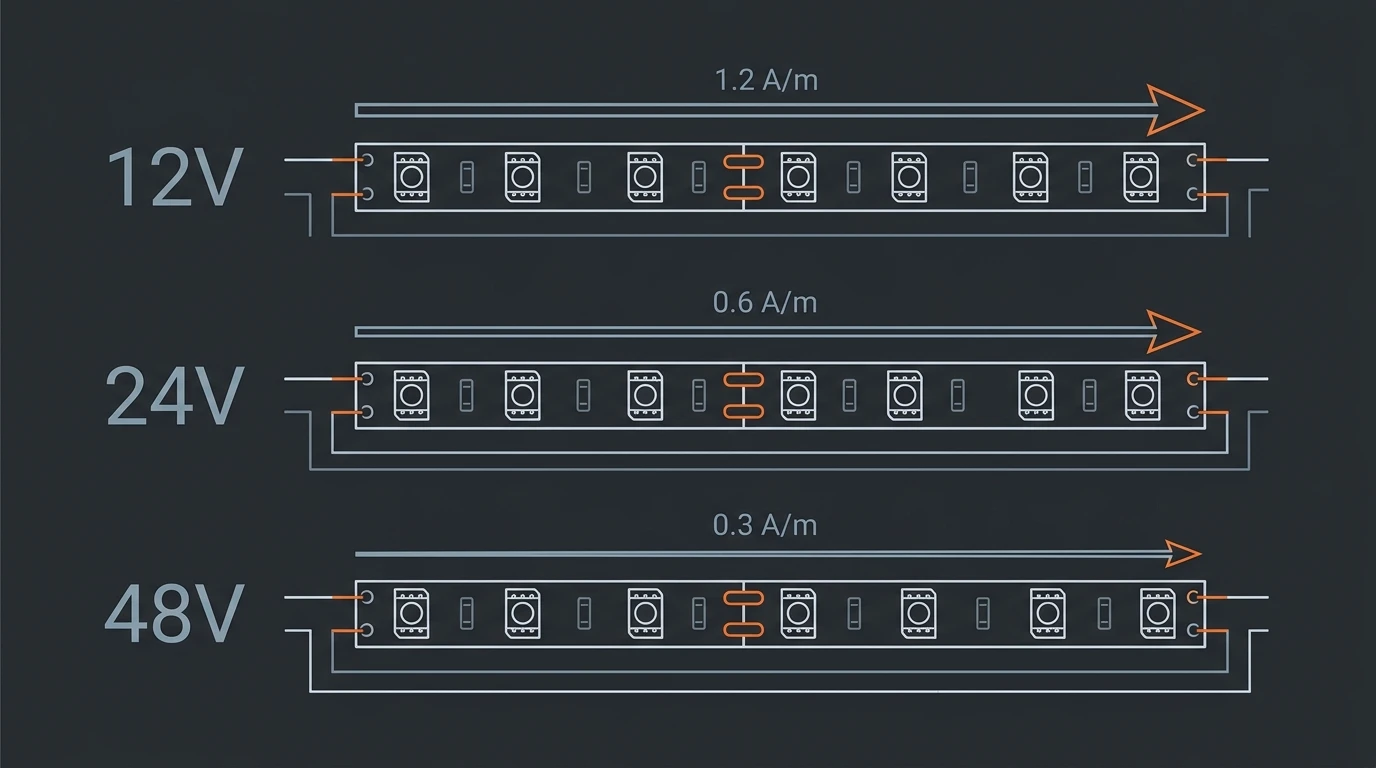
Current per meter falls by half at each voltage step, which is what extends the practical run length.
This is the whole argument for the "high voltage" end of the LED strip spectrum in one table. It is also why a 48V strip is sometimes called a no-voltage-drop strip — not because physics is suspended, but because at 48V the drop becomes small enough to ignore over realistic runs.
Two honest caveats before you go max-voltage. First, real strips vary: a 19.2 W/m 24V strip and a 21.6 W/m 48V strip use their extra voltage headroom on more LEDs, so the practical gain over 12V is usually 2-4× run length, not the theoretical 16×. Second, "high voltage LED strip" in this article means 48V DC, which is still extra-low voltage (SELV) — it is not the 110-230V AC mains strip category sold for plug-and-play outdoor lighting, and the two should never be mixed in one system.
12V LED strip: the compatibility default
12V is where most of the addressable LED world lives. WS2811, WS2815, SK6812, and UCS1903 strips all have 12V variants, and 12V matches automotive systems, most stage controllers, and a huge installed base of power supplies. If you are doing shelf lighting, a small cove, a car show display, or a stage accent that will be rigged and re-rigged, 12V is the path of least resistance.
Its cost is current. A 60 LED/m 12V strip pulls 1.2 A/m — plan a power injection point every 3-5 m, thicker feeders than the strip's own traces, and 4-5 supplies for a 20 m install. 12V is the right answer for short runs and for jobs where the ecosystem (controllers, dimmers, connectors) matters more than distance.
12V is also where a lot of stage equipment lives. Pixel bars, pixel tubes, and DMX/SPI point lights are commonly DC12V fixtures, which means a touring rig can share one 12V distribution with the rest of the show's low-voltage gear. If the project is a stage backdrop, a club install under 20 m, or anything that gets re-rigged between venues, 12V keeps spares and power distribution simple. The tradeoff shows up only when the run grows: at 1.2 A/m, a 30 m 12V run is 36 A of current that has to be fed and injected along the way.
24V LED strip: the commercial sweet spot
24V exists because most commercial lighting — cove, signage, channel letters, storefront neon — sits in the 5-15 m range, where 24V halves the injection points and the supply count compared to 12V. The strip itself is also built differently: LEDs are wired in longer series groups (typically six LEDs per segment instead of three), which is what allows the higher supply voltage in the first place.
This is the bracket where most RGBW and RGBCCT strips live — the ones with a dedicated white channel that specifiers want for cove and retail. A 24V RGBCCT strip at 19.2 W/m is a common spec for warm-dim cove lighting, and 24V is also the standard for S-shape bendable strips and side-emitting strips used in signage profiles. If your project is indoor commercial, starts at 24V and only step down to 12V when a specific controller or LED type requires it.
Two practical notes for the 24V bracket. First, 24V pixel strips exist but lean on specific driver ICs — the pixel bars used for video walls and club facades, for example, are commonly DC24V fixtures, so a 24V pixel project is entirely normal as long as you match the IC to the voltage (the table in the next section covers this). Second, because 24V halves the current, you can often use one 24V supply where a 12V layout would need two — which is why 24V is the default recommendation for most commercial strip work, from storefront neon to office coves. Neon flex strips, which run through silicone profiles in channel letters, are also predominantly 12/24V, so a signage shop can standardize on 24V across both strip and neon product lines.
48V LED strip: built for long runs
48V is the voltage for the runs that 12V and 24V quietly fail: facades, curtain walls, ceiling grids, long perimeter coves — anything past about 20 m where you want one power feed per floor, not a power supply every four meters. Because current is a quarter of the 12V equivalent, 48V strips use thinner feeder cable, generate less heat in the wiring, and hold color across the whole run. The 48V strip architecture is typically constant-current: longer series LED chains driven by pixel-capable constant-current ICs, which is how a 90 LED/m DC48V strip can run 21.6 W/m and still cover a long facade section from one feed.
Two things keep 48V from being the default for everyone. The ecosystem is smaller: fewer off-the-shelf controllers and dimmers speak 48V, and the constant-current ICs used are fewer in number than the WS2811 family. Power supplies for 48V also cost more per unit than 12V bricks, even though you need fewer of them — the math only wins on longer runs. And for very long industrial or tunnel runs, the industry often skips DC entirely and goes to mains-AC strip, which is a different product class with different certification requirements. (If you see "36V" on a spec sheet, check whether it means DC36V — rare — or the AC36V mains-feed strip used in mines and tunnels, which is that AC class, not a DC voltage you can feed from a normal LED supply.)
One more 48V advantage is worth stating plainly: at 48V DC you stay inside SELV (safety extra-low voltage, ≤60V DC under IEC extra-low voltage definitions), so long architectural runs get the distance benefit without crossing into mains-voltage territory and the installation rules that come with it.
The scale argument is not theoretical. Facade and perimeter runs of 800-1,500 m are routine in the projects we have delivered — a 1,200 m wall-washer facade in Germany, an 800 m pixel-tube plaza in China, a 1,500 m strip install in a Malaysian nightclub — and every one of them is a layout problem that the voltage math above decides in the first hour of design. On a 1,000 m facade, 12V would demand hundreds of injection points; 24V dozens; 48V a manageable number of feeds per floor.
Addressable pixel strips: voltage is only half the story
If your strip is addressable — each LED or group individually controllable — the power voltage question is only half the design. The other half is the driver IC and the data signal, and this is where generic 12V-vs-24V articles run out of useful advice.
Driver ICs have their own voltage ranges. You cannot arbitrarily take a 5V chip family and run it at 48V:
Driver IC | Typical supply | Notes |
|---|---|---|
WS2811 | 5-12V (12V common) | Classic pixel IC, 3 LEDs per group at 12V |
WS2812B | 5V only | Built-in IC, short-run/consumer standard |
WS2815 | 5-12V (12V common) | Dual-signal redundancy, 12V strips common |
SK6812 | 5V (RGBW) | White channel option; Pileds also makes 5/12V SK6812 strips |
UCS1903 / SM16703 | 5-12V | Common on 12V addressable strips |
So an addressable pixel project's voltage is usually dictated by the IC family first, then by run length. A WS2811-based 12V addressable strip is the workhorse for stage and signage; 24V pixel strips exist for longer runs; 48V pixel strips use constant-current pixel ICs for facade-scale surfaces. Our driver IC guide covers the chip families in depth.
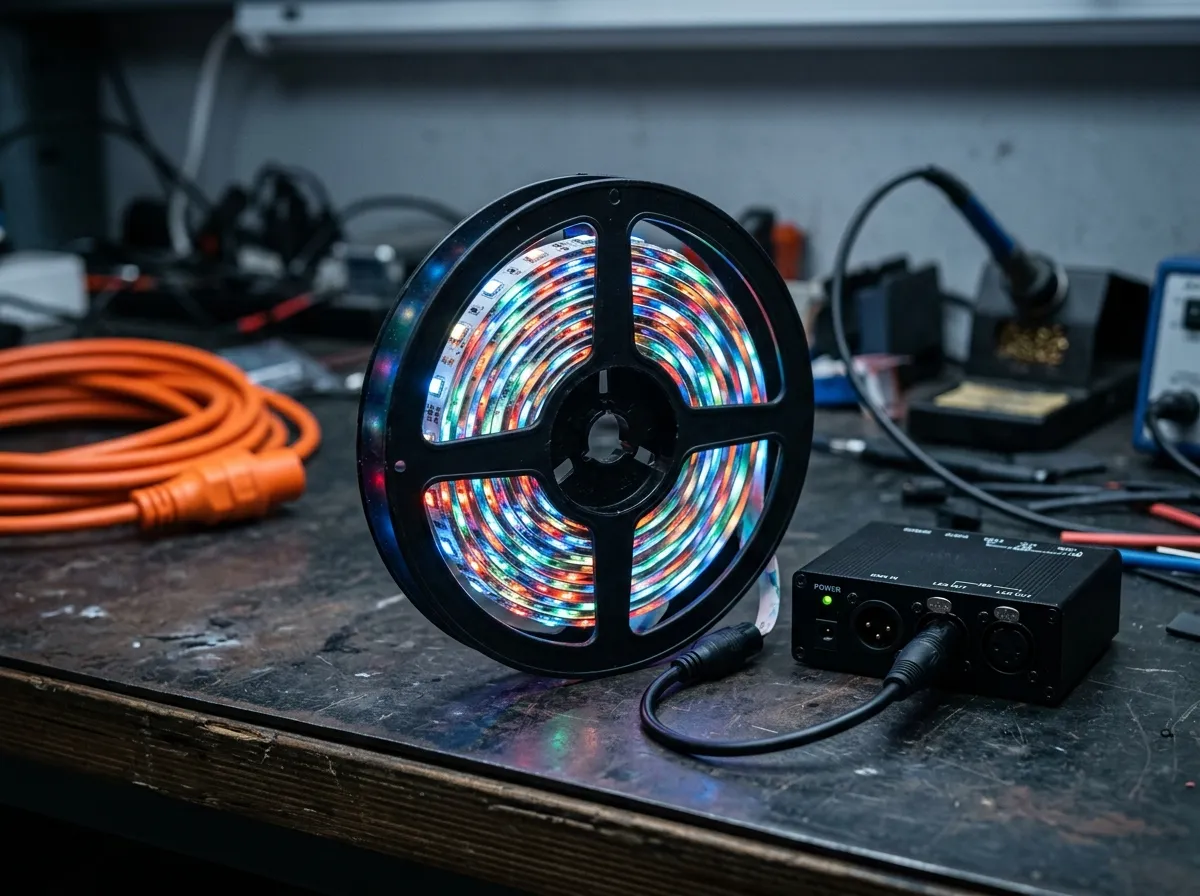
Addressable pixel strip hardware: the driver IC sets the voltage range, the controller sets the data signal — two separate decisions.
One ecosystem caveat specific to 48V pixels: most off-the-shelf DMX/SPI decoders are 12-24V, so a 48V pixel layout usually pairs with a matched 48V decoder or with per-zone 48V-to-24V step-downs at the controller. It is one more line on the BOM, but it buys the long-run power distribution that makes a big facade practical.
Data is a separate circuit from power. On a long pixel install, power at 48V may reach the far end easily while the data line still dies at 15 m. SPI pixel data (WS2811-style, 800 kHz) is distance-sensitive and typically needs a signal booster every 5-10 m, whereas DMX512 and Art-Net were designed for hundreds of meters over proper cabling. That is why long pixel projects use DMX/Art-Net controllers with buffered outputs (or 4-wire injection runs — power, ground, data, and a second ground for the signal return), not just a bigger power supply.
For the color-architecture part of the decision — RGB vs RGBW vs RGBIC and what each means on a job sheet — see our RGB vs RGBW vs RGBIC breakdown, which also covers how voltage, signal, IP rating, and cutting rules change on site. The full RGB, RGBW, and RGBIC pixel LED strip buyer's guide is the starting point for the whole cluster.
How to choose: a five-step decision path
- Measure the run. Shortest unbroken run you must feed from one point. Under 5 m → 12V is fine. 5-15 m → 24V. Over 15-20 m → 48V or multiple injection points.
- Total the wattage. Length × W/m. Divide by voltage to get amps — that number decides feeder gauge and injection count, and it is the number most installers skip.
- Check for pixel control. Addressable project? Confirm the driver IC (and its voltage range) before choosing the system voltage. SK6812 RGBW and WS2811 families set different constraints — a 5V SK6812 strip and a 12V WS2811 strip are not interchangeable.
- Confirm the controller and supply ecosystem. Does your DMX/Art-Net controller or decoder support the voltage? Most pixel decoders are 12-24V; 48V needs matched supplies and sometimes matched controllers.
- Add the environment. Outdoor or damp location? Check the strip's IP rating first — IP rating guide — because an IP68 12V strip with injection points is often more practical than an IP20 48V strip with none.
A quick worked pass: a 20 m storefront cove at 14.4 W/m draws 288 W. At 24V that is 12 A — one 300 W supply and injection at both ends. The same run at 12V would need 24 A, three supplies, and injection every 4-5 m. At 48V, 6 A and a single feed from one supply. Same LEDs, same brightness — three very different distribution designs, which is exactly the point of the table at the top.
Mistakes that cost installs
- Feeding 24V into a 12V strip. The classic. 12V strips are not "underpowered 24V strips" — the LED groups are wired for 12V, and 24V will overdrive them into rapid failure. Check the label, twice.
- One power supply, one end, a long run. Even a 24V strip will sag past its rated distance. Plan injection at both ends (or mid-run) whenever you exceed the datasheet's max run.
- Undersized feeder cable. A 6 A load on 22 AWG hookup wire will drop more voltage in the cable than the strip ever sees. Use the current table above, not the strip's wattage, to size the feeder.
- Loading the supply to 100%. Power supplies derate in warm housings and age. Size at 120-150% of the strip's total wattage and keep the supply in a ventilated spot — the extra margin also covers startup inrush.
- Mixing voltages on one supply. A single 12V supply cannot feed a 24V section. Segment your layout by voltage and supply.
- Ignoring the data line on pixel runs. Power solved ≠ control solved. Budget for signal boosters or a proper DMX/Art-Net backbone before the first meter of strip is hung.
FAQ: the voltage questions buyers actually ask
Is a 24V LED strip better than a 12V? For runs over ~5 m, usually yes: half the current, fewer injection points, and better brightness consistency end to end. For short runs, 12V is equally good and more compatible. "Better" is run-length-dependent, not absolute.
What are the differences between 24V and 48V LED strips? Same relationship as 12V vs 24V, one step further: half the current again (0.6 → 0.3 A/m at the same wattage), roughly double the practical run, thinner feeders — at the price of a smaller controller/IC ecosystem and pricier supplies. 48V is for runs that would otherwise need a power supply every 5-10 m.
What happens if you put 24V to a 12V LED strip? The LEDs and their series resistors get roughly double their rated current. Expect immediate overheating and a short lifespan — in many cases visible damage within minutes. Never test it as a shortcut.
Can I use 24V LEDs on a 12V system? They will not reach full brightness, and many pixel ICs will not start correctly below their rated voltage. Use a supply that matches the strip's rated voltage exactly, and size it at 120-150% of the strip's total wattage for margin.
Does a 48V LED strip use less power than a 12V one? No — at the same brightness and LED density, wattage is identical; voltage only changes current. The saving from 48V is in copper (thinner feeders), supply count, and voltage-drop headroom, not in the power bill. What 48V strips usually do cost more per meter is the constant-current driver ICs and the supplies.
Sourcing the right voltage for your project
Voltage is one line on the spec sheet, but it decides the whole distribution design — supplies, cable, injection points, and whether the far end of a 40 m run is even, or a gradient. Work it out with the math above, then check that the strip family you want exists in your voltage: Pileds builds 12V, 24V, and 48V addressable strips, including the long-run 48V family, with cut-to-length, IP20-IP68, and SPI/DMX/Art-Net options on one order. Send the run length and wattage to our team and get a voltage-matched quote with the supplies and controllers included.
Specifying pixel LED for a real project?
Send the spec — pitch, IC, IP class, run length, voltage — and you get an engineer's answer, not a catalogue. Samples and OEM/ODM quotes from the Shenzhen factory floor.