
IP30 vs IP65 vs IP68: Which Grade Do You Need?
IP30 vs IP65 vs IP68 explained: what the digits mean, how each grade is built, and which waterproof LED strip rating fits your indoor or outdoor pixel project.
IP30 vs IP65 vs IP68 are ingress protection grades that describe where a strip can live: IP30 has no water protection and belongs indoors, IP65 resists rain and low-pressure water jets, and IP68 survives continuous submersion. The grade is delivered by construction — a bare PCB, a silicone coating, or a sealed tube — not by the label on the reel.
If you are choosing between them for an outdoor pixel LED project, the short answer is: IP30 for dry interiors, IP65 for rain-exposed mounting, IP67 for standing water, IP68 for submersion and washdown environments. A full disclosure before we go further: we manufacture strips in all four grades at our Shenzhen factory, so this guide has no grade to push — the right answer depends entirely on where your strip will live.
IP30 vs IP65 vs IP68 at a glance
The table below is the whole decision in one place. All three outdoor grades are dust-tight (first digit 6), so the real difference is water.
Grade | What it means | How it's built | Typical use |
|---|---|---|---|
IP30 | No water protection; protected against tools and wires over 2.5 mm | Bare PCB, no coating | Dry interiors, coves, aluminum profiles, indoor signage |
IP65 | Dust-tight; resists rain and low-pressure water jets | Silicone or conformal coating over the components | Rain-exposed outdoor mounting, eaves, facades |
IP67 | Dust-tight; survives temporary submersion (1 m for 30 min) | Silicone tube slipped over the strip | Puddles, flood-prone spots, seasonal outdoor displays |
IP68 | Dust-tight; continuous submersion at a manufacturer-declared depth | Tube plus sealed ends, or full potting | Fountains, washdown areas, mine and tunnel runs, buried sections |
The pattern worth internalizing before you buy: the IP65 vs IP68 debate is a water question, not a dust question. And the cost ladder follows the construction — coating is cheap, a tube adds material and labor, sealed ends add more. You are paying for the water behavior you actually need.
What the IP code actually tells you
The IP code (IP code is short for Ingress Protection) is defined by the international standard IEC 60529, and it is deliberately mechanical. Two digits, two questions: the first digit (0–6) rates protection against solid objects, from a bare hand (1) up to dust-tight (6); the second digit (0–8) rates protection against water, from nothing (0) up to continuous submersion (8). An X means "not rated for that criterion" — IPX7, for example, says nothing about dust.
Decode IP30 and the picture is immediate: the 3 means the strip resists tools and wires over 2.5 mm — useful on a workbench, irrelevant on a wall — and the 0 means zero water protection. IP65 adds dust-tightness and water jets; IP68 adds continuous submersion. That is the entire ladder: every step from IP30 to IP68 is a step in how much water the strip is tested against.
One habit worth breaking while you are here: "waterproof" is marketing shorthand, not a rating. IP65 strips are regularly called waterproof and will still fail if submerged; IP68 strips are waterproof only down to the depth and for the duration the manufacturer declares. Always ask for the two digits.
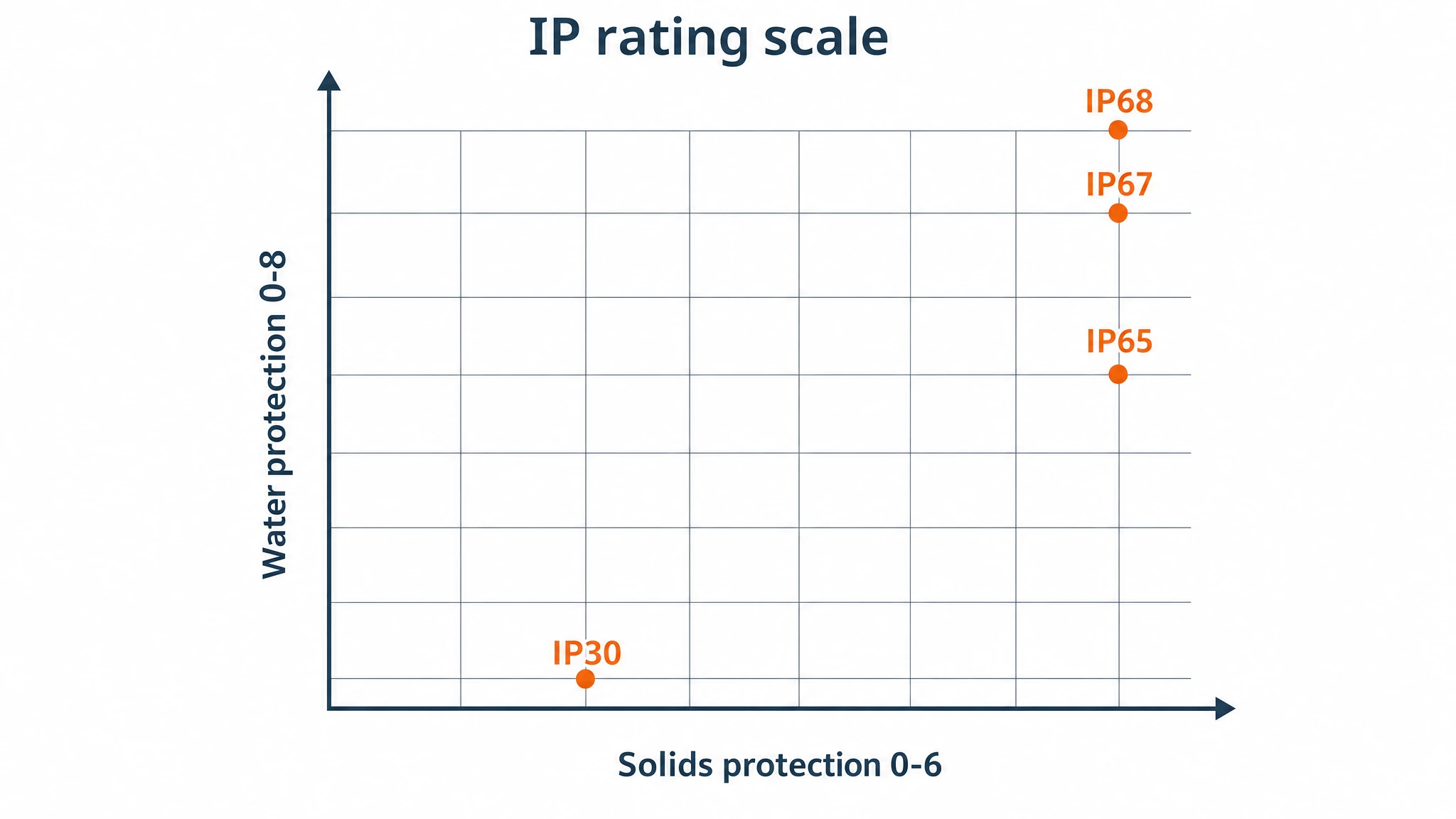
The IP code is two independent scales; every outdoor grade sits at 6 on the solids axis, so the choice is always a water choice.
How one strip becomes four grades: the construction
This is the part most IP explainers skip, and it is the reason one strip design can ship in four grades. Every LED strip starts as the same bare PCB: copper traces, SMD LEDs, and driver ICs. The grade is an added protection layer, applied at the end of the line:
- IP30 — the PCB ships as-is. Nothing is added.
- IP65 — a silicone or conformal coating is brushed or sprayed over the components. It shields the top of the strip from rain and splash, but the back of the PCB and the cut ends are still exposed, and water can wick in through a damaged coating.
- IP67 — the strip is slipped into a silicone tube. Both faces are now covered, which is why IP67 beats IP65 in practice even though the digits differ by only one water level. The tube ends, however, are open.
- IP68 — the tube is sealed at both ends with glue or potting compound, or the strip is fully potted. Water can no longer get in through the ends, which is where IP65 and IP67 strips actually die.
That answers the confusion you will find in every DIY forum — "why is a fully silicone-encased strip rated lower than a tube?" Because encasing in coating (IP65) is not the same as a sealed enclosure (IP68). The coating protects the top; the sealed tube protects everything. When a spec sheet says "IP20–68", it means the same LED strip is available with any of these protection layers — same brightness, same driver IC, different water behavior.
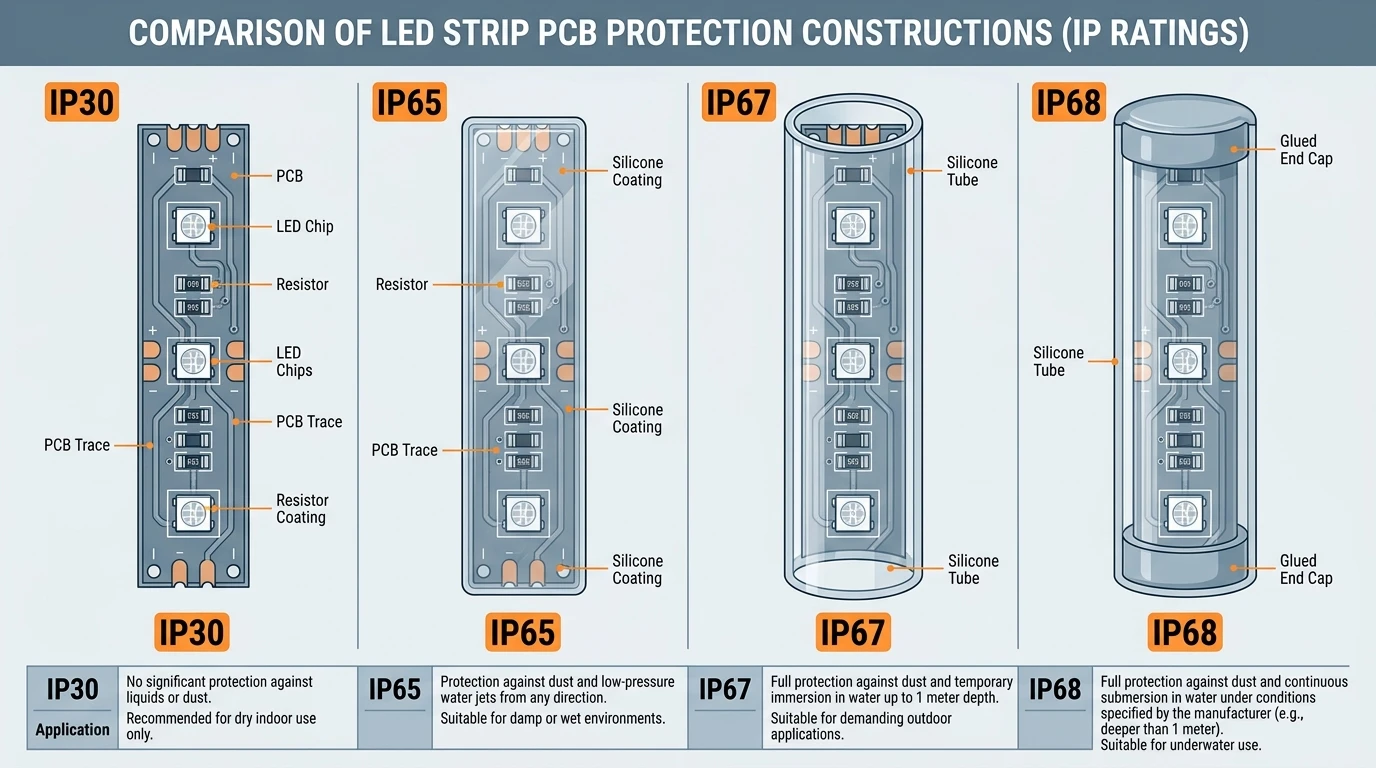
One PCB, four grades: coating, tube, and sealed ends are the three layers that turn a dry-only strip into a submersion-rated one.
IP30: for dry, protected interiors
IP30 (and its close cousin IP20) is the honest label for bare strip. The second digit is zero: there is no water protection at all, not even condensation. An IP30 strip belongs indoors — cove lighting, display cases, office ceiling channels, indoor signage, stage rigs that never see weather — and it does that job perfectly. Inside an aluminum profile with a diffuser, a bare strip is also easier to service: no coating to peel, no tube to fight when you replace a segment.
Where IP30 fails is the moment someone decides to run it outdoors "temporarily." A bare strip under an eave will survive a few dry weeks and die in the first storm — moisture wicks into the cut ends and migrates along the copper traces, and an addressable strip with a damaged IC behaves unpredictably, not just dimly. If the job might ever see water, spec the grade for that outcome, not for the weather on install day.
The IP30 vs IP65 decision is therefore rarely technical: it is a dry-versus-wet question with a clear line. Dry, protected, serviceable → IP30. Any chance of rain, splash, or condensation → step up. If you want the indoor flexibility but the environment is only mildly damp, an IP65 strip in a profile costs little more and removes the argument entirely.
IP65: the outdoor default that isn't waterproof
IP65 is dust-tight (6) and tested against low-pressure water jets from any direction (5) — in practice, rain, splash, and hose-down from a distance. For most outdoor pixel LED work — facade accents, eaves, signage, holiday displays that get rained on but never sit in water — IP65 is the default grade, and it is the one most manufacturers build in volume.
The boundary matters more than the rating:
IP65 handles rain, not submersion, and not standing water.
A puddle, a blocked gutter, or a sprinkler running at the base of the strip for an afternoon is enough to kill it, because the water finds the weak points the coating never covered: the cut ends, the connector, the back of the PCB. On pixel strips there is an extra wrinkle — the coating has to leave the solder pads and data lines reachable, and every joint in an addressable run is a potential leak. If your project sits in a flood zone or a floor that gets washed down, IP65 is the wrong ceiling; see the next section.
For the detailed head-to-head on the middle of the ladder, our IP65 and IP67 comparison walks through where each one earns its extra digit.
IP67 and IP68: when water stops being optional
IP67 adds temporary submersion — per IEC 60529, one meter for thirty minutes — which covers flash floods, snowmelt puddles, and seasonal displays stored in the open. IP68 goes further: continuous submersion beyond one meter, at a depth and duration the manufacturer must declare. That declared figure is the part to read carefully — an IP68 strip rated for 1.5 m and one rated for 5 m are not the same product, even though the label is identical.
IP68 is the grade for environments where water is a feature, not an accident: fountains and water features, tunnel and mine washdown zones, stadium concourses that get hosed down, trenches, and sections of a run that must cross a wet floor. It is also the grade that makes industrial pixel lighting practical in the harshest spots — the AC36V IP68 mine strips used in tunnels and underground galleries are a different product class from a coated indoor strip, and they run on mains AC rather than a low-voltage supply for a reason. The tunnel strip article explains that design split.
For addressable outdoor work, the practical choice between IP67 and IP68 comes down to one question: will any part of the run sit in water for longer than half an hour, ever? If yes, IP68. If the water is always rain and runoff, IP65 does the job and costs less per meter. And when you do spec IP68 pixels, prefer factory-sealed strips with pre-wired pigtails over field-sealed ends — an IP68 addressable RGBW strip ships IP20–68 so the control protocol and the waterproofing are decided separately.
Choosing the right grade for an outdoor pixel LED project
Working through the decision for a real project is simpler than the spec sheets make it look. Three questions, in order:
- Will any part of the run be submerged or sit in standing water? If yes — fountains, washdown floors, trenches, flood zones — choose IP68 (or IP67 if the water is temporary).
- Is the run exposed to direct rain, snow, or hose spray? If yes and question 1 is no, IP65 is the right grade: dust-tight, jet-proof, and considerably cheaper than the submersion grades.
- Is the location dry and sheltered? Coves, channels, indoor signage, stage interiors — IP30 (or IP20) is honest, serviceable, and cheapest.
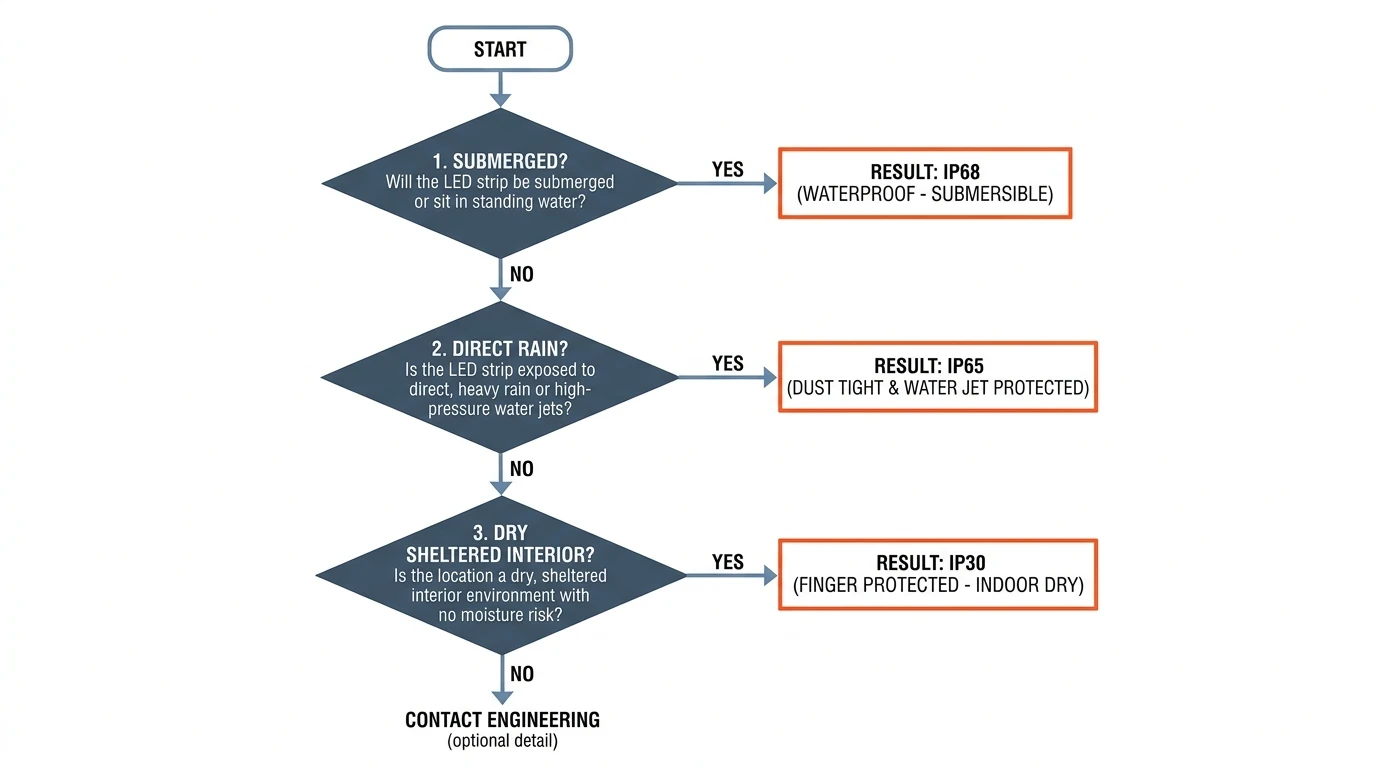
Three questions decide the grade; the construction layer that delivers it is the manufacturer's job to match, not yours to improvise.
Two things outdoor pixel projects get wrong more often than the grade itself. First, the seal is a chain: strip, cut ends, connectors, and data feed all have to match the grade you chose. Sealing an IP68 strip and then joining segments with bare solder and heat-shrink creates a leak at every joint; factory-sealed pigtails or sealed connectors are not optional on wet installs. Second, power injection breaks the seal — every injection point on an addressable run is another hole in the waterproofing, so plan junctions in dry boxes or use sealed feed-throughs before the first meter is mounted. For a sense of scale, one seasonal install we delivered ran 3,600 m of pixel string across a holiday plaza display — the project case study shows how an outdoor pixel layout comes together.
For the full ladder from IP20 to IP68, including how each grade interacts with voltage, IC choice, and mounting, the IP rating guide for outdoor pixel LEDs is the starting point for this whole cluster.
How to verify the rating you're paying for
An IP grade is a laboratory test result, not an adjective — and the skepticism you see in installers' forums about overseas strip ratings is largely a documentation problem. A genuine rating is traceable: the manufacturer should name the standard (IEC 60529, ideally with the edition), produce a test report, and state exactly what was tested — the strip alone, or the strip with its connectors. For IP68 they must also declare the depth and duration. A spec sheet that prints "IP68" with no standard reference and no declared depth is a marketing number, and it is worth asking about before it becomes your warranty claim.
There is a second honesty gap that affects every grade: the test is done on a new, clean sample. Real seals age — UV degrades silicone, thermal cycling opens seams, and a coating that survives the lab can fail in year three on a sun-facing facade. Budget for periodic inspection of end seals on any permanent outdoor run, whatever the rating.
To be transparent about our own position: IP rating is one of the six checkpoints in our production QC, with a dedicated IP/waterproof test, and our outdoor production line carries an IP66 certification tested to EN 60529:2013. That cert covers the strip itself — your joints, injection points, and terminations are your side of the seal, and we say so in the datasheet rather than letting the rating speak for them.
FAQ: the questions that come up on every quote
What is IP30 in LED lights? An IP30 rating means no water protection at all (second digit 0) with basic protection against tools and wires over 2.5 mm (first digit 3). On LED strips, IP30 describes bare, uncoated PCB — fine for dry interiors, never for outdoor or damp locations.
Is IP65 OK for heavy rain? Yes — IP65 is dust-tight and tested against low-pressure water jets, which covers rain and splash from any direction. It is not OK for standing water, flooding, or submersion; those need IP67 or IP68.
Which is better, IP65 or IP68? Neither is better in absolute terms — they are answers to different questions. IP65 is the right call for rain-exposed mounting; IP68 is required only when the strip will be submerged or sit in water. IP68 costs more per meter, so choosing it without a submersion scenario is paying for a test you do not need.
Can I make an IP30 strip weatherproof by putting it in a profile? A sealed aluminum profile with a gasket can protect the strip from splash, but the profile itself becomes the enclosure — and the IP rating then belongs to the profile, not the strip. For a rated solution, buy the rated strip; for sheltered spots, an IP30 strip in a profile is a legitimate indoor solution, not an outdoor one.
Does the IP grade affect brightness or color? No — the protection layer sits between the LEDs and the environment, not in the optical path. The same PCB in IP30 and IP68 form delivers the same brightness and color; what changes is where it can live. (The one caveat: thick coatings and tubes can scatter light slightly on tightly lensed strips, so check the datasheet's lumens per meter for the grade you actually buy.)
Sourcing the grade your project needs
The grade is one line on the spec sheet, but it decides the whole installation story — mounting, joints, injection, and maintenance. Work it out with the three questions above, then check that the strip family you want exists in the grade you need: Pileds builds the same addressable strip designs across IP20–IP68 with cut-to-length, and can pair the strip with sealed connectors and controllers on one order. Send the environment and mounting details — not just the length — to our team, or start from the project RFQ/BOM template and get a grade-matched quote the first time.
Specifying pixel LED for a real project?
Send the spec — pitch, IC, IP class, run length, voltage — and you get an engineer's answer, not a catalogue. Samples and OEM/ODM quotes from the Shenzhen factory floor.