
IP65 vs IP67 vs IP68: What Each Survives
IP65 resists low-pressure jets; IP67 survives 1 m immersion for 30 minutes; IP68 handles continuous submersion. What each rating means for outdoor LED strips.
IP65 vs IP67 vs IP68: The 30-Second Answer
IP65, IP67, and IP68 are all dust-tight ratings that differ only in water resistance: IP65 survives low-pressure water jets from any direction, IP67 survives temporary immersion in 1 m of water for 30 minutes, and IP68 survives continuous immersion at a depth and duration the manufacturer specifies.
That last part is the one most buyers miss. The second digit of an IP rating is a description of a laboratory test, not a promise about real-world survival. An IP67 strip will pass a 30-minute dunk in a test tank; whether it survives ten years on a facade depends on how it was built and how it was installed.
Rating | Dust | Water test it passes | What it survives in practice |
|---|---|---|---|
IP65 | Dust-tight (6) | Low-pressure water jets from any direction | Rain, spray, hosed splash from a distance |
IP67 | Dust-tight (6) | Temporary immersion, 1 m for 30 min | Heavy rain, puddles, accidental submersion |
IP68 | Dust-tight (6) | Continuous immersion, depth set by manufacturer | Fountains, pools, underwater and buried runs |
The comparison people actually search for — ip65 vs ip67 — comes down to one question: can water ever sit on or cover the product? If yes, you are looking at IP67 or higher. If the strip will only ever be rained on, IP65 does the job for a lower cost. For the full IP20 to IP68 landscape, our LED strip IP rating guide walks through every class and where it belongs.
What the IP Code Actually Tests (and What It Misses)
The IP code is defined by the international standard IEC 60529. The first digit covers solids and contact: 6 means dust-tight, the highest class. The second digit covers water, and each level is a specific, repeatable test:
- IPX5 (the "5" in IP65) — water projected by a 6.3 mm nozzle at 12.5 litres per minute, from 3 metres away, for at least 3 minutes. That is a jet, not a soak. "Waterproof" at IP65 means splash- and spray-resistant.
- IPX6 — more powerful jets (100 L/min). This is hose-down territory, which is why IP65 vs IP66 matters for washdown and exposed rooftop gear.
- IPX7 (the "7" in IP67) — immersion in 1 m of water for 30 minutes. The water is still, the depth is shallow, and the test is short. IP67 is "survives an accident", not "lives underwater".
- IPX8 — continuous immersion at a depth and duration the manufacturer declares (for example, 3 m for 72 hours). The digit 8 alone tells you nothing; the manufacturer's spec is the real contract.
- IPX9K / IP69K — high-pressure, high-temperature jets, used for washdown cleaning in food and industrial settings.
The IEC's official IP ratings page states the same hierarchy in plainer language: each class builds on the one before it.
Here is what the test protocol deliberately ignores: UV radiation, salt and corrosion, thermal cycling, mechanical flexing, and — most importantly for LED strips — the sealing of the installation itself. A rating is measured on a sealed sample in a lab. On site, water enters through cut ends, solder joints, connectors, and junction boxes. That is where IP-rated lighting actually fails.
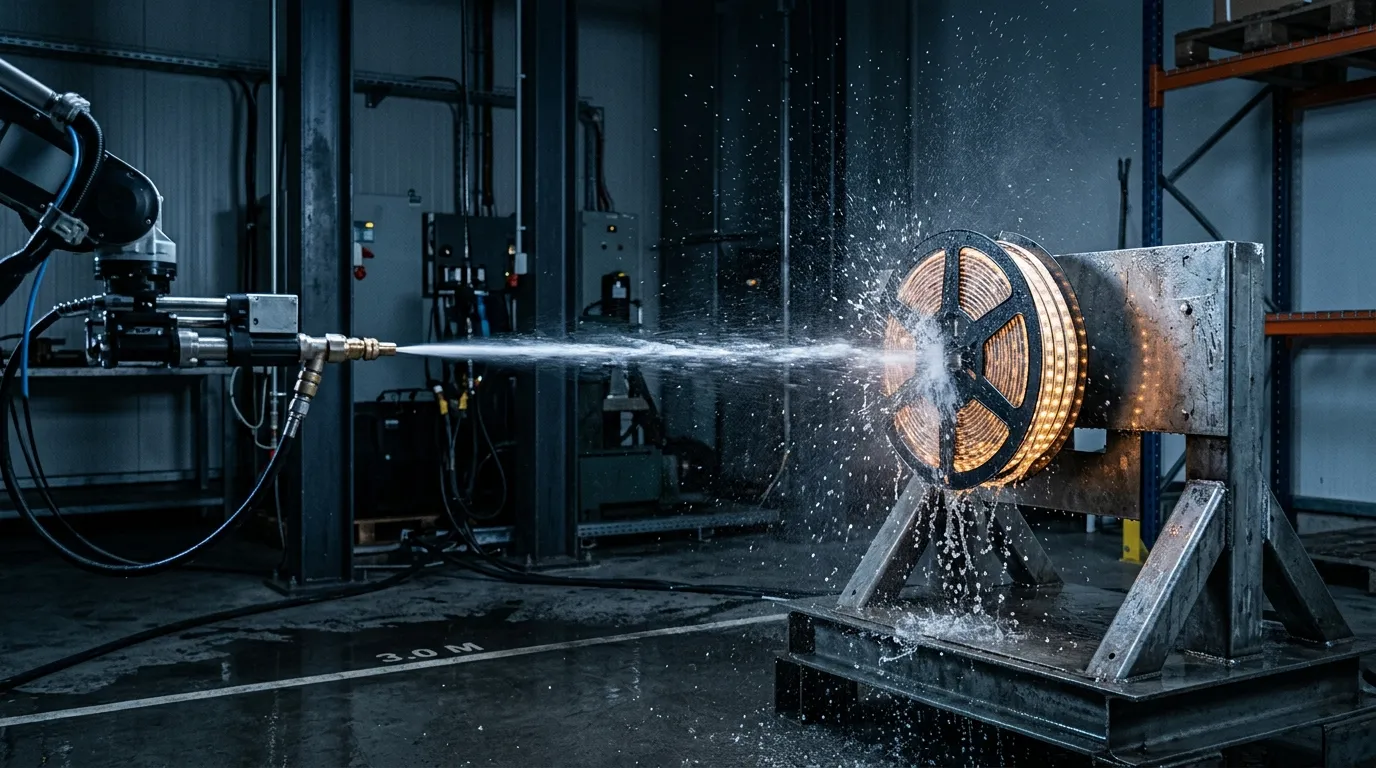
IPX5 test setup: a 6.3 mm nozzle at 12.5 L/min from 3 m. The strip is being sprayed, not soaked.
IP65 vs IP66 vs IP67 vs IP68: What Each Survives
The full boundary table, including the ratings people confuse most often:
Rating | Test it passes | Survives | Does not survive | Typical strip use |
|---|---|---|---|---|
IP65 | Low-pressure jets (6.3 mm, 12.5 L/min, 3 m) | Rain, spray, splash, humidity | Immersion, standing water, powerful jets | Facades, eaves, sign channels, sheltered outdoor runs |
IP66 | Powerful jets (100 L/min) | Hose-down, heavy rain, washdown | Immersion | Exposed facades, rooftops, industrial washdown areas |
IP67 | Immersion, 1 m / 30 min | Heavy rain, puddles, floods, accidental submersion | Continuous submersion | Ground-level signage, holiday displays, event staging |
IP68 | Continuous immersion, depth per manufacturer | Fountains, pools, underwater signage, buried runs | Only what the manufacturer's depth/time spec allows | Fountain and pool lighting, underwater pixel effects |
IP69K | High-pressure, high-temperature jets | Aggressive washdown cleaning | Immersion (usually) | Food plants, tunnels, heavy washdown environments |
All five share the same dust-tight first digit: 6. The trade-off runs mostly down the water column, and each step up costs more in materials, potting, and assembly labour — which is why specifying the correct minimum rating matters. Over-specifying IP68 where IP65 suffices adds real cost per metre on a large facade project; under-specifying IP65 where water pools means a warranty call in month three. If you are planning wall-mounted pixel lighting, our facade and curtain wall lighting guide covers how IP class interacts with mounting, drainage, and maintenance access.
How Waterproof LED Strips Are Actually Built
The rating on a datasheet is only as real as the construction behind it. Three build methods dominate the market:
- Silicone sleeve or partial coating (typical for IP65) — the PCB and LEDs sit inside an extruded or glued silicone profile. It deflects jets and rain well, but cut ends and solder joints stay exposed unless sealed on site. This is why a cheap "IP65 strip" fails at its first cut.
- Full silicone extrusion or full potting (typical for IP67) — the PCB is completely encapsulated, either by extrusion over the board or by filling the channel with potting compound. The strip itself is now genuinely sealed; the remaining weak points are the ends and the connectors.
- Full encapsulation plus sealed connectors (typical for IP68) — everything is potted or double-extruded, and factory connectors are over-moulded or resin-filled. The strip can sit in water because there is no path for water to travel.
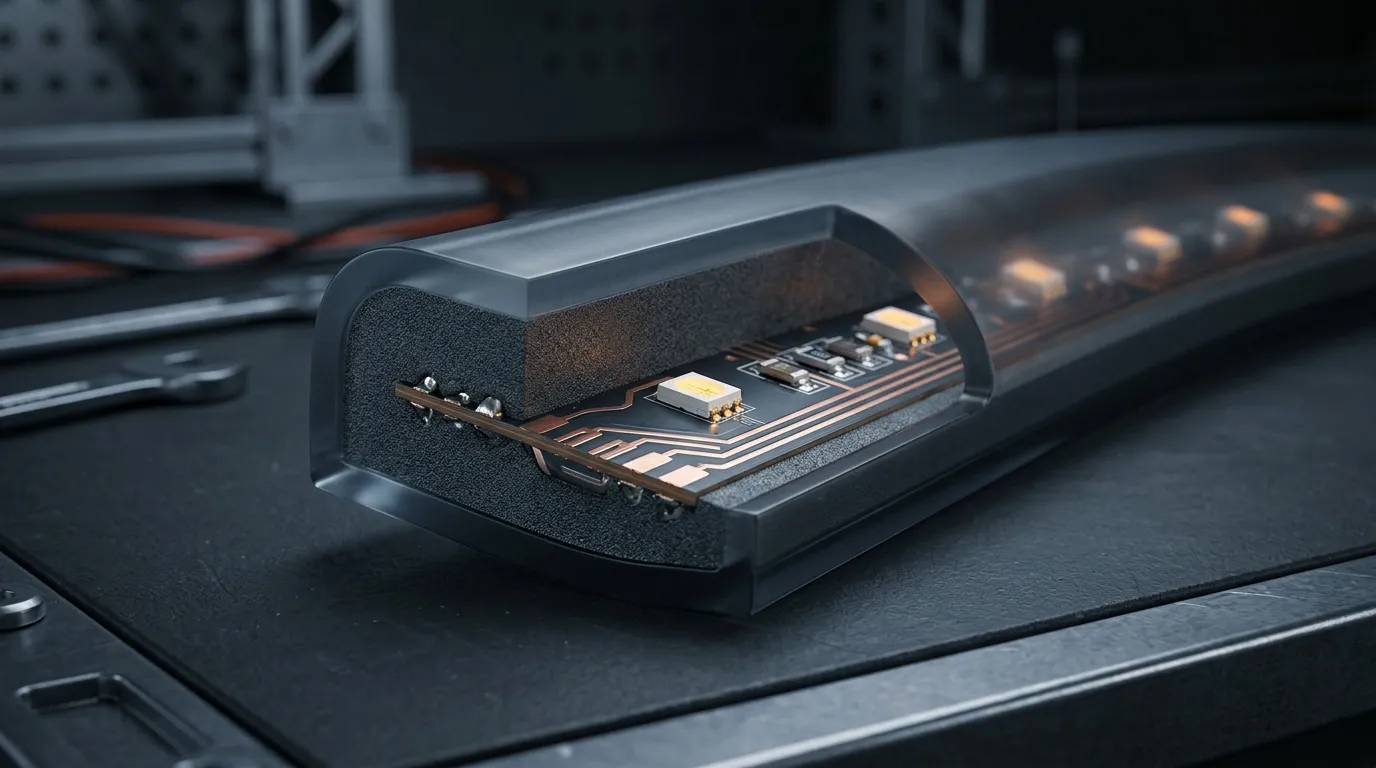
Cross-section of an IP68-rated strip: silicone encapsulation over a potted PCB. No exposed copper, no path for water.
Water does not enter a strip through the silicone — it enters at every place the silicone stops: cut ends, soldered joints, and connectors. A strip rated IP67 on the reel becomes IP20 the moment you cut it and splice it with bare wire. Re-sealing cut ends (heat-shrink with adhesive, resin caps, or factory-terminated lengths) is the difference between a rating that is real and one that is decorative. The driver IC and voltage also shape what you can run outdoors — see how WS2811 vs WS2812B changes voltage drop and wiring on long outdoor runs.
Which Rating Should You Specify Outdoors?
Match the rating to the worst thing that can happen to the strip, not the weather forecast:
- Vertical, drained installations — facades, wall-washing, channel letters. Water hits and runs off. IP65 is usually enough; IP66 buys margin where hose cleaning or strong wind-driven rain is routine. Our waterproof DMX pixel strip covers this class for sign and facade work.
- Ground level or flat surfaces — holiday displays, ground signage, event staging. Puddles happen. Water can sit on the strip for hours. Go IP67 as a minimum.
- Fountains, pools, underwater features — or any run that gets buried. Continuous submersion means IP68, with the depth rating matched to the actual water column. The IP68 addressable RGBW strip is built for this class, with fully potted ends.
Three installation rules apply at every rating:
- Seal the connections, not just the strip. Waterproof connectors, resin-filled splices, and a cable gland where the feed enters any enclosure. A junction box left open kills an IP68 run faster than any strip defect.
- Give water a way out. Drip loops at entry points and drainage holes at the bottom of profiles and boxes. IP ratings protect against ingress, not against being kept permanently wet.
- Remember what IP does not cover. UV breaks down cheap jackets in a few seasons, and salt air corrodes uncoated connectors. For coastal or high-UV sites, ask for UV-stabilized silicone and corrosion-resistant fittings even at IP65.
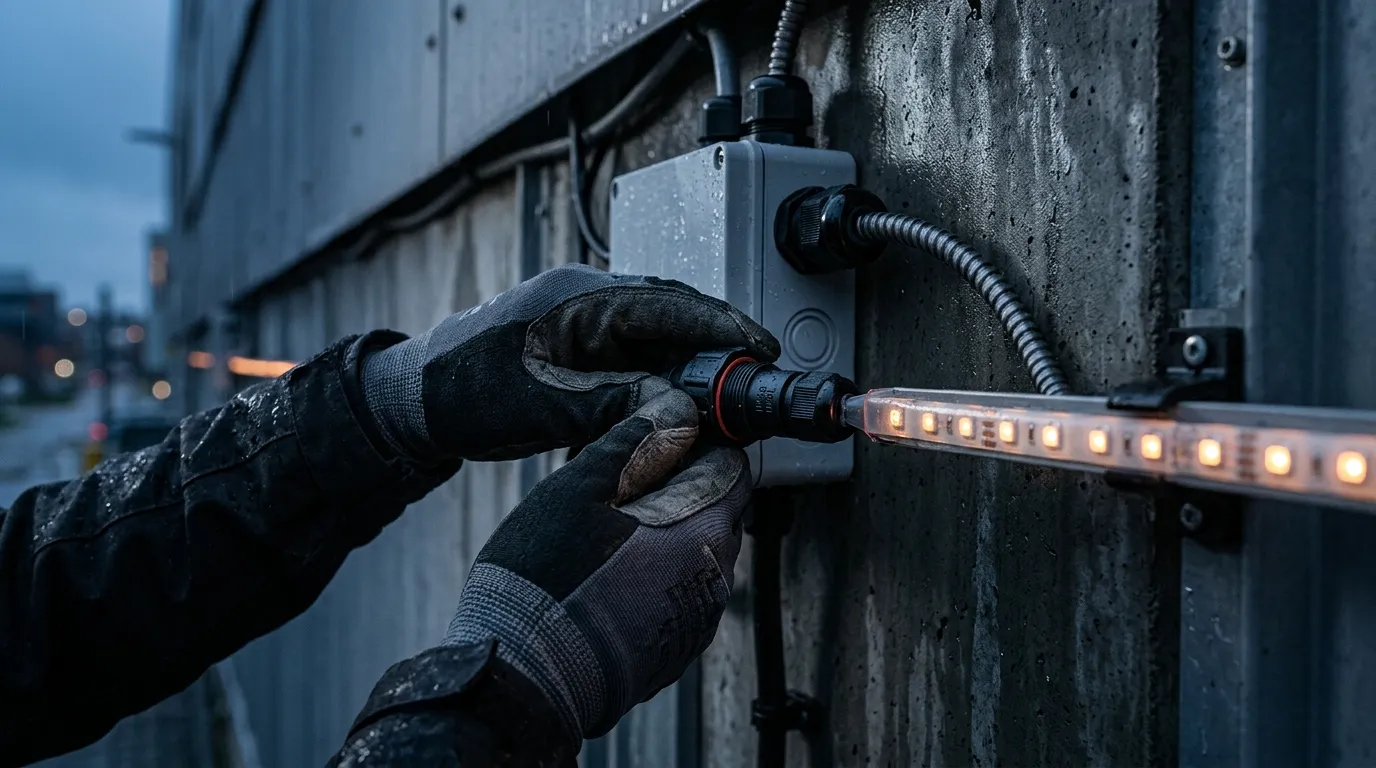
The connection point, not the strip, decides whether an outdoor IP rating holds up.
To the three questions buyers actually ask: Is IP65 enough for rain? Yes, for vertical, drained installations. Is IP65 ok for outside? Yes, with sealed connections and UV-stabilized materials. Is IP67 completely waterproof? No — it survives temporary immersion; only IP68 (at the manufacturer's declared depth) is rated for continuous water contact.
IP65 vs IP67 vs IP68: FAQ
Which IP rating is better, IP65 or IP67? Neither is universally better — IP67 adds temporary immersion protection over IP65's jet resistance. Choose IP65 for rained-on, drained locations; IP67 or IP68 wherever water can pool or cover the product.
Is IP67 completely waterproof? No. IP67 means it survived 1 m of immersion for 30 minutes in a lab test. It is accident-proof, not underwater-rated. For continuous submersion you need IP68 with a stated depth.
Is IP65 enough for rain? Yes, for most outdoor lighting. IP65 resists low-pressure jets from any direction, which comfortably covers wind-driven rain — provided connections are sealed and water can drain away.
How deep is IP68 waterproof? Whatever depth the manufacturer declares — the standard does not fix a number. Read the datasheet: "IP68 (3 m / 72 h)" is a real spec; bare "IP68" is a partial claim.
IP65 vs IP67 vs IP68 for LED strips — which do I need? Rain only, vertically mounted: IP65. Ground level, pools of water, or accidental submersion: IP67. Fountains, pools, underwater, or buried: IP68, depth-matched. On any of them, budget for sealed connectors and properly terminated ends — that is where outdoor LED strips actually die.
Spec the Right Outdoor Pixel LED
The rating is one line of the spec sheet; voltage, driver IC, colour type, and controller protocol matter just as much outdoors. Start from the full IP rating guide for the landscape beyond this comparison, then bring your project parameters — environment, mounting, run length, and control requirements — to our team. PILEDS configures pixel LED strip to IP20 through IP68 with the potting, connectors, and termination your installation needs, and will tell you honestly when a lower rating does the job.
Specifying pixel LED for a real project?
Send the spec — pitch, IC, IP class, run length, voltage — and you get an engineer's answer, not a catalogue. Samples and OEM/ODM quotes from the Shenzhen factory floor.