
10,000 m AC36V Strip in a South African Mine
A South African mine lit by 10,000 m of AC36V IP68 strip — sealed and high-tensile — and why buyers vet a mining lighting supplier on delivery, not datasheets.
A Mine That Eats Ordinary Lights
A South African mining company needed to light its underground workings — the kind of place where water, dust, rock falls, and constant abrasion kill ordinary lighting, and where mine-safety rules decide how much voltage may enter the workings at all. The brief that reached us at Pileds, a Shenzhen manufacturer of mine and tunnel strip, did not start with a lumens figure. It started with a question every serious buyer eventually asks a mining lighting supplier: has this actually survived a working mine, or is it just a datasheet?
Our answer is a delivery record. We supplied 10,000 m of AC36V LED strip for the workings — extra-low-voltage AC36V operation for safety, a sealed waterproof body, and a high-tensile construction engineered to resist pulling, crushing, and impact. Ten thousand meters — two hundred 50 m swimming pools laid end to end — is not a showroom number: in a mine it is a continuous lighting line that has to be installed along a timbered shaft, under support netting, and left to run.
This article walks through what a job of that size actually demands — the voltage decision, the power layout, the sealing and tensile requirements — and why, when you are sourcing for an underground site, the only evidence that counts is the same word on your purchase order: delivered. For the wider set of real projects behind that word, see our collected project case studies.
What a Mining Lighting Supplier Has to Prove Underground
Underground lighting is not exterior lighting with a bigger housing. The environment attacks in four ways at once, and each one rules out a whole class of fixtures.
- Water. Working faces are wet. Water arrives as seepage from the back, as drip from the roof, and as standing pools underfoot, and it finds every unsealed joint. A fixture that is merely "splash-resistant" is a maintenance schedule, not a lighting system.
- Dust. Fine rock dust settles on every surface and works into anything that is not sealed. It also cuts light output — a layer of dust on a lens quietly steals the lumens you paid for.
- Rock falls and abrasion. A working drift is an active excavation. The roof spalls, machinery brushes past, and rock drags along anything mounted low. Fixtures get crushed, nicked, and pulled.
- A punishing electrical environment. Long cable runs, heavy loads, and the constant demand for a safe touch voltage shape the supply architecture before a single fixture is chosen.
One comparison is worth clearing up early, because it trips up buyers arriving from other lighting work: a floodlight, a high bay, and a work light solve a different problem. They throw a bright pool of light onto a fixed point or an open face from one position. A working tunnel needs a continuous line of light down its whole length, which is why the right fixture underground is strip, not a luminaire — and why "how many lumens" is the wrong first question.
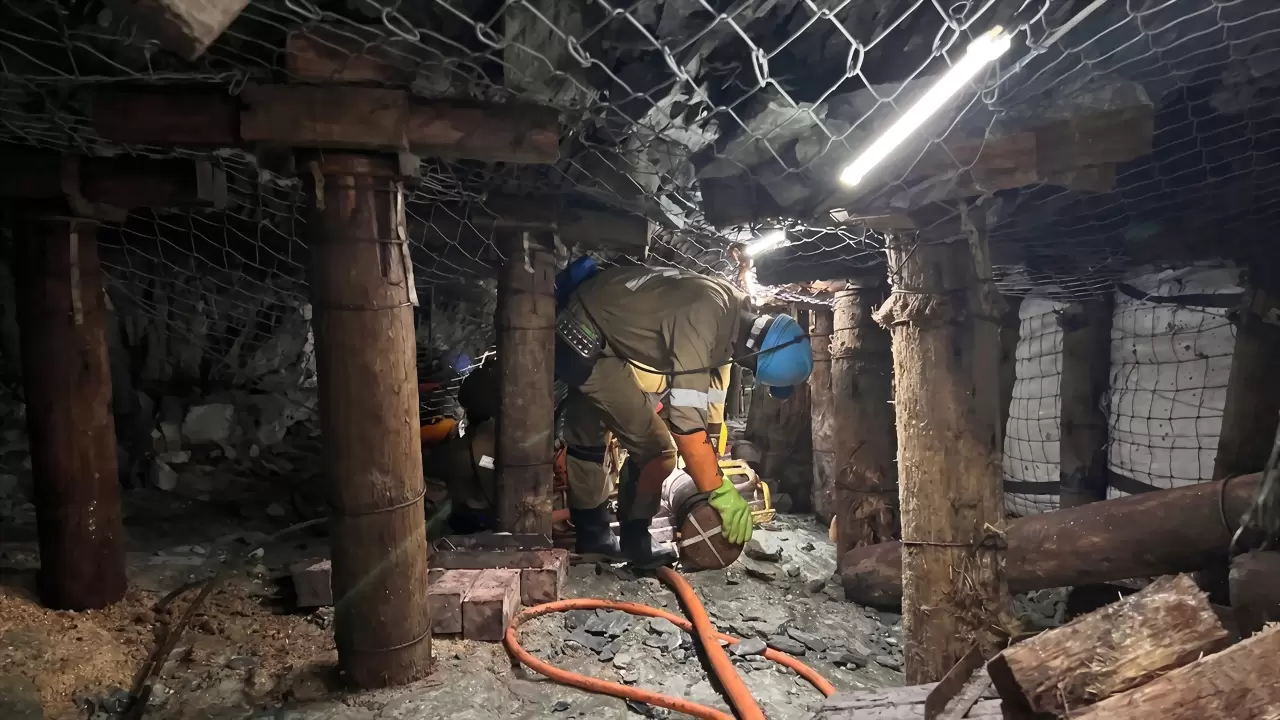
The working environment the delivery had to survive: a lit drift under timber supports and wire mesh. Photo from the project record.
Add the safety dimension and the sourcing brief changes shape. In a mine, voltage is not a preference; it is a regulated boundary, because miners work in wet, confined spaces where contact is possible. That is why the industry so often lands on an extra-low-voltage supply — including the AC36V class this project used — rather than pushing mains potential into the workings. We return to the regulatory side below.
A supplier who has not stood in this environment tends to answer the brief with a catalogue page. A supplier who has done it answers with four things: a voltage system that is defensible, a power layout that holds up over hundreds of meters, a sealing and tensile spec that survives installation and use, and a delivery record. Those are the four sections that follow.
Why the Run Is AC36V, Not 12 V or 24 V DC
The instinct for most buyers, coming from stage or facade work, is to reach for the same 24 V DC strip they already know. On a run measured in hundreds of meters, that instinct is exactly wrong, and the reason is physics you cannot negotiate with.
Every LED strip is a resistor in series with itself. Feed power at one end and current travels the whole length through copper, so the voltage at the far end is lower than at the near end — the simple relationship described as voltage drop, where V = I × R. Two things then compound brutally with distance. First, resistance grows with length, so a longer run sags more by definition. Second, current grows as voltage falls for the same wattage, and higher current means a bigger drop through the same conductor — a feedback loop that punishes low-voltage DC designs over distance. A 24 V strip that looks even on a 5 m sample produces visibly dimmer, off-color light at the far end of a 200 m drift.
There are only two honest fixes. You can raise the supply voltage, which shrinks the current for the same power and cuts the relative drop; or you can inject power at many points along the run, which is expensive in a mine where every junction is a sealed, inspected, failure-prone item. AC36V strip takes the first route.
Why AC rather than a 36 V DC system? A mains-driven AC36V strip carries its own rectification and constant-current regulation in the strip itself, so the run is fed at mains-derived extra-low voltage rather than through one large central DC supply sized for the entire current. Each cut length behaves as its own regulated segment, which is what lets 10,000 m run as long, sparse-fed lines instead of a star of heavy DC feeders. It also lands in the extra-low-voltage band defined by the IEC extra-low-voltage conventions — a deliberate safety choice in wet, confined workings, not an accident of the design. The trade-offs between mains-driven AC strip and low-voltage DC strip are worked through in our guide to why tunnel LED strip runs on AC, not low-voltage DC.
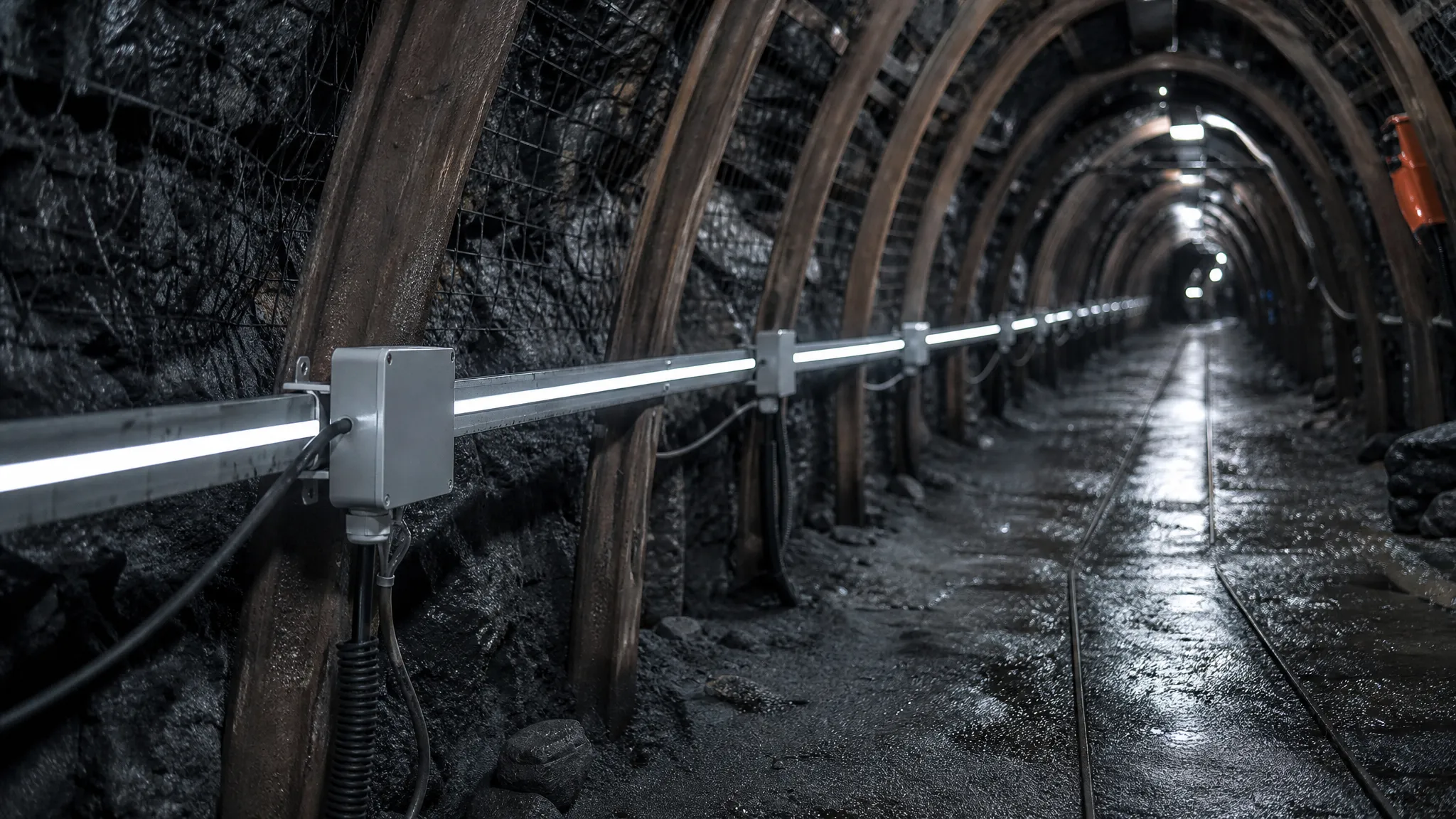
Rendered illustration (not project photography) of the power discipline: on a run measured in kilometers, power comes in at spaced points and each cut length regulates its own current, rather than one supply pushing current down the whole line.
What 10,000 m Actually Means in a Working Shaft
Delivery records compress into one number, so it is worth unpacking what 10,000 m meant on this South African job — and being honest about the line between what the record shows and what we cannot say.
What was delivered is documented: 10,000 m of AC36V strip, in a sealed waterproof build, with high-tensile construction, for the underground workings of a South African mine. Long continuous runs were the point of the design — fewer feed points means less sealed hardware to install, inspect, and fail. The strip threads along the timbered shaft and back under the support netting, held by the mine's own support system rather than a separate cable tray that would have to be fabricated and hung in the dark.
Here is the honest part. The published case record for this project carries four fields and no more: country (South Africa), venue type (underground mine), scale (10,000 m), and product line. Everything beyond those four fields — the exact voltage schedule, the feed-point count, the running lumens, the number of production batches — belongs to the mine and its operating records. We will not invent it to make the story tidier. You can read the field-level record yourself on the South African mine AC36V case page.
Case-record field | Value |
|---|---|
Country | South Africa |
Venue type | Underground mine |
Scale delivered | 10,000 m of AC36V LED strip |
Product line | Mine LED light strip (AC36V, IP68) |
What that table deliberately omits is the point. No client name, no timeline, no bill of materials, no sign-off figures — because none of those belong to us to publish. What remains is the part a buyer can actually use: a scale, an environment, and a delivered product line.
What a buyer should take from that is not a spec sheet but a standard. If a supplier cannot show you a comparable installation — your scale, your environment — then nothing else they show you has been tested under the conditions that matter.
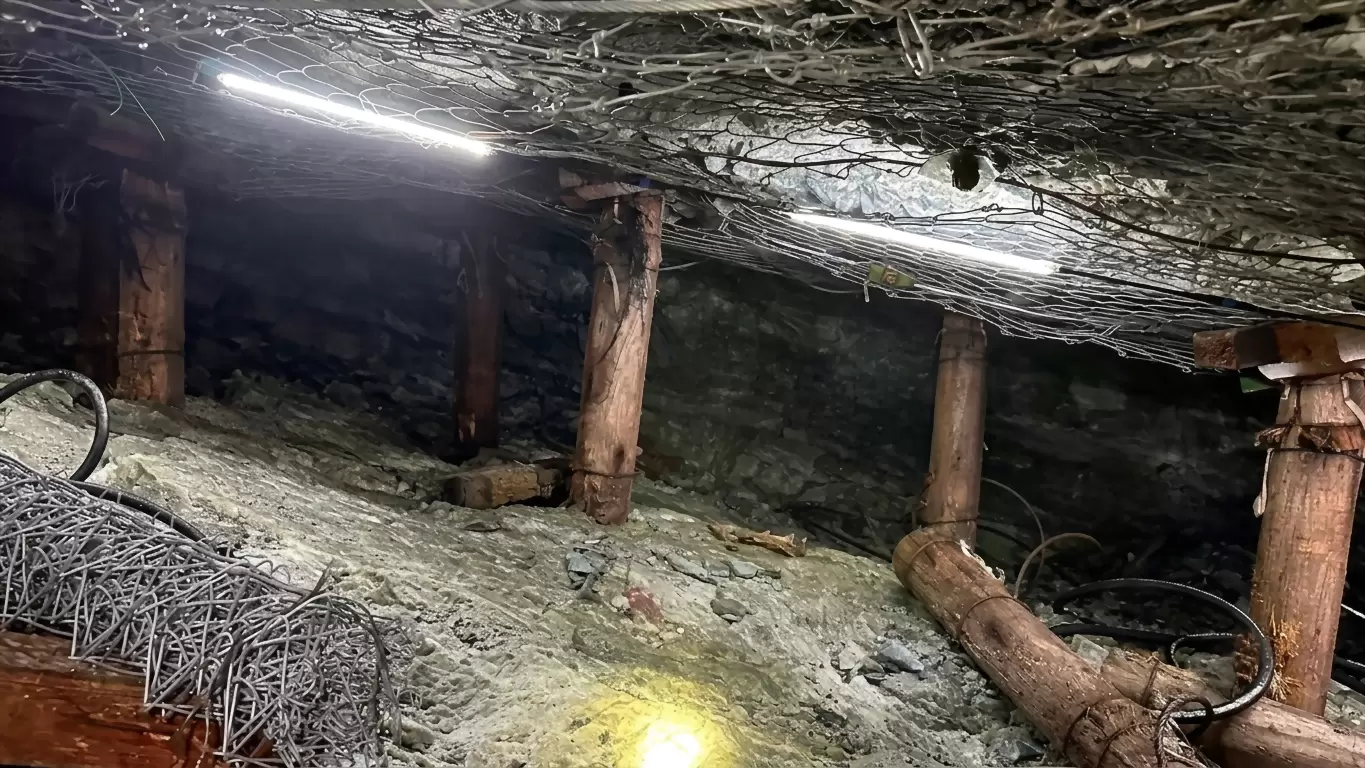
The delivered project: the AC36V strip line threaded along a timbered mine shaft under the roof support netting. Photo from the project record.
Sealing, Tension, Impact: The Three Specs That Decide Survival
The environment section above names four threats, but three of them collapse into a single engineering problem on the strip itself: can the fixture survive water, tension, and impact at the same time, across a run that is kilometers long?
Sealing is the first line, and it is an enclosure decision, not an LED decision. Ingress protection is a two-digit code — the first digit for solids, the second for liquids — formalized in IEC 60529, the IP code. For wet workings the second digit is the one that matters, because water is the failure mode that arrives first and causes the most damage. The practical trap is that a sealed fixture is only as sealed as its worst joint: the ends of a run, the cut points, and the connectors between segments are where water gets in, so the IP rating has to hold across the whole assembled line, not just the extrusion.
Mine strip of this class is built to IP68 — the submersible rating — precisely because "protected against jets" does not survive a shaft that drips from every support. Turning those requirements into something a supplier and an installer can each check without calling anyone is the job of a proper mine strip specification; our guide to specifying an AC36V mining strip lays out the four decisions that go vague most often.
Tension is what installation actually demands. Long runs are pulled through the workings and hung under support. A strip that cannot take that tension is a strip that tears its own conductors on install day, long before the environment gets a chance to fail it. High-tensile construction — reinforcement that resists pulling without stretching the copper trace — is what lets a single run cover a long stretch between feed points.
Impact is the third axis, and it is the one most often skipped in a spec. Rock falls and machinery contact crush and nick whatever is mounted low. An impact-rated, abrasion-resistant build is not a premium option in a mine; it is the difference between a lighting line that lasts and one that is patched every month. These three requirements — sealing, tensile strength, and impact resistance — are the same ones that decide survival in any underground installation, which is why we wrote them up separately in the guide to three things underground lighting must survive.
Behind all three sits manufacturing discipline, not marketing. A build aimed at this environment has to be tested before it ships: at our Shenzhen facility every batch passes six checkpoints — incoming inspection of every LED, IC, and PCB; automated optical inspection during SMT and reflow; integral-sphere testing of color and lumen output; temperature-and-humidity aging; IP and waterproof testing to the rated grade; and a full function and control test before packing. On a sealed run that will sit under a mine roof, a unit that fails its pre-ship test is far cheaper to catch in the factory than to replace on a working shaft.
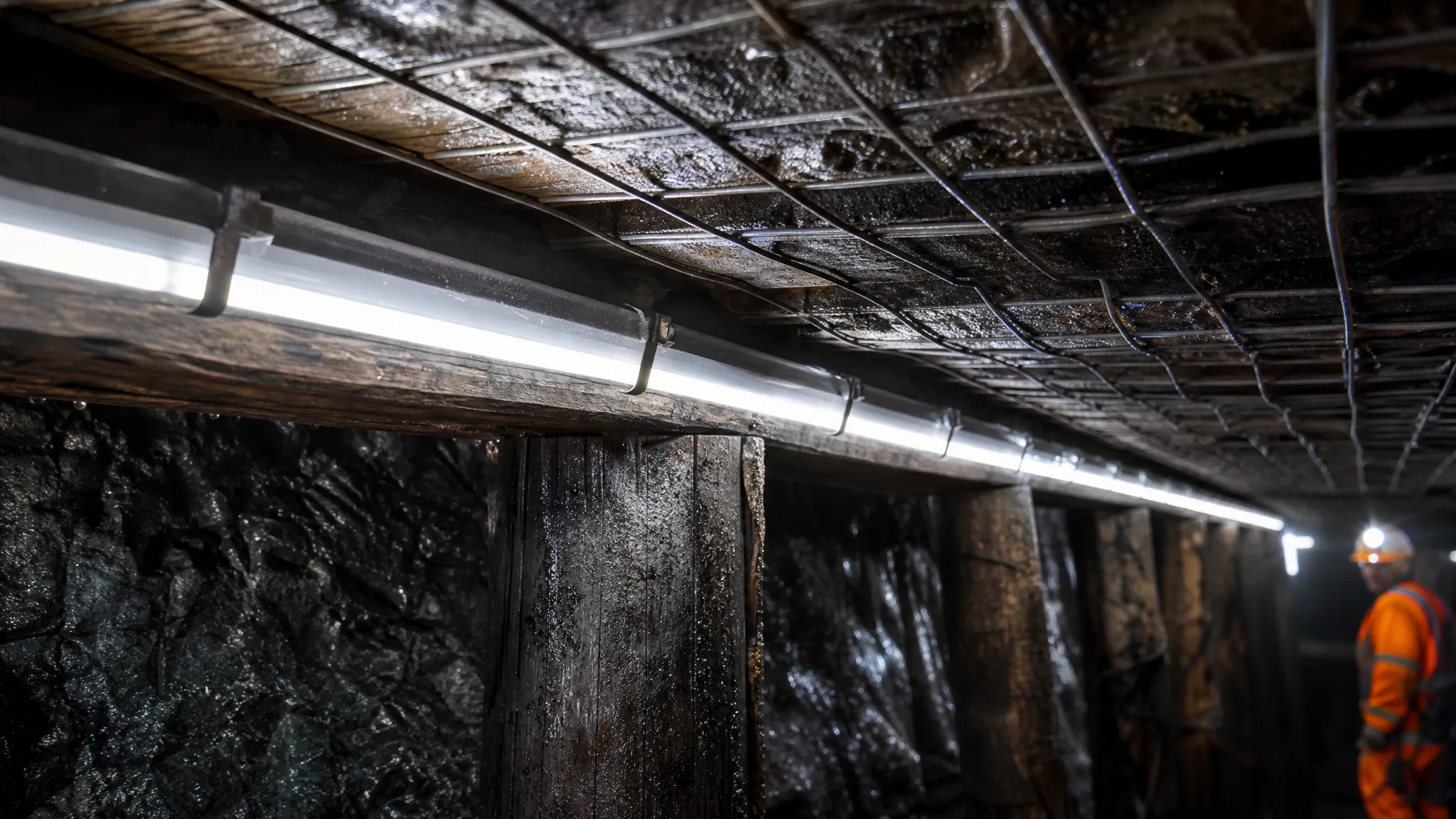
Rendered illustration (not project photography) of the mounting discipline: a sealed, high-tensile run fixed along the support line, its tensile reinforcement carrying the span between feed points.
When a Mine Spec Is a Safety Rule, Not a Preference
It is worth separating two kinds of requirement, because buyers who conflate them either overpay or under-specify.
Some requirements are preferences: color temperature, beam angle, the exact aesthetic of the light. These you can trade.
Others are rules. In mining, the use of extra-low voltage, and the requirement that electrical equipment be safe in a wet, confined space, are set by statute and by the mine's own health-and-safety regime — in South Africa, by instruments such as the Mine Health and Safety Act. A lighting supplier cannot negotiate those numbers downward, and a buyer should treat any supplier who waves them away as a supplier who has not worked in the sector.
One boundary is worth stating plainly, because mine engineers check for it first: hazardous-area classification decides the fixture you may install. Where a working's atmosphere is classified — a gassy coal section, for instance — the lighting has to be built to an explosion-proof standard, and an ordinary sealed strip is not the right product for that zone no matter how good its IP rating is. A manufacturer with a full mine line carries a dedicated explosion-proof strip for exactly those zones; in this product family that is the AC36V explosion-proof mine strip. We describe the product line here rather than restate certifications we do not hold on paper — and we will tell you up front which parts of your mine each product belongs in. A supplier who offers one sealed strip for every zone has not read your ventilation plan.
That changes what you ask for. On a mine job you are not only buying fixtures; you are buying the documentation that lets the mine's engineer sign the installation off. Ask for it explicitly: the voltage system in writing, the sealed build's IP certificate with its number, the color and lumen test method, and the factory test record. This is also where a manufacturer's credentials stop being decoration. Pileds holds CE, RoHS, EMC, IP66, and BIS certifications with certificate numbers on file — the IP66 enclosure certificate, for instance, is issued as JAT24101202622IC-1 — along with 26 granted patents. Note the layering, because engineers check it: the company's on-file enclosure certificate is IP66, while this case's strip line is built and tested to IP68, so ask which grade applies to the exact product you are buying rather than assuming one covers the other. That kind of paperwork is what a mine's acceptance process actually reads. If a supplier cannot produce numbered certificates, the conversation is over before it starts.
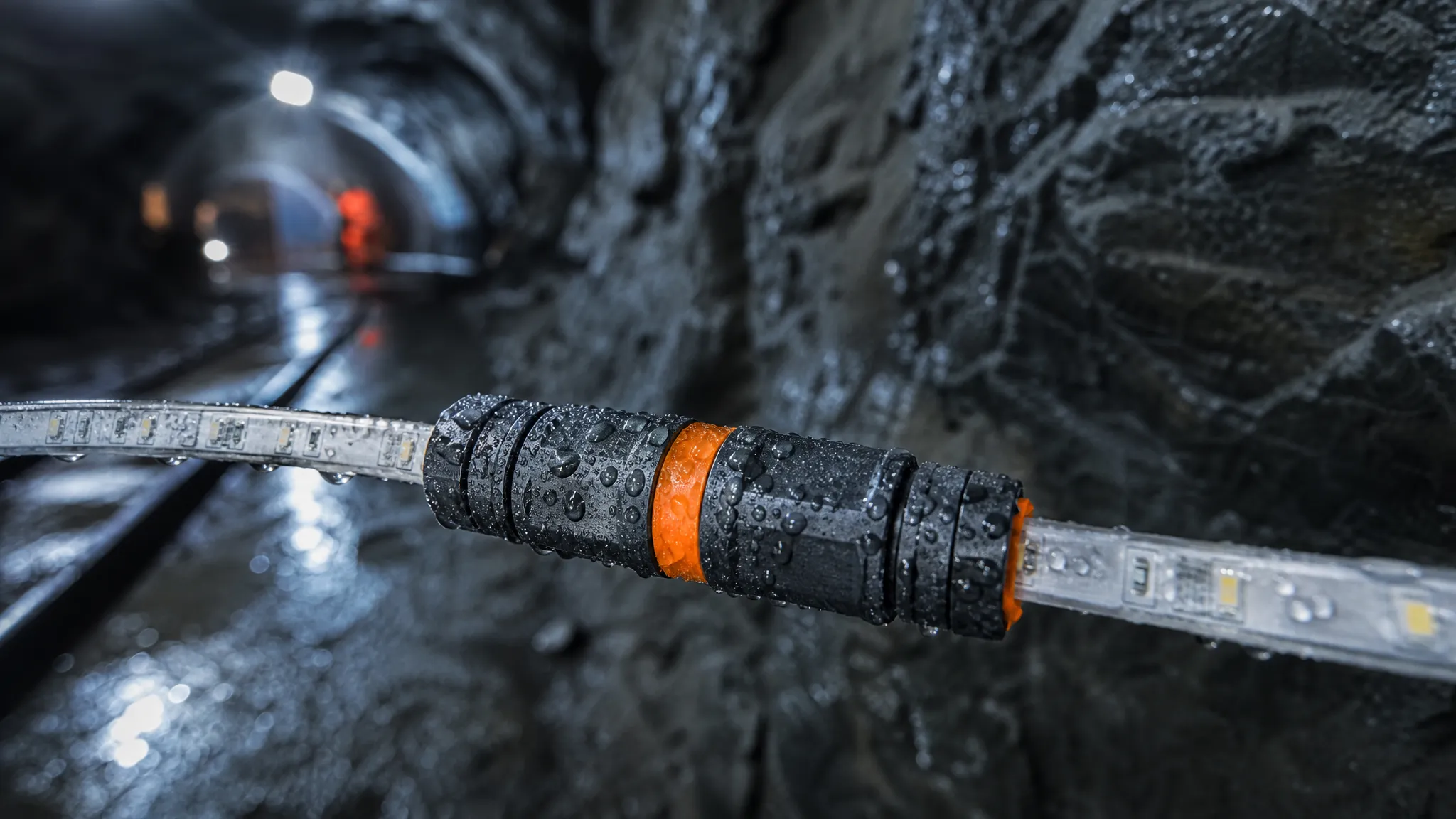
Rendered illustration (not project photography) of the joint that decides outdoor and underground longevity: a sealed IP68 connector, because a run is only as waterproof as its weakest link.
Sourcing Mine Strip: What to Ask a Mining Lighting Supplier
If you are specifying strip for a tunnel, shaft, or working mine, the questions that separate a real supplier from a reseller are the same ones this project answered. Put them in writing.
- Show me a comparable delivery. Not a product photo — a project at your scale, in an underground environment. The AC36V mine LED strip is a product page; a delivered 10,000 m installation is proof, and the two are not interchangeable.
- Why is the supply AC36V and not low-voltage DC at my run length? A supplier who cannot explain voltage drop and injection cadence over hundreds of meters has not engineered your job.
- What is the IP rating, and how are the ends and joints sealed? Demand the certificate number, and demand the sealing method for the run's ends and cut points, not just the body.
- What is the tensile and impact spec? Ask how the strip survives being pulled through the workings on install day and crushed by rock fall afterward.
- Which safety standard governs, and what documentation will I get? On a mine, that answer is regulated; make the supplier name it and commit to the paperwork.
Five questions, and the word delivered running through all of them. It is the difference between buying lighting and buying a lighting system that a mine engineer will accept — and it is the reason a case record matters more than a catalogue. The same standard shows up across our mining and tunnel LED lighting collection and the rest of the delivery record behind it.
If you are specifying mine strip and the questions above are your questions, send a Pileds engineer the outline — the site type, voltage your safety regime allows, run lengths, and how the line will be supported — and you will get an engineer's answer, including what we would need to verify before quoting, rather than a catalogue page. Samples ship for qualified projects, and OEM and custom builds are welcome.
Specifying pixel LED for a real project?
Send the spec — pitch, IC, IP class, run length, voltage — and you get an engineer's answer, not a catalogue. Samples and OEM/ODM quotes from the Shenzhen factory floor.