
Mining LED Strip Specification: AC36V Guide
A mining LED strip specification has to fix four things: the AC36V supply system, where the IP68 seal ends, every cut length, and the compliance boundary.
AC36V IP68 mining strip, supplied cut to length. On more tunnel lighting schedules than anyone admits, that single line is the whole mining LED strip specification — and it has already handed the three decisions that decide whether the run survives its first year to whoever happens to quote the job.
A specification is not a product name. It is a set of statements the supplier, the installer and the accepting authority can each check without calling anyone. Four of them go vague most often, and each one has a known cost: the voltage system, the sealing boundary, the cut lengths, and the compliance boundary.
None of the four needs long prose. Each needs a number and an edge, written so a third person who was not in the meeting can verify it. This article works through the four clauses a mining LED strip specification has to carry, in the order they appear on a schedule, and closes with an inquiry checklist you can paste into the next request for quotation.
Why "AC36V, IP68, cut to length" is not a specification yet
The test is simple: hand the line to someone who was not in the meeting and ask them to verify it.
- Voltage — verified where, and feeding what?
- Sealing — the rating of which assembly, and which joints sit inside the claim?
- Cut length — cut by whom, at which points, and re-sealed how?
- Compliance — which certificate, for which model, approved by whom?
The line survives none of those questions, because each phrase is doing two jobs at once. "Runs on AC36V" names a supply and hides a system. "IP68" is a tested assembly that may not be the assembly you install. "Cut to length" is a supply increment pretending to be an instruction.
What the schedule says | What it leaves open | What the clause must state |
|---|---|---|
Runs on AC36V | Which supply feeds it, who owns the step-down, what voltage reaches the far end under load | Nominal voltage and waveform, voltage at the strip terminals under load, the party responsible for the step-down and its protection |
IP68 | Whether the claim covers the strip as supplied or the finished run with its cuts and cable entry | Rating of the factory length, connector and end-cap class, who makes each field joint and by what method |
Cut to length | Supply increments, the field cut list, and where a cut is electrically legal | Every run length and total metres, the cut interval for the exact model, the sealing method at every cut |
Explosion-proof | Which of several distinct claims is being made, against which standard, for which model | Ingress rating plus hazardous-area certificate number, marking, scope and approving authority |
Every loose phrase in that table hides a decision that belongs on your side of the purchase order. The rest of this article walks the four clauses in order.
Voltage: write the supply system, not a number
"AC36V" describes the supply, not the strip. On long tunnel and shaft runs the voltage is chosen because of how mains distribution scales over distance, not because of anything inside the LED — why tunnel strips run on mains AC rather than low-voltage DC works through that argument in detail. The specification question is narrower and much more practical: what is being fed, from where, and who owns the boundary.
The voltage is not arbitrary. IEC 61140 defines extra-low voltage as a potential that does not exceed 50 V RMS alternating current, or 120 V ripple-free direct current, between conductors or between a conductor and earth — the extra-low voltage band and how the standards define it. That definition is the safety case behind the number. It holds only if the whole circuit stays inside the band under load, at the far end of the run: transformer secondary, feeder, connectors, terminations and strip.
Which is why the voltage clause has to describe a system, not a strip.
Item | What to state | What it costs when it is missing |
|---|---|---|
Nominal voltage and waveform | AC36V, written as AC — never as a bare "36V" | An AC system fitted with a DC-rated connector or feed is an inspection finding, not a rounding error |
Voltage at the strip under load | Measured at the strip terminals with the full run energised | A reading taken at the transformer says nothing about the tail of a 300 m run |
Where the step-down lives | Who supplies and owns the transformer or drive module, its location, and the interval between units | A run designed around step-downs every 20 m and built without them goes dim at the far end, with nobody accountable |
Protection | Device type, rating and who selects it for each feed | Protection follows the supply system, not the strip's wattage alone |
Cable and connector rating | Voltage and current rating of feeder, connectors and terminations | One low-voltage connector inside an otherwise mains-rated system is where the fault will be |
Change control | A plain line stating the voltage is not substituted on site | A field substitution quietly moves the strip outside the system it was approved in |
Ranges are built for more than one supply: the same mine strip family carries AC36V, 48 V, 110 V and 220 V configurations, and wattage changes with the model. None of those options is the right answer in the abstract. The number that belongs in the specification is the one the site's engineered supply already defines, together with the strip, connectors, protection, cable and feed layout specified as a single system. Where that supply does not exist yet, the clause has to say who creates it — and that sentence is frequently the difference between a quotation and an argument.
One line belongs with it: who has done the voltage drop calculation for the feeder. A strip rated for AC36V is still dim at the tail of a long run if the cable was sized on current alone and nobody worked out the drop it produces over the distance, which is exactly the failure mode that makes the far end of a tunnel look like a different product from the near end.
Sealing: write where the IP68 boundary ends
An IP rating is not a property of a material, and it is not a badge. It is the result of a test on one assembled enclosure, defined in IEC 60529 — the IP code classifies protection against intrusion, dust, accidental contact and water. Two details of that standard decide how the clause should read.
The first is that the water digits are not a ladder. Ratings for water ingress are not cumulative above IPX6: an enclosure tested for immersion has not thereby been tested against jets, and one that survives both is written with both, as IPX5/IPX7. The second is that the deepest water test, IPX8, is defined as suitable for continuous immersion under conditions the manufacturer specifies — depth and duration are agreed and recorded in the test, must be more severe than the conditions agreed for IPX7, and are not implied by the two digits. "IP68" without those conditions is a shorter statement than most schedules assume.
Then comes the part that belongs to the installer. What a supplier can rate is the factory-terminated length they built and tested. What gets mounted is that length plus a cut, a connector, a feed cable entry and an end termination. What IP67 and IP68 actually survive covers the ratings themselves; the specification problem is that the tested assembly stops existing at the first joint.
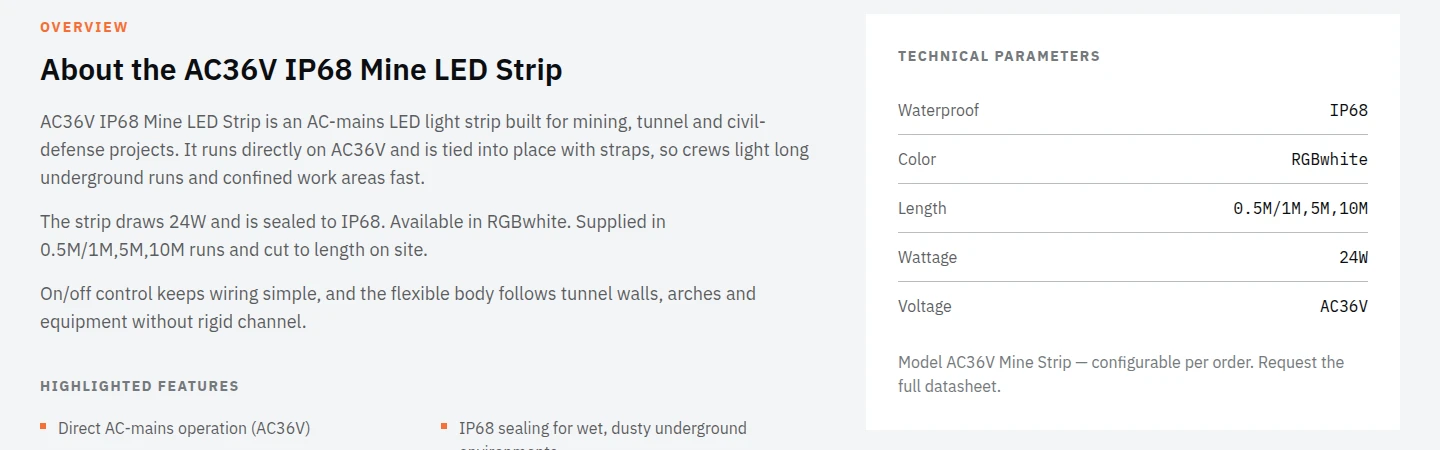
Above: the specification block on the AC36V mine strip product page — the part of the answer a factory can put in writing before an order exists.
A sealing clause that can be checked has six parts:
Item | What to state |
|---|---|
Factory sealing claim | IP68 for the supplied length, plus the manufacturer's stated test conditions when the project needs to verify them |
Connectors | IP68 watertight, screw-locking connectors with end caps — named as a class and a part, not as "suitable connectors" |
Field joints | Who makes each cut, which connector and end cap go on it, and the re-sealing procedure they follow |
Cable entry | The method, the sealing at the gland, and the strain relief, because the entry is a sealing boundary too |
Housing and encapsulation | The profile material — extruded silicone or a polymer — and whether the assembly is fully encapsulated or coated, because the immersion rating sits on the encapsulation |
Verification | What is checked before energising and who signs it off, in a form the accepting authority can read |
Two habits make that clause stick. Prefer factory-terminated lengths wherever the cut list allows, so that the number on the datasheet is the number on the wall. And put the re-sealing method in writing before the first cut is made, not because installers get it wrong but because "we sealed it properly" is not something an inspector can accept. Every field cut moves the sealing boundary, and a boundary nobody wrote down is the one that ends up at the low point of a drainage path.
Cut length: three different lengths wearing one phrase
"Cut to length" is not one number. It is three, and they are not interchangeable.
The length | What it is | Who decides it | What to write |
|---|---|---|---|
Supply increment | The piece lengths the factory builds and ships — on this range 0.5 m, 1 m, 2 m, 3 m, 5 m, 10 m, 30 m and 50 m, varying by model | The supplier's model range | Every run length individually and total metres, per model |
Electrical segment | The repeat interval inside which a cut is legal, set by the strip's internal drive sections | The strip's construction | The cut interval for the exact model, in writing, with the quotation |
Field cut | The cut made on site to make the last metres fit | The installer, working to your cut list | The cut list, the connector and end cap per cut, and the sealing method |
The trap sits between the first two rows. A schedule that lists 0.5 m, 1 m, 5 m and 10 m as order lengths and then adds "cut to length on site" invites the assumption that 50 cm is also the cut pitch. It is not the same number and it is not derived from the supply list. On a mains-driven strip the LED is not the only thing inside the extrusion: the run is built in regulated sections that hold constant current through each section, which is also why brightness holds to the end of a long tunnel run instead of fading along it. A cut is legal where a regulated section ends. Ask the supplier for that interval for the exact model; a supplier who cannot state it has not specified the product for field cutting, and that is a specification answer rather than a customer service failure.
The third row is the one that quietly changes the job. If the tunnel moves between order and install — and it usually does — the sensible split is factory-sealed lengths for everything the drawing fixes, a defined spare allowance for the rest, and a stated field method for the cuts that remain. Field cuts consume connectors and end caps, so the spares line should carry them. Written that way, the phrase stops being an instruction to the installer and becomes a boundary both sides agreed to.
Field rule: if the cut interval for the exact model is not in writing, the product has not been specified for field cutting — order factory-sealed lengths instead, and make the sealing method a contractual line for whatever cuts remain.
The clause most specs forget: the compliance boundary
Ingress protection and explosion protection are separate claims, and no amount of sealing turns one into the other. A hazardous location is a place where a fire or explosion hazard may exist because of gases, vapours, dust or flyings, and electrical equipment installed in one is itself a possible ignition source through arcing or high temperatures — the classification and equipment rules around hazardous areas set out the reasoning. IP68 addresses neither mechanism.
Approval runs through a regulatory route that differs by market: in the United States, electrically operated machines and accessories intended for use in gassy mines or tunnels are approved by the Mine Safety and Health Administration (MSHA), and it is the approval plate carried on the equipment that identifies it as permissible for those locations — 30 CFR Part 18 is the part that governs it — while other markets work through their own schemes.
Write the compliance clause as five named items instead of an adjective:
- The regime that applies to the project and the authority that approves under it.
- The exact model designation, because approvals attach to a model and a construction, not to a product range.
- Certificate number, marking and scope, obtained before the order rather than promised after it.
- Who approves that model against the classification of the area it is going into.
- The country of installation, since certificates are recognised market by market.
If the answer you receive is that the manufacturer holds CE, you have a materials and ingress claim, not a hazardous-area approval. How to verify LED certification documents for a tender covers the paperwork side; the clause above is what makes the paperwork checkable in the first place.
The clauses that are not about the strip: duty, environment and service
Four clauses decide what arrives. The next few decide what happens to it afterwards, and they are the ones that reappear in a dispute. They are short enough to write in one paragraph each.
Item | What to state | Why it has to be a clause |
|---|---|---|
Mechanical duty | What the profile and the fixing must survive — rockfall, machine strike, and the pull on the strap or bracket that holds the run | Impact is rated separately from ingress: an IK rating or an equivalent anti-pull statement belongs here, and the sealing clause will not cover it |
Vibration | Where the run sits relative to drilling, conveyors or vehicles, and the fixing interval chosen for that position | A run that is finger-tight at commissioning loosens its connectors, and a loose connector is a failed seal |
Ambient temperature | The working range of the site, and the range the strip is specified for — the AC mine strip in this range is rated from −30 °C to +55 °C, quoted as a figure rather than as "suitable for underground use" | Heat and cold both move the materials the seal depends on |
Dust and wash-down | Whether the run is washed down, and with what | A wash-down is a jet test, not an immersion test — where both apply, both ratings have to appear |
Light level | The lm/m the specified wattage delivers at the mounting height used, and the target illuminance in lux for the task below it | Wattage alone does not say whether the working face is lit |
Maintenance, access and spares | Where joints may sit, how they are reached without scaffolding, the warranty term, and who holds spare metres, connectors and end caps after handover | A joint nobody can reach is a joint nobody re-seals, and the party holding spares decides how long a dark section stays dark |
What underground lighting has to survive covers the environment itself. The point here is narrower: each of those demands arrives in the specification as a sentence or as an assumption.
A mining LED strip specification you can paste into an inquiry
Everything above collapses into one request. Ask for each answer in writing, and the quotation you get back is a specification rather than a price.
# | Item | What to provide |
|---|---|---|
1 | Site voltage | The engineered supply, and who owns the step-down |
2 | Run lengths | Every run individually, plus total metres |
3 | Task level | Wattage, the lm/m it delivers at the mounting height, or the target illuminance for each area |
4 | Route | Mounting path, bends, fixing interval and access for maintenance |
5 | Environment | Wet, dust, ambient temperature range, vibration from equipment or drilling, and whether anything is washed down |
6 | Joint locations | Where connectors may sit, and how they will be reached later |
7 | Ingress and hazardous-area documents | The rating required, plus the certificate, marking and scope for the exact model |
8 | Cable entry | How the feed enters and how that entry is sealed |
9 | Country of installation | The market where the run will be commissioned |
10 | Spares | Spare metres, connectors and end caps, and who holds them |
Send that as an inquiry and the replies become comparable, because every supplier is answering the same ten questions. It is also the same four decisions a supplier's own selection guide is built on — supply, ingress and termination, run length and mounting, compliance — which is a useful check that nothing in your schedule has been left to a conversation.
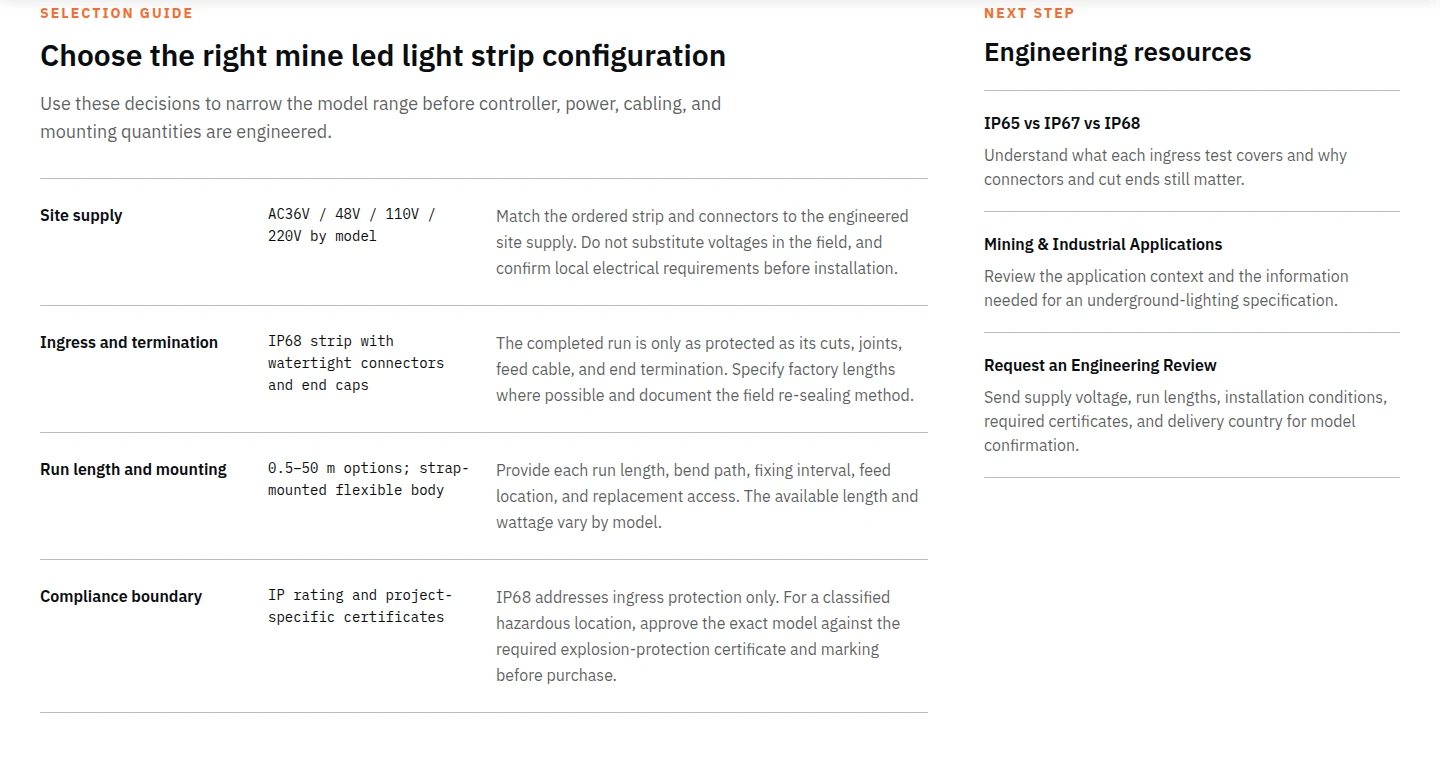
Above: the range selection guide's four criteria — the same four decisions the clauses in this article put in writing.
The fixture-level questions around it — what the range covers and how the models differ before you get to the clauses — are set out in the AC36V mining and tunnel lighting buyer's guide, which is where to look when the supply or the environment has already decided the family and only the detail is left.
What a factory can put in writing before you order
Three of the four clauses can be answered before an order exists, and whether a supplier will do that is a better test than any datasheet. On the AC36V mine strip we build, the figures are on the page: 24 W, IP68, white or RGB, supplied in 0.5 m, 1 m, 5 m and 10 m lengths and cut to length on site, with watertight screw-locking connectors and end caps across the range. The wider mine range adds 13 W/m heavy-duty and impact-resistant tunnel strips across AC36V, 48 V, 110 V and 220 V supplies, plus a flexible model the factory lists as anti-explosion — which still needs the approval named in the clause above — running 100 LEDs per metre at 1,100 lm/m for routes that will not take a rigid profile — the AC36V mine strip and its specifications is the reference configuration for the 36 V case.
The order in which those answers arrive matters more than the product. The cut interval, the connector and end-cap part, and the re-sealing method should come with the quotation, because those three sentences are what the installer will later be held to. A 10,000 m AC36V run in a South African underground mine is what that discipline looks like at scale: the distribution design was the straightforward part, and the joints were not.
If you are writing the schedule now, send the five numbers that decide it — site voltage, run lengths, ambient conditions, the certificates the project requires, and the country of installation. Ask in return for the cut interval on the exact model and the sealing method for each joint. Ask our engineers and the answer comes back in a form you can paste straight into the specification.
Specifying pixel LED for a real project?
Send the spec — pitch, IC, IP class, run length, voltage — and you get an engineer's answer, not a catalogue. Samples and OEM/ODM quotes from the Shenzhen factory floor.