
1,200 m of DMX Wall Washer on a German Plaza
How a German plaza facade was lit by 1,200 m of DMX wall washer: an IP-rated outdoor build of addressable runs mapped into a single full-spectrum wash.
One Plaza, One Kilometer of Facade, One Mapped Wash
A commercial plaza in Germany wanted its building treated as a single canvas. Not a few accent lights on columns, not a logo picked out in white — the whole elevation, washed in color, night after night, through rain and frost. The brief that landed with us at Pileds, a Shenzhen pixel-LED manufacturer, came down to two non-negotiables, the same two that frame every exterior job: weatherproofing that holds up outdoors, and a clean, even light effect across the building.
What we delivered is one of the larger DMX wall washer installations in our delivery record: 1,200 m of DMX-controlled LED wall washer in an IP-rated outdoor build, run along the horizontal facade lines. Every run is individually addressable over DMX512, so the elevation sweeps through the full spectrum as one mapped surface — a rainbow gradient is only one of the states the client can call up from the console.
Put that number in context. Twelve hundred meters is roughly four full laps around a standard athletics track, or the entire glass-and-stone frontage of a city-block-scale plaza building. When that much wash lighting is treated as a single programmable surface, the project stops being a lighting sale and becomes an engineering problem with three hard parts: power, control, and weather. This article walks through each one — what a job of this size demands, and why "delivered" is the only evidence that counts. If you are specifying a facade wash and weighing suppliers, the honest question is not whether a factory can print 1,200 m of LED strip. It is whether anyone has already run that much of it outdoors, and made it look even. For more deliveries with real numbers, see our project case studies.
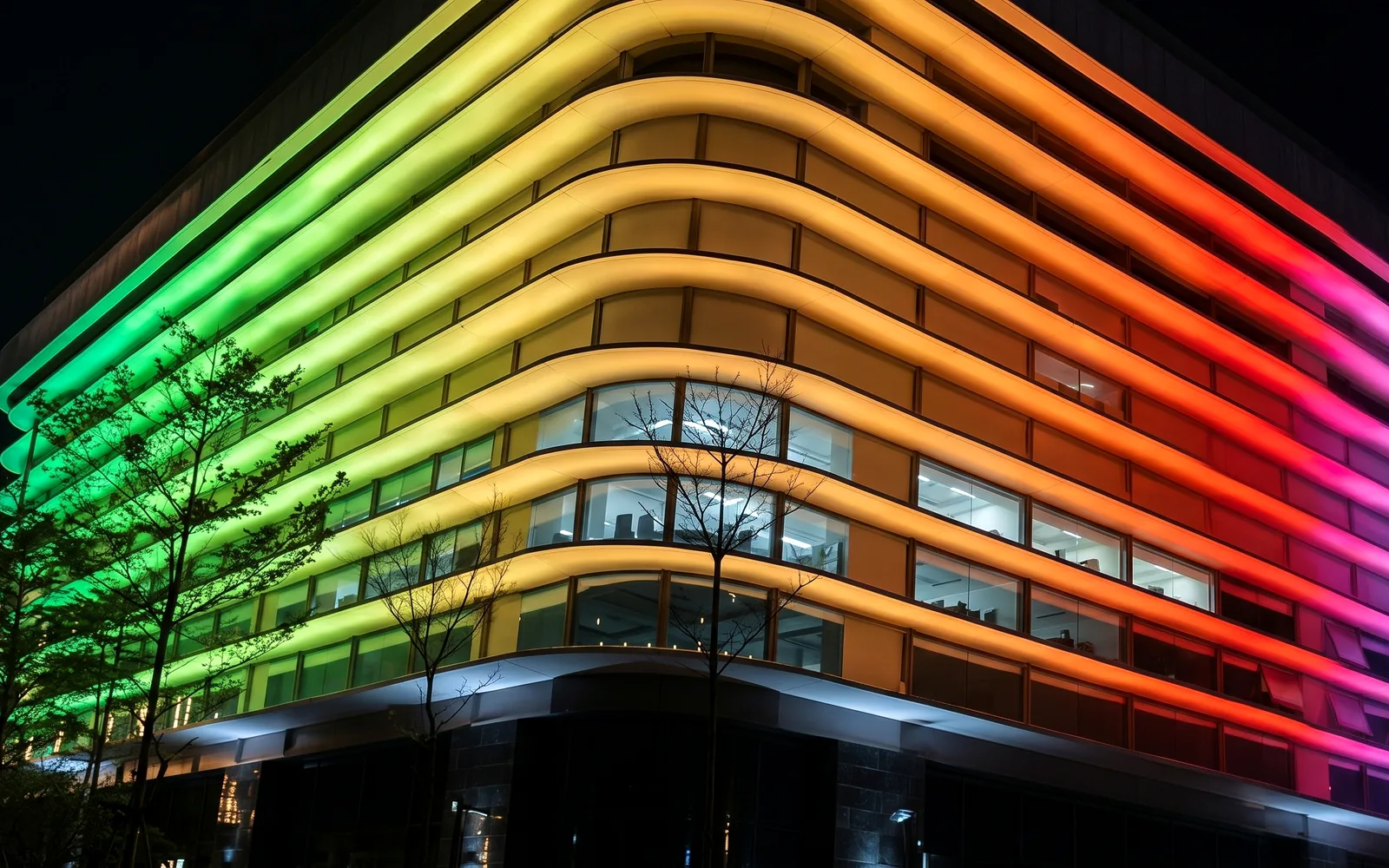
The delivered project: the German plaza facade washed as a single full-color surface. Photo from the project record.
Why a Commercial Plaza Specifies a DMX Wall Washer
A DMX wall washer is a linear LED fixture — or a continuous run of fixtures — aimed to throw an even wash of light up a vertical surface. Add DMX512 control and each fixture or segment becomes addressable: instead of every meter doing the same thing, the whole elevation can be zoned, sequenced, and re-programmed without touching a single cable.
"DMX wall washer" describes the effect and the protocol, not one SKU. Depending on the project, the wash can be built from rigid bars, flexible LED strip behind a lens, or profile-mounted linear modules. What unifies them is DMX512 — the lighting industry's long-standing control standard for theatrical and architectural fixtures — which lets a console or media server treat dozens of separate physical runs as one mapped image.
That is the entire reason a specifier chooses DMX over a standalone controller per zone. Three arguments carry the decision:
- One surface, not many lights. A plaza facade reads as architecture, not as a row of independent fixtures. DMX addressing is what fuses hundreds of physical segments into one visual field.
- Reprogramming without rewiring. Tenants change, seasons change, city events change. With DMX, a new show is a software change, not a site visit.
- A control ecosystem, not a dead end. DMX512 plays well with the wider toolkit — Art-Net and media servers like MADRIX sit upstream of the same DMX line, so a facade planned for simple color washes today can grow into mapped pixel content later without replacing the installed fixtures.
For a buyer coming from the "wall washer light" product pages that dominate search results, the difference is scope. A product page sells you one bar. A project this size sells you a system — and systems are where the engineering decisions live.
What "1,200 m Delivered" Actually Means
Delivery records tend to compress into a single impressive number, so let's unpack what 1,200 m of DMX wall washer meant on this German plaza in practice.
The wash ran along the horizontal facade lines — the architectural bands where floor slabs and cladding meet. Linear fixtures mounted in those lines throw light up the elevation, so a relatively modest number of physical runs produces a wash that covers the whole building height with even distribution. Addressability over DMX meant we did not need one continuous unbroken strip: the system is built from many manageable segments, each one individually addressable, which together behave as a single mapped surface. That is the practical meaning of "full-spectrum building wash" — every segment can hold its own color state while the console drives them as one canvas.
Two honest notes about what this case does and does not tell you. The documented facts are the delivery itself: 1,200 m, DMX-controlled, IP-rated outdoor build, horizontal facade runs, addressable per segment, full-spectrum programming, client satisfied with the whole-building effect. What the record does not break down — and what we will not invent — is the exact universe count, power-supply schedule, or pixel density of this particular job. Those figures belong to the project and its owner. What we can share is the engineering logic that any job at this scale has to follow, which is the rest of this article. The full project page with the delivery record lives at the 1,200 m DMX wall washer on a German facade case study.
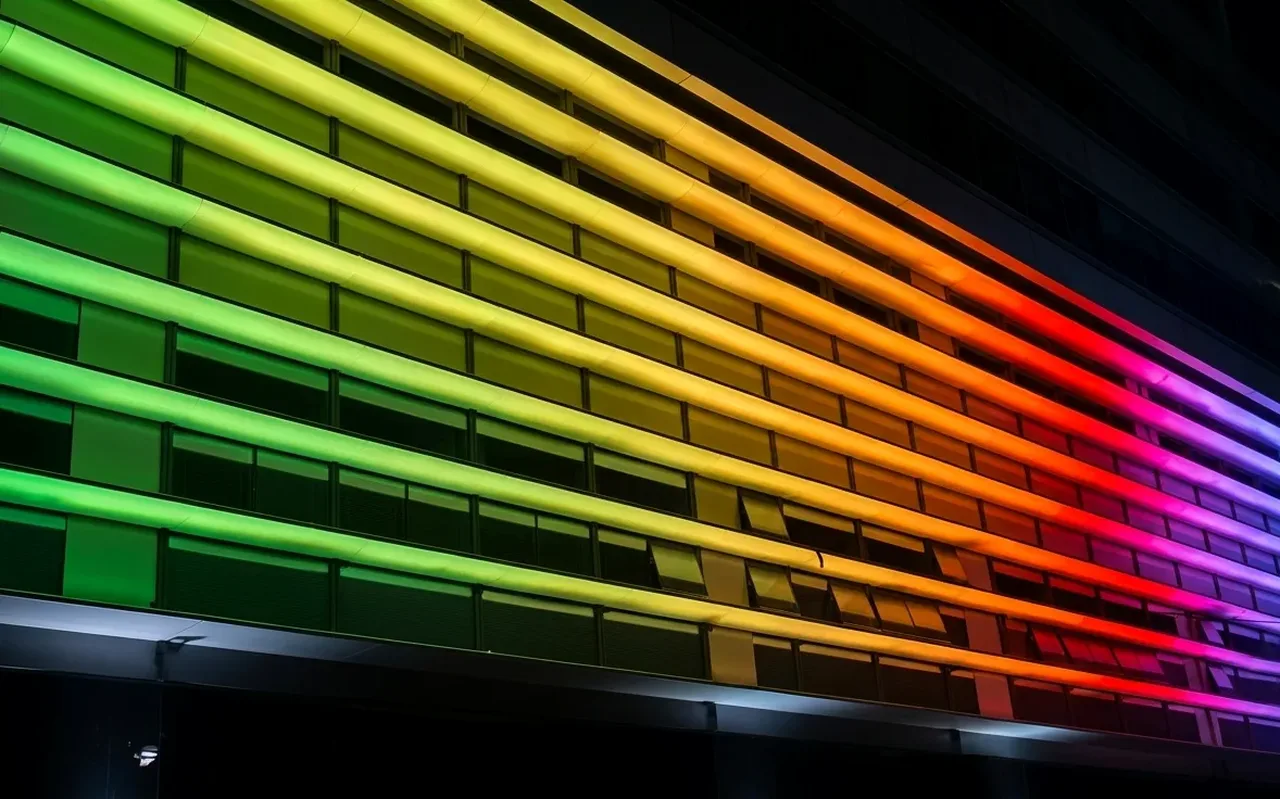
Programmable states: the same 1,200 m of DMX wall washer holding a rainbow gradient. Photo from the project record.
Power Layout Decides Whether a Kilometer-Scale Wash Runs Clean
Strip any outdoor wash project down and the make-or-break discipline is DC power distribution. This is where LED projects of every protocol — DMX, SPI, pixel — quietly fail, and it is the first thing our engineers model when a run length enters the hundreds of meters.
Voltage drop is the physics you cannot argue with. Every meter of cable and every meter of strip has resistance. Push 1,200 m of fixture through one feed point and the far end sees meaningfully less voltage than the near end — which shows up as dimmer light, off-color light, or flicker as the drivers struggle. The fix is not bigger wire alone; it is injection cadence: bringing DC power in at multiple points along the run so no single segment ever draws current through a long stretch of conductor.
Power-supply sizing follows the load, not the meter count. Total wattage is only the starting point. A correct layout adds headroom for voltage sag, for the inrush when large pixel systems boot, and for derating in hot outdoor enclosures. The classic beginner error is buying exactly the theoretical wattage and then wondering why the far end of the run is pink at peak brightness.
Where the boxes go matters as much as what they are. Outdoors, every PSU and junction is an enclosure decision. Power feeds are typically distributed along the facade in weatherproof housings near the injection points, keeping long DC tails short. A layout that minimizes the distance between any PSU and the fixtures it feeds is a layout that survives.
None of this is exotic — it is the same discipline that applies to any large pixel or wash installation, and we walk through the numbers in our guide to sizing a power supply for pixel LED strip. What changes at 1,200 m is the cost of getting it wrong: a voltage-drop mistake at 10 m is a strip you return; at 1,200 m it is a facade that looks wrong from the plaza every single night until someone re-feeds it.
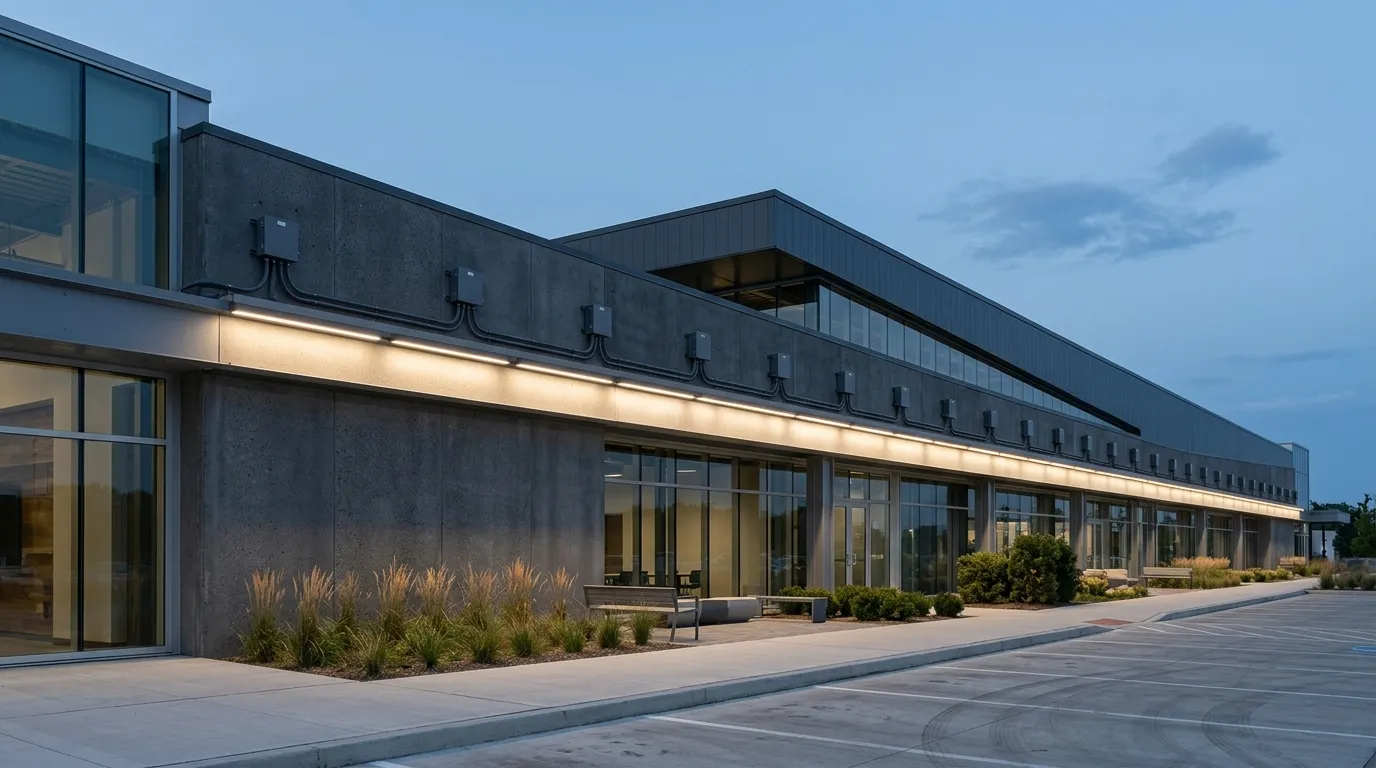
Scale illustration of the discipline described: a kilometer-scale run needs power brought in at regular intervals, not from one end.
DMX Universe Planning: 512 Channels at a Time
Here is the number most specifiers underestimate: a standard DMX512 universe carries 512 channels, and a wall washer that mixes RGBW color uses up to four channels per zone. The arithmetic decides the control architecture long before installation day.
Take 1,200 m of run and run the zoning arithmetic to see how fast it compounds. With RGBW fixtures using four channels per zone, the same facade could sit anywhere from one universe to ten, depending purely on how the design chooses to zone it:
Zoning assumption | Zones | Channels (RGBW) | DMX universes |
|---|---|---|---|
One zone per 10 m | 120 | 480 | 1 |
One zone per 2 m | 600 | 2,400 | ~5 |
One zone per meter | 1,200 | 4,800 | ~10 |
Example zoning math on a 1,200 m facade — illustrative assumptions, not this project's as-built plan.
Real projects make that number sane in three ways:
- Coarser zoning where the design allows. Architectural washes rarely need per-meter pixel resolution; zoning follows the architecture, not the meter rule.
- Rigorous universe budgeting. The console or media server groups fixtures into universes, and the number of universes determines the scale of the distribution hardware — splitters, nodes, and the cabling backbone — that has to be designed, built, and labeled.
- One address plan, documented once. Every segment's universe and start address is fixed at commissioning and recorded. Facades get re-programmed constantly; a clean address map is what keeps a new show from becoming a site-wide debugging session.
Two signal-integrity practices belong in the same conversation. First, proper DMX cabling and termination: daisy-chained fixtures should use cable rated for DMX data, and the end of each chain should be terminated to prevent reflections that corrupt the signal at the far end — the electrical layer the ANSI E1.11 DMX512-A standard defines. Second, separation of data and power: DMX data lines routed beside high-current DC feeders pick up noise; keeping the two paths apart in the trunking is cheap insurance.
When the fixture count is large, most projects route control through a media server or Art-Net node at the head end, with DMX universes fanning out to the runs — the same architecture that lets a holiday display or a stadium scale to thousands of individually addressed points. On a plaza facade, the deliverable is identical in kind: many universes of wash, addressed once, re-programmed forever. The DMX512 protocol overview on Wikipedia is a readable companion on the electrical layer, cabling, and addressing for anyone new to the ecosystem.
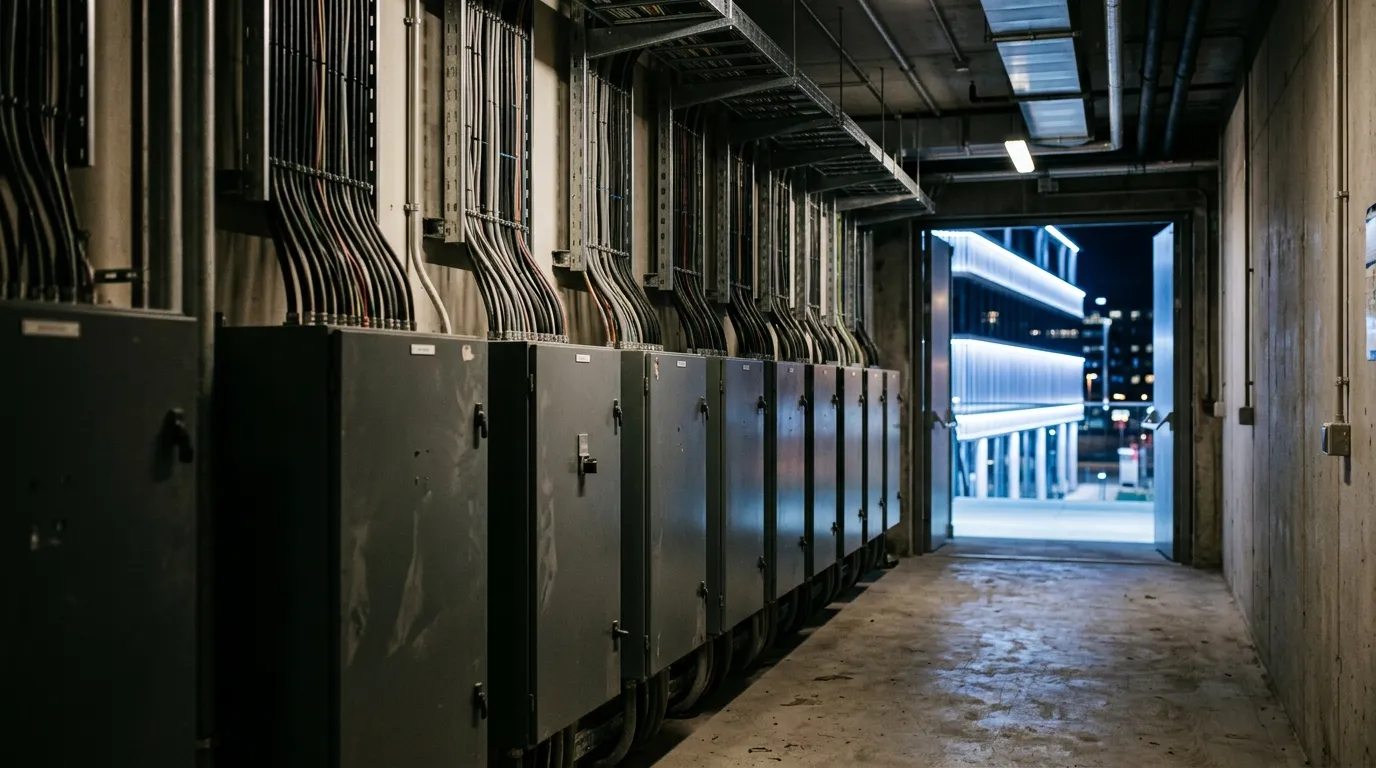
Scale illustration of the control layer: universes are budgeted on paper, then distributed from a clean head-end to the runs.
Weatherproofing a 1,200 m Outdoor Build
An indoor wash bar and an outdoor facade wash share almost nothing except the word "wall." Outdoors, the specification starts with ingress protection, and it ends with how the system is assembled on the building.
The IP code tells you exactly what a rating promises: the first digit is protection against solid objects, the second against water. An IP65 fixture is protected against jets of water; IP66 against powerful jets — and the difference matters on a tall facade exposed to wind-driven rain. The ratings are defined in IEC 60529, and the practical translation for a specifier is: read the rating against your real weather, not against a brochure.
Three things separate an outdoor wash that lasts from one that leaks:
- The fixture's rating is only the start. The weakest points of any outdoor run are the connections between segments and the ends of the runs. Sealed, IP-rated connectors and properly closed end caps are what keep water out of a 1,200 m system — a system is only as waterproof as its worst joint.
- Mounting geometry is part of the weather design. Fixtures mounted along horizontal facade lines need drainage, not puddling: slight angles, drip loops on cables, and mounting that lets water run off the profile instead of pooling against the lens. UV-stable profiles and seals matter for a permanent install that will face years of sun as well as rain.
- The whole chain is rated, or none of it is. A facade system is fixtures plus controllers plus PSUs plus cable. Rating the fixtures IP66 and leaving the power boxes and data nodes unprotected is how "weatherproof" projects fail in year two.
We cover the rating system in depth in our IP ratings for outdoor pixel LEDs guide — IP20 to IP68, what each digit buys, and where buyers routinely over- and under-specify. For the German plaza, the IP-rated outdoor build was the explicit answer to the client's non-negotiable: weatherproofing that holds up year-round. It met the requirement, and the client was satisfied with how the whole-building effect came together.
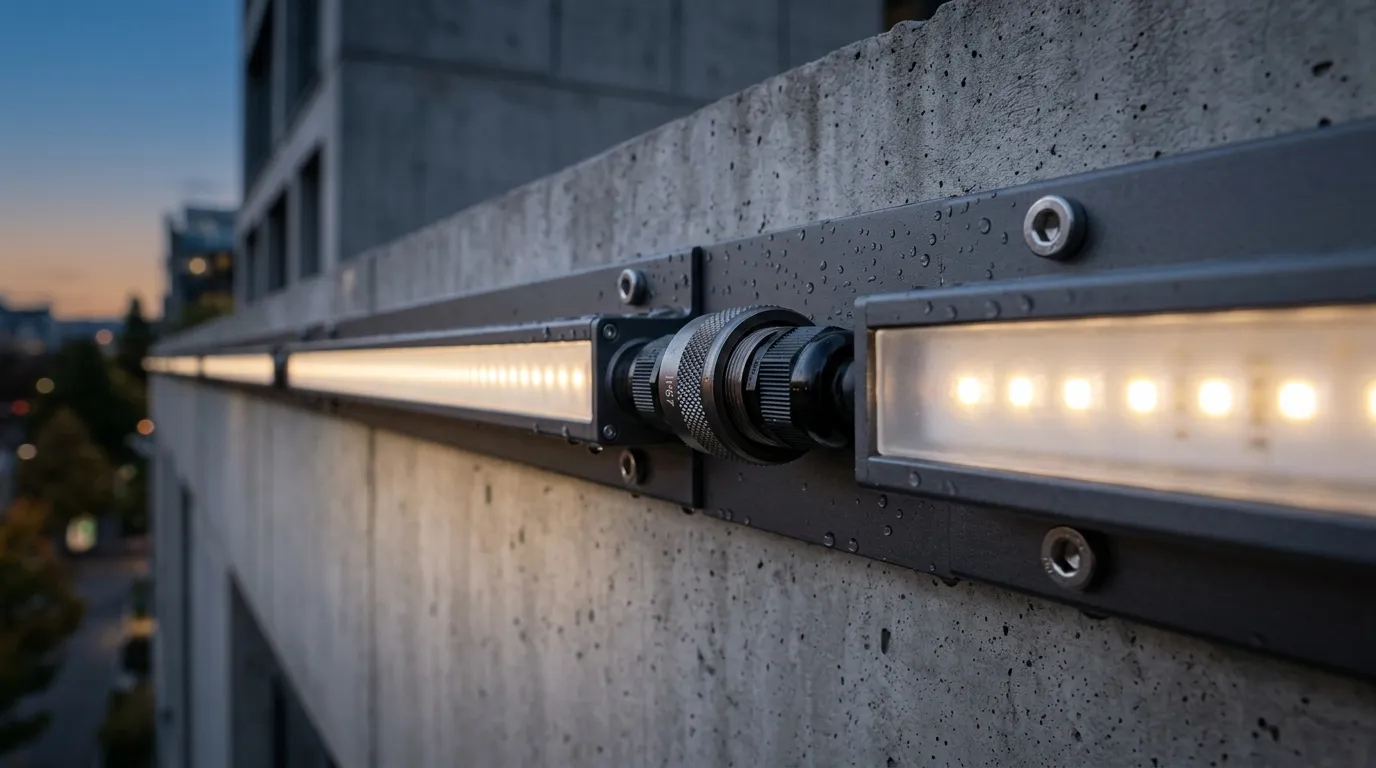
Scale illustration of the detail that decides outdoor longevity: sealed joints between segments, not just rated fixtures.
Color Consistency Has to Be Engineered, Not Hoped For
Wash a single 3 m wall and color variation reads as a quirk. Wash a 1,200 m facade and the same variation reads as a defect across a city block. On a project this size, even color is a manufacturing discipline before it is a programming one — which is exactly where a factory-direct supplier earns or loses the job.
Color consistency starts at the LED bin and ends at the shipping dock. At our Shenzhen facility every build passes six QC checkpoints: incoming QC on every LED, IC, and PCB batch; automated optical inspection during SMT and reflow; integral-sphere testing that verifies the color point and lumen output of each batch; constant temperature-and-humidity aging tests; IP and waterproof testing to the rated grade; and a full function and control test before packing. That last step is worth pausing on: every fixture is control-tested before it ships, because a dead segment discovered on a facade lift is not a warranty claim — it is a night of work for an access crew.
On site, commissioning closes the loop. Addresses get assigned per the universe plan, fixtures get grouped into their zones, and the wash is walked through its states to catch mismatched segments while a crew can still reach them. The same discipline scales both directions: our largest documented delivery is 86,500 individually addressable pixel points on a Singapore observation wheel, and the case study of how that installation was engineered shows the identical pattern — factory QC on the front end, clean addressing and power architecture on the back end, and commissioning as a scheduled phase rather than an afterthought.
What a Kilometer of Wall Washer Teaches Specifiers
Strip the specifics away and four lessons generalize to any large outdoor wash project:
- Buy the delivery record, not the sample. Anyone can show you a bright meter of strip in a showroom. The supplier who can point to comparable installed runs — at your scale, outdoors, in your climate — has already paid the tuition for the mistakes that only surface on real buildings.
- Engineer power before you quote fixtures. Voltage drop, injection points, and PSU placement decide whether a long run is even and reliable. If the supplier's first question is not about your run length and feed points, treat it as a red flag.
- Count universes on paper, twice. DMX channel budgeting determines the control hardware, the cabling backbone, and the maintenance burden for the life of the installation. It is a design exercise, and it belongs before the purchase order.
- Demand the commissioning story. Color consistency is manufactured in (QC, binning, aging tests) and finished on site (addressing, zoning, walk-through). Ask what happens between the factory and the first night of the show — the answer tells you how the facade will look in year three.
If you are in the middle of that thinking for a specific elevation, our specifier's guide to facade and curtain wall lighting walks through fixture choice, control, and planning from the drawing stage.
Specifying a Facade Wash at This Scale?
A 1,200 m DMX wall washer delivery is not a claim we make on a landing page and hope you forget; it is a documented project with photos, product records, and an IP-rated outdoor build behind it — one of the architecture and facade projects we ship from the factory floor. Fifteen such deliveries across nine countries sit in our case files, each with real numbers attached.
If you are specifying a plaza, facade, or landmark wash and the questions in this article are your questions, send a Pileds engineer the outline: run lengths, mounting lines, voltage preference, IP requirement, control system in mind. You will get an engineer's answer — including what we would need to verify before quoting — not a catalogue page. Samples ship for qualified projects, and OEM and custom builds are welcome.
Specifying pixel LED for a real project?
Send the spec — pitch, IC, IP class, run length, voltage — and you get an engineer's answer, not a catalogue. Samples and OEM/ODM quotes from the Shenzhen factory floor.