
How to Vet a China LED Supplier: Capacity, Certs, Lead Time
Vet a China LED supplier before you order: verify the company, factory capacity, certificates, and lead time — with the exact checks and questions to ask.
Most buyers choose a China LED supplier the way they choose a restaurant — on reviews, price, and hope. The quote looks right, the photos look right, and then the shipment arrives with the wrong driver IC, a certificate that borrows another company's number, or a two-week lead time that quietly becomes nine weeks. Vetting a China LED supplier properly is not about gut feeling; it is four evidence checks — the company, the factory's production capacity, the certifications, and the written terms — and each check has a specific document or test you can verify before a single dollar changes hands. This guide walks through each check, what counts as proof, and the red flags that should end the conversation early.
What to check, in one line
Check | The evidence that settles it |
|---|---|
Company | Business license, years operating, export history, factory vs. trading address |
Capacity | SMT lines, monthly output, aging racks, QC headcount, a live floor video |
Certifications | CE / RoHS / IP / UL certificate numbers, verified with the issuer |
Terms | Written lead-time breakdown, MOQ, Incoterms, payment schedule |
The rest of this article is the "how" behind each row. Each step takes an afternoon, and together they remove most of the risk of buying sight-unseen from 8,000 km away.
Step 1 — Verify the company behind the quote
Start with the legal entity, not the salesperson. Ask for the business license (营业执照) and check three fields: the registered name, the registered address, and the establishment date. A company registered in 2022 with a Shenzhen address and a website full of 2015-era project photos is already telling you something. Cross-check the address the sales rep gives you against the license — trading companies commonly register at one address and sell from another, which is legal but means you are dealing with a trader, not necessarily a manufacturer.
The trader-versus-manufacturer tell. A genuine LED factory can answer three questions on the spot, without checking with "the production department":
- Which SMT machines are on the floor, and how many lines?
- What is the monthly output in meters (or pieces)?
- What QC and aging steps run between SMT and packing?
If the answers are vague, or the sales rep cannot describe the production flow at all, you are probably talking to a trading company that resells another factory's output. That is not automatically disqualifying — a good trader can still deliver — but it changes the risk profile, because QC, capacity, and lead time are all outside their control. Our guide to distributor and reseller terms explains how to evaluate that middle layer if you choose to work with one.
Two more cheap checks. Run the company name plus "scam" or "fraud" through a search engine — one bad review on a lighting forum is worth more than ten testimonials on the company's own site. And look at the platform badge critically: "Verified Supplier" or Trade Assurance on Alibaba confirms the company paid for a verification service and shipped some orders through the platform; it does not confirm the factory exists, owns its machines, or will honor a contract outside the platform. Treat it as a hygiene signal, not a guarantee.
Step 2 — Verify production capacity with hard evidence
Capacity is the check most buyers skip, because it is the hardest to fake and therefore the most informative. A factory that can actually build your volume will show you its floor. Ask for, in this order:
- Line inventory. How many SMT lines and what machines (for example, Yamaha or Samsung pick-and-place)? Pixel LED strips are SMT products — if the supplier has no SMT line, it is not manufacturing the strip.
- Monthly output. In meters or pieces per month. Sanity-check it against your order: if you need 10,000 m and the "factory" claims 500,000 m/month but has one SMT line, the math does not work.
- Aging and QC setup. Aging racks (strips powered and burned in for hours before packing), test equipment, and QC headcount. This is where reliability is actually decided, not on the sales floor.
- A live video walk-through. Video call through the floor, asking them to show the line running, the aging room, and the packing area. A pre-recorded factory tour video is marketing; a live call is evidence. If the supplier refuses a short video call, you have your answer.
A factory's own track record is the strongest capacity evidence there is. Look for delivered projects at your scale: a supplier that has shipped and commissioned large pixel LED installs has already solved the production, QC, and logistics problems you are about to hand them. Our case studies document installations like an 86,500-pixel-point observation wheel and a 46,000-point 3D globe field — the kind of scale that only real production capacity can back up. When we (a Shenzhen LED factory ourselves) quote a project, our capacity claim rests on the same evidence we are describing: in-house SMT through reflow, a 1,500 m² floor, and a 6-step QC process including integral-sphere color testing.

The production floor is the primary source of truth for capacity — a live video call beats any brochure.
Verify the datasheet while you are at it. Before production, get the datasheet and check whether the claims are even physically plausible: brightness in lumens per meter, power draw per meter, voltage range, and IP rating. Note the claims down; Step 5 will test them against the actual sample. A supplier whose datasheet cannot survive contact with a multimeter is not ready for your order.
Step 3 — Match certifications to your market
Certifications only matter relative to where the product will be installed. Do not ask for "all certifications" — ask for the ones your market requires, then verify the numbers.
- European Union: CE marking is mandatory for LED lighting sold in the EU, and it covers the applicable directives (low voltage, EMC, RoHS). The European Commission's CE marking page explains what the mark means and who is responsible. RoHS restricts hazardous substances and is a separate requirement under Directive 2011/65/EU.
- North America: UL or ETL listing for the US, CSA for Canada. These are certification-body marks, not self-declared — which makes them checkable.
- Ingress protection: IP ratings (IP65, IP66, IP68) describe how the product withstands dust and water, defined by the IEC 60529 IP code. "IP68" printed on a datasheet is a claim; an IP test report from a lab is evidence. Ask for the test report.
- China export staples: CE, RoHS, and often EMC test reports are the baseline for pixel LED exports; some markets additionally require BIS (India) or others.
Verify the certificate numbers. This is the single most useful habit in supplier vetting, and almost no one does it. A certificate PDF is easy to fake or to recycle from another company; the issuer's database is not. For UL, search the UL Product iQ directory by company name or file number. For CE/RoHS test reports, ask who issued the test (a lab such as TÜV, SGS, or an accredited Chinese lab) and confirm the report number and scope with that lab. The certificate should name the company you are actually buying from, cover the product type you are buying, and be current — not expired and not issued to a different legal entity. Our LED export certification and compliance guide goes deeper into which marks each market needs, and exporting LED strip to the EU walks through the EU paperwork specifically. As a reference point, the certificates we publish carry verifiable numbers — CE, RoHS, EMC, IP66, and BIS — because a numbered, checkable certificate is the only kind that helps a buyer.
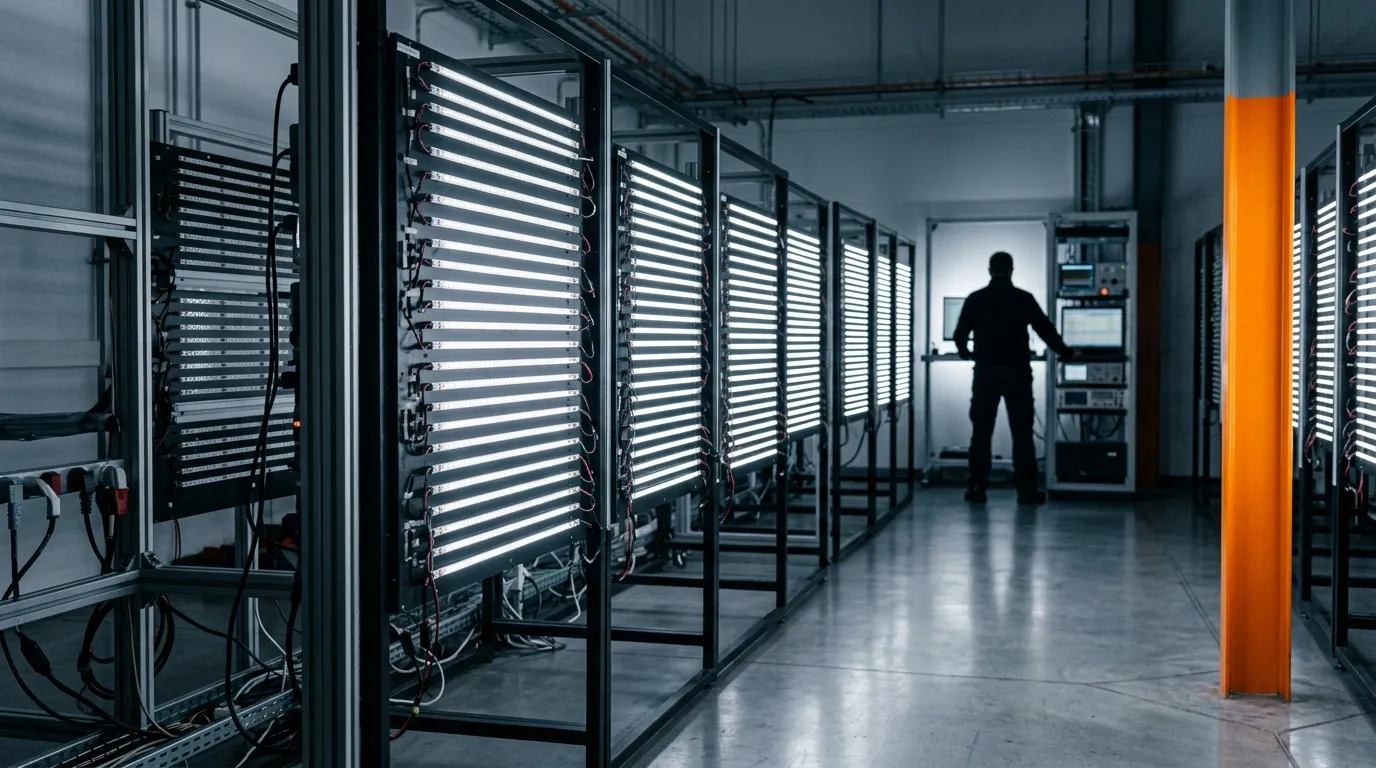
Aging racks are where a factory earns its reliability claim — hours of powered burn-in before anything ships.
Step 4 — Pin down lead time, MOQ and payment terms in writing
A verbal "15 days" means nothing. Ask the supplier to break the lead time into its components, then sanity-check each one. A realistic pixel LED strip lead time looks roughly like this:
Stage | Typical window | What happens |
|---|---|---|
Component sourcing | 2-7 days | Driver ICs, LEDs, PCB, and connectors, held in stock or ordered |
SMT and reflow | 3-7 days | Strip PCB assembly; depends on line availability |
Assembly, aging, QC | 3-7 days | Connectors, waterproofing, 24-72 h aging, integral-sphere testing |
Packing and dispatch | 2-4 days | Reels, boxes, export documents, freight booking |
If a supplier quotes a firm date that is shorter than the sum of these steps for a custom order, either they are overstocked on exactly your spec (unlikely) or the date is optimistic. The follow-up questions that separate serious factories: What is your current line load? When in the week does SMT start for my order? What happens if the ICs are out of stock — is there a substitute you would flag first?
Three terms to get in writing:
- MOQ and price breaks. MOQ for a standard SKU should be much lower than for a custom OEM build — a cut-to-length standard strip order and a fully custom product are different economics. Our custom LED strip guide covers how OEM MOQs and tooling work in practice.
- Incoterms. Agree the delivery term explicitly. ICC Incoterms 2020 defines who pays freight and insurance and where risk transfers — EXW, FOB, and DDP put very different obligations on you and the supplier.
- Payment schedule and penalty. The common pattern is a 30% deposit and 70% before shipment (or after pre-shipment inspection), with T/T or L/C. Treat "100% upfront" or "50% to start production, no inspection step" as a risk signal. A delivery-date clause with a penalty for lateness is normal in B2B contracts — if the supplier refuses any form of it, they are not confident in their own lead time.
This is also where you settle the bigger sourcing question: are you buying off-the-shelf, or building a long-term OEM relationship? The Pixel LED OEM, ODM and Distribution buyer's guide is the pillar resource for that decision — it covers how manufacturers structure custom builds, distribution agreements, and after-sales support, which is the context every lead-time and MOQ negotiation sits inside.
Step 5 — Test samples before you commit
Sample testing is where vetting moves from documents to physics. Order samples from your shortlisted suppliers at the same time, label them, and run the same test on each — this is the only fair comparison. A basic pixel LED sample protocol:
- Power and brightness. Measure current draw per meter at full brightness and compare with the datasheet. A 20% overdraw means the datasheet is fiction and the power budget is wrong.
- Color. Check color temperature and consistency between two reels. For addressable products, verify the driver IC is the one you specified (the marking on the chip, not the label on the packaging).
- IP claim. For an outdoor product, do a basic water test consistent with the claimed rating — a claimed IP68 product that fails a spray test fails your project.
- Aging. Run the strip for 48-72 hours at full brightness. Look for brightness decay, dead LEDs, and heat at the connectors.
- Data and cut points. For pixel products, test the data signal at the end of a long run and confirm cut points land where the datasheet says.
Lock a golden sample. Once a sample passes, keep it — the approved physical sample becomes the reference standard for production. QC at the factory should compare production units against it, and your final acceptance should too.
Add a pre-shipment inspection if the order is large: a third-party inspector (SGS, Bureau Veritas, or similar) visits the factory before you release the balance, checks quantity, verifies the golden-sample match, and confirms the packaging. At typical pricing it is a fraction of a percent of the order value, and it converts "trust me" into a report.
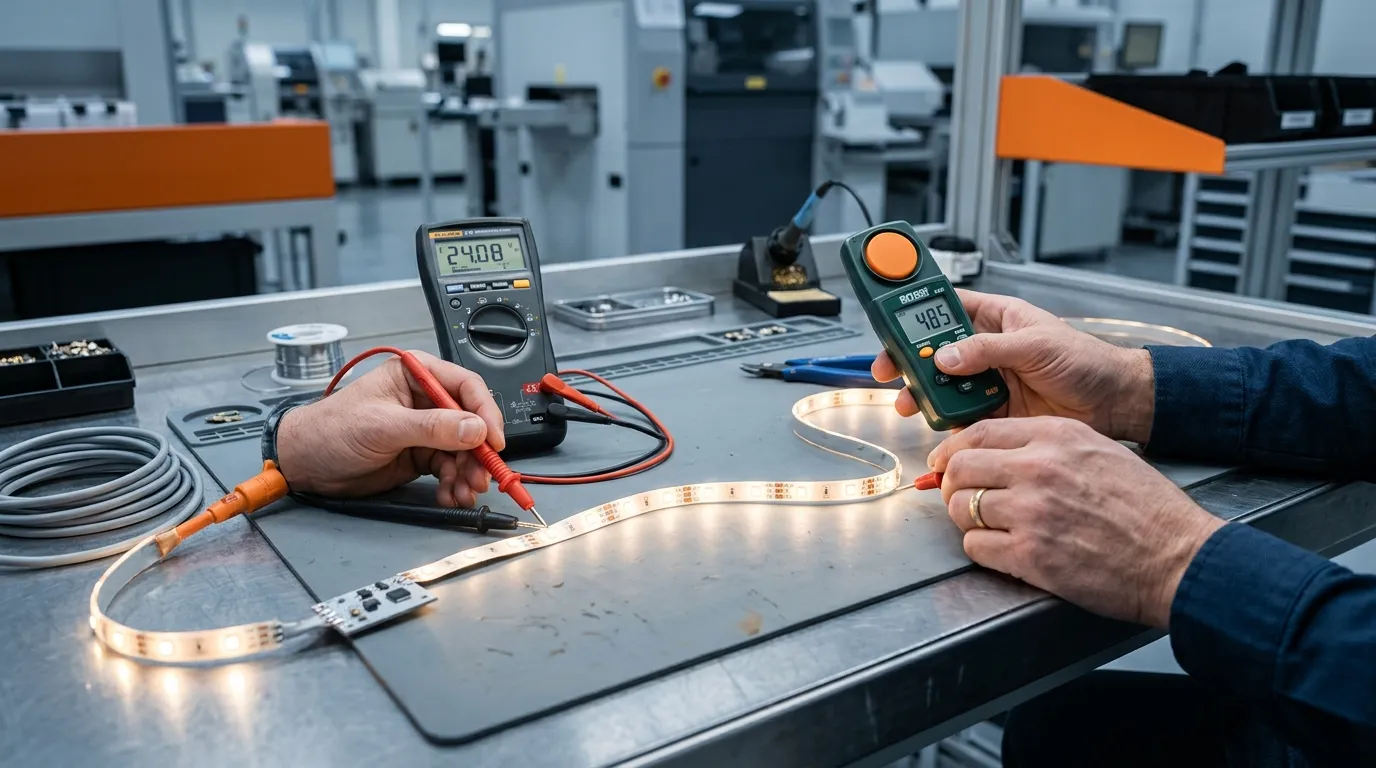
Measure the sample against the datasheet — the datasheet is a claim until the multimeter agrees.
Red flags that end vetting early
- Refuses a live video walk-through of the production floor.
- Certificate numbers that do not verify with the issuer, or certificates in another company's name.
- A "factory" that cannot name its SMT machines or monthly output.
- 100% payment upfront, or pressure to pay before sample approval.
- The same "15-day lead time" for every quantity and every spec.
- Datasheet claims that contradict the sample measurements.
- No mention of aging or QC anywhere in the process description.
- Multiple inconsistent addresses or company names across documents.
Any one of these is a reason to walk. Two or more means the vetting worked — it is exactly what this process is for.
How to vet a China LED supplier: the one-page checklist
Print this or keep it next to your inbox. If every row is satisfied, you have done what most buyers never do.
Check | Evidence to collect | Pass mark |
|---|---|---|
Company | Business license, years operating, address match | Entity registered ≥3 years, address consistent |
Manufacturer status | SMT lines, monthly output, QC/aging setup | Specific, consistent answers; live video confirmed |
Track record | Comparable delivered projects | Projects at or above your scale |
Certifications | Certificate numbers verified with issuer | Number verifies, covers your product and market |
Datasheet | Claims noted down | Claims survive the sample test |
Lead time | Written component breakdown | Sum of steps matches the quoted date |
Terms | PO/contract with MOQ, Incoterms, payment, penalty | Written, not verbal |
Sample | Test results + golden sample kept | Passes power, color, IP, aging, data tests |
A manufacturer that can produce this evidence on request is showing you how they will behave during production. What a real one looks like: our company page documents the factory floor, the 6-step QC process, the numbered certificates, and 15 large delivered installs across 90+ countries — because that is what buyers should be able to check, and what a factory with nothing to hide publishes willingly.
FAQ: vetting questions buyers actually ask
How do I verify a Chinese supplier is reliable? Run the four checks above: verify the company registration, confirm manufacturing capacity with a live floor video, verify certificate numbers with the issuer, and test samples against the datasheet. Reliability is a pattern of verifiable evidence, not a claim.
How do I buy directly from China suppliers? Find factories (not just traders) via B2B platforms, trade shows, or industry directories, then follow the vetting process here before ordering. Buying directly removes the middle layer's margin but puts QC, lead time, and compliance entirely on you — which is why the checks above matter even more.
Who is the best LED light supplier in China? "Best" depends on your product type, volume, and market. A supplier that is excellent for stage pixel fixtures may be wrong for mining lighting. Shortlist factories whose product lines match your spec, then let the vetting evidence — capacity, certificates, samples — pick the winner instead of a reputation ranking.
How do you know if a China supplier is legit? Start with the business license and a live video call through the factory. Then verify certificate numbers with the issuing body, and test a sample against the datasheet. Legitimate factories pass all four; traders and shell companies typically fail at least one.
Once the vetting passes and you have a shortlist, the next step is a properly structured RFQ — our pixel LED project RFQ and BOM template turns the checks above into the document your shortlisted suppliers fill out, so you compare answers, not sales talk.
Sourcing from a factory you can verify
The point of this process is that a good supplier does not need you to take a leap of faith. Pileds is a Shenzhen pixel LED manufacturer — in-house SMT through reflow, QC and aging on our own floor, numbered CE, RoHS, EMC, IP66, and BIS certificates, and documented installs at scale — and we publish the evidence so buyers can run exactly the checks in this article. Send your project spec (length, voltage, IC, IP rating, quantity, target market) to our team and we will answer the checklist questions directly, including lead time and MOQ for your volume.
Specifying pixel LED for a real project?
Send the spec — pitch, IC, IP class, run length, voltage — and you get an engineer's answer, not a catalogue. Samples and OEM/ODM quotes from the Shenzhen factory floor.