
IP67 Waterproof vs IP68: Is Higher Better?
IP67 waterproof vs IP68 compared honestly: what each test really proves, why the higher rating is not always the better buy, and how to pick the right grade.
IP67 and IP68 differ in one way that matters to a lighting BOM: IP67 is a fixed, published test — one metre of fresh water for thirty minutes — while IP68 is whatever depth and duration the manufacturer is willing to put in writing. Higher is not automatically better, because the 8 does not certify more waterproofing; it certifies that somebody declared their own number. For outdoor lighting that distinction changes real decisions: an IP68 fixture you cannot re-enter for service is worse than an IP67 strip you can, and an IP67 tube installed with unsealed joints fails where the water actually arrives.
This is from PILEDS. We build pixel LED strip from IP20 through IP68, so we sell both of the ratings compared here — which is exactly why this page spends more words on where the higher grade loses than on where it wins.
IP67 vs IP68 waterproof: the short answer
Read the two ratings as answers to different questions. IP67 answers "what does it survive?" — one metre of fresh water for thirty minutes, tested the same way for every maker. IP68 answers "what does the maker claim?" — continuous immersion at a depth and for a duration the manufacturer specifies in their own documentation.
So the practical test is not which number is bigger. It is whether your installation will sit in water for longer than half an hour, ever.
- If water only ever arrives as rain, spray, or runoff, IP67 covers it and IP68 buys you a claim you cannot verify.
- If any part of the run sits in standing water, gets flushed, or is washed down, IP67 is the wrong ceiling and the answer is IP68 (or a jet rating, for steam-cleaned areas).
- If the location is dry and protected, both are over-specified — the honest grade is IP20 or IP30, and the money is better spent on drivers and control.
The thirty-minute rule: if water arrives and leaves on its own, IP67 is the specification. If water stays, you need IP68 with a declared depth and duration. Everything else on this page is detail around that one question.
Everything below is the reasoning behind those three lines, plus the four documents to ask for before you accept either label.
What the two digits actually prove
The IP code comes from IEC 60529, the ingress protection standard maintained by the International Electrotechnical Commission. It is deliberately mechanical: two digits, two independent tests. The first digit rates solids, from a hand-sized object up to dust-tight at 6. The second digit rates water, from nothing at 0 up to continuous immersion at 8. An X in either position means the product was not rated for that criterion — which is why an IPX7 device tells you nothing about dust.
Two consequences follow, and both change how you read a spec sheet:
Both outdoor grades share the same dust result. IP67 and IP68 are dust-tight on the first digit, so the comparison between them is entirely a water comparison. The dust half of the rating also describes an enclosure — a housing, a profile, a sealed tube — rather than the bare circuit board inside it. If you mount a strip inside a gasketed aluminum profile, the rating that matters is the profile's, and the profile becomes the part your installer has to keep sealed.
The rating belongs to the tested assembly, not to the reel. A strip sold as "IP20–68" means the same board can be supplied with different protection layers. The rating applies to what left the factory in that configuration. Cut it, join it, or bolt a connector on that was not part of the test, and the number in the datasheet no longer describes the thing on your wall.
That is also where the rest of this cluster lives: the IP rating guide for outdoor pixel LEDs covers the whole ladder from IP20 to IP68 and how each grade interacts with voltage, IC choice, and mounting, while the grade ladder comparison takes the wider view of where each step sits.
The IP68 loophole: "conditions the manufacturer shall specify"
The second digit scales unevenly. Between 6 and 7 the standard is explicit: immersion up to one metre, test duration thirty minutes. At 8 the same standard switches to delegation. The published digit definitions state that equipment rated IPX8 is "suitable for continuous immersion in water under conditions which the manufacturer shall specify", with the test duration set by agreement with the manufacturer and the depth also specified by the manufacturer — generally up to three metres.
That single sentence is why two products carrying identical IP68 labels can be different products:
- a strip declared at 1.5 m for 30 minutes, which is barely past IP67;
- a fixture declared at 3 m for a week, which is a genuinely different class of build;
- and everything in between, including makers who print IP68 and publish no figure at all.
An IP68 label without a depth and a duration is not a stronger claim than IP67. It is an unfinished claim.
There is a second trap worth knowing before you assume 8 implies everything below it: the water ratings do not stack. A product that passes the immersion test at level 7 or 8 is not automatically compliant with the jet tests at levels 5 and 6, because submersion and jet impact load a seal differently. Makers who pass both list them separately. If your site pressure-washes the fixture, ask about the jet rating specifically — the immersion number tells you nothing about it.
The same logic runs in the other direction, and it is the one most often missed: splash is not jet, and neither is immersion. Level 4 is splashing water from any direction — a rain-driven facade and nothing more. Levels 5 and 6 are jets at increasing pressure. Levels 7 and 8 are submersion. A strip built for rain and splash is a different specification from one built for a hose, which is why the two are listed as separate results rather than as steps on one ladder.
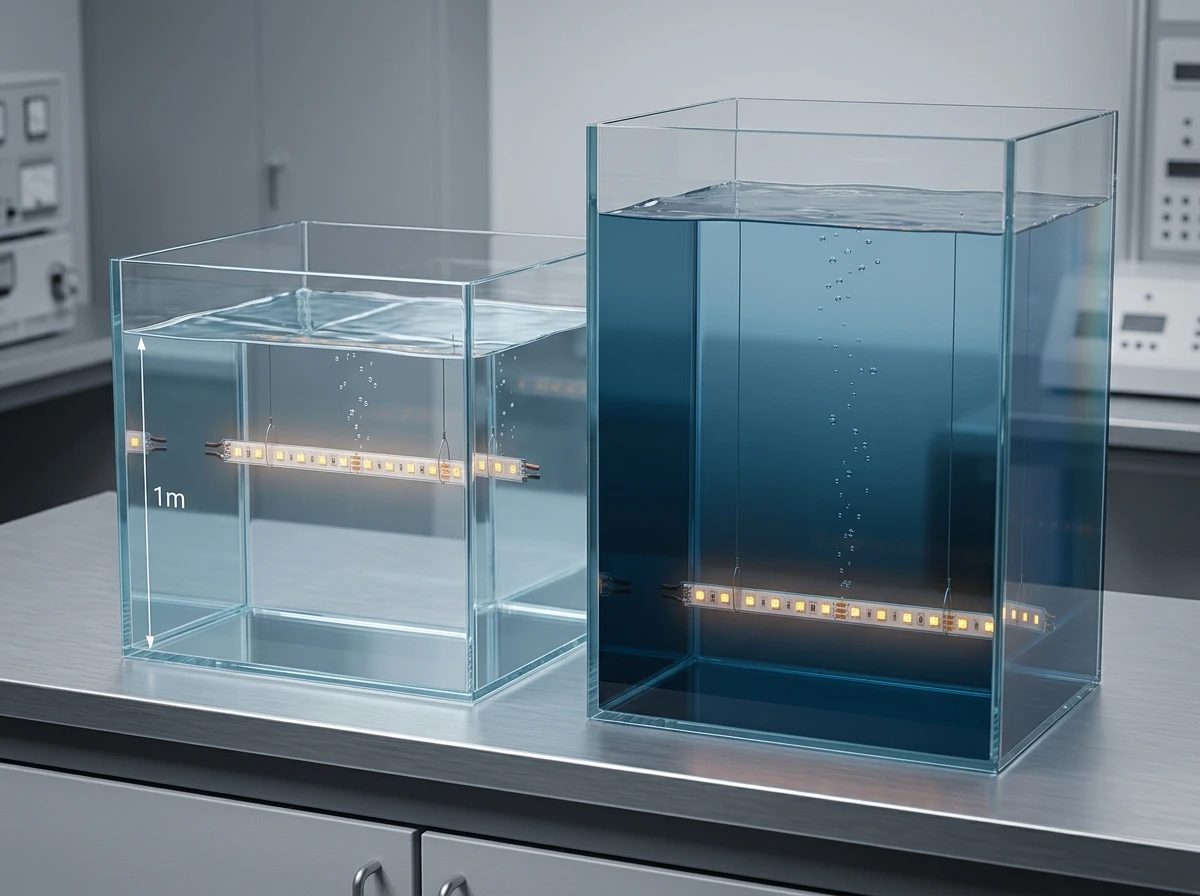
Left: the IP67 test is a fixed recipe — one metre, thirty minutes, every maker tested the same way. Right: the IP68 test depth and duration come from the manufacturer's own declaration, which is why the label alone is not comparable.
At a glance: IP67 vs IP68
Dimension | IP67 | IP68 |
|---|---|---|
Test condition | Immersion to 1 m, 30 minutes, fresh water | Continuous immersion; depth and duration set by the manufacturer |
Dust (first digit) | Dust-tight ( | Dust-tight ( |
What it proves | A published, repeatable test result | A manufacturer-declared result you have to read |
What it does not prove | Jet, steam, or chemical resistance; anything beyond 30 minutes | Anything at all until the depth and duration are published |
Typical outdoor lighting use | Eaves, facade accents, signage, seasonal displays in rain | Fountains, washdown floors, trenches, mine and tunnel runs, buried sections |
Construction it needs | Silicone tube over the board | Tube with sealed ends, or full potting |
Serviceability | Re-enterable; segments can be replaced | Often sealed permanently — plan spares before installation |
Relative cost per metre | Baseline for wet-rated strip | Higher: extra sealing steps, sealed ends, tested connectors |
Where IP68 earns its money
IP68 is not a markup trick. Three environments genuinely need it, and in those places the higher grade stops being a preference and becomes an engineering requirement.
Standing water and washdown floors. Fountains and water features, stadium concourses that get hosed down, food and beverage areas, truck-wash bays, and any trench or sump where the fixture sits in liquid rather than under falling water. Here IP67's thirty-minute clock is the wrong instrument: the water does not leave.
Industrial runs where the environment never dries. Underground galleries and mine headings combine washdown, dust load, and mechanical abuse. The reference build in this category is the AC36V mine strip: a run of 10,000 m of AC36V strip in a South African mine is a different product class from a coated indoor strip, and it runs on mains-driven AC distribution at 36 V AC — the extra-low-voltage form — precisely because of the distances involved.
Sections of an otherwise dry run that cross water. A facade run that passes a planter drain, a floor-run that crosses a wash bay, or a seasonal display that gets stored in the open. You do not need to upgrade the whole run — you need to give the wet sections a genuinely sealed strip and a sealed transition, and the IP68 addressable RGBW strip exists in that role: it ships in the IP20–IP68 range on one strip design and is configured to order — so specify the end treatment and connector grade in writing rather than letting them be improvised on site.
One rule applies in every one of those cases: a sealed strip joined by unsealed methods is not a sealed run. If the IP68 section terminates in a bare solder joint and a length of heat-shrink, the water enters at the joint. Factory-sealed pigtails or connectors rated to the same grade are part of the specification, not an accessory.
Where IP67 is the better buy
Three situations where the smaller number is the correct choice — and where specifying IP68 costs money and buys risk.
1. Rain-exposed mounting with no standing water. Facade accents, eaves, soffits, canopy edges, signage, and seasonal displays that get rained on but drain. IP67 covers every water event in that list, because nothing in it stays submerged for half an hour. Upgrading here is buying a declaration whose test condition you will never reach, and paying for extra sealing you then have to work around.
2. Any run somebody will have to service. Sealed ends are permanent by design. A potted end cap cannot be reopened, and on an IP68 strip a failed pixel near the end of a run generally means replacing a whole section, not swapping a segment. IP67 in a tube is re-enterable: pull the strip, replace the segment, re-sleeve it. For installations with maintenance access and a multi-year service life, that difference is worth more than a label. This is the least glamorous argument on the page, and it is the one project managers come back to.
3. Tight geometry, weight, and heat. The layers that produce IP68 — thicker tube walls, potting compound, sealed collars — add stiffness, weight, and thermal mass. On a small-radius architectural detail or a lightweight structure, a stiffer strip is harder to install cleanly, and a potting layer traps heat that a tube would let escape. If two candidate strips are close on price, check the bend radius, the weight per metre, and the lumen maintenance at the grade you actually buy.
The honest counterweight: none of this makes IP68 a bad buy. It makes it a specific buy. If water reaches your fixture and stays there, no amount of serviceability compensates for a strip that drowns — and if you are unsure which of the two situations you are in, the deciding question is not price, it is duration of contact with water.
Same strip, different construction: coating, tube, sealed ends
The mechanism behind the two ratings is simpler than the datasheets suggest, because it starts from the same place. Every strip begins as one flexible board: copper traces, LEDs, driver ICs. The grade is a protection layer added at the end of the line.
- Coating. A silicone or conformal layer over the components. This produces the jet-rated grades and protects the top face; the back of the board and the cut ends stay exposed.
- Tube. The board slides into a silicone sleeve, so both faces are covered. The sleeve's ends are still open — which is precisely the difference that matters between the immersion grades.
- Sealed ends. The same sleeve, finished with potted or glued ends, or the whole assembly encapsulated. Water can no longer enter where it used to: at the ends.
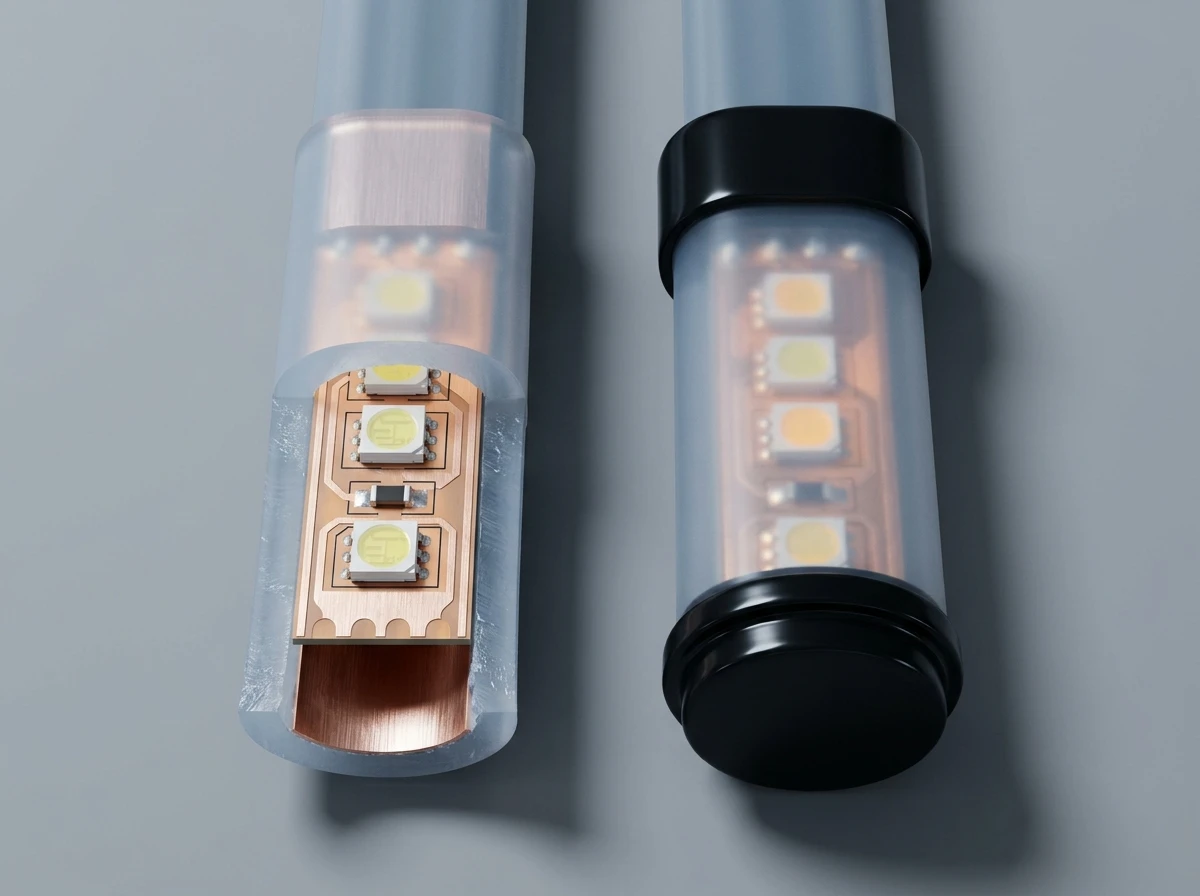
The board, the LEDs, and the driver ICs are identical in both samples. The grade is decided by the two ends — which is also where field-cut and field-joined runs lose it.
Two practical details follow. First, cutting is a rating event: every cut end is a new opening, so a cut-to-length strip needs end sealing that matches the grade you specified, done with the right materials rather than whatever is in the van. Second, the connector usually matters more than the strip. Cable entries, glands, and plugs are where a sealed run leaks, and a connector rated for immersion is a different part from a plug that merely keeps rain out. On an addressable run, every power-injection point is another entry to seal, so plan junctions inside dry enclosures or use rated feed-throughs before the first metre goes up.
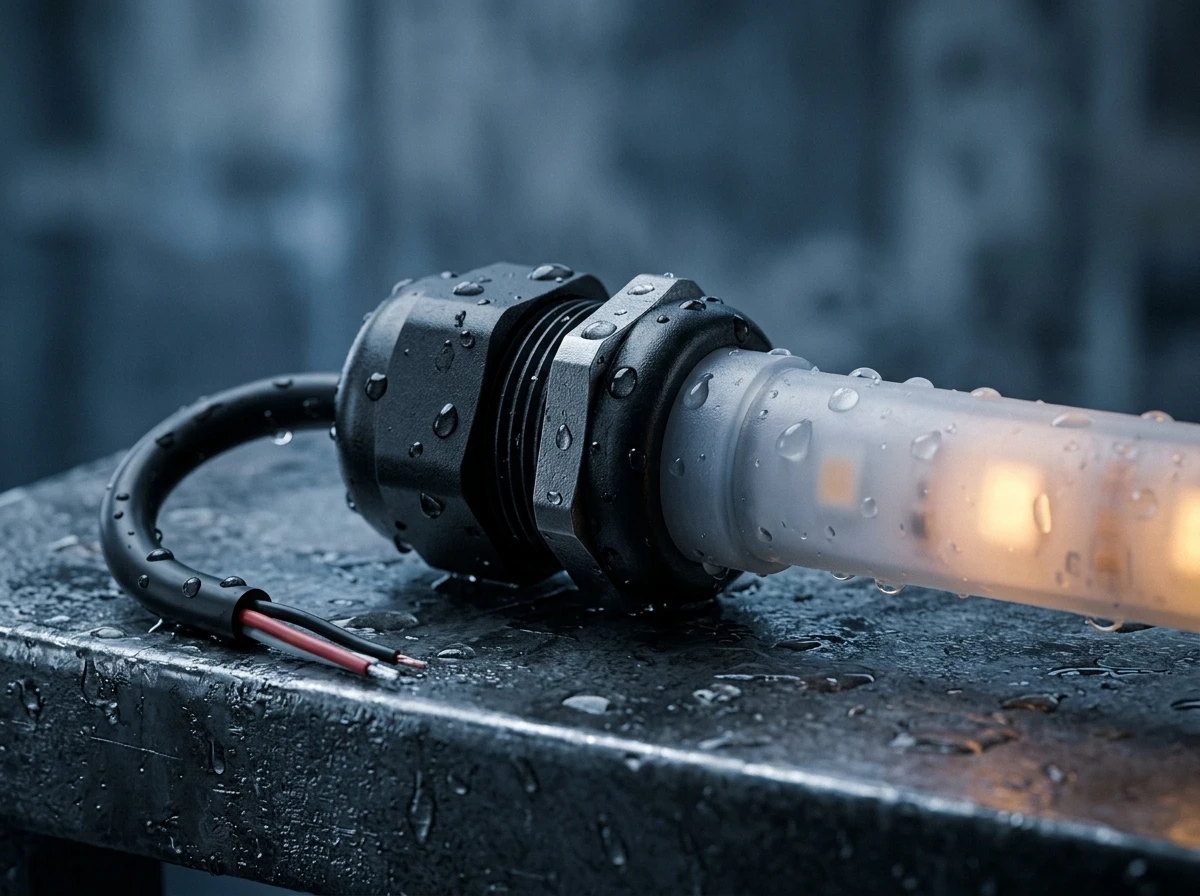
A rated cable entry is a machined part with its own seal, not a layer of heat-shrink. On a wet run this junction, not the strip, is the likeliest point of failure.
The middle of the ladder is worth understanding too — IP65 and IP67 compared walks through where each one earns its extra digit, which is useful when a project spans a rain-exposed facade and a wet service yard in the same order.
Water is not one thing: fresh, chlorinated, salt, heat
Every immersion number above comes from a fresh-water tank. The standard is explicit that other fluids sit outside the rating: salt water, oils, and solvents each need separate chemical resistance testing before anyone can promise protection from them. That is not a technicality if your project is a coastal facade with salt-laden spray, an indoor water feature running treated water, or a marine-adjacent installation.
The same gap applies to cleaning method. High-pressure and steam washdown is covered by a different family of tests: the K ratings come from ISO 20653, the road-vehicle protection standard, whose IP69K level describes high-pressure, high-temperature jet cleaning. An IP69K fixture is not automatically safe to submerge, and an IP68 fixture is not automatically safe to steam-clean. If the site is washed with a pressure washer, the specification you need is the jet rating, and you should treat the immersion rating as a separate question.
Two slower effects also sit outside the label. The first is thermal cycling: a fixture that runs hot and cools overnight, or a tube that expands and contracts against a rigid end cap, works its seals in a way a room-temperature immersion test never reproduces. The second is time. UV, ozone, and repeated flexing harden silicone, and a seal that passed at year zero is not the same seal at year five. On permanent outdoor runs, budget periodic inspection of end seals whatever the number on the label — and choose a construction whose ends can actually be inspected.
For interior industrial work the environment usually dictates voltage as well as protection: the tunnel strip design explains why long underground runs move to mains AC rather than low-voltage DC, since cable loss over hundreds of metres decides the supply, not the IP grade.
How to verify the rating you are buying
An IP rating is a laboratory result, and the skepticism installers express about imported numbers is mostly a documentation problem. Four things make a rating checkable, and all four are documents you can ask for before placing an order:
Ask for | What good looks like | Why it decides your order |
|---|---|---|
The standard and its edition | The datasheet names IEC 60529, ideally with the edition, or its EN equivalent | Two digits alone cannot be checked against anything |
The test report | A certificate or report reference that traces back to a test house | Separates a tested product from a logo pasted into a brochure |
The tested object | A statement of whether the sample was the strip alone or the strip with its connectors and end seals | Decides whether the number covers the assembly you are buying |
For IP68, the declared figure | Depth and duration, in writing | Without both, the label carries no engineering content |
The test that separates suppliers: ask two IP68 suppliers for the declared depth and duration. The one who answers with numbers in an email is the one whose rating you can put in a BOM; the one who answers with a datasheet logo has told you nothing you can hold them to.
Two honest limitations belong in the same conversation. The test is performed on new, clean samples, so the result describes a new strip rather than a five-year-old one. And a warranty that excludes water damage is not automatically bad faith — the standard's own logic is that the rating covers the tested assembly, while the joints, entries, and terminations are created on site by somebody else. Any supplier who tells you otherwise is overpromising.
To be concrete about our own position rather than hiding behind the explanation: we hold an IP66 certificate (certificate no. JAT24101202622IC-1, tested to EN 60529:2013), and sealing to the rated grade is one of six checkpoints in our production QC, alongside an integral-sphere color test and an aging burn-in. The certificate covers the sample as tested. Your joints, gland entries, and injection points are the other half of the seal, and no supplier can certify those for you.
Choosing between them on a real project
Work through three questions in order, and the grade follows. This is the whole decision:
- Will any part of the run be in contact with water for more than thirty minutes at a time — standing, flooded, or repeatedly flushed? If yes, specify IP68, and specify the declared depth and duration. If it will also be pressure-washed or steam-cleaned, add the jet rating.
- Is the run exposed to rain, snow, or hose spray, and does it drain? If yes and question one was no, IP67 is the right grade and IP68 is over-specified.
- Is the location dry and sheltered? Coves, indoor signage, display cases, ceiling channels. IP20 or IP30 is honest, cheapest, and easiest to service.
Then apply the constraint that decides whether any of it works: the whole chain has to match the chosen grade. Strip, cut ends, connectors, glands, and every power-injection point. A run specified as IP68 that terminates in an unsealed joint is an IP68 strip inside an IP67 installation, and it will fail at the joint.
One counter-case deserves naming, because it changes the answer. If a client asset standard, an insurer, or a maintenance contract requires the highest listed grade regardless of environment, the decision is already made — and the work shifts from choosing a grade to sealing and documenting it. Under-specifying is not free either: a failed run costs far more in access, replacement, and reputational damage on a visible facade than the sealing difference between the two grades. The argument here is not that IP67 is better; it is that the grade should follow the water.
If you would rather not adjudicate it yourself, send the environment rather than the length: mounting surface, whether water stands or drains, cleaning method, run length, and how many flush zones there are. That is enough to give you a grade-matched answer the first time — send those details to our team and we will come back with the construction, the sealed connectors, and the declared figures rather than a bare number.
FAQ: the questions that come up on every quote
Is IP67 100% waterproof? No. It means the item passed a specific test: immersion to one metre of fresh water for thirty minutes, on a new sample. It says nothing about jets, steam, salt water, chlorinated water, or seals that have aged. "Waterproof" is marketing shorthand; the two digits are the specification.
Is IP68 100% waterproof? No — and the reason is structural. IP68 means the maker declares the depth and duration, so the rating is only as strong as the figure behind it. Two IP68 products can differ by metres and by hours.
Is IP68 enough for swimming? For a consumer device, swimming usually means depth, movement, and chlorinated water for an extended period — a phone rated IP68 and a luminaire rated IP68 are not the same load case, and one of them is being asked to move. For a lighting fixture the question is simpler and better: will the fixture itself sit in water? If it will, IP68 with a declared figure; if it will not, buying IP68 does not protect you from the joints you left unsealed.
How does IP66 compare with IP68? They answer different water questions. IP66 is a jet rating — the first digit 6 for dust-tightness plus 6 for powerful water jets from any direction — which makes it the right grade for fixtures that get hosed down hard but never sit in water. IP68 is a submersion rating. Neither replaces the other, and a fixture that gets both treatments should list both results.
What is IP69K, and do I need it? IP69K comes from the road-vehicle standard ISO 20653 and describes resistance to high-pressure, high-temperature jet cleaning — the strongest washdown test in common industrial use. It is not a submersion rating and does not replace IP68. Specify it where the cleaning method is aggressive: food production, vehicle bays, and any floor that gets steam.
Is IP67 water resistant or waterproof? Both words appear on packaging and neither is a grade. Water-resistant, splash-proof, and waterproof are descriptions; IP67 and IP68 are test results. If you need to compare two products, ask for the digits, the standard, and, for the 8, the declared depth and duration.
Does the protection layer reduce light output? Not meaningfully. The layer sits between the LEDs and the environment, not in the optical path, so the same board delivers very similar brightness in either grade. The exception is grazing angles on tightly lensed strip, where a thicker tube scatters slightly. Read lumens per metre for the specific grade you are buying rather than assuming the family figure transfers.
Bottom line
Buy IP68 where water stays; buy IP67 where water visits. The 8 is not a better version of the 7 — it is a different kind of claim, defined by the manufacturer rather than by the standard, and it costs more per metre and more at service time. The 7 is a fixed recipe you can hold any supplier to, and for rain-exposed architectural work it is usually the right specification.
Whichever way the decision goes, three things decide whether it holds on site: the declared figures behind the IP68 label, the sealing of every cut end and joint, and whether the construction can be maintained. Get those right and the grade on the box becomes what it should be — a documented detail rather than a hope.
Specifying pixel LED for a real project?
Send the spec — pitch, IC, IP class, run length, voltage — and you get an engineer's answer, not a catalogue. Samples and OEM/ODM quotes from the Shenzhen factory floor.