
Neon Signs from China: Flex or Pixel Strip?
Buying neon signs from China? Neon flex and pixel strip solve different jobs: static glow or animation. Compare brightness, installation, lifespan, sourcing.
Neon flex and pixel strip are not competing versions of the same sign — they are different light engines for different jobs. Neon flex (also sold as LED neon flex, silicone neon strip, or LED neon rope light) makes one continuous glowing line, which suits text, logos, and channel letters that hold a single color. Pixel strip (addressable LED strip) makes a row of individually controllable dots, which is what you need when the sign has to move: chasing, scrolling messages, or video. Most buyers who search "neon signs from china" start with the wrong question — "which one is cheaper?" The question that actually decides the order is: does this sign need to animate?
This article is from Pileds, a Shenzhen manufacturer that builds both LED neon flex and addressable pixel strip. That matters for two reasons: we can tell you honestly where each one loses, and we have no incentive to pretend the two are interchangeable — the sale is the same either way, but the installed sign is not. What follows is the comparison we would walk through with you on a quote call, written down.
Neon Flex and Pixel Strip Are Different Light Engines
Start with how the light is made, because every later difference — brightness, animation, repair — follows from it.
Neon flex is a string of SMD LEDs inside a silicone (or PVC) tube or co-extruded strip. The tube walls diffuse the light from each individual LED until the eye sees a single continuous line of light with no visible dots. That diffusion layer is the whole trick: it is what makes LED neon read as "neon." The profile is soft enough to bend around curves, and the silicone skin seals the electronics for life. It is the modern replacement for glass neon tubes — the high-voltage gas-discharge tubes that defined neon signage for a century but now survive mainly in restoration work, because they need fragile glass, rare-gas filling, and a transformer running at thousands of volts (Wikipedia's neon sign article covers that history). Everything sold today as a "neon sign," including the vast majority of neon signs from China, is LED neon flex or a pixel product dressed to look like neon.
Pixel strip is a flexible PCB with LEDs mounted at a fixed pitch — 30, 60, or 144 per meter are the common densities — where each LED (or a small group) carries its own driver IC. Each pixel can be told a different color at the same time, which is what makes animation and video possible. The trade-off is written on the product: individual addressable dots are visible up close, and the strip is a flat tape, not a glowing tube.
One honest overlap before we go further. The two families are converging: manufacturers now put addressable pixels inside silicone neon profiles, so you can buy "360° pixel neon" that looks like neon flex and animates like a pixel strip. If you read a spec sheet that says "RGB neon, WS2811, 120 LEDs/m," that is the hybrid. Treat it as a third option: it costs more than plain neon flex and does less than a purpose-built pixel strip at video densities — but for medium-complexity animation it is often the fastest install. Keep it in mind when you reach the decision section.
If you are lighting a whole storefront rather than one sign — fascia, window displays, and channel letters together — the storefront pixel lighting guide walks through the full set of choices this article narrows to two.
Neon Flex vs Pixel Strip at a Glance
Dimension | Neon flex | Pixel strip |
|---|---|---|
Light output | One continuous, dot-free glowing line | Discrete dots; spacing visible up close |
Animation | Static color, or slow segmentation on addressable hybrids | Pixel-level chasing, scrolling, video |
Typical density | 30–240 LEDs/m inside the tube | 30–144 pixels/m on the PCB |
Cutting unit | Cut at tube segment marks; reseal the end | Cut at pixel marks; re-solder or splice |
Mounting | Direct into channel letters, aluminum channel, clips | Flat surface or profile; lettering needs a backing route |
Outdoor protection | Silicone skin, commonly IP65–IP66 out of the box | IP20 bare; IP65–IP68 needs sleeve, coating, or potting |
Failed section | Replace the whole sealed run | Cut out the dead segment and splice a new one |
The rest of the article unpacks each row, then adds the supply-chain view that "from china" actually implies.
Light Output: Uniform Glow vs Discrete Pixels
For signage, the first spec that matters is not lumens — it is what the light looks like at the viewing distance.
Uniformity is neon flex's native advantage. Because the silicone tube diffuses every LED into the same continuous surface, a letter made from neon flex looks equally bright along its whole length, including tight corners. This is precisely why it is the default for letterforms: an "OPEN" sign or a logo outline wants to read as one unbroken stroke of light, and neon flex delivers that with zero optics work. The visible result is what photographers call a clean line: no bright spot at each LED, no dark gap between them.
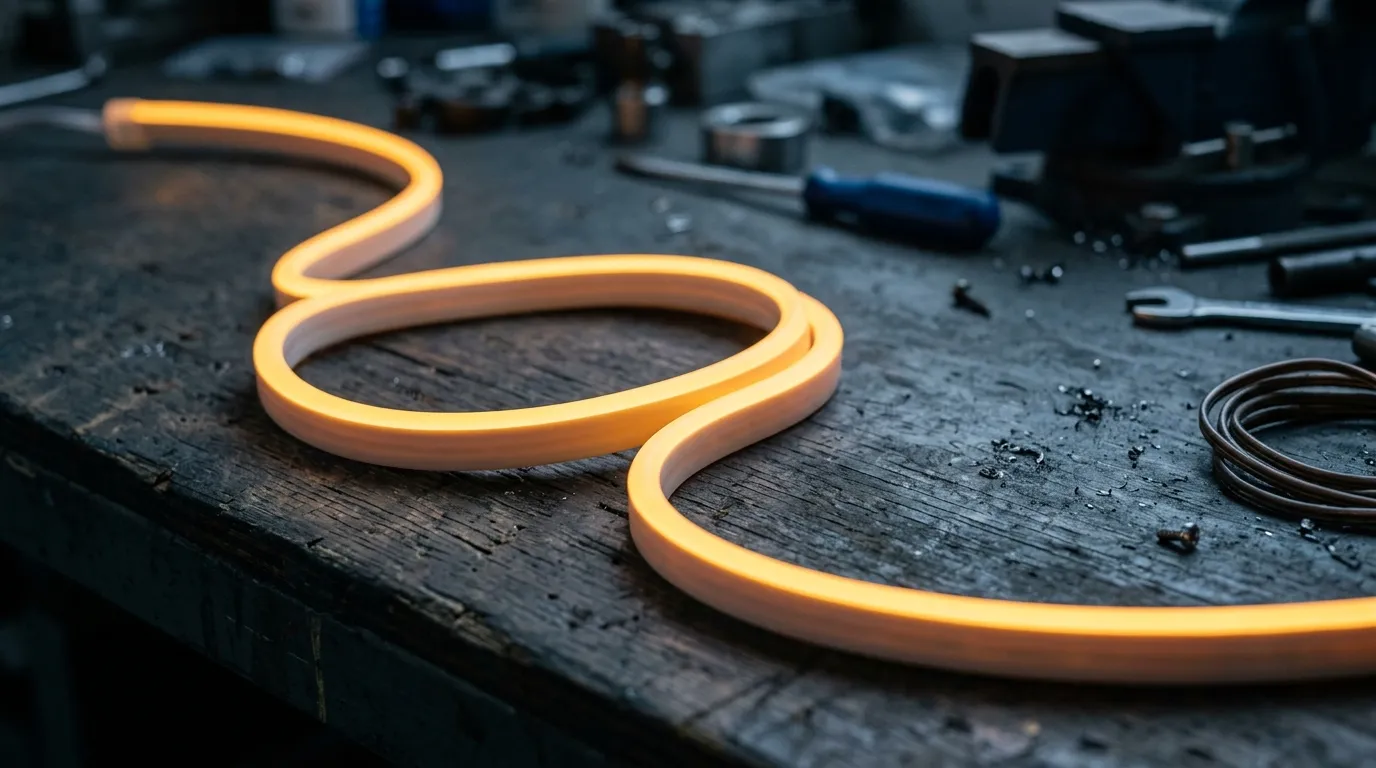
LED neon flex in an S-curve: the silicone skin diffuses individual LEDs into a single continuous glow — the property that makes it read as "neon."
Pixel strip sells brightness and density, not uniformity. A 60-pixel/m strip puts an LED every 16.7 mm; at arm's length you see the spacing, and even behind a diffuser the pixel pitch sets a floor on how close a viewer can get before the image breaks into dots. That is fine when the content is meant to be read as pixels — animated sequences, chase effects, video — and wrong when the client expects a smooth neon stroke. Strip suppliers get around this with diffuser channels and milky covers, but every layer of diffusion costs brightness and adds install time.
Two numbers to compare on any spec sheet:
- Density. Neon flex typically packs 30–240 LEDs/m inside the tube (12 mm profiles commonly quote the 30–240 range, 360° tubes around 120 LEDs/m). Pixel strip is specified in pixels/m — 30, 60, 144 — and 144-pixel/m products exist specifically for low-resolution video.
- Power. A typical RGB neon flex draw is roughly 12–15 W/m at full white; a 60-pixel/m strip runs a similar band, and high-density video strips climb to 20 W/m and beyond. Full-white current draw decides your power supply budget, and it is usually the second line a good supplier asks about after length.
Color quality depends on the LED mix, not the format. For brand colors and saturated effects, both families do fine with RGB. The gap appears on white: a storefront that runs white lettering at night (most of them do) needs either single-color white LEDs at a chosen color temperature or RGBW pixels with a dedicated white chip. RGB-only pixel strip makes white by mixing red+green+blue, which reads slightly pink or green and drifts with temperature and age. If your sign is white-by-default with occasional color, put "RGBW or white LED" on the RFQ regardless of which family you choose. When driver IC behavior matters — signal redundancy, voltage tolerance, which chip handles what — our WS2811 vs WS2812B comparison explains the practical differences between the ICs you will see on Chinese spec sheets.
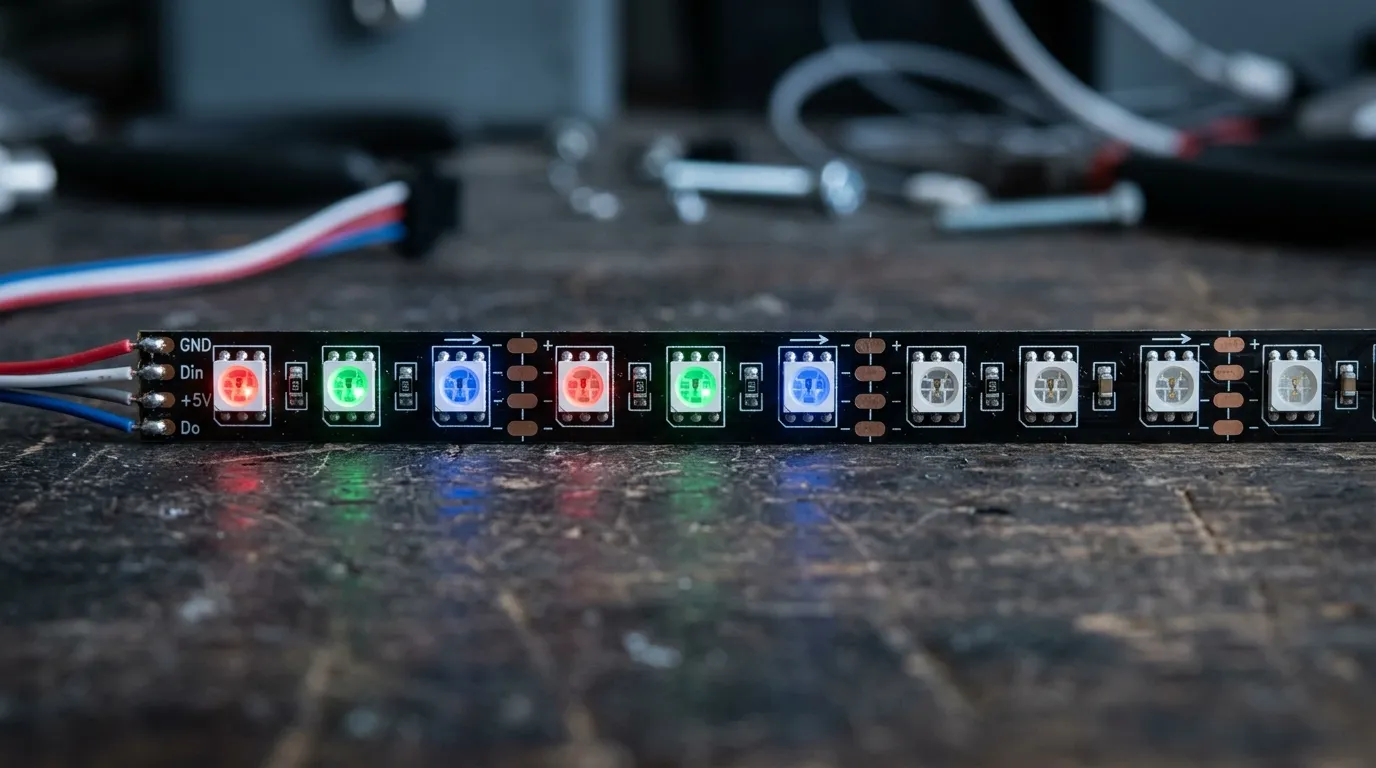
An addressable pixel strip: each dot is an independently controlled pixel — the source of animation capability and of visible spacing up close.
Animation: Static Color, Chasing, and Video
This is the dimension that separates the two products, so it deserves the blunt version: neon flex cannot animate the way pixel strip can. Standard neon flex changes color as one whole segment or as a few pre-wired zones. If the design calls for light that travels — a runner, a wave, letters that chase, a countdown — a plain neon flex sign physically cannot do it, no matter how good the supplier is. A buyer who orders static flex for an animated concept will learn this after install, which is the most expensive possible time to learn it.
Pixel strip's addressability is what makes motion possible. "Addressable" means each pixel carries a driver IC and a unique position in a data chain, so a controller can tell pixel 1 red and pixel 47 blue in the same frame. The same mechanism drives everything from slow color fades to scrolling text to low-resolution video. The Adafruit NeoPixel guide is the clearest public explainer of how addressable LEDs and their data protocols work — worth a skim before your first call with a factory, because it gives you the vocabulary (data-in/data-out, pixel count, refresh) that Chinese suppliers use in every quote.
The ecosystem cost is real, and buyers often miss it: an animated sign is a system, not a strip. You are buying:
- the strip itself, at a per-pixel or per-meter price;
- a controller — SPI controllers and decoders for WS2811/WS2815-class strips, or DMX512/Art-Net controllers when the sign integrates with existing show or building control;
- addressing and mapping — someone configures pixel order, zones, and content, and either writes content to the controller or connects it to software (MADRIX and similar run whole buildings of pixel fixtures);
- ongoing content — an animated sign without someone to update its content becomes a static sign with a higher electricity bill.
None of that exists in a neon flex order, which is why a flex sign is cheaper end to end. The correct framing for a procurement conversation: flex is a lighting product; pixel strip is a display product with a lighting substrate.
The hybrid worth naming again here: addressable neon (pixels inside a silicone profile) covers the middle ground — segmented color changes and simple effects without exposing the pixel look. It is the right answer more often than buyers expect, and the wrong answer whenever the content needs real resolution.
Installation: Bending, Cutting, Mounting, and Power
Install cost, not unit price, is where most sign budgets actually go over, and the two technologies install differently.
Bending. Neon flex is made to follow curves: its minimum bend radius is small enough for letter arcs, rounded logo corners, and wraps around posts. Silicone profiles also tolerate tighter bends than PVC versions without cracking. Pixel strip bends in one plane easily (it is a tape) but the LED side must not be sharply folded, and while "S-shape" side-bend strips exist for 2D curves, none of them wrap like a neon tube. Rule of thumb: any letter with a tight radius belongs to flex; any flat surface that will carry animated content belongs to strip.
Cutting. Both families are cut-to-length, which is why per-meter pricing is the norm on every Chinese quote. The difference is in the cut unit and what happens after the cut. Neon flex is cut at segment boundaries (typically every 0.5–1 m of LED run inside the tube), and the freshly cut end must be sealed — with a plug, a cap, or a resin end — or moisture enters the silicone. Pixel strip is cut at every pixel mark, which gives finer length control, but a cut end exposes solder pads that must be re-terminated or spliced. For either technology, ask two questions before ordering: what is the shortest cut unit I can order, and how is the end terminated in your standard quote? Un-terminated ends are the single most common cause of "the sign died after six months" complaints in outdoor signage.
Mounting. Channel letters and dimensional letters are the neon flex home turf: the flex routes inside the letter's aluminum return and glows through the open face, or sits in a shallow channel for a halo effect. For wall-mounted logo signs, flex clips into aluminum channels that follow the drawn path. Pixel strip wants flat, continuous mounting: an aluminum profile, a routed backing board, or a cove. Making animated letters from strip means building the letterform first (acrylic face, backing board, or channel) and routing the strip along it — more fabrication labor than dropping flex into a letter.
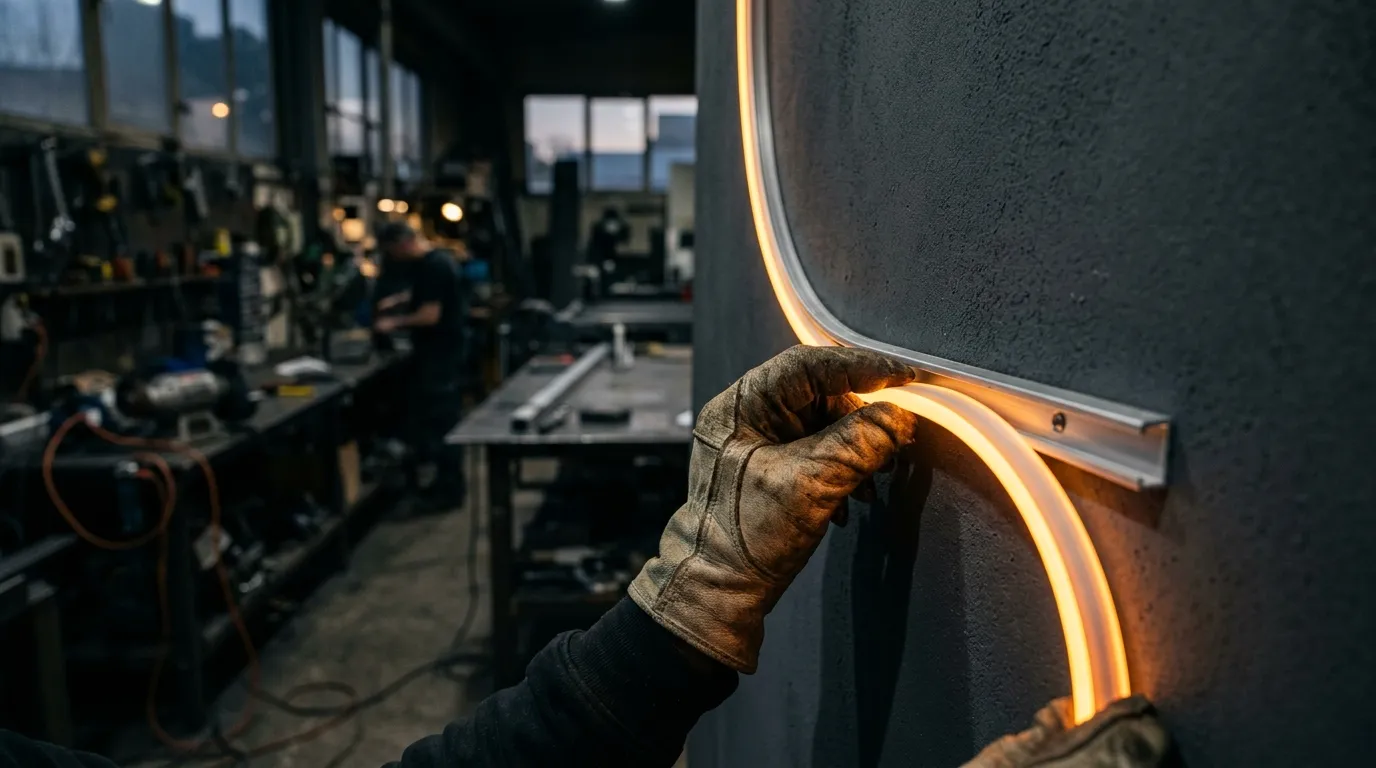
Neon flex routes into aluminum channel and letter returns — the install pattern that makes it the default for dimensional signage.
Power and voltage drop. Both run on low-voltage DC (12 V and 24 V dominate; 48 V appears on long-run products). The practical difference is current. Neon flex's lower LED density keeps per-meter current modest, so a single feed carries a longer installed run. High-density pixel strip draws more current per meter, and at 12 V a long run loses enough voltage that pixels at the far end dim or drop out — the reason power injection points are planned every few meters on 12 V animated runs. The 12 V vs 24 V vs 48 V guide covers that decision in depth; the short version is that animated, high-density, or long runs should be quoted at 24 V or higher, and the power budget needs 20–25% headroom above calculated draw.
Outdoor Protection, Lifespan, and Repair
Outdoor signage is the default for storefront work, so protection and what happens when something fails belong in the same section — they are the same decision.
Protection. Neon flex wins out of the box: the silicone skin is extruded over the electronics in one piece, so the product is sealed along its entire length with no exposed solder joints, and most neon flex is rated IP65–IP66 as standard. That is why flex letters survive rain and car-wash spray without extra work. Pixel strip ships bare at IP20 and only becomes outdoor-safe through add-on protection — a clear silicone sleeve, a resin or gel coating, or a fully potted/IP68 build. The coating changes the product's flexibility and heat behavior, so it is not a free upgrade. If you are comparing two quotes where one strip is IP20 and the other IP68, the difference is not "one is more waterproof" — it is whether the electronics are sealed by the factory or by the installer, and unsealed field joints are where water damage starts. The IP rating guide for outdoor pixel LED strip explains the IP20-to-IP68 scale as it applies to strip products, and the IEC's own IP code page is the authoritative definition of what each digit means.
One material warning specific to neon flex: silicone yellows under prolonged UV, and a white tube that reads crisp at install can look warm and aged after two years of direct sun. Ask whether the profile uses UV-stabilized silicone and check the warranty's stance on outdoor white. It is the one durability complaint we hear about LED neon that is real and recurring.
Lifespan and repair are opposites in disguise. Neon flex has fewer failure points — sealed electronics, no field splices — and its rated life is typically quoted in the 50,000-hour class. But when a sealed run fails, the repair is replacement: you cut the dead segment out and install a new sealed piece, or re-run the whole letter. Pixel strip fails at the component level: one driver IC or LED dies while the rest keep working, and because it is addressable the failure usually announces itself as a stuck or dead pixel rather than a dead sign. The repair is surgical — cut out the bad segment, splice a new one — but it is field work with a soldering iron or connector kit, and spliced sections can show slight color differences. For an animated video wall, one dead pixel is a visible defect and the buyer should plan spare stock; for a chase-effect sign, a single dead pixel is often invisible in motion. Put the maintenance reality into the decision: who services this sign after install, and how far is the nearest spare?
Sourcing Neon Signs from China: What the RFQ Should Ask
Here is where the technology choice meets the actual search that brought you here. "Neon signs from china" is a procurement query, and the SERP it returns is almost entirely supplier homepages, marketplace listings, and factories — almost none of which tell you which light engine you are buying. You will now be the buyer who knows the difference, which changes what you ask.
The quote lines that change between the two technologies. When you send a drawing to three suppliers, the RFQ should force them to quote the same spec, or the prices are not comparable:
RFQ line | Neon flex order | Pixel strip order |
|---|---|---|
Unit of measure | Per meter of installed letter path | Per meter and total pixel count |
Controller | Rarely needed (static or zoned) | Always required for animation — is it included? |
Protection | Quote the tube's IP rating | Quote IP20 + coating/sleeve as separate lines |
Terminations | Sealed ends included or extra? | Splices/connectors per cut — priced how? |
Content | Not applicable | Who maps/addressing? Who loads content? |
Samples | 0.5 m lit sample | 1 m + controller demo, or a lit photo of your color |
Ask every candidate the same three technical questions and write the answers down: What driver IC or LED density is in this quote? What is the IP rating of the exact product quoted — not of the "series"? Is the controller in the price? Suppliers who cannot answer without forwarding your email to an engineer are trading companies, which is not disqualifying — but you should know you are paying a layer, and their quality claims are the factory's, not theirs.
Why "made in China" quality varies more than technology. The LED, silicone, and PCB costs in a neon flex sign differ only slightly between a good factory and a bad one; the real difference shows up in lifespan and uniformity, and it is invisible in a photo. Three checks do most of the work: request a lit sample or a video of the actual sign before production; ask for certificate numbers (CE and RoHS are the baseline for EU-bound product, and the EU's CE marking pages explain what the mark does and does not certify); and ask how many comparable signs the factory shipped in the last year, then look for those projects rather than the hero photos on the homepage. If you are sourcing through a platform rather than direct, the same vetting applies one layer up. Our guide to vetting a China LED supplier covers audits, samples, payment terms, and inspection in the order a buyer actually hits them.
Wholesale and custom orders change the negotiation, not the technology. If you are buying wholesale neon signs to resell, you are usually buying standard shapes and colors at volume, and your bargaining power is MOQ, lead time, and packaging — not spec. Custom neon signs (your logo, your artwork) are where the technology decision above matters most, because the factory will happily make an animated design in static flex if you do not stop them, and will quote you pixel hardware for a static logo if you let them. Two practical points for volume buyers: confirm the factory's shortest production length and cut units before committing to a design grid, and pin down the acceptable dead-pixel rate on video-grade runs (often a few percent, and usually negotiated per square meter of active pixels) before the order, not at inspection. For OEM work — your brand, their factory — the OEM, ODM and distribution guide covers IP, tooling, and minimums from the distributor's side.
Finally, the question that shows up in every PAA box and every forum thread: is it "real" neon? Real neon is glass, gas, and high voltage, and it is rare in new signage. Almost everything sold as a neon sign from China — custom, wholesale, or storefront — is LED neon flex or pixel-based LED dressed in a neon profile. That is not a scam; for most buyers it is a better product (cheaper shipping, unbreakable, low voltage). But it changes your expectations: LED neon will not have the exact flickerless gas glow of glass at 1 cm, and it should be bought on LED spec sheets, not on the word "neon." If a seller claims genuine glass neon for storefront volume, ask how they ship it internationally without breakage — that question alone filters most of the noise.
How to Choose: A Decision Path
Work the decision from the content backward, then confirm with the budget.
When neon flex is the better choice. Your sign holds still: a logo, a wordmark, an icon, a symbol, a store name that changes color rarely or never. You are building channel letters or dimensional letters. The sign is outdoor and you want sealed-and-forget installation. You have no control system, no content person, and no appetite for field splicing. For most storefront signage — the static sign that identifies a business — neon flex is the better answer, and choosing pixel strip for it buys capability the sign will never use.
When pixel strip is the better choice. The content moves: chasing borders, scrolling messages, animated logos, waves, or anything driven by a control desk. You need RGBW for clean white plus effects. The surface is flat and continuous (window frames, soffits, fascia lines, cabinet signs) and you or your client will maintain the content. If the sign's job is to change — hourly messages, seasonal colors, video — pixel strip is not a luxury; it is the only option that does the job.
When the hybrid wins. The design needs segmented color or simple effects but must keep a smooth neon look, and the content complexity is low enough that pixel-perfect control is overkill. Addressable neon (pixels inside a silicone profile) is the fastest install path there.
Two failure modes worth naming, because they are the expensive ones: buying neon flex for a concept that will animate (the sign must be rebuilt, not upgraded — you cannot retrofit pixels into a sealed tube), and buying pixel strip for a static sign (you pay for a controller, mapping, content tools, and field maintenance to reproduce what a sealed meter of neon flex delivers on its own). If a future animation is even plausible, price the hybrid before you decide — it is the insurance option that keeps both doors open.
The Bottom Line
Static brand signage, channel letters, and letterforms: neon flex. Animated, video, or content-driven signage: pixel strip. When you need smooth neon with simple motion: addressable neon. From a sourcing standpoint, all three are manufactured well and poorly in China, and the technology decision is only half the job — the other half is vetting the supplier who builds it and putting termination, IP rating, controller, and dead-pixel terms into writing before the deposit.
Take your drawing and walk it through the at-a-glance table once: if the answer is "static," ask for per-meter neon flex quotes with sealed ends and an IP rating; if it is "animated," ask for pixel counts, controller inclusion, and a lit demo. A 0.5-meter sample order before the production run is the cheapest insurance in this industry — every supplier on the shortlist will sell you one, and the sample tells you more than the sales deck ever will.
Specifying pixel LED for a real project?
Send the spec — pitch, IC, IP class, run length, voltage — and you get an engineer's answer, not a catalogue. Samples and OEM/ODM quotes from the Shenzhen factory floor.