
LED Strip Operating Temperature: Ta, Tc or Tj?
Most LED strip datasheets quote a single operating temperature without saying which node it measures. Here is how to read Ta, Tc and Tj and compare fairly.
What "LED Strip Operating Temperature" Is Really Measuring
An LED strip's operating temperature is the range at one specific point in the assembly, not the temperature of the light and not a property of the LEDs alone. Usually it is either the ambient air the strip sits in or the temperature of a marked test pad on the strip surface, and the manufacturer only guarantees the published flux, colour and lifetime inside that range. Two datasheets can both say "operating temperature" and mean two different things, which is why so many comparisons go wrong before anyone opens a calculator.
Three temperature nodes matter, and they are not interchangeable. The figure below is the whole argument in one picture.
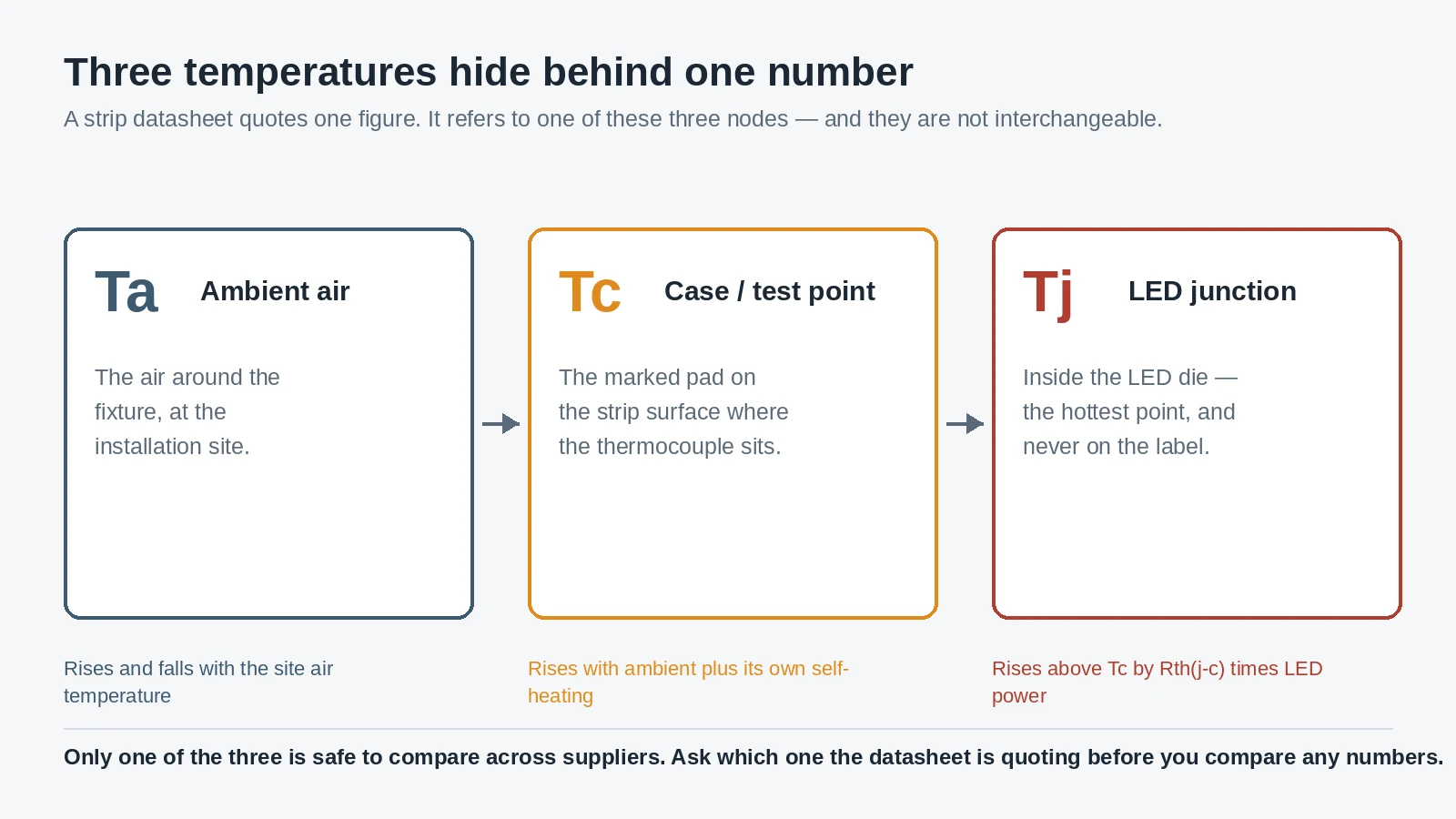
Ta, the ambient. The air around the fixture at the installation site. It is the number you can actually measure with a wall thermometer, and it is the only node that exists before the strip is powered.
Tc, the case temperature. The temperature at a specific marked point on the strip, read under steady-state conditions. In module datasheets the Tc point is where a thermocouple is attached during the manufacturer's own test, a convention defined in the IEC 60598 and IEC 62031 standards rather than invented by each supplier. Philips, for example, lists a nominal Tc of 55 °C, a lifetime Tc of 85 °C and a maximum Tc of 85 °C for the same 1 ft module, with a note that the last value is the limit for safe operation.
Tj, the junction temperature. The temperature inside the LED die itself. It is always higher than Tc, by an amount set by the thermal resistance from junction to case multiplied by the power the LED is dissipating. Almost no strip datasheet prints a Tj limit, because the customer cannot measure it; the chip maker sets it and the module maker works backwards to a Tc limit you can check.
So when a supplier says the strip runs from −20 to +60 °C, the useful question is not whether that is a good range. It is which of these three nodes the number belongs to.
Why the Number You Compare Is Often the Wrong One
Pull three real datasheets side by side and the problem becomes concrete.
Datasheet | Operating range (Tc) | Ambient range (Ta) | Storage |
|---|---|---|---|
LumiFlex 3090, Cree 4000 K | −40 to +85 °C | −40 to +50 °C | −40 to +100 °C |
BILTON BL ONE Comfort | −5 to +60 °C | −20 to +45 °C | 0 to +60 °C |
Philips CertaFlux 1 ft HV4 | −40 to +85 °C (nominal 55 °C, max 85 °C) | not quoted on the module sheet | — |
Three products, three different ideas of what the word operating means. The LumiFlex 3090 Cree strip datasheet lists its Tc range and its ambient range 35 K apart, which is entirely normal: the metal the strip is bonded to runs hotter than the air in the room. The BILTON BL ONE Comfort datasheet separates the same concepts differently again, and rates the strip to survive colder air than its own case is rated for, because the case only warms up when the strip is running and the mounting surface is doing its job.
Now put a marketing line such as "wide temperature range, −40 to +85 °C" next to either of those. It is not false. It is just quoting a Tc envelope while the reader is imagining site air, and the two differ by more than most projects have margin for. A strip whose Tc limit is 85 °C may be perfectly safe on a 45 °C factory ceiling, or it may not, depending on how much of its own heat it has to shed through the profile it is glued to. The datasheet number alone cannot tell you which.
This is the single most common sourcing error in temperature specs: comparing a Tc figure from one supplier with an ambient figure from another and concluding that one strip is tougher. It is the same class of mistake as comparing IP20 and IP66 as if the second digit meant the same thing in both grades, which is why ingress protection needs its own IP rating guide for outdoor pixel LEDs rather than a one-line summary.
What Heat Costs You in Light and Hours
Temperature is not a pass/fail gate that opens below a magic number. It is a price list, and the currency is flux, efficacy and hours.
The Philips CertaFlux 1 ft 1100 lm HV4 datasheet publishes flux against case temperature for the 3000 K (830) version at nominal current: 1082 lm at Tc 25 °C, 1029 lm at the nominal 55 °C, and 969 lm at the 85 °C maximum. That is roughly 10 % of output gone between a bench measurement and the top of the rated envelope, and module efficacy falls with it, from 161 lm/W to 149 lm/W across the same span.
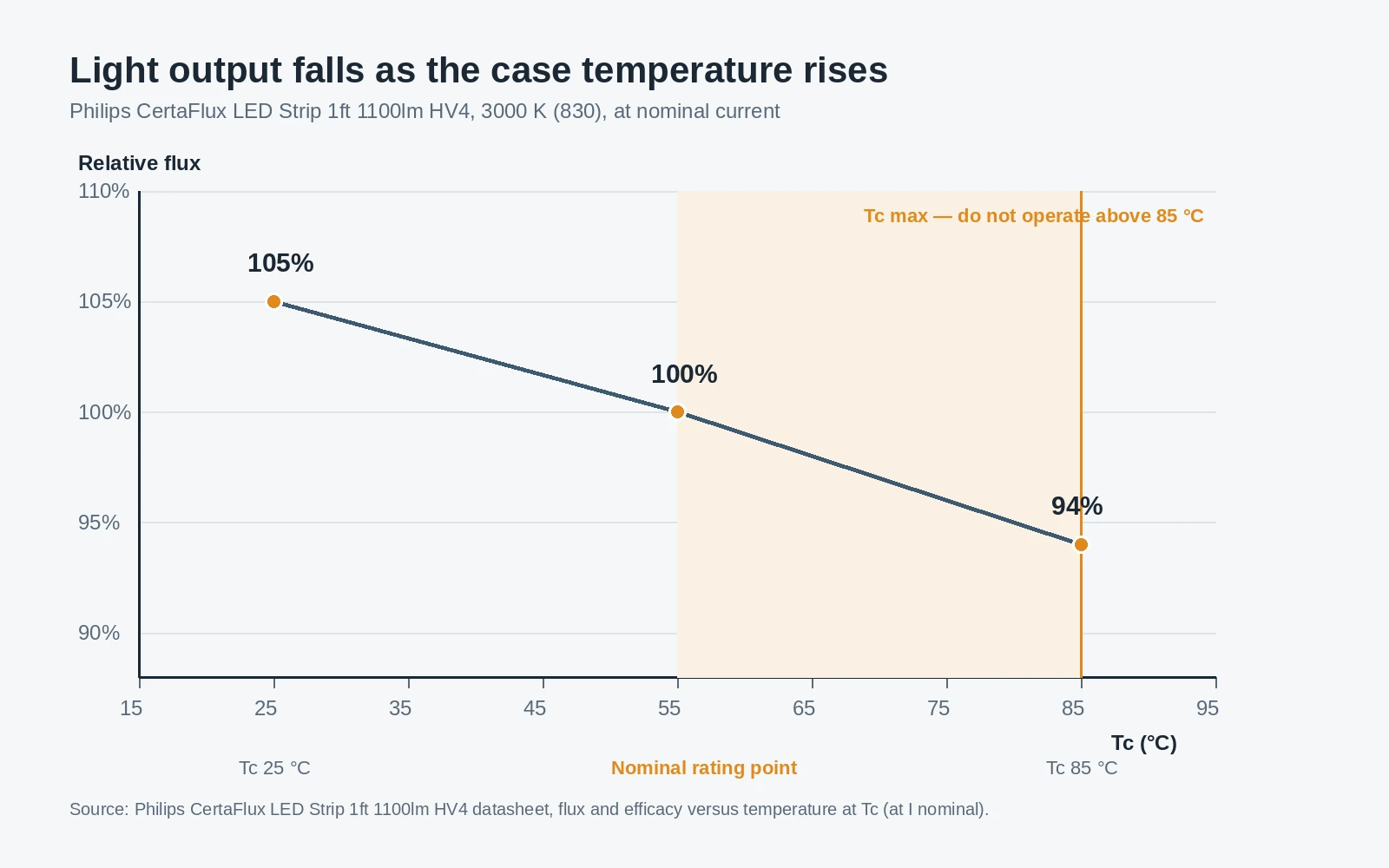
The shape matters more than the exact numbers, because it repeats across manufacturers: the curve is gentle at first and steepens as Tc climbs. An installation that runs at 70 °C case temperature is not 15 % worse than one at 25 °C; it is somewhere on the shoulder of that curve, and the only reliable way to know where is to ask for the derating table rather than interpolate from the headline lumen figure.
Lifetime follows the same logic. BILTON states 60,000 hours L80/B10 at 25 °C for a strip whose Tc limit is 60 °C, which is a strong claim made at a temperature well below the limit. That is normal and honest practice, but it means the 60,000-hour figure is only comparable with another supplier's figure if both are quoted at the same Tc. A life number with no temperature attached is not a specification; it is a hope.
What you rarely see quantified is the colour drift. It is real, it is cumulative, and on a facade or a broadcast set it shows up as a patch of pixels that no longer matches its neighbours after two summers. If a supplier cannot tell you the Tc at which their LM-80 data was collected, treat the colour consistency claim as unverified.
The Rest of the Temperature Block Deserves a Read Too
The operating range is one line in a block of related numbers, and the others constrain the design just as hard.
Datasheet field | What it actually constrains | Where projects get caught |
|---|---|---|
Storage temperature | Shipping and warehouse conditions, unpowered | A storage range wider than the operating range is normal; do not read it as headroom |
Tc maximum | The surface temperature the module may never exceed in service | Quoted without the test-point location, so nobody can verify it on site |
Ambient at Ta = 25 °C | The conditions behind the maximum run length | Long runs derated for voltage drop assume 25 °C air, not a 45 °C ceiling void |
Soldering and rework limits | Field termination and repair | Hand-soldered joints cooked past the pad limit fail months later |
Mounting surface requirement | The thermal path the rating assumes | Adhesive on plasterboard instead of aluminium turns an 85 °C rating into fiction |
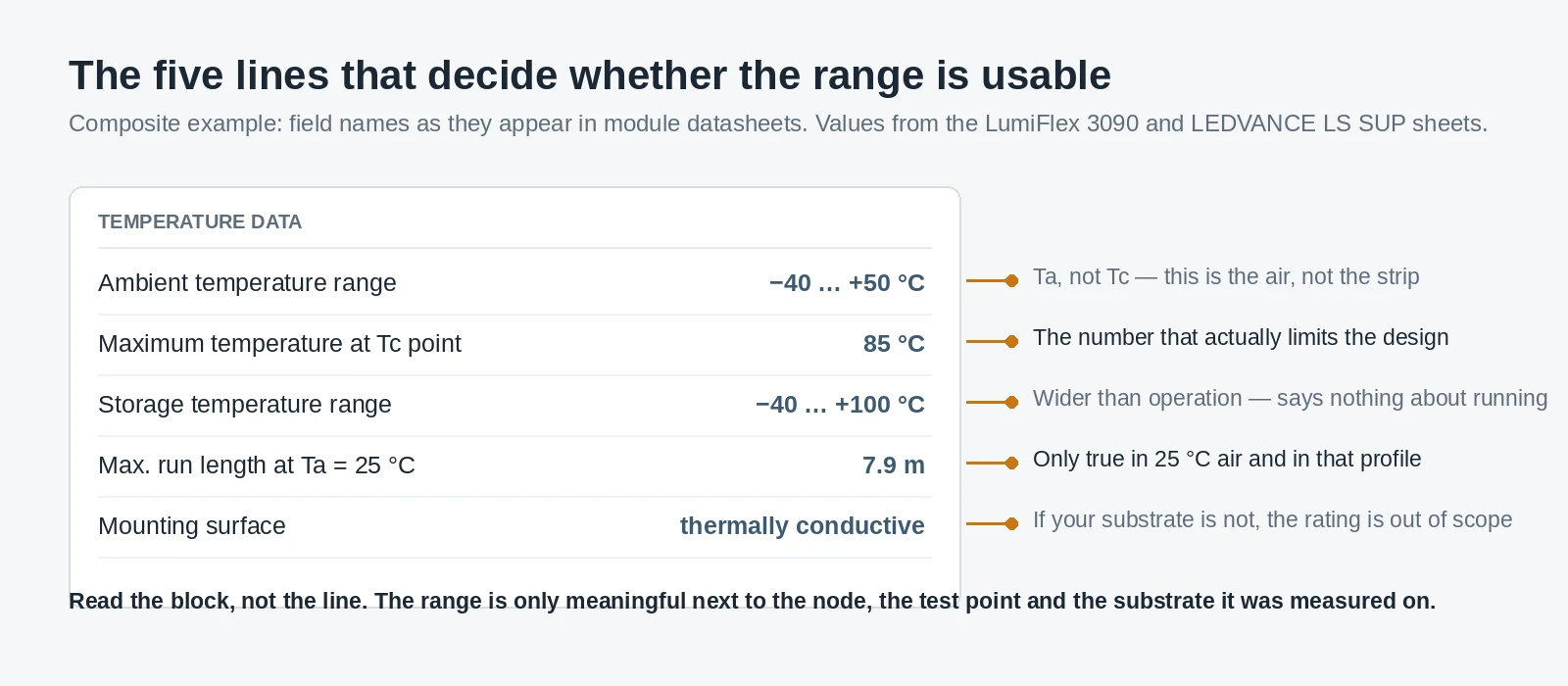
Storage is the one most often misread. The LumiFlex sheet allows −40 °C to +100 °C in storage against −40 °C to +50 °C of ambient air while the strip is running, with its Tc range quoted separately at −40 to +85 °C; BILTON allows 0 °C to +60 °C in storage against −20 °C to +45 °C of ambient while running, with a Tc range of −5 to +60 °C. Storage limits describe what the packaging and the unpowered components tolerate; they say nothing about what happens when current starts flowing.
The LEDVANCE LED STRIP SUPERIOR TW datasheet makes the mounting assumption explicit: the module must be mounted to a thermally conductive surface to ensure that Tc is not exceeded, and the maximum run length is quoted at Ta = 25 °C. Those two sentences carry more engineering weight than the temperature range on the front page. If your substrate is not thermally conductive, or your ambient is not 25 °C, you are outside the conditions the numbers were measured in.
Safety ratings sit on top of all of this rather than replacing it. UL 8750 is the standard for LED equipment, and a listing tells you the assembly was evaluated for fire and shock risk under defined conditions; it does not tell you the strip will hold its colour at 70 °C. Ingress protection and thermal rating are separate claims from separate tests, and a certificate number proves neither on its own.
Site Conditions That Quietly Break the Rating
Most field failures traced to temperature are not caused by a wrong number. They are caused by a right number evaluated in the wrong place.
The profile is part of the thermal system. An aluminium extrusion spreads heat along the run and adds surface area; the same strip on a wooden pelmet has nowhere to put it. This is why choosing an aluminium profile that will not block the light is a thermal decision as much as an optical one, and why a diffuser that traps air changes the case temperature even when nothing about the strip has changed.
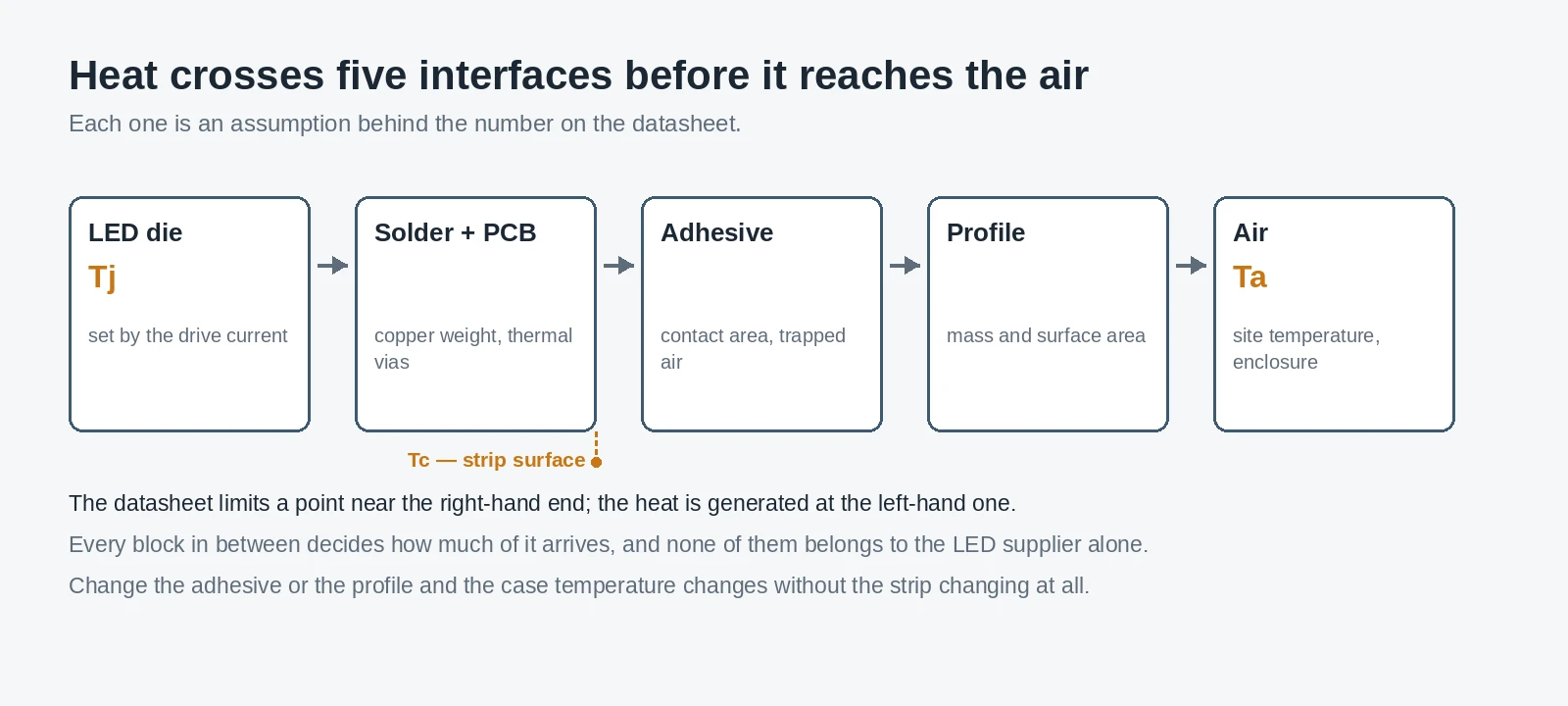
Enclosed voids run hotter than the room. A cove, a sign box or a ceiling plenum often sits several kelvin above the space you measured, and the air stratifies. Measure inside the enclosure at the hottest hour of the day, not at the thermostat.
Solar gain is an ambient multiplier. A dark facade panel in direct sun reaches well above air temperature, and the strip bonded to it inherits that. Outdoor projects need the ambient figure read as "air in the shade at the panel", then corrected upward.
Cold is a mechanical problem more than an electrical one. LEDs start readily below freezing, but PVC and some silicones stiffen, adhesive loses tack, and a strip installed at −10 °C may never sit flat again. The LumiFlex ambient floor of −40 °C is an operating limit, not an installation instruction.
Dimming helps; voltage does not. Cutting output cuts the heat in proportion, which is the cheapest thermal fix available on a marginal run. Changing from 12 V to 24 V does not reduce total watts at the same brightness, so it does not reduce the heat load either.
When a run does overheat, the first symptoms are rarely a dead pixel. They are flicker at the far end, a colour shift on one section, or a driver that trips on a warm afternoon, all of which are covered in the addressable LED strip flickering troubleshooting guide.
How to Compare Two Datasheets Fairly
Four questions will expose more about a supplier's thermal engineering than any headline range.
Ask | A good answer | The red flag |
|---|---|---|
Which node is the range, and where is the test point? | "Tc maximum 85 °C, measured at the pad marked in the drawing" | A range with no node name and no test-point drawing |
At what Tc is the lifetime figure quoted? | "L80 at 60,000 h, measured at Tc 55 °C" | 60,000 hours with no temperature attached |
Is there a derating table or curve? | A flux-versus-Tc curve, or at least two points | A single maximum with no shape to the curve |
What mounting substrate and ambient were assumed? | "Aluminium profile, still air at 25 °C" | Silence, or a claim that the profile does not matter |
Ask those four before price, and the comparison changes shape. A strip with a lower headline maximum but a published derating curve at your ambient is often the safer choice than one with a spectacular range and no data behind it.
This is also where the difference between a factory and a trading company becomes visible. Aging and thermal testing happen in-house or not at all, and the six-step QC process is where a batch earns or loses its stated Tc behaviour. A supplier who runs those tests can tell you the Tc point and the substrate behind a number; one who buys finished reels usually cannot, which is why the four questions above so often end the conversation. Our own pixel strips go through that aging step before packing, and the LED strip range can be configured on voltage, IP grade, IC and run length for the site rather than the catalogue page.
Temperature belongs in the spec sheet because it is the one line that tells you how much of the published performance you will actually receive. Read it as a pair, node and number, and the rest of the datasheet stops being a list of claims.
Specifying pixel LED for a real project?
Send the spec — pitch, IC, IP class, run length, voltage — and you get an engineer's answer, not a catalogue. Samples and OEM/ODM quotes from the Shenzhen factory floor.