
Top Addressable LED Manufacturers in China: A Pixel Lighting Supplier Comparison
Eight addressable LED manufacturers in China, each checked on its own product pages: what they make, which control platform they suit, and who to skip.
The phrase "addressable LED manufacturers" covers three different kinds of company, and picking badly usually means picking across a lane boundary rather than picking a bad factory. The eight suppliers below were each checked on their own product and company pages in November 2026: Shenzhen LED Color, SuntechLite, MSHLED, SDIP Light, Eonjoy, Senfey, Clenled and PILEDS. They are listed by what they actually sell — components, tape at catalogue scale, then fixtures plus control gear — because that grouping, not the driver IC list, decides whether a supplier can serve your project at all.
One disclosure before the list: this article is published by PILEDS, which is one of the eight. It appears in its lane with its limitations stated, in the same format as the others, and it is not ranked first.
The eight, at a glance
Supplier | Base | Built for | Control / IC | Model data published |
|---|---|---|---|---|
Shenzhen, est. 2012 | Own driver ICs plus the strip built on them | LC8812 / LC8808 / LC8822, WS2811, SK6812, APA102 | IC datasheets and chip-level product pages | |
Shenzhen, est. 2014 | Deepest strip catalogue of the eight | SPI (WS2811–APA102), DMX (UCS512/TM512) | Per-model pages plus per-family downloads | |
Shenzhen | Strip with model-code spec tables | SK6812, UCS1903, UCS2904B, TM1814, WS2815 | Full model table: pixel/m, W/m, cut length | |
Dongguan | Strip plus nodes, decoders and controllers | DMX512, SPI, MADRIX-class controllers | Decoder and controller model pages | |
Shenzhen, est. 2014 | Addressable COB strip | WS2811, WS2812, UCS7604, SK6812 on COB | COB density and IC list per series | |
Shenzhen factory, Zhongshan office | Narrow, spec-locked pixel strip | WS2811, WS2812B, Bluetooth controller | Spec card per model, indicative pricing | |
Shenzhen, est. 2007 | Stage and rental pixel fixtures, matrix, kinetic | Art-Net, Art-Net/RDM, DMX, SPI | Fixture and controller model pages | |
Shenzhen, since 2015 | Pixel fixtures plus a 13-model control range | Art-Net, DMX512, SPI, MADRIX | Per-model pages with published model codes |
How this list was built
Inclusion was deliberately narrow. A company qualified only if all four of these held when checked:
Criterion | What counted as evidence | Where it was checked |
|---|---|---|
Makes addressable product | A catalogue of individually controlled strip, pixel fixtures, nodes, or the driver chips themselves | The supplier's own product pages |
Says what the item is | Model or item codes with pixel count, voltage and IC or protocol published | Product and specification pages |
Can change the product | OEM, ODM or custom configuration stated as an offering, not implied | About / customisation pages |
Reachable and current | Site loads, English product pages, catalogue actively maintained | Direct fetch, 1 November 2026 |
Excluded on purpose: B2B marketplace storefronts (Made-in-China, GoldSupplier and similar), which list hundreds of trading companies behind one domain and cannot be verified as factories; directory listicles that rank suppliers without citing any product page; and any candidate whose own site would not serve a page over HTTPS — one frequently cited name, ipixelled.com, answered on plain HTTP that day but failed its TLS handshake (its apex domain resolves; the www host does not), which for a supplier taking B2B orders is itself a finding. It is noted here rather than dropped silently, and rather than described from memory.
What this list does not rank: price, MOQ, lead time, warranty terms in practice, or certificate validity. Those cannot be settled from a website, and a comparison that pretended otherwise would be inventing data. They are the subject of a separate check — how to vet a China LED supplier — and the last section of this article says exactly which of them this comparison leaves open.
Manufacturer, factory, supplier, trading house
The word "manufacturer" is doing four different jobs here, and the difference changes what a quotation means. A factory owns the SMT line, the reflow oven and the aging racks, and can show you the floor. A manufacturer, in the sense this article uses it, also reconfigures the product for your order. A supplier or trading house sells the same goods without owning the line: capable at documentation and logistics, but it cannot commit to a change it cannot make.
The test costs one email — ask for a specification that is not in their catalogue. A factory answers with a drawing, a sample lead time and a quantity question; a trading house answers with "let me check with the factory". Only one of those can be held to a PO. This article assumes you are talking to the first two, and the vetting guide linked above is where that assumption gets tested.
The three lanes these eight compete in
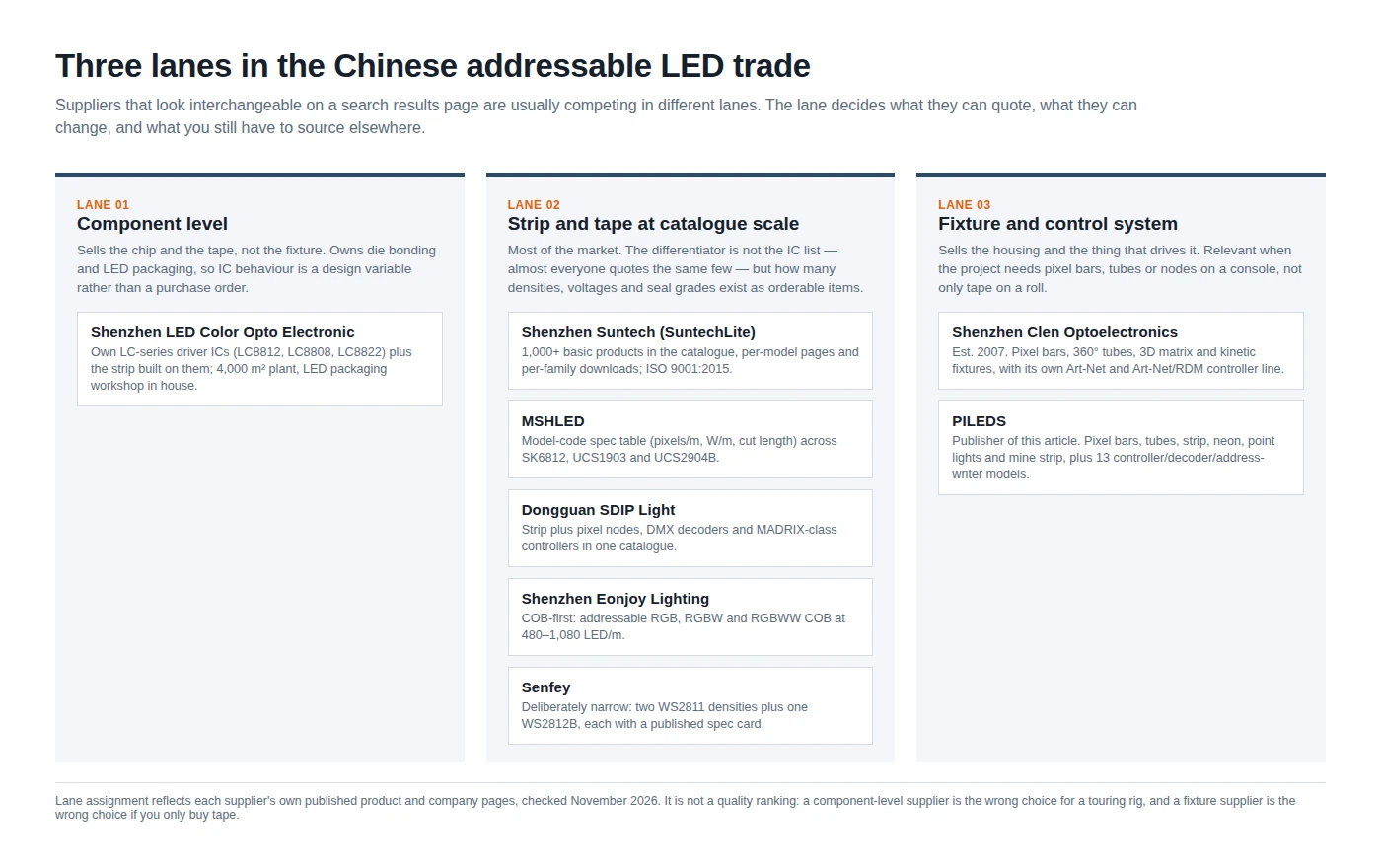
The distinction that matters is not brand size. It is how far up the chain the supplier goes.
Component level. The supplier makes the driver chip and the tape that carries it. Shenzhen LED Color sits here: it publishes its own LC-series ICs (LC8812, LC8822, LC8808 and relatives) alongside the WS, SK and APA parts it also packages, and runs its own LED packaging workshop. If the strip is going inside your own product and the IC behaviour is part of your design, this is the conversation to have. If you need a fixture housing, this lane stops.
Tape at catalogue scale. Most of the market. Almost everyone here quotes from the same short list of driver ICs — WS2811, WS2812B, SK6812, UCS1903 — so that list tells you very little about which one to pick. Senfey is the clearest illustration: three specifications, built on WS2811 and WS2812B and nothing else. What differs is how many densities, voltages, widths and seal grades exist as separately orderable items, and whether the specification for each is published. That is also where the RGB-versus-RGBW decision lands: the fourth channel is only worth paying for if it is driven independently, which in practice pushes you toward SK6812 or a COB build rather than a WS2811 tape with a white LED next to it. Break-point-resume parts such as WS2813, WS2818 and TM1934 show up almost exclusively in this lane, because the buyers who care about a single failed pixel on a 200 m run are strip buyers. Voltage is the other axis that settles the run before any supplier conversation: 5 V carries a few metres before it needs injection, 24 V carries much further, and the 12 V, 24 V and 48 V comparison is where that trade-off is worked out.
Fixture and control system. The supplier sells the housing and the thing that drives it: pixel bars, tubes, 3D matrix panels, point lights, controllers and decoders. Clenled and PILEDS sit here. This lane matters when the deliverable is a lit object on a console rather than tape on a reel — and it matters most when the controller and the fixture have to be matched by the same party.
A supplier in the wrong lane is not a worse supplier. It is a supplier whose answer to "can you do this?" will be a referral, a month late.
One question sorts a vendor list into lanes before any quotation exists: can the party you are emailing change the IC, the density, the seal grade or the housing on your order — or can it only quote what is already in the catalogue?
What each one is genuinely good at
Shenzhen LED Color — when the chip is part of your design
The unusual thing here is vertical reach into the LED package itself. The company states a 4,000 m² plant with LED and IC die-bonding, wire bonding, SMT and reflow under one roof, and it sells its own LC8812, LC8822, LC8813, LC8816, LC8818, LC8826, LC8828 and DC12V LC8808 parts next to the APA102, SK6812, SK9822, GS8208, WS2812B and WS2813B chips it also packages. Package sizes run from 5050 down to 1515 and 2020, including 4020 side-emitting. Strip assembled on those chips is offered to IP65, IP67 and IP68, with OEM and ODM stated.
Best for: a brand that needs a specific IC, package or colour behaviour and wants the tape made by the party that packs the chip.
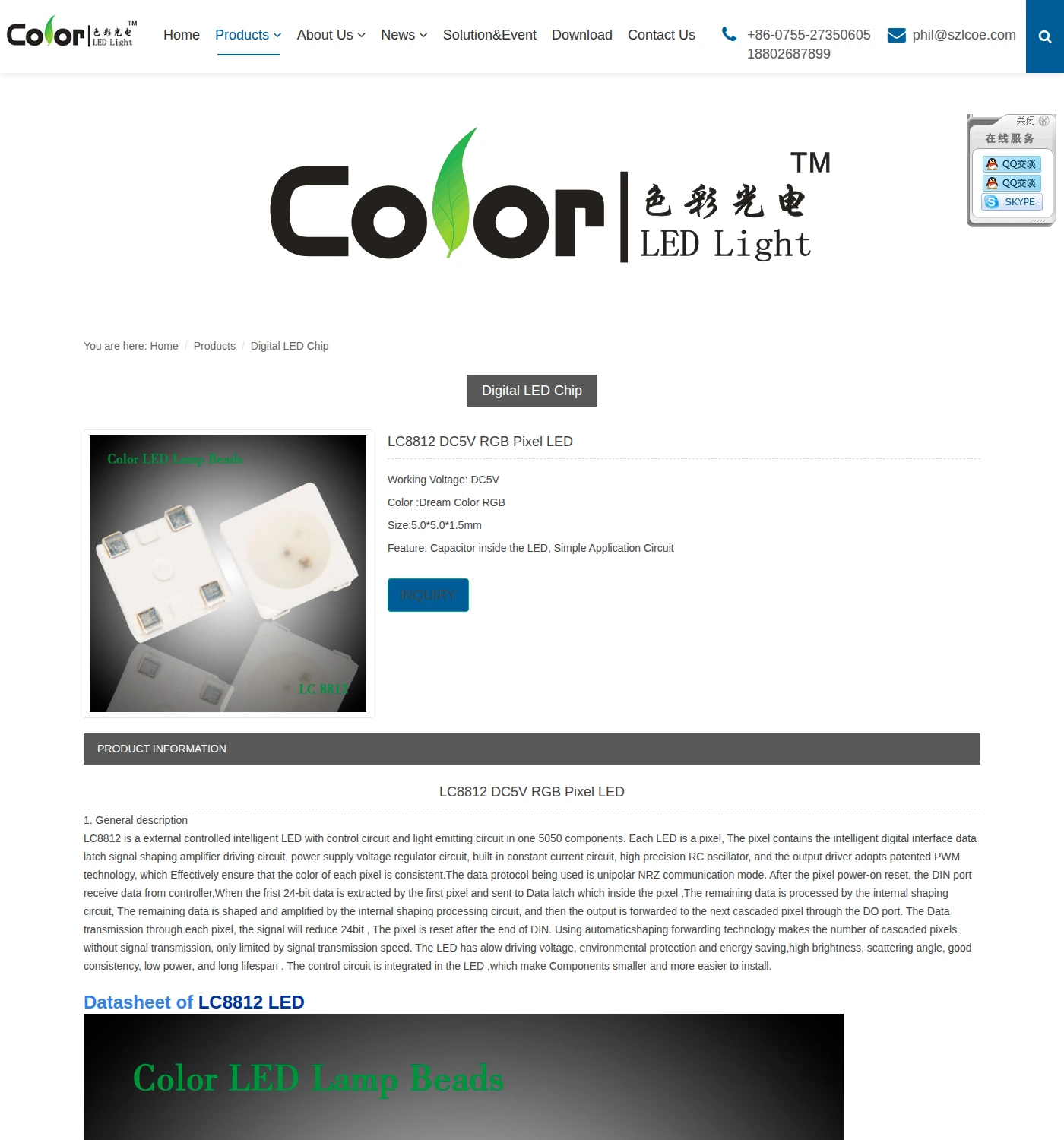
That is what "own IC" looks like on a supplier site: a part number, a package drawing, an electrical description and a datasheet, rather than an IC name borrowed from a chip maker's catalogue.
Watch out for: the catalogue stops at chips, strip, linear and display boards plus a controller and decoder line — no pixel bars, pixel tubes or point-light fixtures appear among the products reviewed, and no project case work is published. At roughly 70 staff, plan capacity conversations early on a large roll-out.
SuntechLite — when you need the strip to already exist
SuntechLite (Shenzhen Suntech Company Limited, trading since 2014, ISO 9001:2015 stated) has the deepest strip catalogue of the eight: the company states 1,000+ basic products in its catalogue across SPI families from WS2811 through WS2812, WS2813, WS2815, SK6812, SK6813, SK9822, UCS1903, UCS5603, UCS2903, UCS2904 and APA102, plus DMX families built on UCS512 and TM512, plus neon, pixel bars and tubes. Each item is published with an item code and a spec block — LED quantity, voltage, cutting unit, power, pixel quantity, break-continue, PCB width — and there is a downloads area with per-product files.
Best for: a distributor or contractor who needs an unusual density, width or voltage to exist already, at a documented price of entry.
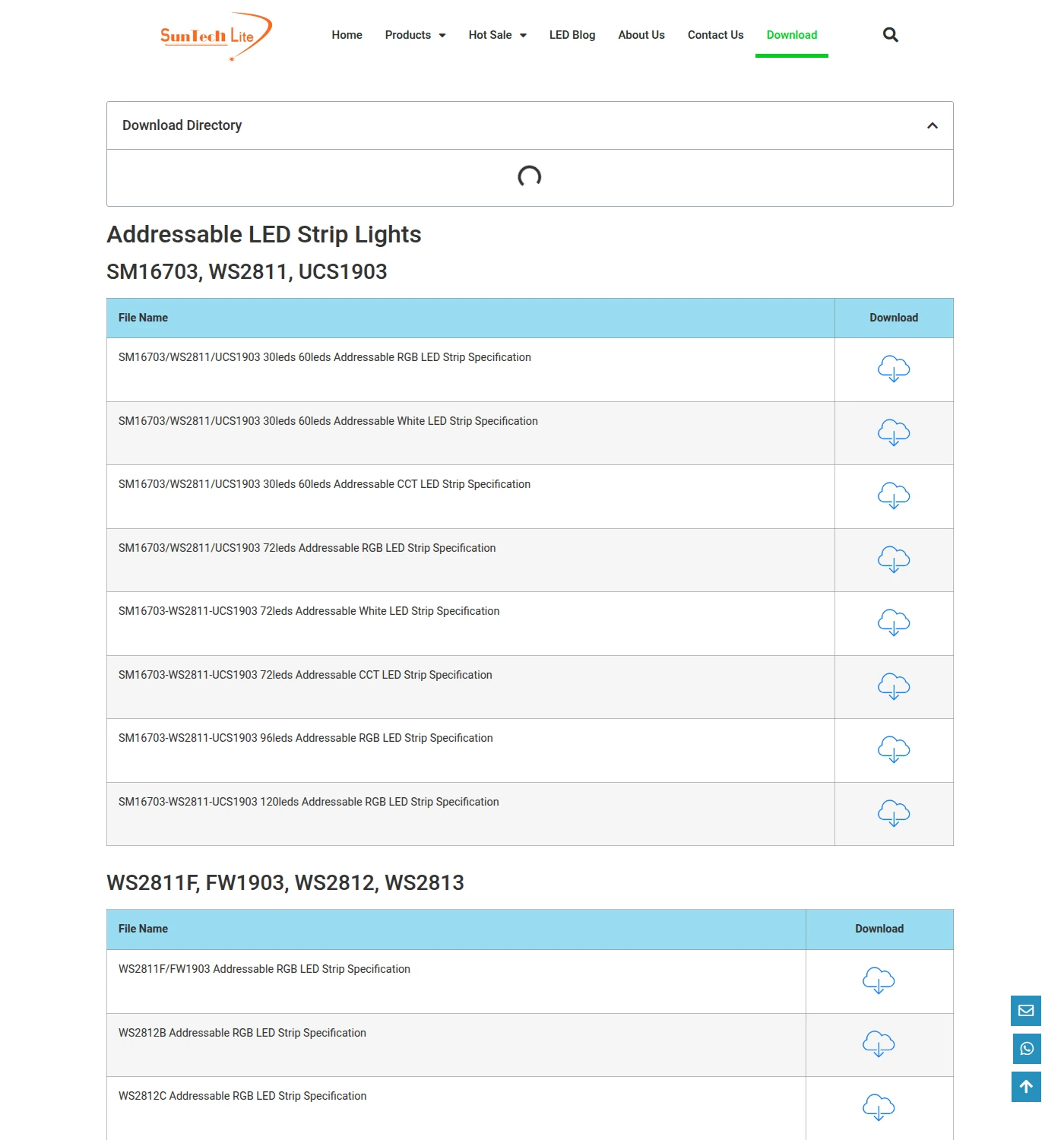
The downloads directory is the part worth copying when you compare suppliers: a specification file per strip family, named by IC and density, instead of a generic catalogue PDF.
Watch out for: the about page states ISO 9001:2015 and a 1,000+ product catalogue but no plant size and no list of production lines, so ask which processes are in-house before assuming the strip is extruded and sealed on their floor; and a catalogue that size invites near-duplicate part numbers, which is exactly where a wrong-code order happens.
MSHLED — when you want the numbers on one page
MSHLED's strip page does something most competitors do not: it publishes a model table with the full operating set in one grid — model code (for example S010060-SK6812RGBW-5V), IC, data line, pixels per metre, LEDs per metre, voltage, watts per metre and cut length — across SK6812, UCS1903, UCS2904B, TM1814 and WS2815 variants. The company states a team of over 100, automated production lines, free samples, 7–9 day delivery, LM-80, CE and RoHS, and OEM/ODM for wholesalers and distributors.
Best for: procurement teams who build a BOM from published numbers and want to compare like for like without emailing for a datasheet.
Watch out for: the certification claim is LM-80, CE and RoHS on the pages reviewed — no UL or ETL, so if your market needs either, that is a question to ask early rather than assume. The published strength is strip; fixture housings are thin.
SDIP Light — when the strip and the decoder should come from one place
Based in Dongguan, SDIP sells addressable strip (WS2811, WS2818, WS2812, WS2813, WS2815, UCS512, SK6812), pixel nodes from 8 mm to 100 mm, LED strings, rigid bars, and a control range of DMX decoders and MADRIX-class controllers (SC01SB decoder, SC803TC master, SC801RC eight-port sub-controller, SC802TB offline master, SC802RA four-port). The company describes its customers as engineering companies and product manufacturers, and states on-site construction counselling as part of the service.
Best for: project work where the decoder, the sub-controllers and the pixel product are specified together and a single party has to answer for the DMX behaviour.
Watch out for: after-sales terms are not published next to the products, so get the repair and exchange window in writing before the PO; and the about page gives no plant size or headcount, so capacity is a question to ask rather than read.
Eonjoy — when the look has to be a continuous line
Eonjoy's deepest addressable line is COB. Its range covers WS2811 and WS2818 breakpoint-resume COB at 480 RGBW, 576 RGB, 720 RGB, 784 and 1,080 LEDs per metre, plus 5 mm and 5 V pixel COB variants, with external IC options of WS2811, WS2812, UCS7604 and SK6812. A COB addressable strip has no visible dot pitch at close range, which is the reason to choose it over SMD. The company states ISO:9001, CE, RoHS, FCC, UL and ETL, and QC from incoming material through SMT, assembly, test and packing.
Best for: coves, feature walls and retail detail where the viewer is close enough to see individual LEDs on a standard strip.
Watch out for: COB pixel density is quoted in LEDs per metre, not pixels — the two are not the same when one IC drives a group, so ask for the pixel count. The addressable range is strip-only: no pixel bars, tubes or point fixtures, and no console-grade controller. Besides addressable strip, the catalogue also carries SMD and high-voltage strip, neon flex, wall washers, aluminium profiles and connectors, with simple controllers filed under accessories.
Senfey — when one specification has to be right, not broad
Senfey is the outlier: three strip specifications, each with a published card. The ES-WS2811-30-12V and ES-WS2811-60-12V run 12 V with 30 and 60 LEDs per metre, 10 mm wide, CRI 80 across the catalogue, IP20 as standard with IP65 and IP67 built to order; the third is WS2812B at 5 V where per-LED resolution is genuinely needed. The company publishes indicative unit pricing on the product page, states OEM/ODM for cut-to-length runs, custom pixel grouping, connector and lead configurations, private labelling and distributor packaging, and recommends a sample length before commitment.
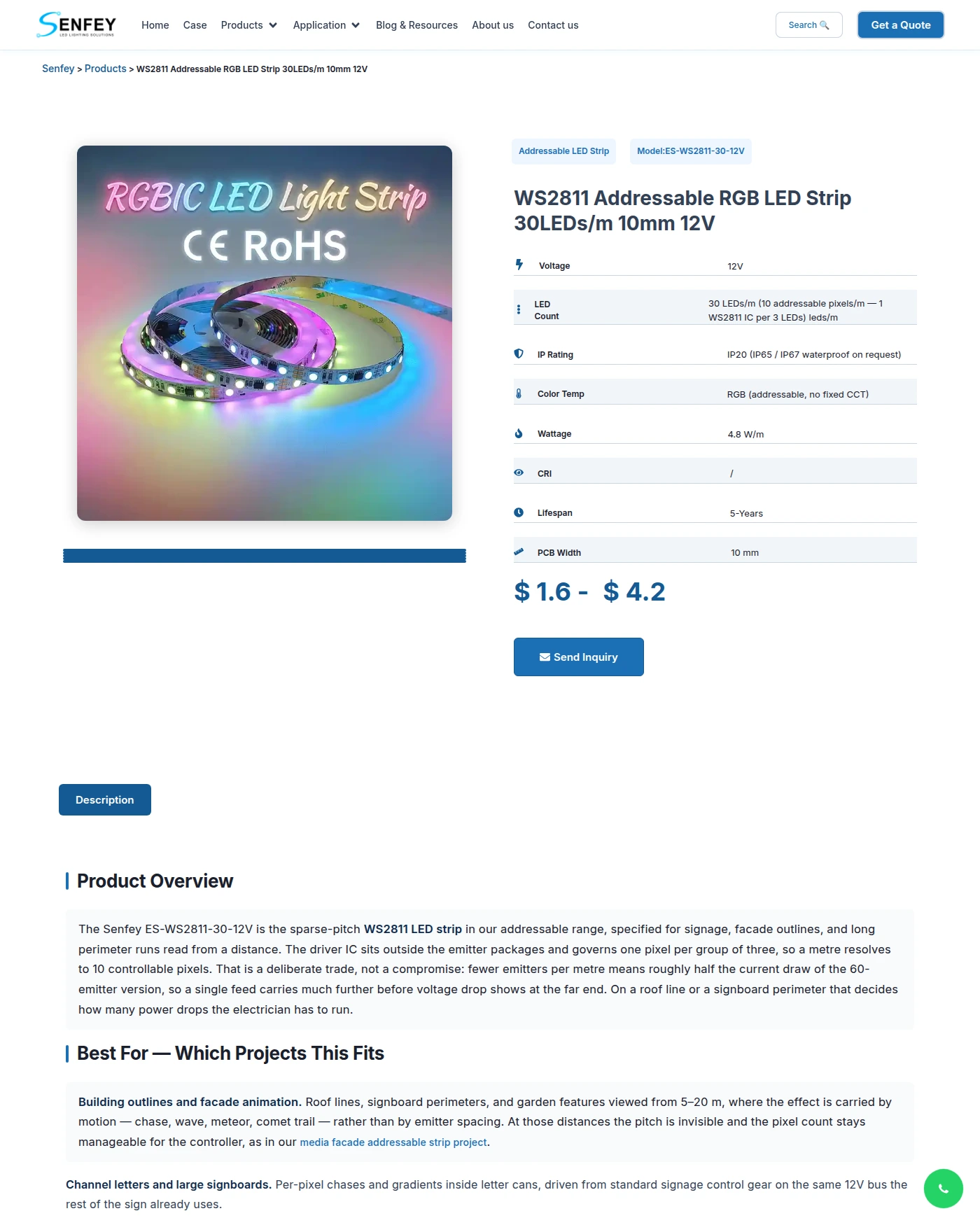
That card is the most complete single-page specification in this list: density given as pixels per metre with the LED-per-IC ratio stated, the seal grade, the PCB width — and a price band on the same page, which is the part none of the other seven publishes.
Best for: a buyer who has already decided the specification and wants it documented, quoted and repeated identically — signage, long architectural runs, a line item that must not drift.
Watch out for: the narrowest range in this list by an order of magnitude. If you need RGBW, DMX-over-UCS512, 24 V runs or IP68, this is the wrong shortlist entry, and the site says as much itself.
Clenled — when the deliverable is a lit object, not a roll
Founded in 2007 — earlier than any other supplier in this list whose founding date is published — Clenled sells the fixture end of pixel lighting: LED pixel bars, 360° tubes, a "magic 3D matrix", a scalelike matrix, flexible LED screens, CNC kinetic motors and a proprietary "Hondys" tube, plus strip, neon and pixel rings. The part worth noticing is the control line — DMX10 port, CL-804PS Art-Net, CL-404R Art-Net/RDM, CL-104PS Art-Net with SD record, AN804PRO Art-Net and RDM, AN404 Art-Net and DMX, and a 3U chassis AN804PS.
Best for: stage, rental and immersive installations where the fixture is the product and the console is fixed. Its published case work is exactly that shape: neon canopy lighting, a suspended 360° tube installation driven over Art-Net, and a large matrix piece.
Watch out for: specification depth per SKU — the catalogue is organised by product family rather than by model-code tables, so expect to request drawings and data for the exact configuration.
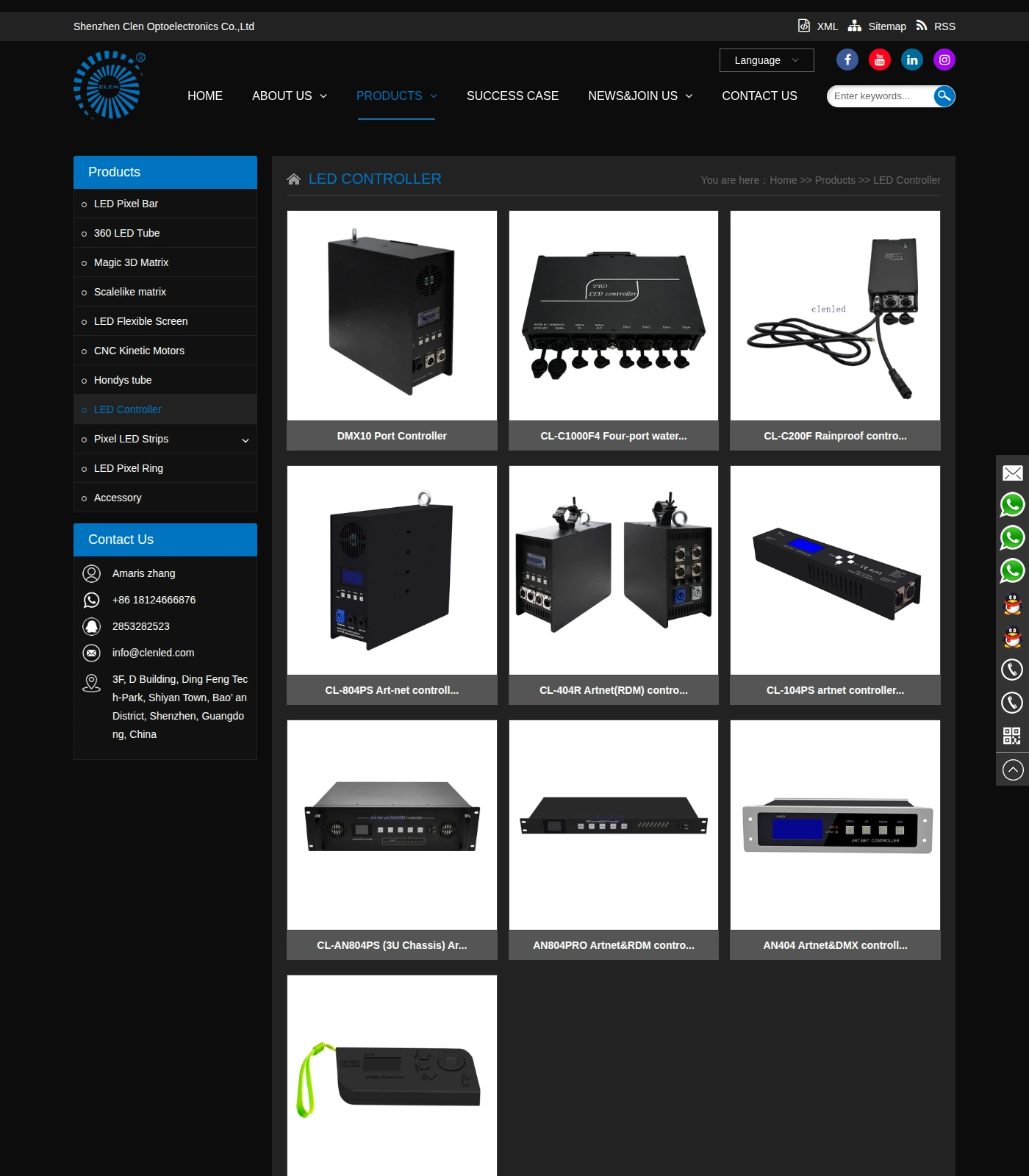
That screenshot is the whole control argument in one page: an Art-Net, Art-Net/RDM and DMX controller family published alongside the bars and tubes it drives.
PILEDS — the fixture-and-control lane, with the disclosure attached
PILEDS (publisher of this article) sells pixel bars, 360° tubes, addressable strip, neon flex, point lights from 12 mm to 100 mm, and AC36V/AC220V IP68 mine strip, with 13 controller, decoder and address-writing models including 8-, 12- and 16-port Art-Net units and DMX-to-SPI decoders. QC is published as six checkpoints including an integral-sphere colour and lumen test and an aging burn-in, and certificates are listed with numbers (CE, RoHS, EMC, IP66, BIS). The company states a 1,500 m² plant since 2015, OEM/ODM and low MOQ.
Best for: a project that needs fixtures and the control layer from one party, especially where the run is long and the environment is hostile.
Watch out for: a 1,500 m² plant, one of the smaller ones in this list, which is the wrong answer for a million-metre tape tender; no chip packaging in house, so the IC is bought in rather than developed; no COB addressable strip in the current catalogue; and no kinetic or CNC fixtures.
What most of them have in common
Two things are true almost across the board, and both should shape a shortlist.
Most of them quote from the same handful of driver ICs. WS2811, WS2812B, SK6812 and UCS1903 recur across the eight, and the overlap is wide enough that "IC supported" cannot separate them: the IC is a purchased component for almost everyone, and the driver IC comparison is a specification question, not a supplier question.
Most also publish some controller or decoder range next to the pixel product, and of the eight, only Senfey publishes indicative unit pricing (on its model pages); the other seven quote after enquiry. Any listicle that shows you per-metre prices for Chinese pixel LED is either using a stale figure or a marketplace one.
Matching the supplier type to the project
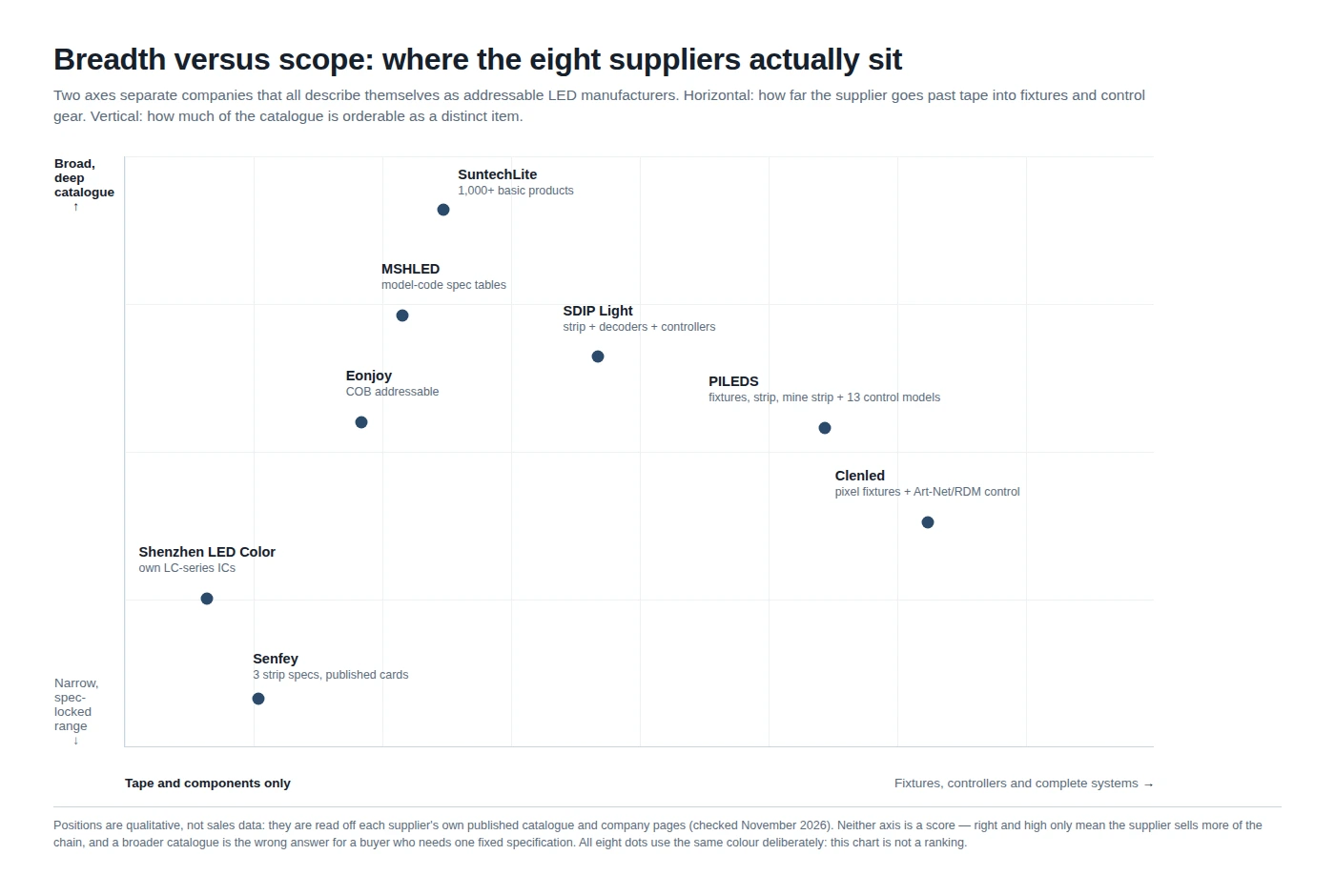
Four project shapes, four different answers:
Permanent facade, mapped video, console control. You need fixtures that accept Art-Net or DMX, sealed to the site's IP rating, and a controller line that the fixture supplier will stand behind. Start in the fixture-and-control lane. If the design is mostly tape in extrusions with a handful of nodes, buy the tape from a strip-lane supplier and the control from the fixture lane, and make the two talk before the order, not after.
Long tape runs, many variants, distributor stock. Catalogue depth is the value. You want the density, width, voltage and seal grade to exist as a part number, with a published cutting unit, because that is what your resale customers will ask for. This is where SuntechLite, MSHLED and SDIP compete, and where distributor terms decide whether the relationship survives the second order.
The strip is a component inside your own product. You need the IC to be a variable, not a given. That is the component lane, and the questions are about package size, colour binning and whether the supplier will build to your drawing.
A single fixed specification, repeated. Narrow beats broad. A supplier with three documented specifications and published pricing will hold a line item steadier than one carrying a thousand.
Equally useful in reverse: do not put a tape-lane supplier on the hook for a console-driven facade, and do not ask a fixture house to quote a 20 km tape order it will only broker. If the project is fixtures plus control, the lane-three product pages above are the shortest route to a spec drawing; if it is tape, the specification pages in lane two are.
Whichever shape you are in, the next step is the same document request rather than another shortlist: two suppliers per lane, the same four questions, and the answers checked against the pages they came from.
What this comparison deliberately leaves open
Four things decide a pixel LED order and none of them can be settled by reading websites: the real price at your quantity, the MOQ and lead time in writing, whether the IP rating survives the actual sealing process, and whether the certificate belongs to the factory that will make your goods. Every one of those is a document request, and each has a specific artefact that settles it — the certificate number checked with the issuer, a lead-time breakdown in the PO, a sample length tested in place, an FOB or EXW term written into the offer rather than assumed. The same applies to photometric claims: a CRI figure or an LM-80 curve is only worth what the report behind it is worth, and a report issued by Intertek, SGS or TÜV is a different object from a supplier's own letterhead.
That work is the subject of the separate supplier-vetting walkthrough linked above, which covers the four evidence checks in order. The QC side — what a factory's inspection stations actually prove — is set out in the six-step LED QC process. This article stops at the shortlist; those two finish it.
If the wider question is how pixel LED supply is organised — brand, OEM, ODM or distributor — the pixel LED OEM, ODM and distribution guide is the place to start, and if you are still deciding what "addressable" means for your fixture, what an addressable LED is covers the basics.
Questions this shortlist usually raises
Where are addressable LEDs actually made? For the supply chain this list covers, mostly in the Pearl River Delta — which reflects how the list was built (English-language sites that load and publish model data), not a census of the industry. The driver chip is designed and fabricated by a handful of specialist IC houses; the LED die come from the big chip makers; and the packaging, SMT assembly, sealing and testing happen in factories in Shenzhen, Dongguan and Zhongshan like the eight above. That split is why a supplier can be a genuine manufacturer of strip and still be a buyer of the IC — and why "we make our own chips" and "we make our own strip" are two different claims worth testing separately.
Can you run an addressable strip without a controller? No. Every part in this article needs a data signal on a data line — SPI from a small controller or a console, DMX512 or Art-Net from a lighting desk, or a phone app over Bluetooth on the simplest builds. Wiring the strip straight to a power supply gives you no light or one frozen colour. A hobby controller such as WLED on an ESP board, or an Arduino with FastLED, is enough for a prototype or a home build; anything that has to survive a commissioning walk-through wants the controller specified by the same party as the fixtures.
Do these manufacturers do OEM work for a brand? All eight — from a component-level pixel LED manufacturer in China to a fixture house — state OEM, ODM or custom configuration on their own pages, which is weaker evidence than a signed NDA and a drawing revision. What differs is the depth: the component-level and strip-lane suppliers can change the IC, density, width and seal; the fixture-lane suppliers can change the housing, connector and control. Ask for the last custom build they shipped and the drawing that went with it.
Can one supplier cover both the pixels and the controllers? Most of them list some controller or decoder range next to their pixel product — Clenled, SDIP Light, SuntechLite, MSHLED, Senfey, Shenzhen LED Color and PILEDS all do; Eonjoy's controllers sit under accessories rather than forming a console-grade range, so its addressable offer is tape. Whether that range suits your console is a separate question: an eight-port Art-Net box and a Bluetooth pixel controller are both "controllers" and are not interchangeable.
Shortlisting two suppliers per lane and asking each the same four document questions takes about a week. That week is cheaper than the one it replaces: discovering at commissioning that the tape and the controller were specified by two companies who never spoke.
Specifying pixel LED for a real project?
Send the spec — pitch, IC, IP class, run length, voltage — and you get an engineer's answer, not a catalogue. Samples and OEM/ODM quotes from the Shenzhen factory floor.