
BIS Certification for LED Lights in India
Yes — if your LED product is on India's compulsory registration list. Here is the product-by-product scope, who must hold the R-number and the 2027 deadline.
Yes — you need a BIS registration to sell LED lighting in India, but only for the LED product categories listed in the government's compulsory registration order, and the registration has to be held by the factory and name your brand. "LED lighting" is not one regulated thing in India: self-ballasted lamps, seven luminaire types, independent LED modules, controlgear and LED dimmers are each listed separately, each with its own Indian Standard and effective date. The question "do you need BIS certification to sell LED lighting in India?" therefore resolves into three narrower ones: is my product on the list, is my brand on the registration, and is that registration still live under the current standard version.
This is written for export managers, brand owners and importers answering that question for a real SKU. If you are still mapping which marks each market needs, start with our LED lighting export certification guide and come back. The framework below is India-specific; into Europe the chain differs, as covered in exporting LED strip to the EU.
The short answer for LED lighting in India
BIS certification for LED lights in India runs through the Compulsory Registration Scheme (CRS), not through ISI mark licensing. CRS is operated by the Bureau of Indian Standards under Scheme-II of Schedule-II of the BIS (Conformity Assessment) Regulations, 2018, on the strength of a compulsory registration order issued by the Ministry of Electronics and Information Technology (MeitY). The order was first notified on 3 October 2012 for fifteen product categories; LED lamps and luminaires came in later tranches.
Compulsory certification and CRS registration are not the same phrase. BIS publishes the full set of products under compulsory certification, which gathers orders from several ministries; CRS is principally the route for electronics and IT goods, and the one that governs LED lighting — though the registration list has since grown to include products notified by other ministries, from solar modules to industrial chemicals. The registration goes to the manufacturer, but the duty to keep unregistered goods off the market reaches importers and resellers.
Under the order, as the CRS portal states it, "no person shall manufacture or store for sale, import, sell or distribute goods which do not conform to the Indian standard specified in the order and do not bear the Standard Mark with unique registration number obtained from BIS." That reaches manufacturing, importing, storing, distribution and retail selling — which is why an importer or an online seller is as exposed as the factory, even though the registration is issued to the factory.
Two products in the same container can therefore have opposite compliance status. A self-ballasted LED bulb has been covered since September 2015; a pixel strip sold as a decorative ribbon is a different question, answered by the category it maps to.
A CRS registration is not the ISI mark, which is a separate conformity route for other product families — "we have ISI" has not answered a CRS question. Under CRS the mark you should see is the Standard Mark plus a registration number in the form R- followed by eight digits.
Which LED products the notification actually covers
The list is finite and public: the CRS portal publishes every notified category with its Indian Standard and effect date. The LED entries are these:
Product category | Indian Standard | In force since | Revised standard |
|---|---|---|---|
Self-ballasted LED lamps for general lighting services | IS 16102 (Part 1):2012 | 13 September 2015 | IS 16102 (Part 1):2026 |
DC or AC supplied electronic controlgear for LED modules | IS 15885 (Part 2/Sec 13):2012 | 1 December 2015 | — |
Fixed general purpose LED luminaires | IS 10322 (Part 5/Sec 1):2012 | 1 March 2016 | IS 10322 (Part 5/Sec 1):2026 |
Recessed LED luminaires | IS 10322 (Part 5/Sec 2):2012 | 23 May 2018 | IS 10322 (Part 5/Sec 2):2026 |
LED luminaires for road and street lighting | IS 10322 (Part 5/Sec 3):2012 | 23 May 2018 | IS 10322 (Part 5/Sec 3):2026 |
LED flood lights | IS 10322 (Part 5/Sec 5):2013 | 23 May 2018 | IS 10322 (Part 5/Sec 5):2026 |
LED hand lamps | IS 10322 (Part 5/Sec 6):2013 | 23 May 2018 | IS 10322 (Part 5/Sec 6):2026 |
LED lighting chains | IS 10322 (Part 5/Sec 7):2017 | 23 May 2018 | IS 10322 (Part 5/Sec 7):2026 |
LED luminaires for emergency lighting | IS 10322 (Part 5/Sec 8):2013 | 23 May 2018 | IS 10322 (Part 5/Sec 8):2026 |
Independent LED modules for general lighting | IS 16103 (Part 1):2012, later IS 16103 (Part 1):2025 | 1 April 2021 | IS 16103 (Part 1):2025 — concurrent running ended 21 July 2026 |
Lighting chain (rope lights) | IS 10322 (Part 5/Sec 9):2017 | 1 April 2021 | — |
Dimmers for LED products | IS 60669-2-1:2008 | 1 October 2021 | — |
Two things in that table catch exporters out. First, how far "component" products reach: controlgear (the driver), standalone LED modules and dimmers are notified items in their own right, so a registered luminaire can still sit next to a separately regulated driver. Second, the 2015 and 2016 dates are when the requirement started to bite, not when the standards were written — a 2014-dated catalogue sheet proves nothing today.
Nothing on the list covers "LED lighting" in the abstract: if a product does not map to one of these categories, CRS does not apply. But that mapping is a technical judgement, not a marketing one — and for the most contested case, LED strip, BIS has answered in writing: LED strips and tape lights "are similar to chain light and hence they are covered under CRO under the appropriate category based on technical specifications" (Phase IV FAQ, which also confirms that chain lights, rope lights and LED modules sit in their own categories). Get the lab to state the category in writing before you quote a delivery date.
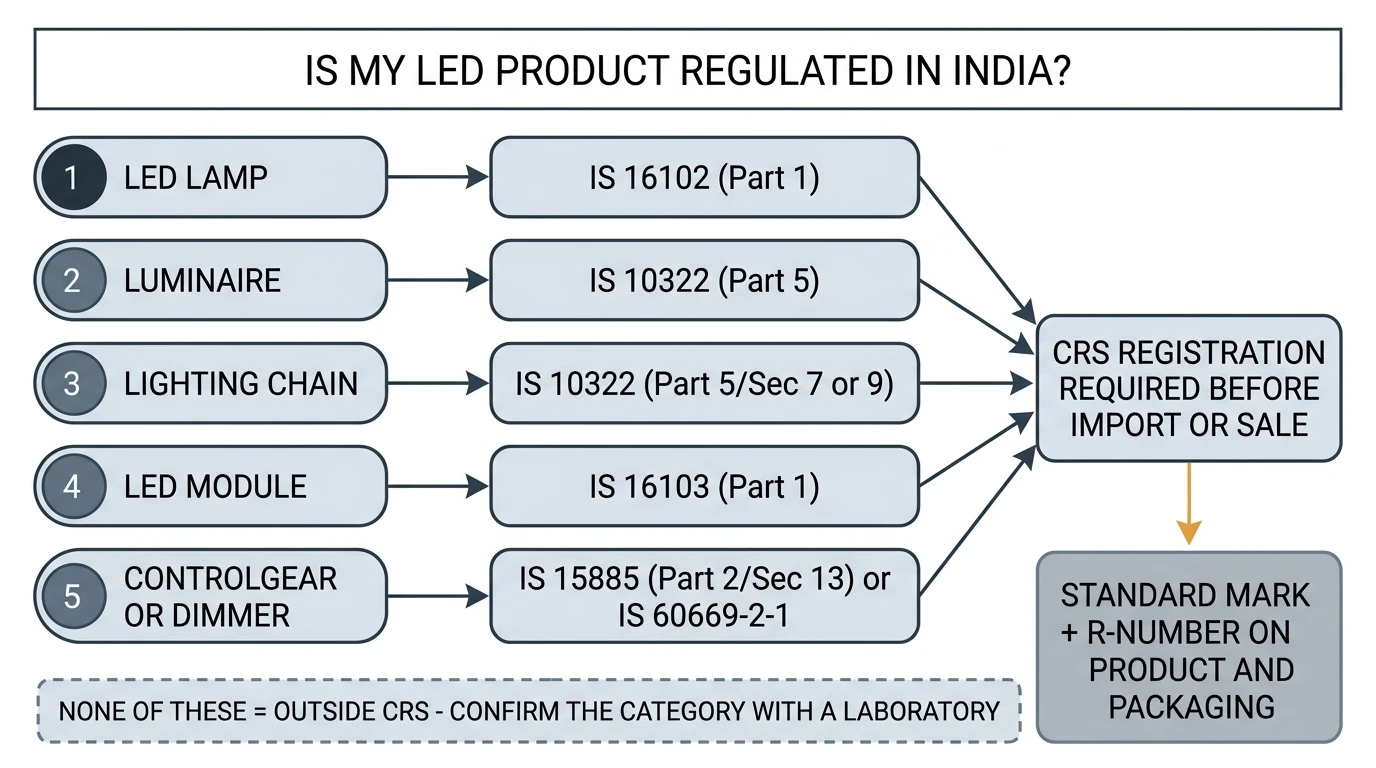
Work down the tree by function: the category you land in decides whether CRS applies at all.
Who has to hold the registration — and who only has to check
This is where most procurement disputes start. The registration number is issued to the manufacturer and is tied to four things: the manufacturer, the factory location, the product and the brand — the structure BIS's own CRS FAQ sets out. Everyone else in the chain must make sure the registered product is what they are moving, but none can register on the factory's behalf.
Party | What the rules require |
|---|---|
Factory / manufacturer | Applies for and holds the registration; gets the product tested at a BIS-recognised laboratory; applies the Standard Mark with the R-number on product and packaging |
Overseas manufacturer | Same obligation; works through an Authorized Indian Representative (AIR) nominated in India, and BIS addresses communications to the registered entity or its AIR |
Brand owner / private label | The brand must be covered by the registration. A different brand needs its own registration, though it can rest on a shared test report when the product and factory are identical |
Importer | Does not hold the registration, but may not clear or sell goods that are unregistered or unmarked; the same product from a second factory needs a second registration |
Distributor, retailer, marketplace seller | Must be able to show a compliance statement for the goods on request, and supplement it with the registration certificate or evidence of source when asked |
Two consequences follow, and both belong in a purchase contract: multiple brands require separate registrations, and a second plant requires its own application and its own test report from that location. So when an importer in Delhi is offered a good price on a container carrying their own house brand, the question to ask is not "does the factory have BIS?" but "is my brand named on the registration, and does the registration name the plant producing this order?"
Buy through a trading company and the disclosure chain gets longer; those risks are in our guide to distributor and reseller terms. If you are still choosing between factories, certificate questions belong in the shortlist stage, not the purchase-order stage — that is the workflow in how to vet a China LED supplier.
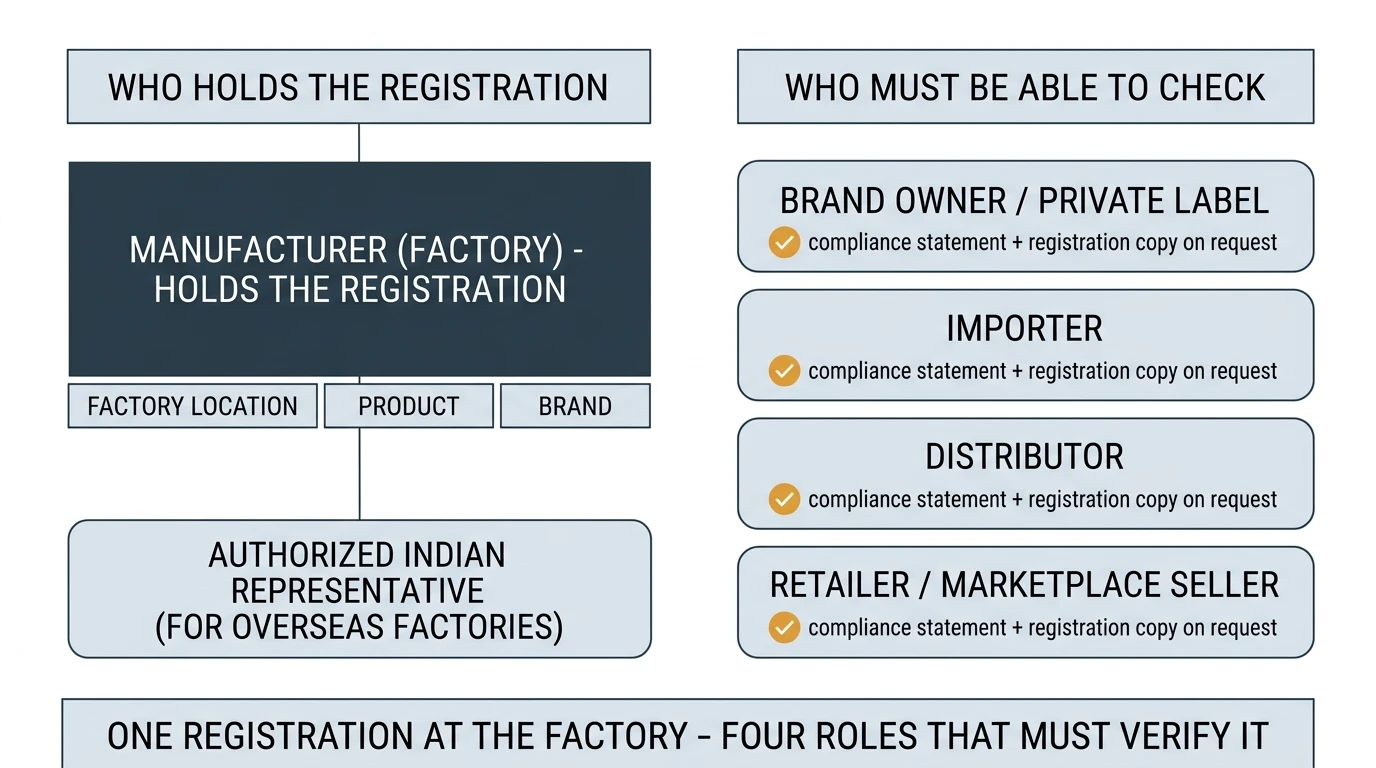
One registration is held at the factory; four other roles carry a duty to check that it covers what they are moving.
The 2026 revision — and the deadline that moved
The Indian LED standards were revised in 2026, and it is the most likely thing to be out of date in anything you read about BIS this year.
In February 2026, BIS's Registration Department issued guidelines for IS 16102 (Part 1):2026, the revised safety standard for self-ballasted LED lamps, replacing the 2012 edition. In March 2026 it followed with guidelines for the revised LED luminaire standards, covering IS 10322 (Part 1):2014 becoming :2026 and the Part 5 sections for fixed general purpose, recessed, road and street, flood, hand lamp, lighting chain and emergency luminaires.
Both guidelines originally set the last date of concurrent running — the window in which a licence could remain on the old standard — at 2 August 2026. BIS then moved it: on 31 July 2026 the Registration Department issued an extension for the LED luminaire standards and a matching one for IS 16102 (Part 1):2026, pushing the deadline to 2 February 2027 across those categories.
The consequence of missing it is written into the guidelines rather than left to interpretation:
Beyond the last date of concurrent running, no licence shall remain operative where compliance with the Revised Standard has not been ensured by the licensee.
The same guideline provides that cancellation of the licence, or deletion of the model from its scope, may be initiated — a lapse is not a fine to be absorbed, it is a product that can no longer be legally placed on the market.
The module standard moved a year earlier on the same pattern: guidelines of 9 September 2025 set 21 January 2026 as the last date of concurrent running for IS 16103 (Part 1):2025, and a circular of 1 January 2026 extended it to 21 July 2026 — a deadline that has already passed, unlike the luminaire dates above.
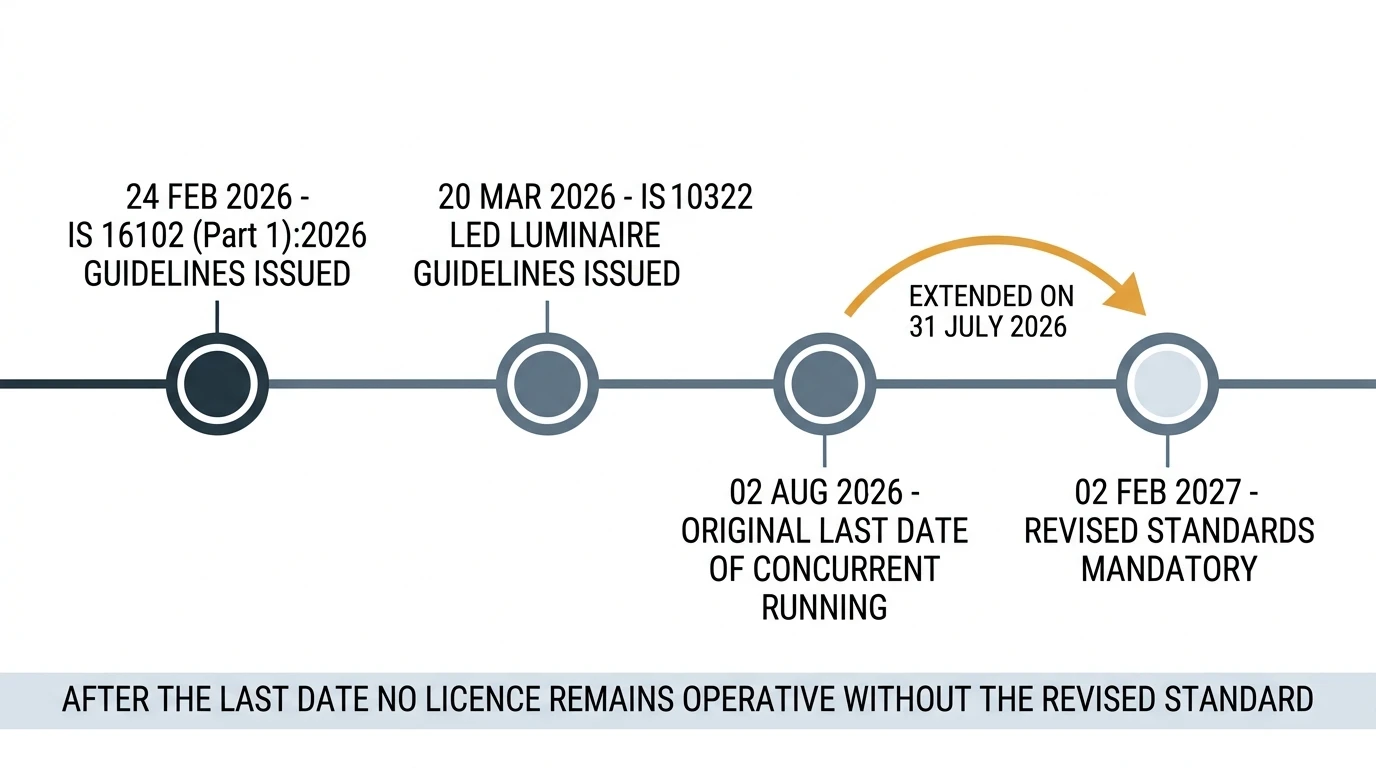
Two dates matter, not one: the original concurrent running end and the extension that replaced it.
What changed is technical, and it lands on the product, not just the paperwork. The luminaire revision brings IPX9 ingress protection, EMF safety, PELV and SELV provisions, extra requirements for controllable control gear, revised shock-protection tests and extended photobiological safety. The emergency section adds lithium battery and EDLC requirements; the chain section adds provisions for temporarily installed protected lighting chains. For a buyer that means one instruction: ask which edition of the standard the test report was issued against — a 2012 edition report is not evidence that a registration is current.
How to confirm your own SKU: five steps
The check needs the product, the portal and a laboratory.
- Classify by function, not by marketing name. Is it a lamp, a luminaire of one of the seven Part 5 types (sections 1, 2, 3, 5, 6, 7 and 8), a rope light under section 9, controlgear, an independent module, or a dimmer? Write the classification down before you look anything up; everything else depends on it.
- Match it to a notified entry. The full list, with standards and effective dates, is published on the CRS portal's products under CRS page. If nothing on that list describes your product's function, you are outside CRS — record why, in writing.
- Get a test report that is young enough. Registration applications must be supported by a test report from a BIS-recognised laboratory, and a report older than ninety days at the time of submission is not accepted — a rule that catches suppliers who forward last year's report. A supplier's own laboratory, or an overseas CB test house, does not stand in for it — not even where the product already carries CE or UL listings.
- Check that the registration covers your commercial reality — the brand on the label, the factory that will make the order, and the standard edition in force.
- Verify the number yourself rather than reading it off a PDF. The CRS portal has a "search by R-number" function that returns the registration record and its status; the mechanics of that lookup, and of lookups for other certification bodies, are in our walkthrough on how to verify a certificate number.
Once granted, a Scheme-II registration now runs for five years with fees payable annually in advance, and renewal is granted for a further five years — the position after the amendment dated 25 February 2026 to the BIS (Conformity Assessment) Regulations, 2018, restated in BIS's circular of 27 May 2026. The 2018 CRS FAQ, which says two years, is out of date on this point; miss the annual fee and production details and suspension or cancellation provisions apply.
What a CRS registration looks like — and what it does not cover
A CRS registration is a short document, and every field on it is a testable claim: the registration number (R- plus eight digits), the manufacturer's legal name, the factory address, the product category and name, the Indian Standard tested to, the brands covered, the status and the validity date. If a field is missing from what a supplier shows you, that is the field to ask about.
For a concrete example: our own production entity holds R-41220418. Searching that number returns the manufacturer (Shenzhen Yishuguang Light Co., Ltd.), the product (fixed general purpose LED luminaires), the standard (IS 10322 (Part 5/Sec 1):2012), the status (Registered), the validity date (24 March 2028) and the brand (Yishuguang) — reproduce it in the search box and you are looking at the same screen we are. If you are specifying our products into an Indian project, ask for the certificate copy and the scope statement with the quotation; our company page lists the certificates we hold.
Two fields deserve attention. The brand field records the registered brand, not a licence to put any logo on the product — which is why a private-label order needs its brand question answered in writing. And the standard field records an edition, which is the field the 2026 revision changes; if your specification names the revised edition, ask where the migration stands rather than assuming.
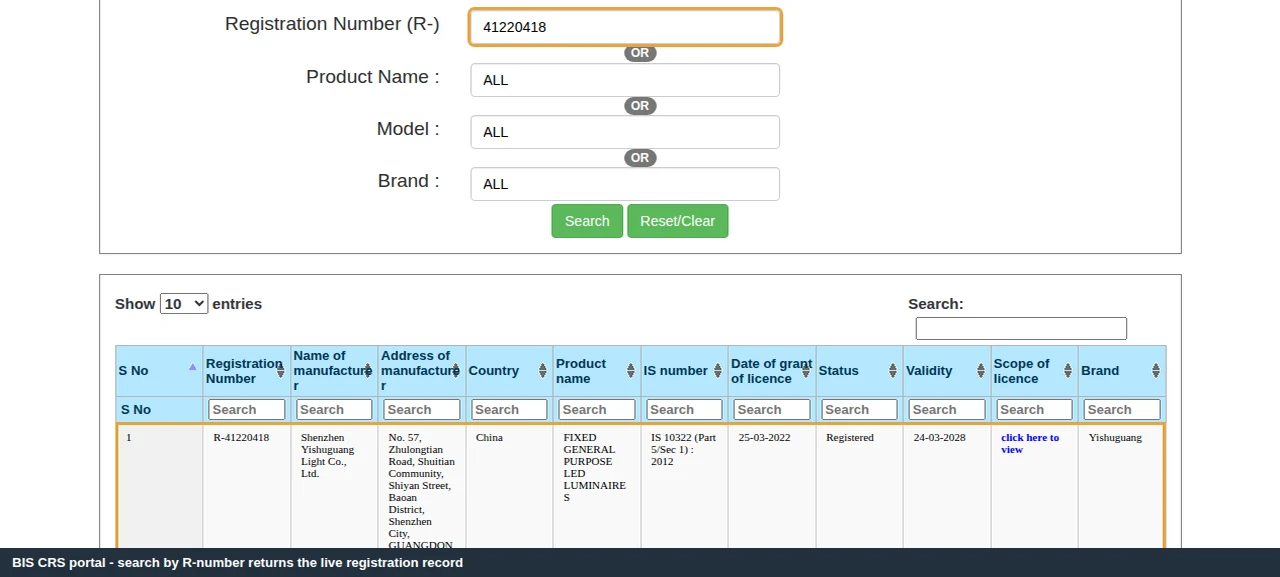
The portal lookup returns the registration record and its status — the check takes a minute and does not require an account.
That is the honest version of every "we are BIS certified" claim you will receive: a registration covers specific products, from a specific plant, under a specific brand, against a specific edition — change any one of the four and the answer changes.
What happens if you import or sell without one
Enforcement starts before the goods reach a shelf. Under the compulsory registration order, an unregistered or unmarked product exposes the manufacturer to prosecution, including seizure provisions. The CRS FAQ adds the timing rule: goods manufactured or imported before the requirement took effect are outside the order, but consignments landing in India on or after that date must comply — shipment timing, not order timing, is what counts.
In practice, three checkpoints catch unregistered products: customs clearance at the port of landing; a surveillance pickup, where the registered entity keeps a counter sample and a trader must produce a compliance statement; and commercial gatekeeping, since institutional buyers, tenders and marketplaces increasingly ask for the registration number before they list a product.
One more risk sits inside the registration itself: a registration not migrated to the revised standard by 2 February 2027 stops being operative, so a product compliant in 2025 can be non-compliant in 2027 with no change to the product.
FAQ
Is BIS certification the same as the ISI mark?
No. For LED lighting the requirement is CRS registration, which rests on a laboratory test report and a self-declaration of conformity. ISI mark licensing is a separate route under the BIS Act, used for other product families; one does not satisfy the other.
Can a CE or UL certificate replace it?
No. CE is a European self-declaration and UL a North American listing; neither substitutes for a test report from a BIS-recognised laboratory against the Indian Standard. Other regimes' certificates are evidence of design quality and nothing more where CRS applies.
Do I need a separate registration for every model?
Not necessarily. Series guidelines allow models of the same family to be covered under a lead model, where the construction data and labelling support the series. A change of circuit or component source does require action: an updated test report and construction data form go on record with BIS.
Who pays for the testing?
The registered entity bears the cost of registration and of surveillance, and the test report has to come from the manufacturer's own production: samples are submitted by the manufacturer at application, and picked up independently only during surveillance.
If a product is registered, can anyone import it?
Anyone can import, sell or distribute a registered and marked product of that manufacturer, brand and category; a second factory, a second brand or a different product means a new registration. This account reflects the published Indian framework and is not legal advice — confirm the current position against the certificate and the live notification before you commit.
Next step
The fastest way to close the compliance question is to ask for the paper rather than a reassurance. Write to our team with the product category you are sourcing and we will send the CRS registration copy and the scope statement covering it, so you can run the R-number against the portal before anything goes into an RFQ.
Specifying pixel LED for a real project?
Send the spec — pitch, IC, IP class, run length, voltage — and you get an engineer's answer, not a catalogue. Samples and OEM/ODM quotes from the Shenzhen factory floor.