
Vetting Long-Term Supply: Questions to Ask
Supplier vetting for a multi-year partnership: the questions to ask before you commit, the evidence that settles each one, and the failures that surface later.
Long-term supplier vetting starts where the factory audit stops
Supplier vetting is the work you do before money changes hands: deciding whether the company behind a quote can be trusted with your order. Most guidance treats it as a single event — check the licence, visit the plant, test a sample, sign. That answers one question. It does not answer the one that decides whether a relationship survives.
Two different jobs hide under the same name.
A factory audit asks whether the supplier is real: manufacturer or trading company, how big the line is, whether the certificates exist, whether the sample matches the spec. That first job has its own checklist, and the one-time factory audit checklist covers it end to end.
Long-term supply vetting asks something harder: will the third order, the thirtieth order, and the order after the main driver IC changes all look like the first? A first-order audit cannot answer that, because the interesting failures are not about whether the factory exists. They are about whether it can stay the same across years, component generations and peak seasons.
This page covers that second job. It sits inside the wider OEM, ODM and distribution relationship a distributor or private-label brand builds with a factory; here we stay on the questions you ask before you sign it.
The failures that matter most arrive late. In sourcing communities, buyers describe the same pattern: a supplier who looks fine on paper and then falls apart by the third or fourth order. No audit of order one sees that coming.
Order one is a sample. The relationship is proven by order three — so the questions below are aimed at what only shows up later.
The supplier vetting checklist: ten questions and the evidence that settles each
Stop asking "are you reliable?" — every supplier says yes — and ask questions whose answer is a document or a number. Ten carry most of the weight. A documented quality system such as ISO 9001 is the floor rather than the proof: it says a process exists, not that it holds batch after batch. These are the questions to ask a supplier before you commit.
Question to ask | The evidence that settles it | Red flag |
|---|---|---|
| A written change-notification process, a service-life statement per IC, and a named second source | "We'll tell you when it happens" |
| Per-batch test records and a stated acceptance limit for colour, brightness and electricals | "They're all the same off our line" |
| A delivery-rate or fill-rate figure, with its definition and the period it covers | "We always ship on time" |
| A capacity disclosure and a ramp plan tied to the forecast you actually give them | "Whatever you need, we'll manage" |
| A defined QC document package — incoming, in-line, ageing and pre-ship results | "Inspection report on request" |
| DOA and RMA data, a root-cause report on request, and a replacement commitment | "That never happens with our product" |
| A price-validity period, an agreed trigger for re-pricing, and a notice period | "Prices are stable" — with no number |
| Written tooling and IP ownership, and what happens to it if the relationship ends | Silence, or "it's a partnership" |
| Factory-direct access, plus a straight answer on who signs the change notices | "We work with several factories" |
| A documented backup arrangement and force-majeure terms that survive contact with your lawyer | "That won't happen" |
A supplier who answers eight or nine of those in writing is a different prospect from one who answers none. One item recurs across the list — certificates — and knowing which certificates must stay valid for export to your market is part of reading those answers. The sections below walk the questions that carry the most risk in pixel and addressable LED supply.
Product continuity: will your SKU still exist in year three?
This is the question distributors leave until it is expensive to ask. Addressable LED products are built around a driver IC — WS2811, WS2812B, WS2815, SK6812, UCS1903 and their equivalents — and ICs go obsolete on the supplier's schedule, not yours. When the IC or its package is discontinued, the fixture you standardised on stops being a catalogue item and becomes a project. That is the part of the risk no site visit surfaces: on the day of the visit, everything is fine.
Before you commit, ask for four things in writing: a service-life statement for the IC in each product you intend to stock; a supplier change notification commitment with a notice period long enough to re-test and re-qualify the part; a last-time-buy window so you can cover the gap; and a named alternate IC, ideally form-fit-function compatible, so a change lands as a revision rather than a redesign. Naming the JEDEC standard behind that expectation signals that you know the industry has a process for it.
Two facts make this manageable. Addressable ICs are largely pin- and protocol-compatible within a family, so a second source is usually possible — which is where understanding the driver IC and protocol landscape pays off. And a factory that builds in-house can tell you which parts of a fixture change and which do not. A trading company often cannot, because it does not control the bill of materials it is quoting from.
Batch-to-batch consistency: ask for the evidence chain, not the claim
"Consistent" is a claim. Consistency is a chain of records, and a supplier either keeps it or does not. Ask to see one recent batch end to end: the IC and LED reel batch codes, the assembly line and date, the colour and brightness measurement, the ageing result, and the pre-ship inspection outcome — connected, so that a fault on a customer's bench can be traced back to a reel.
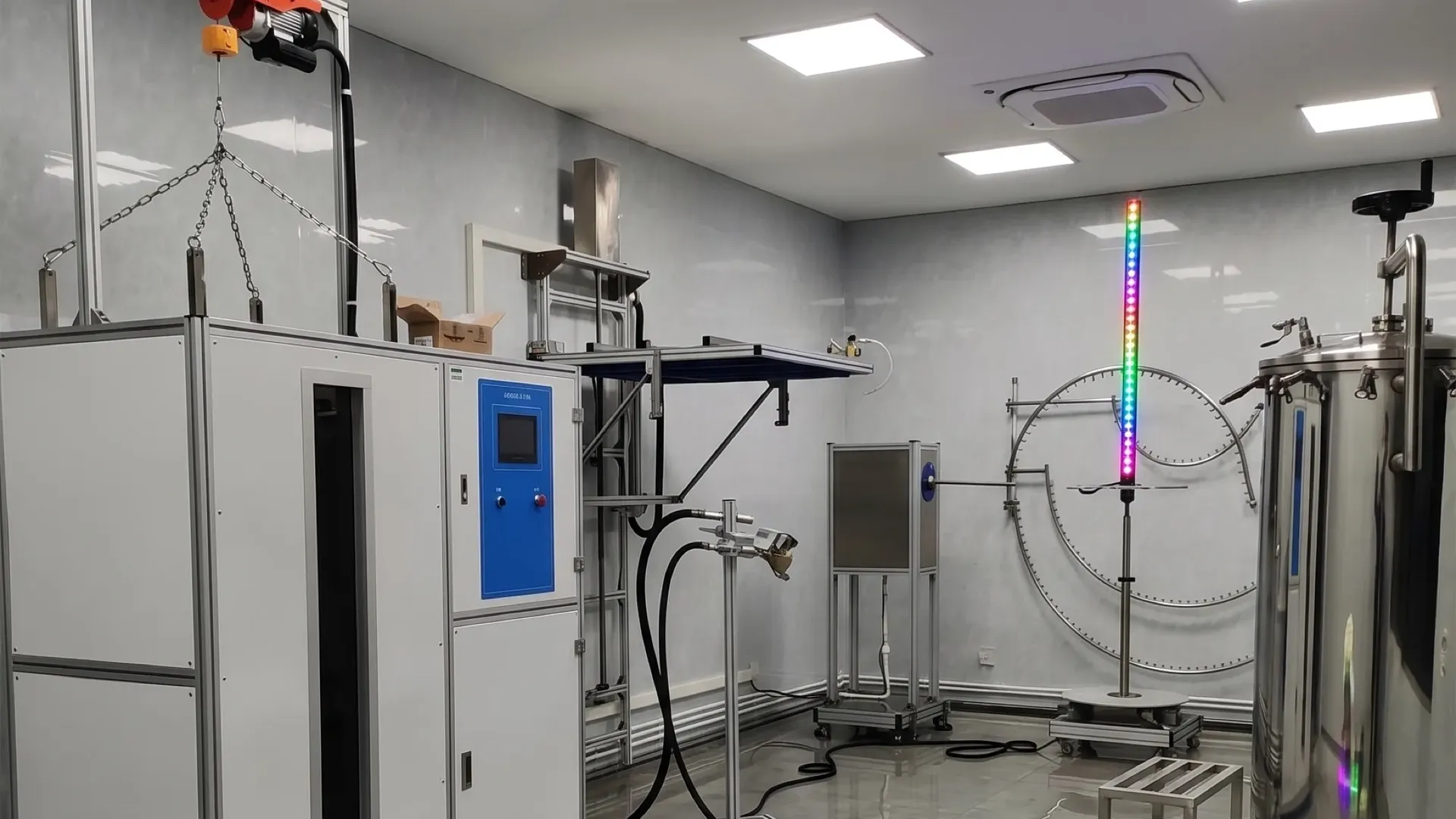
Per-batch testing is the difference between a consistency claim and a consistency record.
Colour and brightness are the visible half of consistency, and they deserve their own measurement discipline. The half buyers forget is everything else that has to hold from batch to batch: solder-joint quality and electrical characteristics, dimensional tolerance, and the IP-seal performance you are paying for — because an outdoor fixture that seals on sample one and leaks on batch nine has failed at the seal, not at the colour. Workmanship acceptance is normally written against a published standard, so it is fair to ask which one the supplier tests to; the accepted benchmark across electronics assembly is set by IPC, and a factory should be able to name the class it builds to.
Push the same logic into the paperwork: a QC documentation package should say what was checked, to what limit, on which batch. A factory that runs its own incoming QC, in-line optical inspection, ageing and pre-ship stations can hand you one record per batch; a supplier that buys finished goods can only ask someone else for it. If a supplier answers with a certificate rather than a record, that is a different question — certificates prove a product can meet a standard, not that a given batch did. Verifying certificate numbers against the issuing body is a separate procedure again.
Capacity and delivery reliability: can they scale and still ship on time?
Lead time is a promise. An on time delivery rate is a measurement, and the difference shows up exactly when you need the goods. Two numbers decide whether a supplier can carry a long-term relationship: how reliably they hit the dates they quote, and how much headroom they have when your forecast grows.
Ask for both. On delivery, request a fill-rate or on-time figure with its definition attached, since "on time" is meaningless without saying whether it means shipped or delivered, and over what window. On capacity, ask what changes when your volume doubles: line time, tooling, staffing, and the components that are on allocation. A supplier that can talk through a ramp in concrete terms plans ahead; one that answers every volume question with "we'll manage" never has.
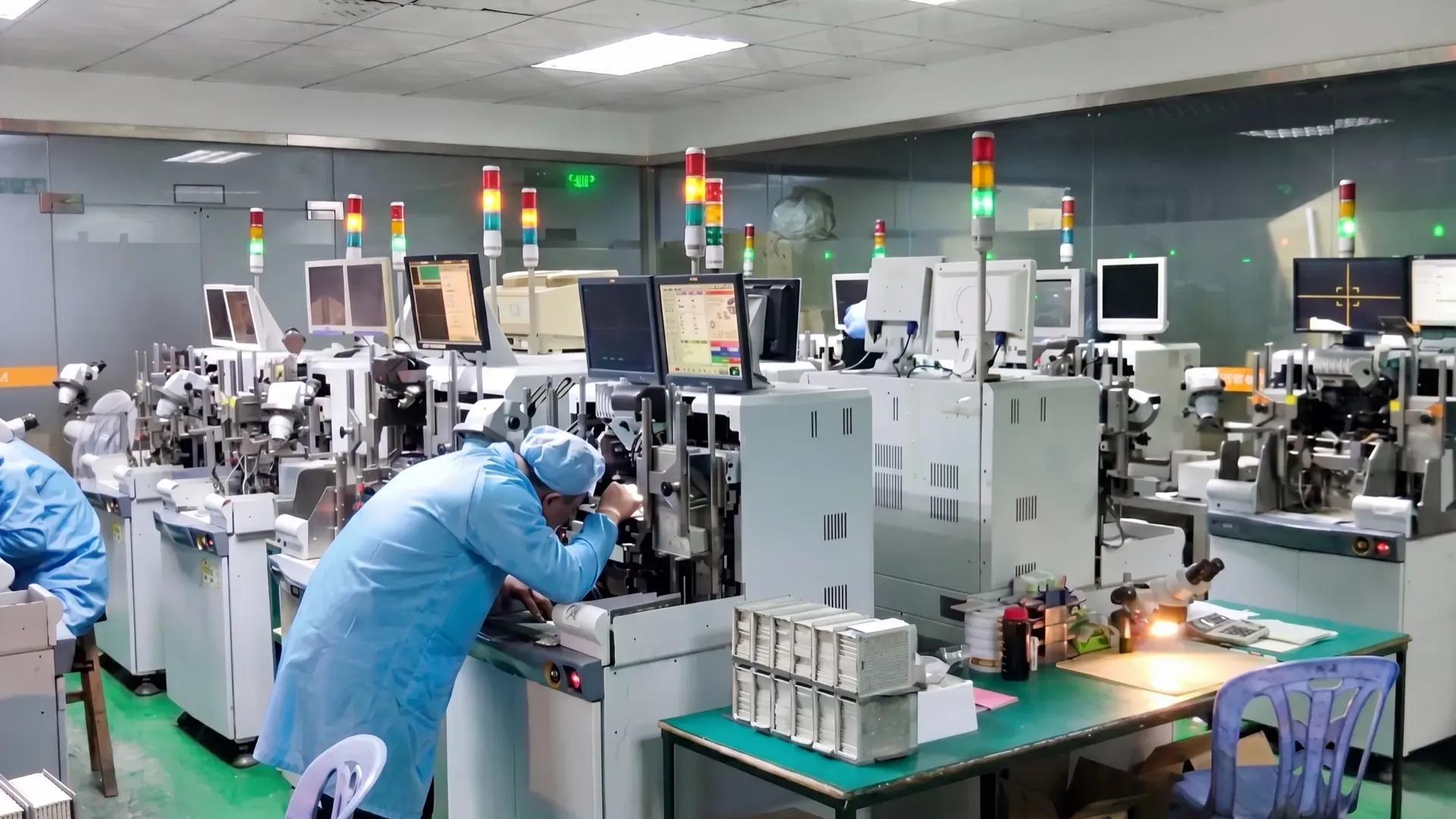
Capacity is easy to claim and hard to fake: an in-house line either has headroom or it does not.
Seasonality belongs in the same conversation. Every factory calendar has a slow month and a shutdown; in southern China, Chinese New Year empties the line for a stretch that arrives on a date you can look up a year ahead, and a long-term partner should be quoting you around it rather than apologising for it in February. This is where continuity of supply is decided — not by a pledge, but by whether the supplier holds buffer stock, reserves line time, or plans around the holidays you both already know are coming. If your own response is to carry deeper stock, that is a different decision with its own arithmetic, covered in how deep to stock a pixel LED line.
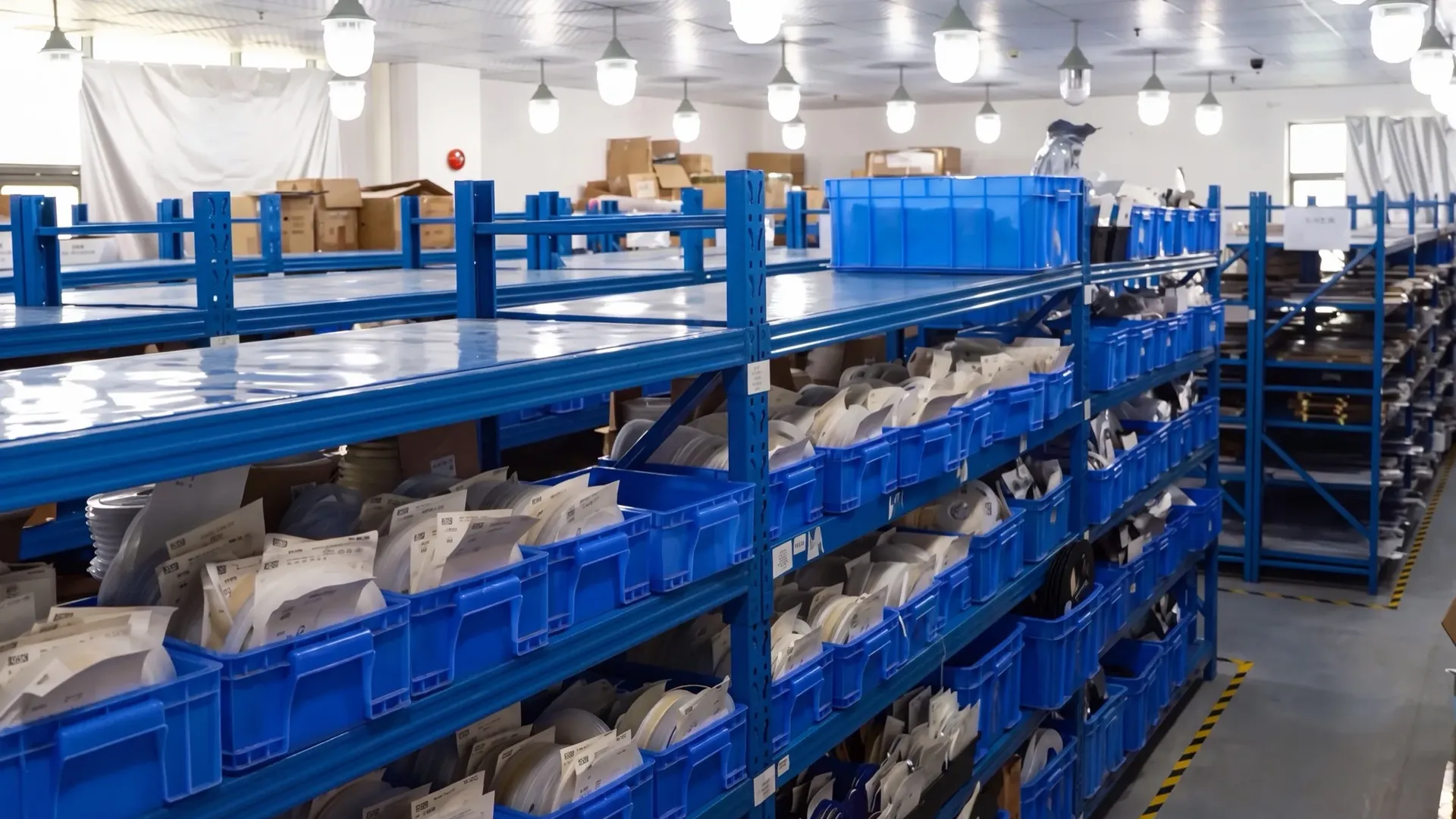
Continuity of supply is a stock position, not a promise: a supplier either holds the buffer or it does not.
Single source or dual source?
The most consequential supply decision you make is not which supplier — it is how many. Dual sourcing protects supply continuity when one factory stumbles, but it costs you the volume leverage of a single partnership and doubles the qualification work. The honest split: single-source the parts where switching is cheap and the relationship is strong, and dual-source anything whose failure stops a customer's show — the controller, the connector, the single IC your whole line depends on. A supplier worth a long-term agreement will not be offended by that question. It will have an answer ready, and it will already know which of its own parts you should not single-source.
From sample to commitment: the four-stage qualification order
Nobody should jump from a sample to a multi-year agreement. The sample proves a product; a qualification order proves a supplier. Run it in four stages, each with its own exit test, and treat each as a gate you can fail.
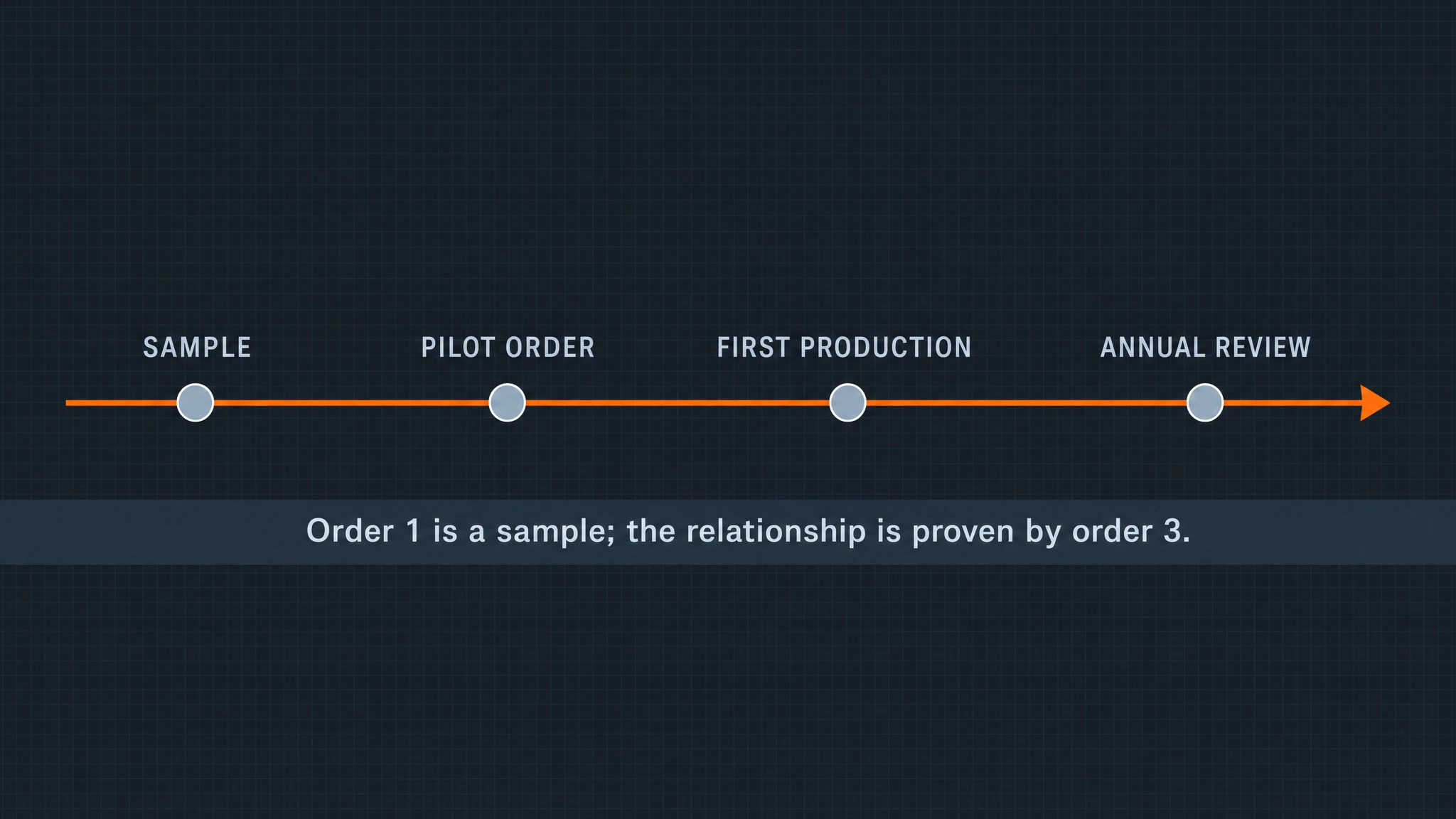
The relationship is proven on order three, not order one — so build the orders that get you there.
- Sample. Confirm the product against your spec, not the supplier's. If the sample needs a special setup to pass, expect production to be worse.
- Pilot order. A real, paid, small run through the full process — paperwork, lead time, packing, shipping, documentation. This is where you learn whether the supplier's process, not its salesperson, can repeat.
- First production order. The first order at real volume. Watch the per-batch records here; this is where consistency is either demonstrated or quietly missing.
- Annual review. Once the relationship has a year behind it, re-check the items that drift: price mechanism, PCN history, delivery performance, and whether the ICs you standardised on are still in service.
The point is to make commitment a series of small decisions rather than one large one. A supplier that clears all four stages has earned the long-term agreement; a supplier that is reluctant to be tested in stages is telling you something before you spend the money to find out.
What a long-term supply agreement should lock down
The commercial terms of a first order — MOQ, samples, tiered pricing — are their own subject, and distributor terms in pixel LED covers them. What a multi-year agreement adds is the handful of clauses that only matter over time:
- Price mechanism, not just a price: validity period, what triggers a re-price, and how much notice you get.
- Volume commitment, two-way: what they reserve for you, and what you are on the hook to buy.
- Exclusivity and territory, if you are building a brand or a region on the product.
- Change notification, tying the PCN promise to a defined notice period and a last-time-buy.
- End-of-life compensation, so an obsolete IC is a planned transition rather than your problem alone.
- Compliance continuity, so the product stays inside the current rules for your market after the certificate was first issued — a moving target, not a one-time pass, as the EU RoHS Directive shows.
- An escalation path, so a quality dispute in year two has a named contact and a response window rather than a new salesperson each quarter.
- Continuity and force majeure, written so that "we could not ship" comes with a plan, not an apology.
What if they do not survive the contract?
A multi-year agreement is only as good as the supplier's ability to still be there in year three. Three things settle it, and all three are documents rather than assurances:
What you are checking | What to ask for |
|---|---|
Solvency | Audited accounts, or a bank credit reference, covering the last two years |
Customer and supply concentration | Whether one customer, or one IC supplier, carries most of their volume |
Continuity of ownership | Who owns the business, and what happens to your tooling and orders if it is sold |
None of it is exotic, and all of it is easier to agree before the first large order than after.
FAQ: supplier vetting questions buyers actually ask
What are the steps involved in the supplier vetting process? For a long-term supplier, four: audit the company for authenticity, qualify it in stages through sample and pilot orders, agree terms that govern the relationship over time, then review it annually.
What belongs on a supplier vetting checklist? Anything with a document or a number as the answer: service-life and change-notification commitments, per-batch test records, delivery performance, failure and RMA data, tooling ownership, price mechanism, and a continuity plan. Claims without evidence are the items to leave off.
What is the difference between single sourcing and sole sourcing? Single sourcing is a choice — you buy a part from one supplier because that supplier is the natural source for it. Sole sourcing is a constraint — only one supplier can make it. The first is a strategy; the second is a risk to be managed with a qualified alternative.
What is a supplier change notification? It is the notice a supplier gives before changing a part or process that affects a product you buy — a new IC, a moved line, a changed material. Ask for a defined notice period and what the notice must contain; a verbal heads-up after the fact is not a change-notification process.
The first order is the test, not the ceremony
A long-term supply relationship is decided less by the quote than by the answers behind it: whether your SKU survives the next IC transition, whether batch twenty matches batch one, whether the delivery date holds in the busiest month of the year. Every one of those is checkable before you sign — it just takes questions that expect evidence instead of reassurance.
If you are working through a pixel or addressable LED line, put the spec and the volume curve in front of us and we will answer the same ten questions in writing, batch records and all. Tell us what you are sourcing.
Specifying pixel LED for a real project?
Send the spec — pitch, IC, IP class, run length, voltage — and you get an engineer's answer, not a catalogue. Samples and OEM/ODM quotes from the Shenzhen factory floor.