
What RoHS Means for LED Controllers
RoHS on an LED controller is decided by the materials inside the box, not the label: what the directive covers, which documents prove it, and a 7-step check.
RoHS compliance on an LED controller is decided by the materials inside the enclosure, not by the line on the quotation. A controller can carry the CE mark and still fail a material check at a terminal block, a solder joint or a cable jacket — and the buyer usually finds out at incoming inspection or at customs, months after the order shipped.
This guide is for the people who specify DMX, Art-Net and SPI controllers for projects and OEM builds: integrators, the technical team behind a lighting designer, and product managers sourcing a controller to put their own brand on. It covers what RoHS means for LED controllers in practice, then how to check a claim in seven steps, most of which need nothing more than the label, a document request and a bench. If you are still mapping which marks each market requires, start with our LED lighting export certification and compliance guide.
What RoHS actually requires of a controller
The EU RoHS Directive — 2011/65/EU, amended by delegated directive (EU) 2015/863 — restricts ten substances in electrical and electronic equipment. The full legal text is on EUR-Lex, and the four phthalates added in 2015 are in the amending directive. What matters for a controller is where the limits are measured: not on the finished assembly, but on each homogeneous material inside it.
The directive defines a homogeneous material as one material of uniform composition throughout, or a combination of materials that cannot be pulled apart by mechanical actions such as unscrewing, cutting, crushing or grinding. A tin-plated brass terminal therefore contains at least two homogeneous materials — the brass body and the plating. So does a jacketed cable: the copper conductor, the insulation and the outer jacket each get measured separately.
Limits are 0.1 % by weight for nine of the ten substances and 0.01 % for cadmium, measured per homogeneous material. The European Commission's RoHS overview lists the current ten.
Substance | Limit (by weight, per material) | Where it typically sits in a controller |
|---|---|---|
Lead (Pb) | 0.1 % | Solder, brass and bronze terminals, PVC insulation stabilisers, component terminations |
Mercury (Hg) | 0.1 % | Older relays and contactors |
Cadmium (Cd) | 0.01 % | Some plated contacts and older pigments |
Hexavalent chromium (Cr VI) | 0.1 % | Chromate passivation on zinc-plated screws, brackets, chassis parts |
PBB and PBDE | 0.1 % each | Flame retardants in older connector and housing plastics |
DEHP, BBP, DBP, DIBP | 0.1 % each | Plasticisers in soft PVC cable jackets, gaskets, sleeving |
Timing is the second thing buyers get wrong, because controllers do not all fall under the same date. Categories 1 to 7 and 10 have been in scope since 2 January 2013. Medical devices and monitoring and control instruments joined from 22 July 2014, and industrial monitoring and control instruments from 22 July 2017. The four phthalates applied from 22 July 2019 generally, but only from 22 July 2021 to medical devices and to monitoring and control instruments, a delay the amending directive explains by their longer innovation cycles.
That leaves an honest question about which category a lighting controller belongs to. A DMX or Art-Net controller sold as lighting control equipment is generally treated as lighting equipment; the same box installed as part of an industrial control system can be argued into the monitoring and control category. The argument changes which date the phthalates attached to and how long an exemption on the file can run — five years for most categories, seven for medical and monitoring equipment, under Article 5 of the directive. It does not change the answer to "is it in scope", which is yes — a controller that fits neither category falls under category 11 of Annex I, "other EEE not covered by any of the categories above", which Article 4(3) brought into scope from 22 July 2019 for equipment placed on the market. A supplier who says the category takes their controller out of RoHS is describing a gap that closed years ago.
One boundary worth stating, because the two directives get quoted together: RoHS restricts what goes into the equipment, while WEEE governs what happens to it at end of life. A RoHS file says nothing about your WEEE registration and take-back duties, and the reverse is also true.
Why a mercury-free LED does not make the controller compliant
Most of the RoHS content written for the lighting trade explains that LEDs contain no mercury, which is true and almost irrelevant to a controller. The LED die is one component on a board that also carries solder, terminal blocks, electrolytic capacitors, DC-DC modules, a microcontroller, network jacks, ribbon or round cable, gaskets, sometimes potting compound, and a coated enclosure. Each of those is an assembly of homogeneous materials, and each of those materials has to sit under the limits.
That is the structural point: compliance is aggregated from hundreds of material declarations, not asserted once per product. No factory can test its way to a controller-level answer — the evidence has to come from the component and material suppliers and be assembled upward. Which is why "our LEDs are mercury-free" answers a question the buyer did not ask, and why a genuine answer looks like a file rather than a sentence.
If the controller drives fixtures in the same project, the control side has its own compatibility questions that sit outside RoHS — Art-Net controller options covers protocol and port count, which is a different conversation from materials.
The three documents that carry the claim
RoHS is a self-declaration regime. There is no EU register of RoHS certificates and no notified body that issues one, so the compliance claim travels in three documents, each doing a different job.
Document | Who produces it | What it must contain | What it does not prove |
|---|---|---|---|
EU declaration of conformity (DoC) | The manufacturer placing the unit on the EU market | Model structure set by Annex VI of the directive: identification of the equipment, a statement that the Article 4 requirements are met, the harmonised standards applied, signatory and date | That the materials were actually checked — it is a legal claim, and it must be updated when the product changes |
Technical documentation | The manufacturer | BOM-level material declarations, test reports, the exemptions relied on, supplier declarations | Nothing on its own — it is evidence, and it only counts if it covers your model |
Test reports | A testing laboratory | Sample identification, the homogeneous materials tested, the methods used, the date, and whether the result is screening or confirmation | Coverage of the whole BOM — a report on one sample of one material is one data point |
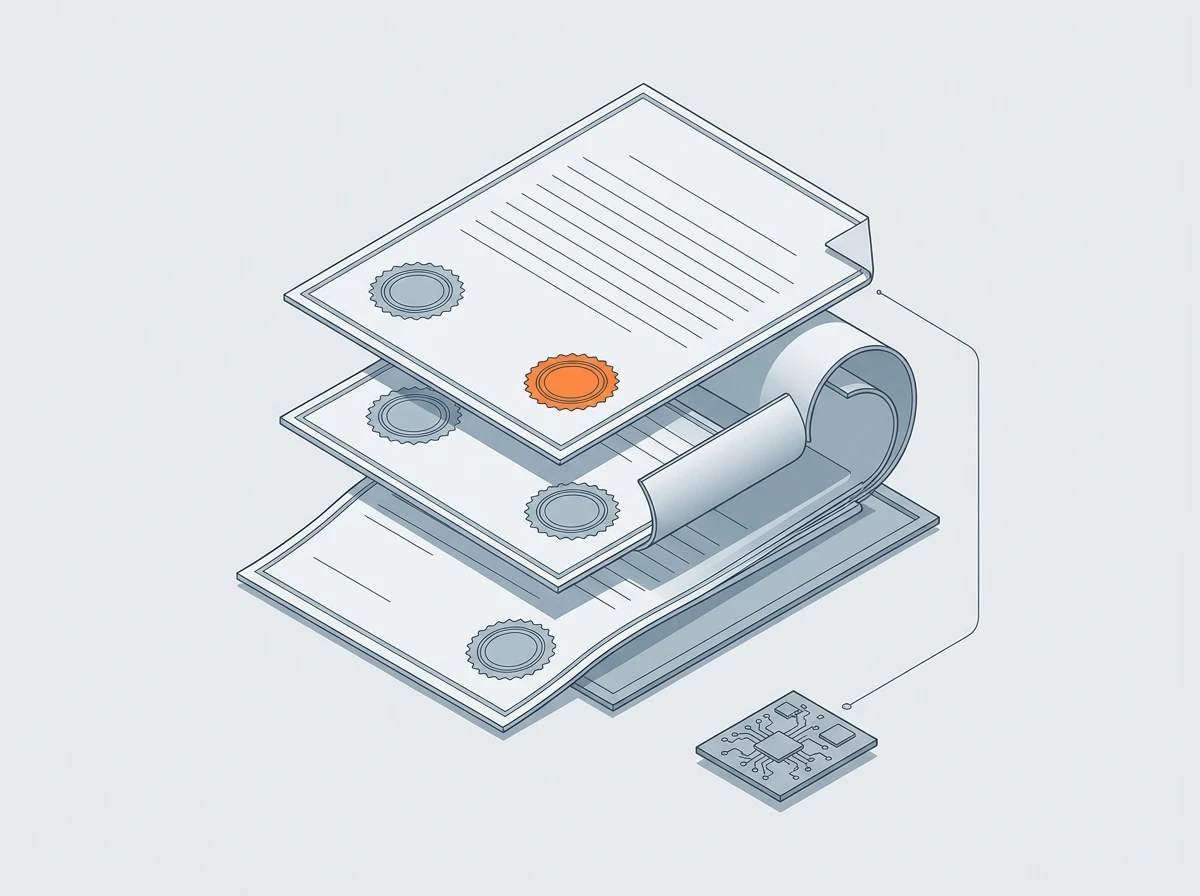
The declaration sits on top; the technical file and the test reports are what it rests on.
The technical documentation has a defined shape. EN IEC 63000:2018 is the harmonised standard under RoHS for technical documentation, and it sets out what the file should contain to demonstrate conformity; Finland's safety and chemicals authority Tukes describes it alongside the IEC 62321 test series used for the analysis itself. Under Article 7, point (d) of the directive, the manufacturer keeps the technical documentation and the DoC for ten years after the equipment is placed on the market, and produces them to market surveillance authorities on request.
One obligation gets skipped more often than the rest: who the manufacturer is. If you buy controllers from a factory and sell them under your own brand, you are the manufacturer for RoHS purposes. The DoC has to be in your name, the ten-year retention is yours, and for a manufacturer outside the EU the authorised representative arrangement in the directive exists so that a national authority has someone in the EU to ask. A DoC signed by the factory while your brand sits on the label is a document about somebody else's product. If you also need to confirm the certificate numbers a supplier quotes, verifying a certificate number covers the lookup mechanics.
How to check a controller's RoHS claim in seven steps
The sequence matters. Steps 1 to 4 establish whether a compliant product exists on paper at all; steps 5 to 7 establish whether the box in front of you is that product.
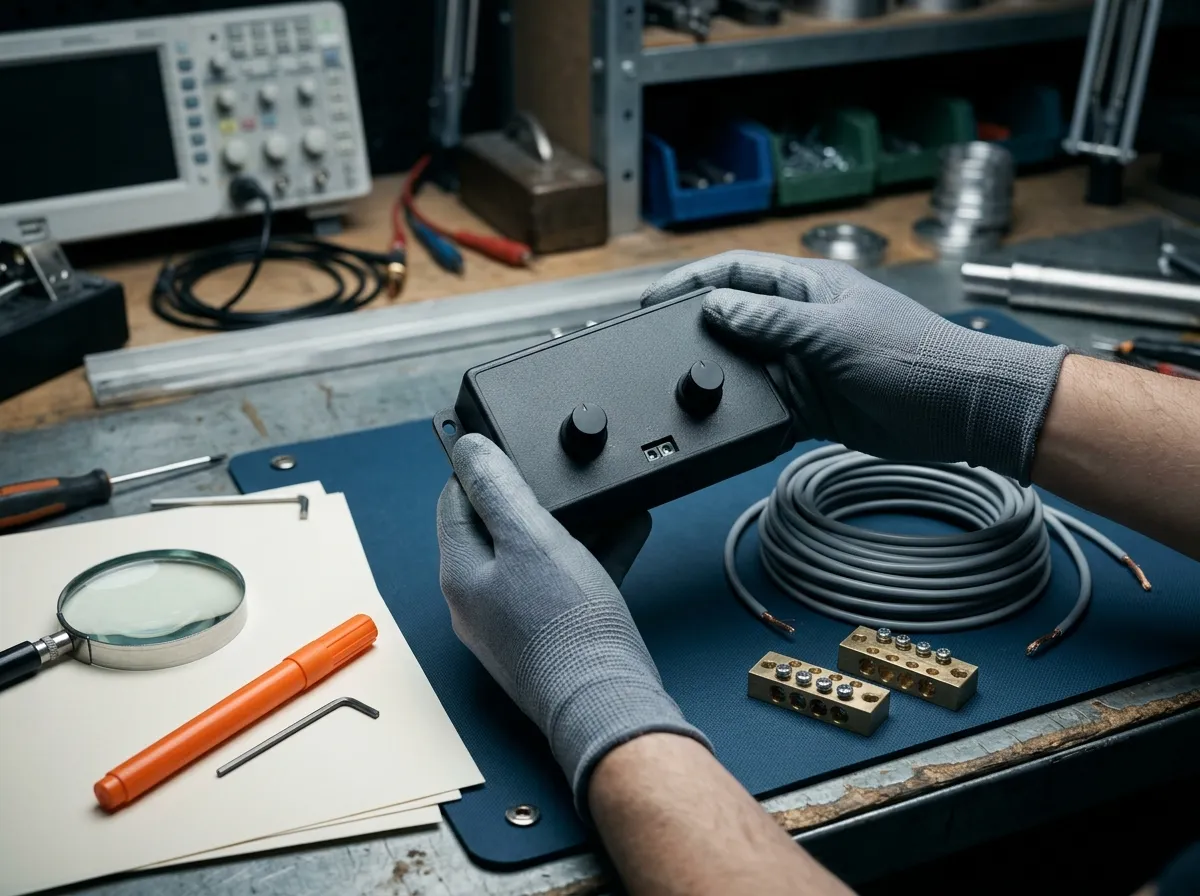
Steps 1 to 4 and 6 need a bench, the label and a document request — not a laboratory.
1. Find who is legally responsible. Read the label: whose name and address is on it. If it is yours, the DoC must be yours as well. Fail signal: a DoC in the factory's name while your brand is on the unit.
2. Read the four load-bearing fields of the DoC. The directive numbers it cites — both 2011/65/EU and (EU) 2015/863, not the older one alone; the product identification, by model or type rather than "LED controller"; the harmonised standards applied; and a signatory with a date, plus a name and address an authority can write to (the manufacturer, its authorised representative where one is appointed, or the EU importer). Fail signal: no model identification, or a document written before the phthalates applied.
3. Check model and revision coverage. The file has to cover the exact model and hardware revision you are buying. A DoC naming a series is workable only if the technical documentation defines which models that series includes. Fail signal: the model on the label is a revision the DoC predates, or the series is named but never defined.
4. Ask for the structure of the technical file, not the whole file. How many homogeneous materials are declared, which suppliers provided declarations, which exemptions are relied on, which reports sit behind it. You are testing whether a file exists, not reading it. Fail signal: only a product-level certificate and no BOM-level declaration behind it.
5. Match the report's scope to your BOM. The report should identify the parts and materials tested — the terminal plating, the solder alloy, the cable jacket. IEC 62321 methods are the usual reference. Fail signal: a report whose scope reads "LED" or "LED module" when you are buying a controller, or an XRF screening result presented as a confirmation test.
6. Cross-check the physical unit. Terminals, cable jacket, PCB revision marking, screws and their plating, gasket material: compare what you can see and touch against what was declared. Fail signal: parts on the unit differ from the declared parts — a substituted terminal block or a different cable supplier is the usual cause.
7. Set a refresh and change-control routine. Any component substitution, new terminal or cable supplier, new enclosure material or board revision should trigger a technical file update; exemptions expire and get renewed on a cycle, so an annual re-confirmation is a reasonable cadence. Fail signal: a file dated before your last hardware revision, or a supplier who cannot say which exemptions the file relies on.
Steps 1 to 4 and 6 cost a desk, a bench and two emails. Step 5 needs the report in hand. None of them needs your own laboratory.
Where controllers fail first: four material hot spots
Across controller hardware, the same four places account for most of the material risk.
Solder. Leaded solder fails outright. Lead-free alloys such as SAC305 are the norm, but the second soldering process is where lead comes back — a selective solder pot shared with leaded work, or a mixed alloy at the terminals.
Terminal blocks, studs and screws. Entry 6 of Annex III permits lead as an alloying element above the general limit: 0.35 % for steel, 0.4 % for aluminium and up to 4 % for copper alloy, as the California DTSC sets out. Those figures are not open-ended. Commission Delegated Directive (EU) 2025/2364, applicable in the Member States from 1 July 2026, splits entry 6 into points 6(a) to 6(c) and dates each one: 6(a), the 0.35 % steel and galvanised steel allowance, expires on 11 December 2026, while 6(a)-I, 6(a)-II and the 4 % copper alloy allowance (6(c)) run to 30 June 2027.
Brass terminal bodies and bronze inserts commonly sit on 6(c), so a design that depends on it needs a substitution path inside the life of the project. It is also the entry most often misread: the allowance covers the alloy, not the plating on top of it, and a zinc-plated steel screw cannot borrow the copper alloy figure.
Cable jackets, gaskets and sleeving. Soft PVC brings plasticisers, which is precisely what the 2015 amendment added. A test report dated before 22 July 2019 cannot answer for DEHP, BBP, DBP or DIBP, however clean the rest of it is.
Passivation and coatings. Hexavalent chromium turns up in chromate conversion coatings on zinc-plated brackets and screws. Trivalent passivation is the substitute process, so "which passivation do you use" is a fair question to put in writing.
Hot spot | The evidence that should cover it | The question to put in writing |
|---|---|---|
Solder alloy | Material declaration for the solder plus the process specification | "Which alloy runs in the selective solder pot, and is that pot ever used for leaded work?" |
Terminals, studs, screws | A declaration that names the alloy and the plating separately, plus the entry it relies on | "Which exemption entry does this terminal rely on — 6(a)-I, 6(c) — what is its expiry date, and does it cover the plating as well as the alloy?" |
Cable jacket, gaskets, sleeving | A test report dated after 22 July 2019 that includes the phthalates | "Does the report for this jacket cover DEHP, BBP, DBP and DIBP?" |
Passivation, coatings | A process declaration from the plating shop | "Trivalent or hexavalent passivation?" |
Red flags in the paperwork
Eight things that should stop a purchase until they are explained:
- A "RoHS certificate" from a laboratory offered as the compliance document. RoHS has no certificate scheme; the legal instrument is the DoC.
- A test report dated before 22 July 2019, presented as full compliance.
- A report whose scope is an LED or an LED module when the product is a controller.
- A DoC citing 2011/65/EU alone, with no reference to (EU) 2015/863.
- XRF screening results — fast and non-destructive, but screening — offered as confirmation.
- One DoC for an entire catalogue, with no model list and no technical file behind it.
- Exemptions relied on but not identified by entry number.
- No EU contact point on the DoC of a manufacturer based outside the EU.
Red flag 1 has a cousin that catches buyers in the other direction: assuming a supplier must hold UL or ETL to be legitimate. Those are separate schemes with separate scopes, and which certificates a supplier actually holds explains why their absence says nothing about RoHS.
RoHS outside the EU: UK and California
Two markets worth checking separately, because both have their own instruments rather than an EU rubber stamp.
The UK runs its own instrument — the RoHS Regulations 2012, as amended — and the UK government guidance sets out what it asks of a supplier. Three of those points are checkable from outside the file: a technical package kept for ten years after the last product is first placed on the market and produced to the Office for Product Safety and Standards (OPSS) on request; the importer's name or trademark and a contactable address on the product or its packaging; and a GB exemptions system that runs independently of the EU one, while Northern Ireland keeps following the EU system. California reaches the same substance limits through its own statute for general purpose lights: manufacturers must certify compliance to sellers on request, and provide technical documentation to the Department of Toxic Substances Control within 28 days of a request.
Other markets run their own restricted-substance rules with their own scopes and evidence formats. Rather than assume equivalence, ask the supplier for the market list in writing, and keep the EU technical file as the baseline — of the regimes described here, it is the one that demands the most detail. The wider document chain for EU shipments is covered in exporting LED strip to the EU.
This is a procurement guide, not legal advice; confirm your own declaration and technical file with your compliance team or an EU-based consultant.
What to put in your RFQ
The check collapses into seven lines you can paste into an enquiry:
- Confirm the DoC is issued in our company's name, and provide a draft if it is not.
- State the directive references: 2011/65/EU and (EU) 2015/863.
- List the models and hardware revisions the DoC and technical file cover.
- Provide the material declaration summary at BOM level, with the exemptions relied on by entry number.
- Provide the test report, with its sample scope and the methods used.
- Confirm the solder alloy, the terminal and screw materials and their plating, the cable jacket material, and the passivation process.
- Confirm how a component substitution is handled — who updates the file, and how we are notified.
Pileds builds LED controllers — Art-Net, DMX512, SPI, decoders and address writers — in the same plant as the fixtures they drive, and holds RoHS documentation under reference XDH0923574011130419CC, assessed against (EU) 2015/863. Ask us which models that file covers, and we will send the DoC and the test report for the models it does. If your project spec has a materials clause in it, send us the spec and we will answer it line by line.
Specifying pixel LED for a real project?
Send the spec — pitch, IC, IP class, run length, voltage — and you get an engineer's answer, not a catalogue. Samples and OEM/ODM quotes from the Shenzhen factory floor.