
46,000 Globe Points for a French Exhibition
What it takes for an immersive light installation supplier to ship 46,000 globe points for a French exhibition: control, DC power layout and batch colour proof.
An Immersive Light Installation: 46,000 Globe Points
A light-art exhibition in France wanted visitors to stand inside the light. Not walk past a lit wall, not watch a projected show from a barrier — stand in a room where the light is all around them, with real depth in every direction. The brief that landed with us at Pileds, a Shenzhen pixel-LED manufacturer, was the sort of job that tests an immersive light installation supplier end to end. What we delivered was 46,000 globe points, strung into volumetric columns and an immersive mirrored room, driven as one addressable surface. It is one of the larger point-based installations in our delivery record.
The number is the easy part to say and the hard part to earn. Forty-six thousand individual light sources is not a quantity you buy by the metre; it is a population you have to control, power, hang, colour-match and re-check. Every one of those points has to land in the right place in the picture, at the right colour, for years of daily operation.
So the useful question for a project of this size is not "can you supply the fixtures". It is "who has already run this many of them, and what did they have to solve".
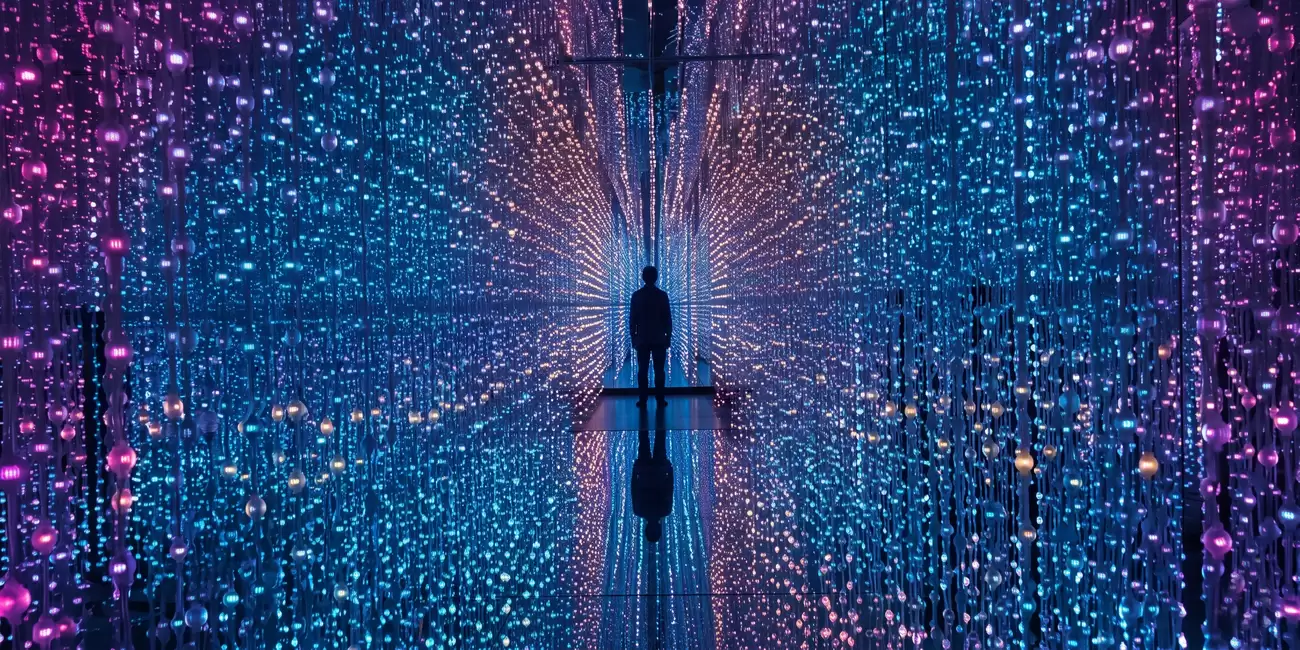
The delivered project: the mirrored room with its globe-point field lit as one surface. Photo from the project record.
What "46,000 Globe Points" Actually Means in the Room
A globe point is a small diffused sphere with an LED inside it, hung on a thin cable. In this build the spheres are 50 mm across and emit in every direction, and they are strung into vertical columns so that the room reads as a field of light rather than a set of lamps. Add mirrored surfaces and the visible depth doubles: the reflections complete the volume without buying more hardware.
Two consequences follow from that construction. First, the density is set by geometry, not by brightness: string spacing, point spacing within a string, and the distance to the nearest surface. Second, nothing about the effect survives a bad power or data design — which is why the rest of this article is about the invisible half.
The count itself is a consequence rather than a target: a designer fixes the spacing the effect needs, then measures how much volume the room offers. That is also why point counts are a fair way to compare suppliers — 46,000 points surfaces power, data and colour problems a 4,000-point room never meets.
It also matters to be exact about what a delivery record does and does not contain. Here is the boundary for this project, stated plainly, because you will be handed dozens of glossy case pages that blur it.
Documented in the project record | Deliberately not claimed here |
|---|---|
Country: France · venue type: immersive light exhibition | The exhibition's name, the client's name, or the city |
46,000 globe points delivered | The exact string count, spacing schedule, or rigging drawing |
50 mm, 360° emission, volumetric columns + mirrored room | The show's running order, any interaction or audio-synchronisation layer, or visitor numbers |
Products: addressable point light + LED control | Contract value, delivery dates, or installation duration |
Delivered state: the walk-in 3D field, mapped as one addressable surface | Colour tolerance figures or per-batch records for this job |
That table is not hedging. It is the difference between a page you can quote in a tender and one you cannot.
Why a 360° Globe Point Instead of a Flat Pixel
The alternative to a globe point is a flat addressable pixel — a small square emitter on a strip or a panel. Flat pixels are excellent when the audience sees them from one direction: a facade, a sign, a screen. Inside a walk-in volume they fail for an optical reason. A flat emitter throws most of its light into a hemisphere, so from most viewpoints a viewer sees a bright disc and then a dark back face; the field turns into a grid of visible hardware.
A 360° globe point removes that failure mode. Because the sphere emits in every direction, each point looks lit from wherever you stand, and the light also spills sideways into the space between points — which is what makes a sparse physical grid read as a continuous field. That spill is why the room in the photograph above holds its depth from every angle rather than only from the camera position.
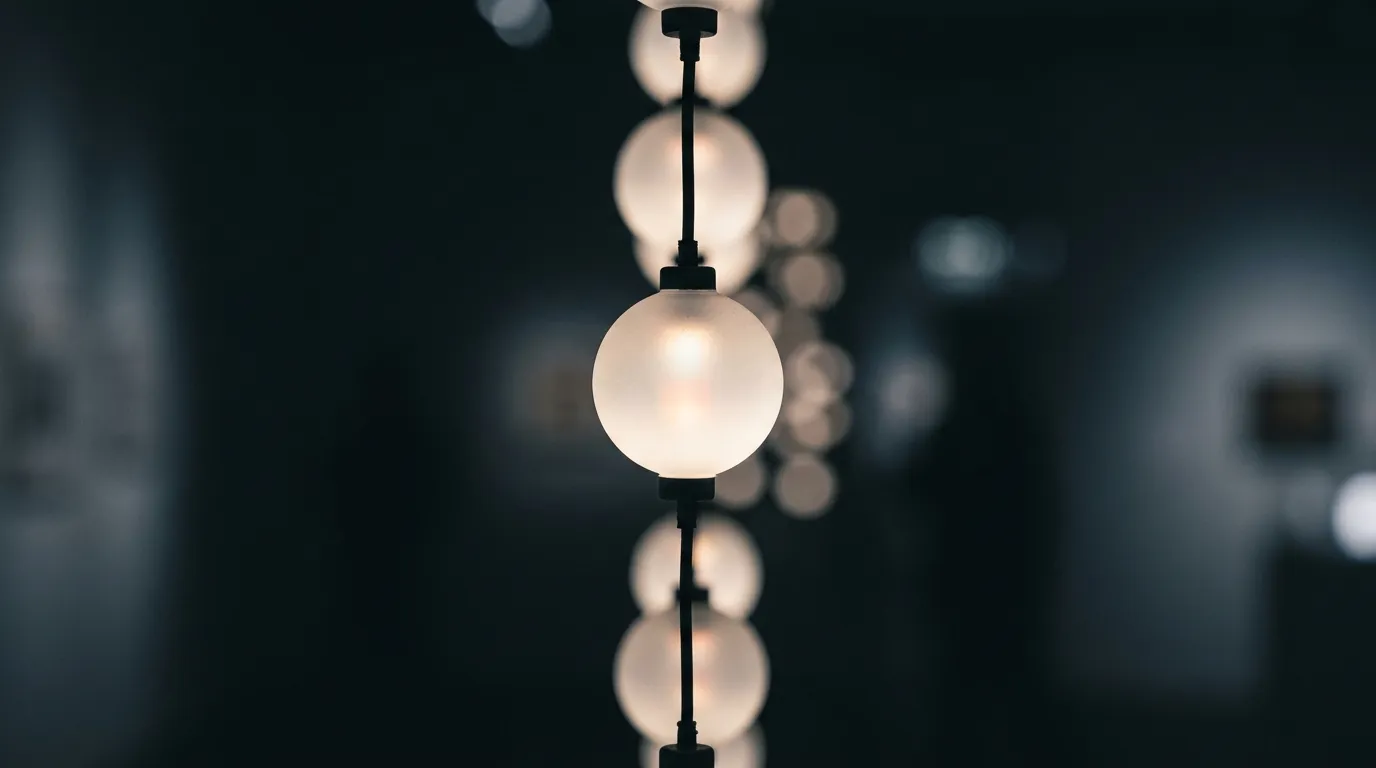
Globe point design detail: a single 50 mm sphere emitting in all directions inside its string. Scale illustration.
Three selection consequences that buyers should test any supplier on:
- Diffusion, not glare. The sphere has to be diffusing enough that a visitor standing centimetres away sees a soft point, not a retina-burning LED. This is a material and wall-thickness decision, not a spec-sheet wattage.
- Addressability per point. Each sphere is individually controlled, so the surface can be re-programmed without rewiring — the same property that makes a facade future-proof.
- Mounting that survives 46,000 pendants. Cable gauge, strain relief and the string's attachment to the structure decide whether the field is still straight in year three.
The 50 mm globe point used here is a standard product rather than a one-off: it appears in our catalogue as a 24 V RGB globe point light, and the same family is built in DMX variants for rooms that will be driven from a console. One discrepancy to flag: the catalogue page rates that standard part at 270°, while this build's record states 360° emission — if 360° is what your design depends on, have the figure written into the drawing.
Control at 46,000 Points: One Surface, Many Universes
Addressing is where most large point installations become small installations painted large. A full-colour point consumes three channels — red, green and blue — and a DMX universe carries 512 of them, a limit set by ANSI E1.11, the DMX512-A standard. Do the arithmetic on this project and 46,000 individually addressed points is a roughly 270-universe problem — 170 points fill a universe, and every one of those 270 streams has to arrive, in order, in the same frame.
Nothing about that is exotic once the topology is right. Data fans out over Ethernet from the show controller to node-level LED controllers, which translate the network stream back into the pixel protocol the spheres speak. Above the DMX line, Art-Net and sACN carry far more universes per cable than a serial DMX chain could, which is what lets a media server treat the whole room as one canvas rather than as a rack of independent fixtures. Our own comparisons of the two protocol families, and where each one stops being the right answer, are in DMX512 vs Art-Net.
Interaction and audio synchronisation sit above that chain, feeding the show controller rather than the pixels; this project's record documents neither, and this article claims nothing about them.
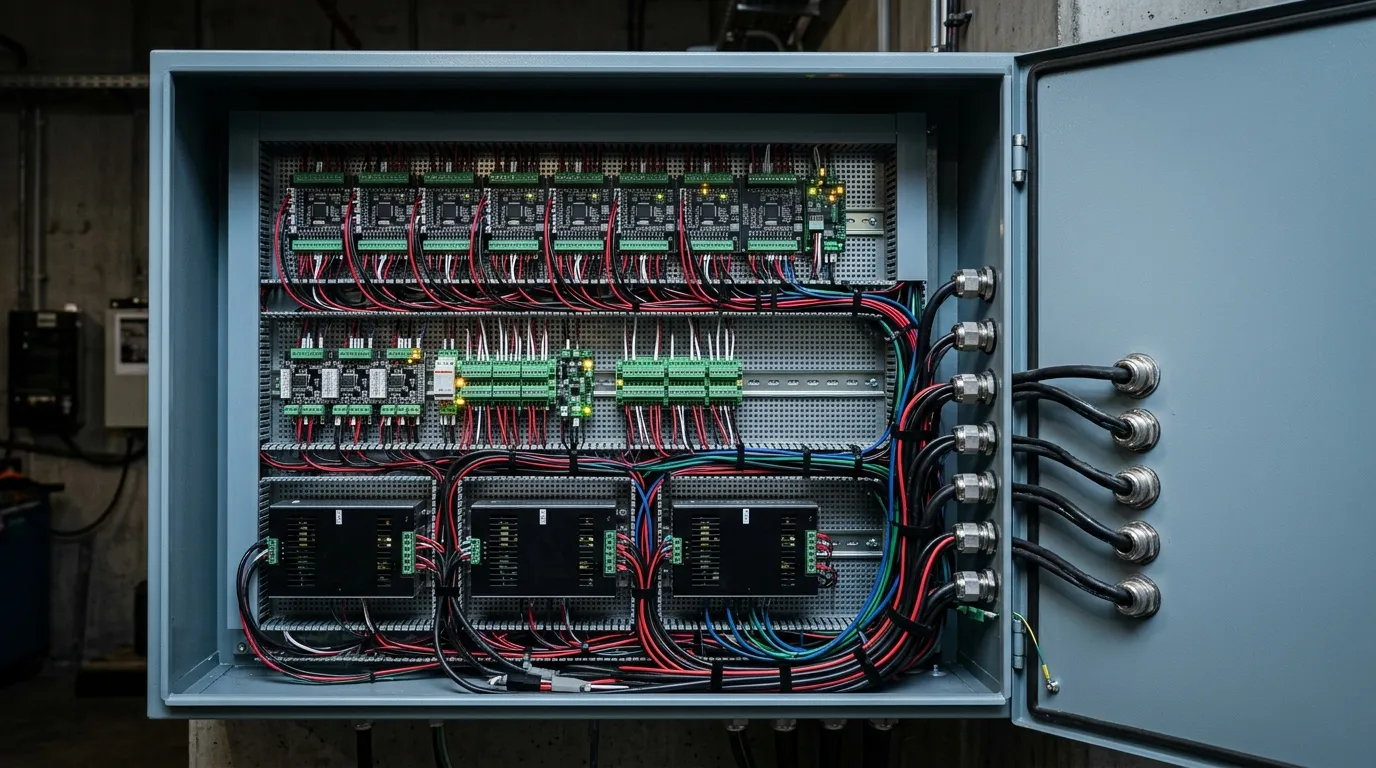
Scale illustration: the controller and power stage behind a point installation — one cabinet's worth of universes.
The engineering questions a supplier should be able to answer on the spot:
- How many points per controller, and per universe? Too few controllers and the cabinet count explodes; too many and a single failure blanks a whole column.
- What happens at frame boundaries? A field this size is unforgiving of timing errors — a one-frame lag in one universe shows up as a visible seam running through the room.
- How are colours matched across controllers? Colour calibration is per string, not per fixture family, once you are mixing thousands of points from different production runs.
- What is the fallback state? Exhibition rooms run daily for years; the installation needs a defined behaviour after a power cut, not a black room until an operator arrives.
Power and Data Through a Volumetric Field
DC distribution is where large point projects quietly fail, and the first thing our engineers model when a point count enters the tens of thousands. Every metre of cable and every LED carries resistance. Feed 46,000 points from a handful of power points and the far end of each run sees less voltage than the near end: dimmer output, a colour that drifts pink at full brightness, or flicker when the drivers hunt.
The fix is structural, not electrical heroics. Power is injected at multiple nodes along each run so that no segment draws current through a long stretch of conductor — the same discipline described in Voltage Drop in Pixel LED Runs, where the cadence of injection points, not the thickness of the copper alone, decides whether the far end matches the near end.
Sizing follows the load rather than the fixture count: total wattage is the starting point, and a correct layout adds headroom for sag, for the inrush when a large pixel system boots, and for derating inside warm enclosures. We published the sizing logic separately in Sizing a Power Supply for Pixel LED Strip.
Three things change when the load is thousands of pendants rather than a strip:
- Weight and copper stop being an afterthought. Point fields need distributed supplies close to their loads, because long DC tails are a voltage-drop problem and a weight problem in a suspended rig.
- Inrush stops being theoretical. Switching a large pixel population on creates a current spike that trips undersized supplies in the first second of operation.
- Service access has to be designed in. A supply you cannot reach from a maintenance walkway becomes a scaffold, a closure, and a lost show day.
Building the Room: Columns, Mirror, Commissioning
The physical build is where the drawings meet the building's tolerances. Columns of globe points hang from the structure above, the mirrored surfaces multiply the visible depth, and the strings are dressed so that the spacing you see is the spacing you designed. Commissioning a field this size follows an unglamorous sequence: hang and level the strings, verify injection points and enclosure positions, power the runs in stages rather than all at once, then map and calibrate the field as a single surface before hand-over.
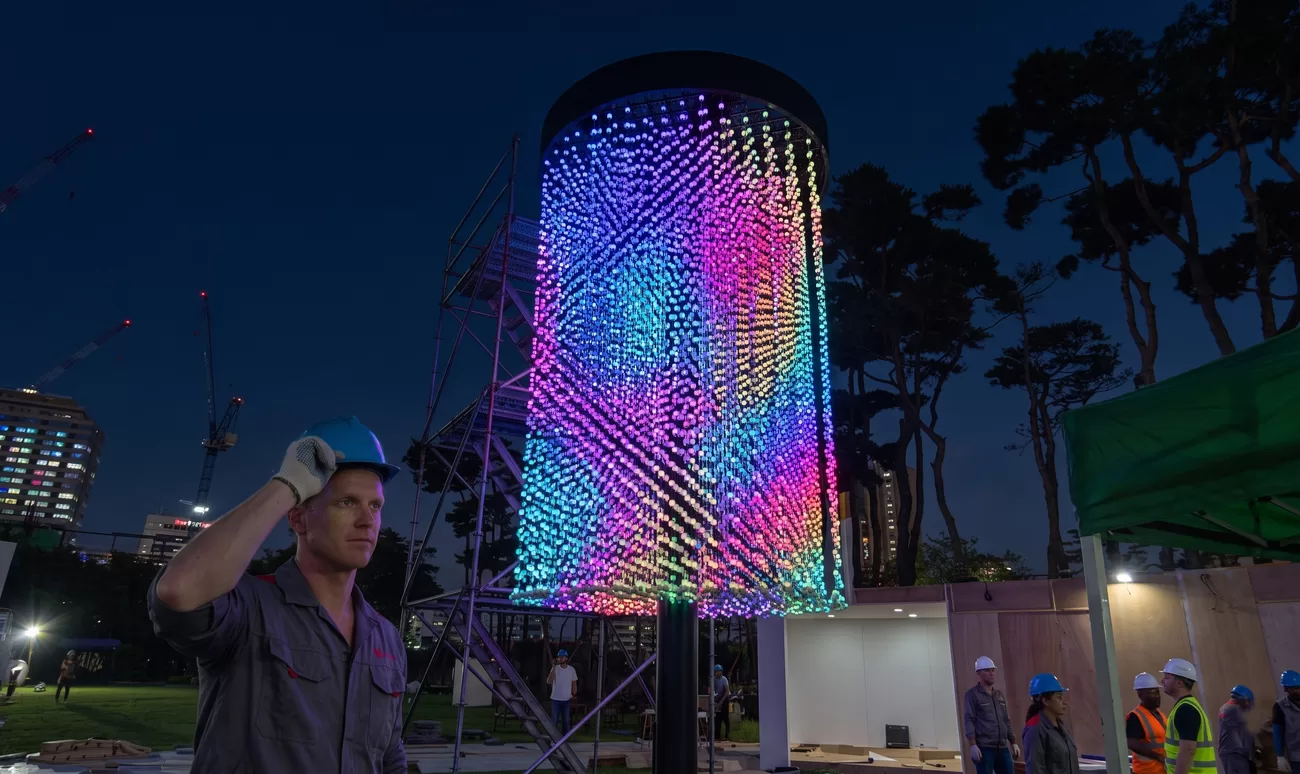
On site during the build: a globe-point column lit and being dressed. Photo from the project record.
Two points that buyers tend to discover late. Commissioning is a real line item. Mapping and colour-calibrating a 46,000-point field takes skilled hours that a fixtures-only quotation quietly omits. And indoor does not mean unprotected: exhibition rooms are dusty, cleaned, and occasionally refurbished, so connector sealing and cable management still matter. The same globe-point family is also built in sealed outdoor versions, where the protection level is defined by the IEC 60529 IP code — worth understanding if your project spills outside the gallery.
For the same engineering problem at other scales: 86,500 pixel points on a Singapore observation wheel covers the outdoor moving-structure case, and 1,200 m of DMX wall washer on a German plaza covers the long linear run.
How 46,000 Points Get Proven Before They Ship
A field this dense is a batch problem before it is an installation problem. If one production run is visibly cooler or greener than the next, no amount of programming will hide it once the reflections double every string. This is the part of the process that separates a factory from an assembler.
Every batch of spheres that goes into a project like this one passes through six checkpoints:
# | Checkpoint | What it catches |
|---|---|---|
1 | Incoming QC | LED, driver IC and PCB batches that arrive out of spec |
2 | In-line AOI | Solder and placement defects during SMT and reflow, per board |
3 | Integral-sphere test | Colour point and lumen output, verified per batch — not per sample box |
4 | Aging test | Early failures that only appear after a burn-in at temperature and humidity |
5 | IP / sealing test | Water and dust ingress on the sealed variants, to the rated grade |
6 | Pre-ship QC | Full function and control test of every string before packing |
Checkpoint 3 is the one that decides how a 46,000-point field looks. An integrating sphere measures total radiant output and colour of a light source from all directions at once, which is exactly the question a diffused globe point raises: how much light leaves the sphere, and what colour is it. Measuring that per batch — rather than trusting a bin code — is how you keep a project's colour consistent from the first string hung to the last.
The plant in Shenzhen Bao'an keeps the stages that decide colour under one roof — its own SMT and reflow lines, the integral-sphere station, the aging chamber, and hand assembly and wiring. That is what makes per-batch measurement real rather than aspirational, and it pays off after hand-over too: when one point in a field of 46,000 eventually fails, the replacement has to match the strings around it, and a factory that retained each batch's colour point can pull a matching one.
What This Means If You Are Vetting an Immersive Light Installation Supplier
Bring the same questions to every supplier and the answers will separate them quickly.
- Ask for point counts, not projects. "We lit an immersive exhibition" is a sentence. "46,000 addressable points, individual control, delivered" is evidence. Read the rest of our delivered pixel LED projects the same way.
- Ask who builds the control stage. A supplier who only sells fixtures will hand your integrator a data sheet and a headache. Ask how many points fit per controller and who maps the field.
- Ask for the power layout. Injection cadence, supply placement, and inrush headroom are the three answers that reveal whether a factory has actually run large point loads.
- Ask how colour is held across batches. If the answer is a bin code, you are buying a lottery ticket with thousands of tickets in it.
- Ask about the aging and pre-ship tests, and whether the test data is retained. Process claims without records are marketing.
- Ask what happens after hand-over. Spare strings, matching batch colour for replacements, and a serviceable power path are what keep the room running in year five.
The project behind this article is documented on its own page, alongside the fixtures and control hardware that carried it: the French 3D globe-point exhibition project. If your brief is a walk-in light field at an unknown scale, send the dimensions, viewing distances and point target to Pileds for a layout review — that is where the answers above stop being abstract and become a bill of materials.
Specifying pixel LED for a real project?
Send the spec — pitch, IC, IP class, run length, voltage — and you get an engineer's answer, not a catalogue. Samples and OEM/ODM quotes from the Shenzhen factory floor.