
DMX512 vs Art-Net: 4 Questions to Decide
DMX512 vs Art-Net is a wiring decision, not a speed contest. Four questions — pixel count, port count, offline operation, on-site Ethernet — settle it.
DMX512 and Art-Net carry the same data; they differ in how far it travels and how much of it fits. DMX512 puts one 512-channel universe on one daisy-chained cable. Art-Net wraps that same DMX512 data — plus RDM — in UDP packets and sends thousands of universes down one Ethernet link. Pick DMX512 when one universe reaches everything you are controlling; pick Art-Net when any of these four answers comes back the other way: your pixel count does not fit one universe, you need more than a couple of output ports, the installation must run without a console, or you have Ethernet where the fixtures live. This is from PILEDS, a manufacturer that builds both DMX/SPI decoders and 16-port Art-Net controllers, so we have no reason to push you at either — here is the four-question test, the channel arithmetic behind it, and the failure modes that decide whether the rig actually works on site.
It is worth clearing one myth up front: neither protocol is faster in any way you will feel. A DMX512 line refreshes its 512 channels continuously, and Art-Net sends the same frames at a comparable rate over the network. Art-Net was never created to beat DMX512 — it was created to stop you running a separate cable for every universe. The official Art-Net site states the protocol is royalty-free, transports 32,768 universes per network, and is implemented by 500-plus manufacturers, which is why it has become the default answer for pixel-heavy work rather than a niche alternative.
The one number that matters commercially: implementing Art-Net costs nothing in licence fees — an OEM code is required, but there is no per-universe or per-device royalty.
DMX512 vs Art-Net: the short answer
DMX512 (ANSI E1.11) | Art-Net | |
|---|---|---|
Carries | 512 channels per universe | The same 512-channel universes, plus RDM, inside UDP |
Per-link capacity | One universe, one cable | 32,768 port-addresses on one network |
Distance | Roughly 300 m (about 1,000 ft) before repeaters, ~32 loads per line | 100 m per copper segment; switches and fibre extend it indefinitely |
Topology | Daisy chain, terminated at the far end | Star or tree through switches and nodes |
Licensing | Open ANSI/ESTA standard, no fee | Royalty-free; an OEM code is required to implement it |
Best fit | One universe's worth of fixtures, simple rooms, fail-safe local branches | Pixel walls, multi-zone rigs, anything past a few universes |
The structure of DMX512-A itself is defined by ANSI E1.11, maintained by ESTA; its bi-directional companion RDM is ANSI E1.20, and the sACN streaming alternative is ANSI E1.31. Art-Net is not a standards-body document in the same way — it is published openly by its author as the Art-Net specification, which is the document to have on hand the day a manufacturer's feature list and the wire disagree. The two do not look alike either: a DMX512 line is RS-485 differential signalling on shielded twisted pair, conventionally terminated in a 5-pin XLR connector because it must never be confused with a microphone line, while Art-Net uses the same Cat5e or Cat6 cabling as the rest of a network. If you have ever been told your pixel wall "doesn't fit in one universe," that is the 512-channel limit being reached, and it is the single most common reason people arrive at this comparison at all. The broader map of how protocols sit on top of driver ICs is covered in our addressable LED driver IC and protocol guide.
The rule of thumb that survives contact with a real show: Ethernet for the backbone, DMX for the last three metres, and a copper island for the looks you cannot afford to lose.
Question 1: does your pixel count fit inside one DMX512 line?
Start with arithmetic, not with opinions. Every pixel is a group of channels: three for RGB, four for RGBW. A 512-channel universe therefore holds about 170 RGB pixels or 128 RGBW pixels. That is the whole budget — there is no partial universe you can borrow from.
What you are driving | Channels it needs | Universe space |
|---|---|---|
50 RGB pixels (a small chase) | 150 | Well inside one |
170 RGB pixels | 510 | Exactly one |
128 RGBW pixels | 512 | Exactly one |
A 20 × 20 RGB matrix (400 pixels) | 1,200 | Three universes |
1,024 RGB pixels | 3,072 | Six universes |
Note the last two rows against a spec sheet you may already have: a DMX→SPI decoder rated for 1,024 pixels and a 16-port controller rated at 1,024 pixels per port are both real products in our own range, and neither number is a universe count. Pixels per box and channels per universe are two different budgets; conflating them is how a rig ends up two universes short on load-in day. The decoder also has to speak the right dialect at the pixel end — a DMX→SPI box is only useful if it matches the driver IC your strip carries, and the most common fork in the road there is compared in our WS2811 vs WS2812B driver IC comparison. Once the answer to question 1 is "more than one universe," Art-Net stops being a preference and becomes the plumbing — one network link carries all of those universes where copper would have needed one cable each.
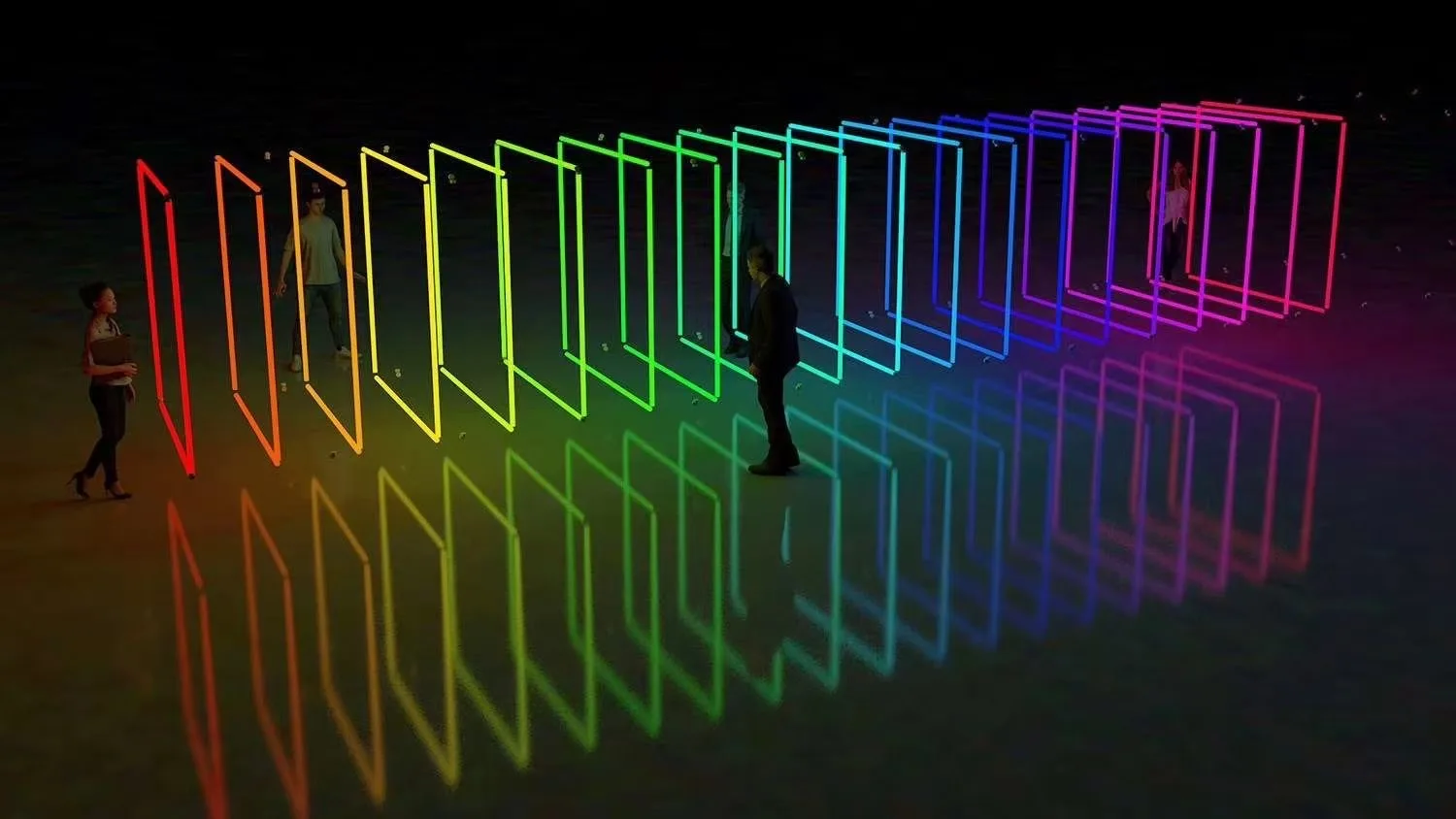
A run like this is a channel-budget problem before it is an optics problem: every frame in the row is another block of three-channel pixels competing for the same 512-channel universe.
Question 2: how many outputs and zones do you actually need?
The second question is where the protocol decision turns into a product decision, because "universe" is a software concept and "port" is a physical one. Each output port on a controller serves one run of fixtures on one universe; if your rig has eight separate zones with eight separate cable runs, you need eight ports regardless of which protocol carries the data.
Control line | Ports | What it suits |
|---|---|---|
Single-output DMX→SPI decoder | 1 | One run, one zone, or a local branch off a bigger network |
8-port controllers (PI-808SD, PI-8008B) | 8 | Mid-size stages and permanent installations with a handful of zones |
12-port controller (PI-1212A) | 12 | Larger venues, facades with distinct elevation zones |
16-port controller (PI-1616A) | 16 | Full pixel walls and multi-zone shows on one Art-Net link |
Two things follow. First, port count is the number every supplier quotes in, whichever brand you end up buying — it is what actually constrains the design, and asking for "an Art-Net controller" without it gets you a box that runs out of outputs at commissioning. The models in the table above are simply where ours sit on that ladder. Second, this is the point at which a networked control line repays its complexity: sixteen ports need at least sixteen universes, and up to three apiece once a port is filled to its full 512-pixel DMX rating — 512 RGB pixels is 1,536 channels, which is three universes, not one. In a DMX-only world that is sixteen cables and rising; in an Art-Net world it is one Ethernet link plus one box. Our own controller and decoder range runs from single-output decoders up to the 16-port Art-Net units for exactly this reason — the protocol and the port count are chosen together or not at all.
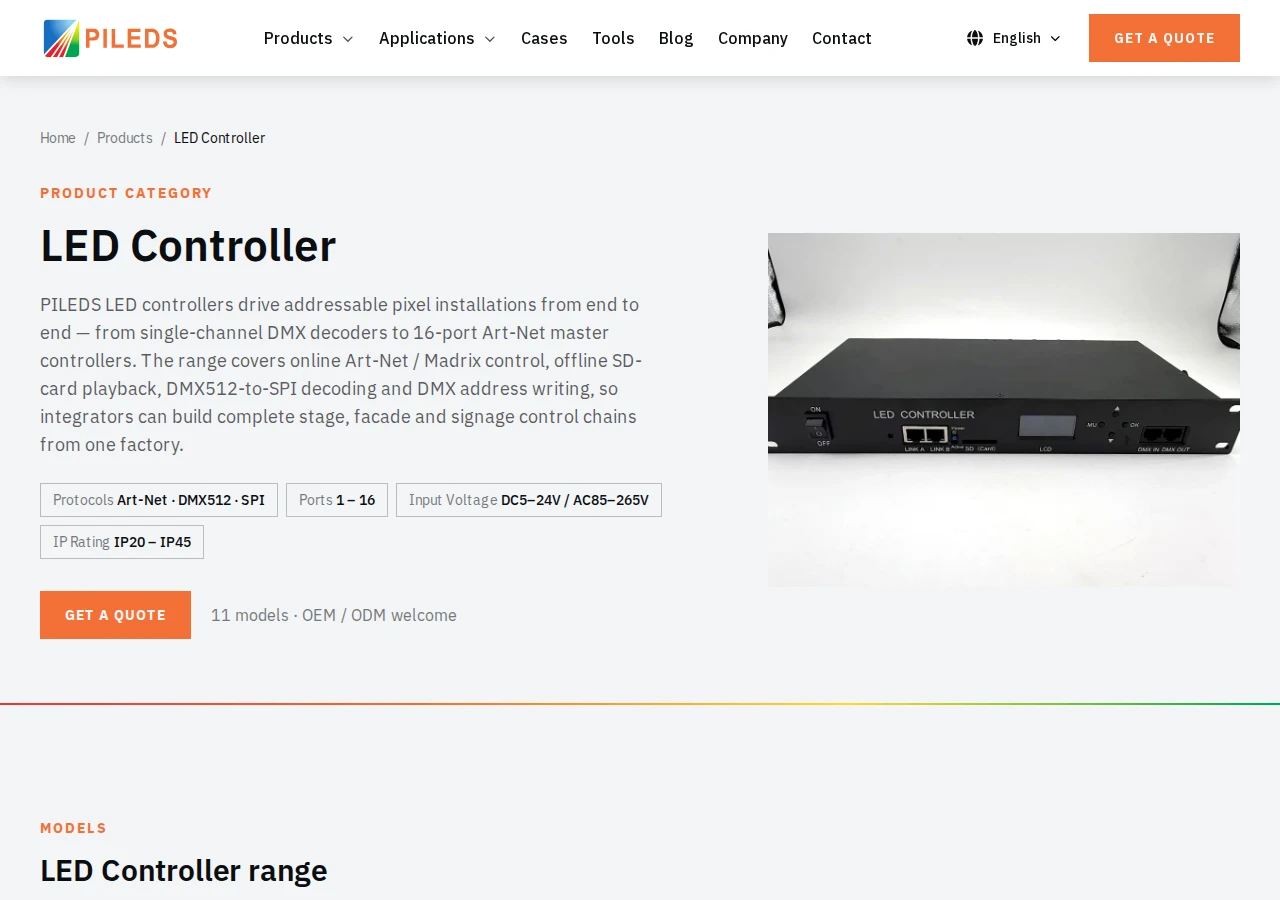
The right way to read a controller catalogue: find the port count first, then check which protocols and offline modes that model supports.
Question 3: will a console be running, or must the show run itself?
This is the question most selection guides skip, and it is the one that reverses the answer. Art-Net and sACN are live network protocols: the data exists only while a console, media server, or mapping computer is generating it. If the console stops, the pixels hold their last state or go dark. DMX512 has the same property — it is a streaming signal — but the failure is easier to reason about because there is exactly one cable in the path.
So ask who is in the room. A touring or broadcast rig always has a console and an operator: Art-Net is ideal, because the console can address every universe on the network and you can add a backup desk to the same fabric. A permanent installation — a facade, a club ceiling, a hotel lobby, a storefront that switches on at 18:00 every day — usually has nobody, and a network protocol with no controller running is a very expensive way to leave the lights off. That installation wants a controller that can play a show file from an SD card with the network disconnected, such as the PI-808SD, whose online/offline mode is the entire point of the product.
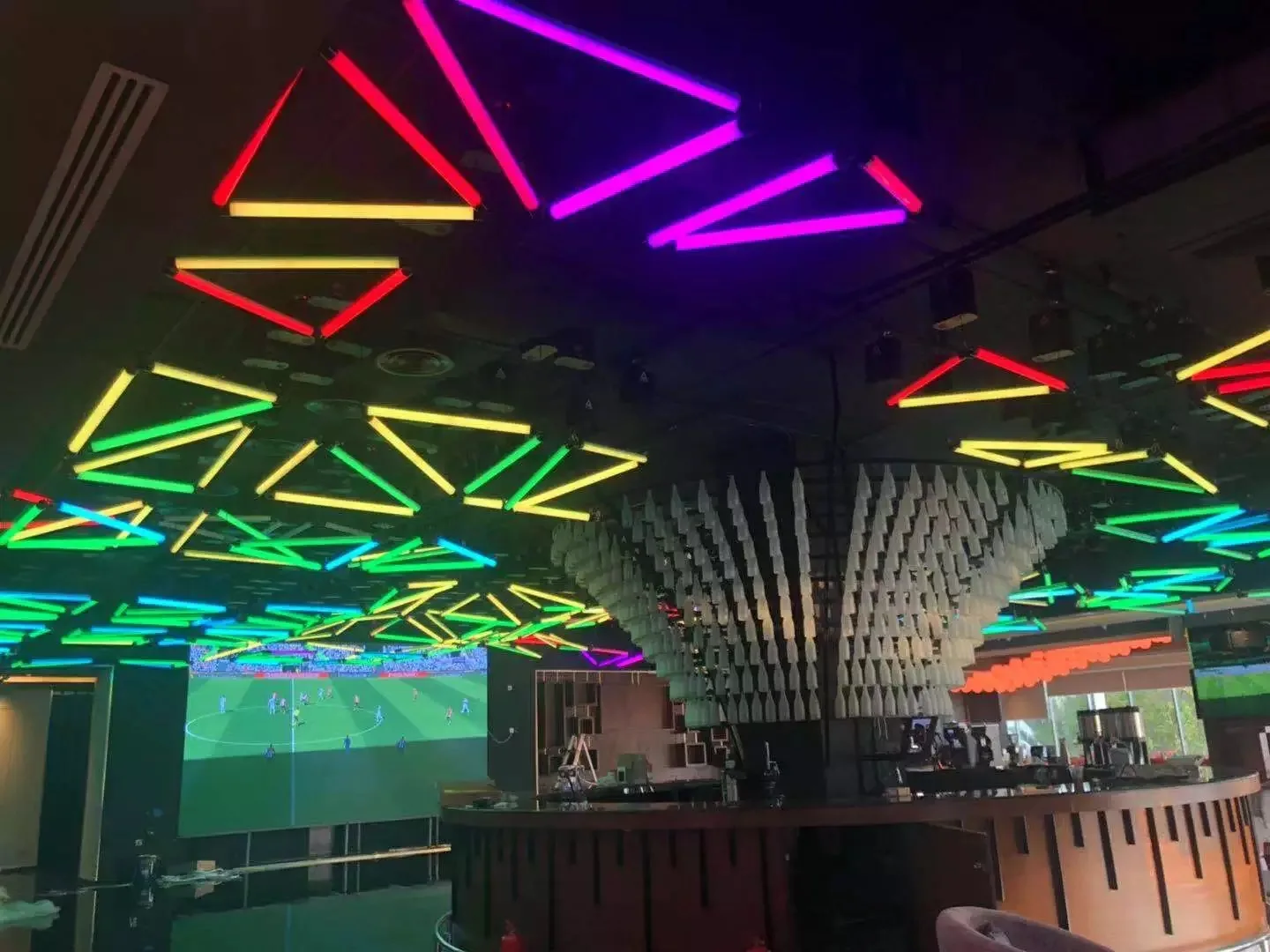
Permanently installed feature lighting is the case that decides question 3: nobody is holding a console when it powers up, so the controller has to hold the show.
Question 4: is there usable Ethernet where the fixtures live?
Art-Net needs a network — and a network is a piece of infrastructure somebody has to design, install, and label. That is the last question, and the one most often skipped at design stage and discovered at load-in.
A DMX512 line needs a cable and a terminator. An Art-Net link needs cable runs within the 100 m copper segment limit, a switch with enough ports, addresses and netmasks that match on every device, and a rule about how universes are addressed. The bandwidth itself is rarely the problem: one universe is a continuous stream of packets at roughly 40 to 44 per second, about 0.2 Mbit/s, so a modest 100 Mbit link carries dozens of universes with headroom and latency stays in the millisecond range. What does bite is addressing, and three engineering constraints that rarely make it into the guides are worth designing in from the start:
- Unicast, not broadcast, once you grow. Broadcast is the easy default on a small network: every packet goes to every device, and each device discards what it does not need. Switch hardware cannot filter broadcast traffic, so at tens of universes every node spends real processor time discarding packets it never wanted. Art-Net's discovery mechanism (a controller broadcasts an ArtPoll, each node answers with its address and universes, and the controller then unicasts each universe only where it belongs) is the fix, and the Art-Net 4 specification directs controllers to unicast where possible, with most modern software now doing so by default — ENTTEC's Art-Net reference documents the packet behaviour, the addressing fields, and the netmask traps in more detail than the guides usually bother with. The same reasoning is why shared networks need attention: on a managed switch, enable IGMP snooping and QoS so that streaming traffic for cameras or signage cannot starve control packets, and keep lighting on its own VLAN.
- Wi-Fi is for the last few metres, not the backbone. Wireless Art-Net works and is genuinely useful for a follow-spot data link or a temporary truss drop. It is a poor backbone choice: packets are dropped, a lost frame is overwritten by the next one within tens of milliseconds so you normally will not see it, but a contended access point produces exactly the intermittent flicker that operators remember for years. Keep the backbone wired; scope wireless to low-stakes hops.
- PoE will not drive your pixel run. Power over Ethernet is attractive because it collapses power and data into one cable, and it does work for small control devices. It does not work as a pixel power source: a dense 60 px/m RGBW strip draws on the order of 14–18 W per metre, and a PoE port budget is measured in tens of watts for an entire device. Pixel power stays on local 12/24/48 V supplies at the fixtures, and the network side only carries data. Size those supplies from the strip's actual wattage before you count ports — the method is the same one we describe in the power-supply budget walkthrough for pixel LED strip.
Where this gets big, the network pays for itself immediately: a project with 86,500 pixel points on a single observation wheel is a channel-budget exercise long before it is a lighting effect, and no practical cable count covers that arithmetic.
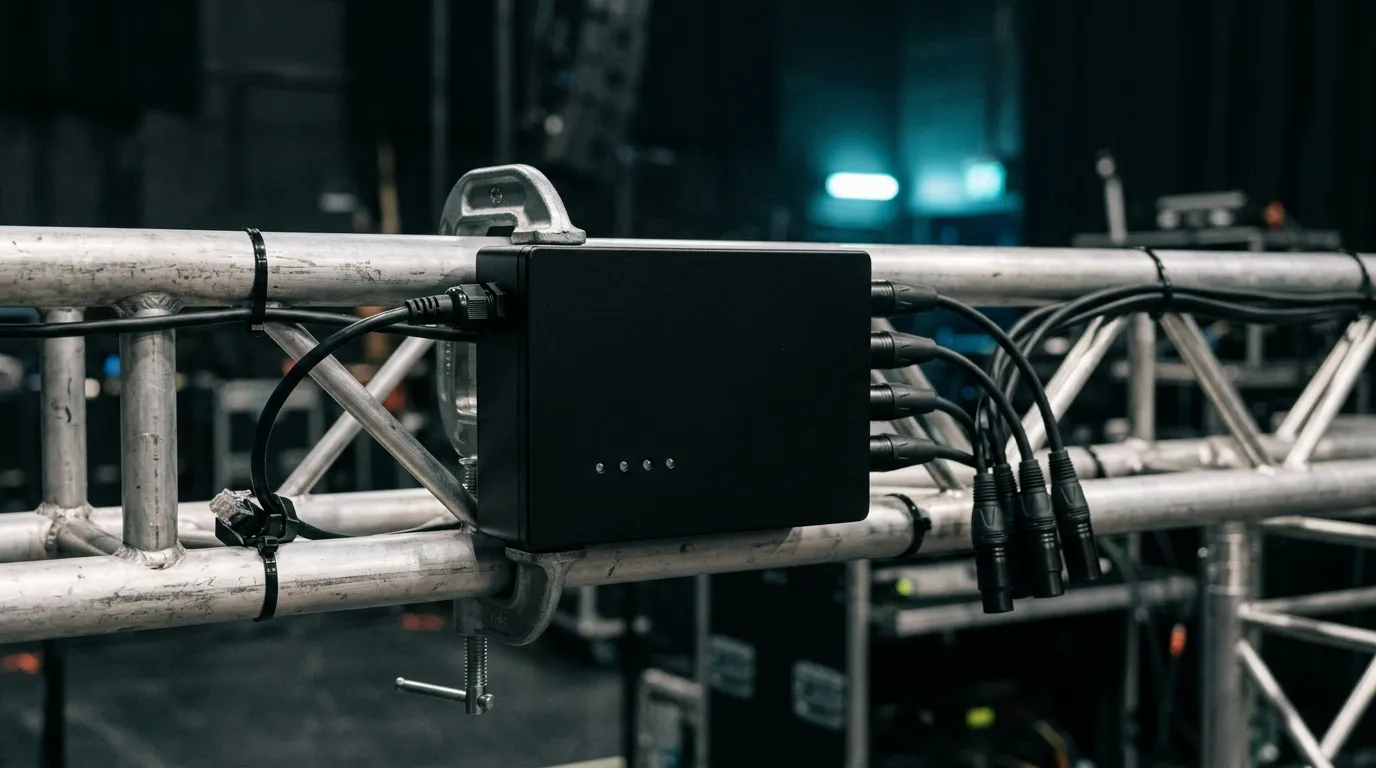
The layer that decides question 4: one network link in, several DMX universes out, sited near the fixtures rather than back at the control position.
What still goes wrong in either world
Two protocols do not make a reliable rig by themselves. These failures appear in both worlds, and the Art-Net-specific ones are almost always network configuration rather than lighting equipment. They are not folklore either — the four Art-Net rows below are the cases ENTTEC's Art-Net reference documents, with the fix each one points to:
Symptom | Usual cause | Fix |
|---|---|---|
Fixtures respond one universe off | Sending software counts universes from 1, the wire counts from 0 | Compare the raw Net / Sub-Net / Universe values shown in the node, not the labels in the software |
Node is visible but receives nothing | Mismatched netmask between controller and node | Put every device in the same range with the same mask; test by connecting node and laptop directly |
Works in rehearsal, stutters mid-show | Broadcast flooding a switch, or control traffic sharing a segment with other services | Move to unicast, isolate lighting on its own VLAN, enable IGMP snooping and QoS |
Random flicker on long runs | DMX line past its practical length or load limit, or a wireless hop in the path | Re-terminate and split the run, or repeater/splitter it; take wireless out of the backbone |
Software cannot see the node | Discovery blocked — UDP port 6454 closed by a firewall, or a router in the path | Discovery does not cross routers; confirm one subnet and open UDP 6454 |
The DMX side has its own physics: 120 Ω shielded cable, correct termination, and roughly 32 loads per line before you split. A microphone cable plugged into a 3-pin DMX socket is still the most common cause of an intermittent fault in small rigs, and no amount of networking fixes it. RDM exists precisely because a plain DMX512 line cannot report any of this back — it is a one-way signal, which is why address setting and fault reporting needed a separate standard on top of it.
When DMX512 alone is the better answer
It would be easy, writing this from a company that sells network controllers, to pretend Art-Net always wins. It does not, and here is where a plain DMX512 line is the right engineering answer:
- One universe genuinely covers the job. A bar, a restaurant, a small retail unit, a handful of par fixtures and a couple of movers: a single DMX512 line with a terminator is cheaper, faster to commission, and has no addresses or netmasks to get wrong.
- The signal must survive on its own. When a line misbehaves you can walk it, unplug devices, and put a tester on the cable. That directness is why touring and broadcast rigs often keep a small DMX island for the critical looks, even inside otherwise fully networked shows — if the network is disturbed, the show does not go dark.
- The cable already exists. Plenty of venues were wired in DMX years ago and it still works perfectly. Adding a network where a working copper run already reaches everything buys complexity and nothing else.
- Somebody else's equipment is on the other end. If the pixel run feeds a fixture that only speaks DMX, the last hop is DMX regardless — and that is fine.
A 1,200 m DMX wall-washer installation, like the German plaza project in our case library, is a useful reminder that the protocol decision is about topology and control reach, not about how impressive the project sounds. Long linear runs answered to DMX512 routing decisions, and the result works.
Writing the four answers into a spec
Once you can answer the four questions, the specification writes itself in about eight lines. Put these on paper before you request a quote from anyone:
- Total pixel count, and the colour format (RGB or RGBW) — this fixes the channel budget and the universe count.
- Universes required, and how many of them sit on one control line.
- Output ports and zones, zone by zone.
- Control mode: live console or media server, or an offline show file with the network disconnected.
- Network plan, if any: switch ports, cable routes, segment lengths, VLAN, unicast.
- Power plan per zone: strip wattage per metre × metres, and the supply for each run.
- DMX island: any part of the rig that must keep working if the network is disturbed.
- Spares and addressing: spare ports, spare universes, and who documents the patch.
Two honest limits on what the PILEDS range does and does not cover, since this is our own product list. Our controllers and decoders are specified per project — port count, protocol mix, offline mode, and voltage — rather than as a fixed catalogue of standard boxes, which means the exact configuration is confirmed at quotation rather than chosen from a stock list. And a controller is not a lighting design: if the four answers above are not settled, no controller will rescue the plan, which is why our usual first reply to a pixel enquiry is a question about pixel count and zones rather than a price. Bring the four answers, and send your spec or point count to our team — we will come back with a port layout, the supply sizing, and the universes your console actually needs to patch.
DMX512 vs Art-Net: FAQ
What is the actual difference between Art-Net and DMX512? DMX512 is a physical serial link: one 512-channel universe per cable, daisy-chained, roughly 300 m before repeaters. Art-Net carries the same DMX512 data over Ethernet as UDP packets, so one network link carries thousands of universes. Art-Net does not replace DMX512 at the fixture — a node converts the network data back to a physical DMX512 output for the last few metres.
Can Art-Net transmit DMX signals? Yes, that is precisely what it does. Art-Net transports DMX512 (and RDM) data over IP; a node or gateway turns those packets back into real DMX512 output on physical ports, which is why every Art-Net rig still ends in a DMX cable between the node and the fixtures.
What are the most common DMX512 problems? Cable and termination faults first: wrong cable type, missing or double terminators, too many loads on one line, and runs past the practical length limit. Then addressing: two fixtures on the same start address, or a patch that assumes a universe has room it does not have once you multiply pixels by three channels.
What software converts Art-Net to DMX? Strictly, the conversion is done by hardware — an Art-Net node or gateway, which turns those packets back into physical DMX512 output. In a pixel system the equivalent box may instead be an Art-Net DMX/SPI controller, which converts the stream onward to the pixel strip rather than back to a DMX cable. Software handles the other half: a console or a mapping application originates the Art-Net in the first place, normally straight out of the computer's own network port. A USB DMX interface is the separate, older path — it produces real DMX512 from the computer rather than Art-Net, and it is how you drive a rig with no node in it at all. Which application you use is a decision made on the software side and kept out of this comparison on purpose — but something upstream has to be generating the Art-Net, because a network with no controller on it carries nothing.
Do I need sACN instead? Not for most pixel projects. sACN (ANSI E1.31) is the other DMX-over-IP standard, and it uses multicast groups that managed switches can prune, which some large permanent installations prefer. Art-Net's simpler addressing and very wide hardware support make it the default in stage and touring work. If your project is hundreds of universes on shared IT infrastructure, compare the two properly before committing.
Can a rig mix both? Yes, and most serious ones do: Ethernet as the backbone carrying Art-Net, with short DMX512 branches from nodes to fixtures at the edge — and a small pure-DMX island for the looks that must not fail. If your project is a stage or touring rig rather than a permanent installation, our stage and touring pixel LED guide covers the fixture side of the same decision.
Specifying pixel LED for a real project?
Send the spec — pitch, IC, IP class, run length, voltage — and you get an engineer's answer, not a catalogue. Samples and OEM/ODM quotes from the Shenzhen factory floor.