
LED Color Consistency Binning for QC Specs
Binning sorts LED chips by color, flux and voltage. What a pixel-LED buyer should write into a QC spec — per-channel bins, batch identity and test method.
LED color consistency binning is the sorting step where an LED maker measures every chip and groups it with others that match on color, flux and forward voltage — and the important half of that sentence is the last word. Binning is the maker's promise about a single chip. What a buyer receives is a batch, and a batch is only as consistent as the bin rules written into the order. If your QC spec does not name the bin, the bin mix and the batch identity, the supplier is free to ship anything inside the catalogue range.
This page is written from the factory side, and it comes with a disclosure: PILEDS builds addressable pixel strip and the bin rules in this article are close to the rules we quote against — we run an incoming check on every LED, IC and PCB batch, and a color-and-lumen measurement on an integrating sphere as the third of six QC checkpoints. So where a spec clause makes life harder for the supplier, that is our problem too, and those sections are not shorter than the ones that make life harder for you. Where a claim comes from a standard or a datasheet, the source is named. Where it comes from our own line, it is labeled that way.
What LED binning actually controls
An LED is a manufactured part, not a painted surface. The emission wavelength of a chip depends on the composition and thickness of the epitaxial layers, and those vary slightly across a wafer, from wafer to wafer, and again through phosphor deposition on a white LED. Two parts that leave the line as the "same" product can differ enough that side-by-side they read as two different colors. Binning exists to turn that continuum into countable groups.
A standard LED datasheet separates the measurements into three bins, and the separation is the whole point:
- Color bins — for a white LED this is a chromaticity region around a target color temperature; for a red, green or blue LED it is a dominant-wavelength band in nanometers.
- Flux bins — luminous intensity or luminous flux, in mcd or lm, with a stated tolerance.
- Forward-voltage bins — the V_f range, which matters to the driver design and to how evenly current divides in a parallel run.
A real datasheet for a 5050 RGB part shows exactly this three-way split: separate bin tables for luminous intensity (for example 600–700 mcd and 700–800 mcd on red), for dominant wavelength (red 620–625 nm, green 520–525 nm, blue 460–465 nm), and for forward voltage (2.00–2.20 V, 2.20–2.40 V, and so on), each bin carrying its own code (Inolux IN-P55TATRGB datasheet, PDF). The letters and numbers in the ordering code are not decoration; they are the only place the actual limits live.
That table is the origin of the first thing worth knowing: "same bin" can mean three different things at once. Two reels can share a color bin and differ in flux, or match on color and flux and sit at opposite ends of the V_f spread. A purchase order that says "consistent color" and nothing else is not a specification — it is a hope.

White-light binning: what the standards pin down
Most of the material written about binning online is about white light, and the reason is that white LED color has an unusual property: it has a name (3000 K, 4000 K) and a tolerance, and the two are constantly confused with each other.
A correlated color temperature is a target, not a value you hit exactly. Manufacturers group white LEDs into chromaticity bins around a target CCT, and the size of a bin is expressed in MacAdam ellipses — the region on the CIE 1931 (x, y) chromaticity diagram within which a color difference is one "step" of perceptibility. In lighting practice the same unit is quoted as SDCM, the standard deviation of color matching, so a "3-step MacAdam" bin and a "3 SDCM" bin describe the same size of color region.
For general white lighting, the American National Standard ANSI C78.377 is what defines the recommended chromaticities and the tolerances around them, and it settles the ellipse-versus-quadrangle question explicitly: four-step MacAdam ellipses are used in the older fluorescent-lamp standard ANSI C78.376, while seven-step MacAdam ellipses and seven-step quadrangles are used for solid-state lighting, the wider quadrangles being adopted because they raise yield while admitting chromaticities just outside the corresponding ellipses (ANSI C78.377-2017 preview, PDF). If you have ever wondered why two "4000 K" fixtures from different suppliers look different, that difference is normally a bin-size difference, not a CCT difference.
Europe approaches the same quantity through the ecodesign rules for light sources, and its definition is the one worth copying into a spec, because it says out loud what "consistent" is measured against. Under (EU) 2019/2020, color consistency is the maximum deviation of the initial, spatially averaged chromaticity coordinates (x, y) of a single light source from the chromaticity center point the manufacturer or importer declares, expressed as the size in steps of the MacAdam ellipse formed around that center; LED and OLED light sources have to stay "within a six-step MacAdam ellipse or less", and during verification the measured number of steps must not exceed the declared number, with the ellipse center taken as the supplier's declared center to a tolerance of 0.005 units (Regulation (EU) 2019/2020, EUR-Lex).
Two useful consequences follow, and both belong in a QC conversation. First, the number is meaningless without the center: a 3-step claim about a center you never agreed on is a claim about a color you may not want. Second, the definition is anchored to the initial measurement — it says nothing about where the color goes after a thousand hours, which is a separate question and a separate evidence request.
Color binning on an RGB, RGBW or RGBIC strip is a different problem
Here is where most of the binning material on the web stops being useful for a pixel-LED buyer. Almost all of it is written about white light — CCT, MacAdam ellipses, SDCM — because that is where the lighting industry's color-consistency vocabulary was built. On a color-changing strip the mechanism is different, and the vocabulary has to change with it. Our pixel LED strip buyer's guide covers the RGB-versus-RGBW-versus-RGBIC decision at the product level; what follows is the binning layer underneath it.
Three differences matter.
Color is binned per channel, in nanometers. A red LED is not specified by a color temperature. It is specified by dominant wavelength, and a small difference in nanometers is a large difference to the eye: the datasheet bins above put red at 620–625 nm, 625–630 nm and 630–635 nm as separate groups, with green and blue divided just as finely. A pixel strip therefore does not have a color bin. It has one for red, one for green, one for blue, and on an RGBW or RGBCCT part a fourth and fifth for the white and the warm-white channels.
The white on an RGB strip is a sum, not a bin. When all three channels run at once the result is a mixed white whose chromaticity is determined by the three channel outputs and their ratios. Manufacturers of RGBW parts have an advantage here — a dedicated white die carries a real white-light bin with a real CCT and a real tolerance — but the mixed white from the RGB triplet still drifts if the individual channels drift. This is why asking an RGB strip supplier for a "CCT tolerance" is a category error, and why the answer to "will the color hold?" has to be asked channel by channel.
Mixing multiplies the bins. A strip that drives red, green and blue chips in parallel is drawing on three bin populations at once, and the mixed colors you see are combinations of three independent spreads. A run assembled from a wide flux bin on green and a narrow one on red will show a green cast at low output and a magenta cast at high output. Nothing about that is a defect in any single LED; it is a scheduling decision made when the batch was picked from stock.
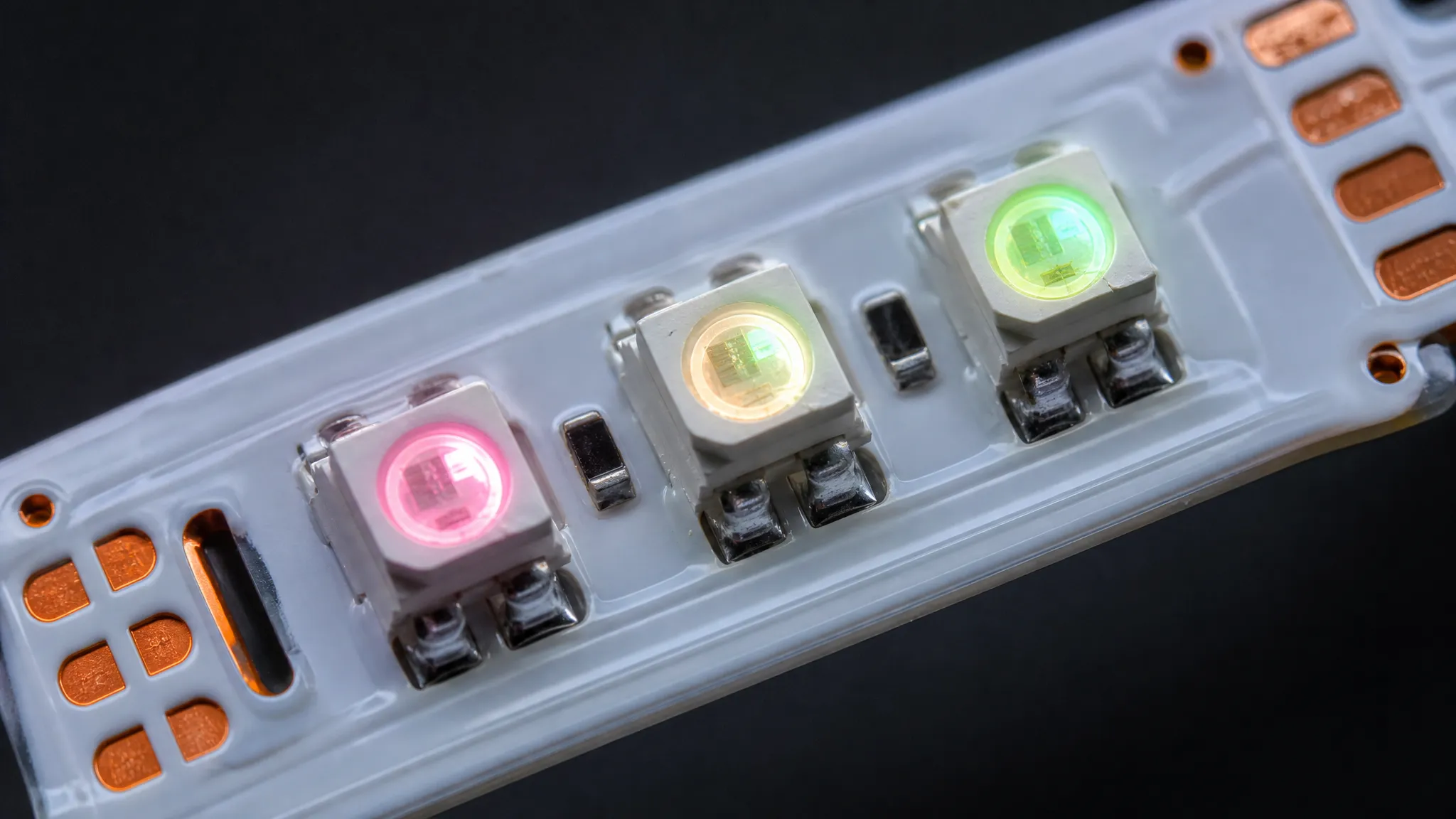
The practical translation is short. For a color strip, the bin list your supplier should be quoting has at least three entries per channel — dominant wavelength, flux and forward voltage — and if the part is RGBW or RGBCCT, a fourth for the white die — or a fourth and a fifth on an RGBCCT part, where the cool-white and the warm-white dies bin separately. An order that names a bin for white chip stock, and nothing for the color channels, has specified the least color-critical half of an RGBW part. The different color types and how many bins each one actually needs are compared in our RGB vs RGBW vs RGBIC breakdown.
Where the bin chain breaks: chip, reel, batch, installation
Binning is done by the LED maker. Consistency, as the buyer experiences it, is decided later, by whoever picks reels out of stock and builds the run. That gap is where most real projects get their color surprises, and it is worth following the part through the chain.
The chip. The maker measures and labels. Everything after this point is a matter of which labels get used.
The reel. Reels are the unit of binning, and reels are packed into boxes. A datasheet states the packing reality without softening it: an immediate box may hold five reels, and "the 5 reels may not necessarily have the same lot number or the same bin combinations" of intensity, dominant wavelength and forward voltage — each reel carries its own label identifying its specification (Inolux IN-P55TATRGB datasheet, PDF). Read that as a purchasing instruction: the box is not a matched set. If your order does not say that all reels in a shipment must share one bin combination, they need not.
The batch. When a strip is built, boards are loaded from whatever reels the line has. A single order may span two or more bin populations, and the strip produced in week one may come from a different population than the strip produced in week three — the same part number, a slightly different color. This is the batch-to-batch consistency question, and it is the reason projects get a "matched to the earlier delivery" clause written into the contract, or do not.
The installation. Finally, color consistency is judged on the wall, where the run is long and the eye compares neighboring segments. This is why the sentence that matters is not "how tight is the bin?" but "what bin does this delivery match, and can you match the next one to it?"
The honest limit of all of this: at some point the bin spread is wider than the eye's threshold for the distance in question, and no amount of paperwork fixes it — you buy a tighter bin, or you accept the spread, or you group the line by bin at the factory. The useful move is to decide which one you are doing before the order, and to write it down. Planning the stock side of that decision — how much to hold, and how much to hold in matched groups — is the subject of our note on stocking a pixel LED line, and the hardware side of splitting a run into matched segments is where our pixel LED accessories guide starts.
What to write into a QC spec
Everything above collapses into a short list of clauses. A pixel-LED order that names all of them is a specification; one that names two of them is a preference. The right-hand column is the failure mode the clause closes.
Clause | What it should say | What it prevents |
|---|---|---|
Color bin per channel | A dominant-wavelength band per color channel, e.g. red 620–625 nm, green 520–525 nm, blue 460–465 nm — not "RGB" | A run whose reds sit 10 nm apart at the two ends of the wall |
White bin on RGBW / RGBCCT | Where a dedicated white die exists — each white die on an RGBCCT part — the CCT and the MacAdam ellipse steps around it, plus the declared center | Two "3000 K" parts with visibly different whites |
Flux bin | Luminous intensity or flux range per channel, with tolerance | A run that is noticeably dimmer in the middle of a long strip |
Forward-voltage bin | The V_f range, and whether it applies to mixed parallel strings | Uneven current splitting, which shows up as color shift at brightness |
Bin mix per order | The maximum spread allowed across the reels shipped for one order, and whether one order may span more than one bin population | A shipment that is individually spec-compliant and collectively mismatched |
Batch identity | The lot or bin combination recorded on the reel label and on the delivery documents | An unprovable claim about what was shipped |
Match to previous delivery | If the project is phased, a clause requiring color match to a retained reference sample or to the recorded bin of the earlier batch | Phase two that does not match phase one |
Test method and standard | The measurement basis — chromaticity coordinates on CIE 1931 (x, y), measured on an integrating sphere with a spectroradiometer, following the current ANSI/IES LM-79 method | A color claim with no stated measurement behind it |
Sampling and acceptance | How many meters or pixels are measured per lot, and the criterion that fails the lot | A dispute with no agreed way to settle it |
Field of the measurement | Initial versus aged — and, if aged, the hours and conditions | Reading an initial-measurement claim as an over-life promise |
Three rows of that table deserve a paragraph each, because they are the ones suppliers push back on.
The test method is not a formality. Absolute photometry and a calibrated instrument are what make two numbers comparable at all. The current approved method is ANSI/IES LM-79, and the integrated measurement is done on an integrating sphere, which captures the total output of the test source in a single measurement and is also the most common apparatus for capturing colorimetric data (US DOE, Understanding LM-79 Reports, PDF; the standard is listed as ANSI/IES LM-79-2019 on the DOE's metrics and test methods page). A supplier who claims a bin and cannot name the method used to establish it has given you a marketing number.
Initial is not the same as long-term. The measurement above is a snapshot at a point in time under specified conditions; it is not a statement about how the color behaves over thousands of hours. If your project has a maintenance expectation, that is a second, separate data request — and it is a question worth asking early, while you still have leverage.
Batch identity is the cheapest clause on the list. Recording the bin combination on the reel label and repeating it on the delivery note costs the supplier nothing and gives you the only usable ground for a later color-match request. Asking for it is how you find out whether the factory tracks bins at all.

For a parts list where all of this has to be resolved at once, an RGBCCT or five-in-one part is the harder case — four channels plus a warm-white die, each with its own bin, in one package. Our 5050 RGBCCT five-in-one strip is exactly the kind of part where a spec that omits the per-channel bins has not specified anything.
How to verify a delivered batch
A QC spec that is never checked is a document, not a control. The verification side is simpler than most buyers expect, and it fits into incoming inspection.
- Check the paperwork against the spec first. Reel labels, lot numbers and the bin combination on the delivery note should match what was ordered. If the bins are not recorded anywhere, the rest of the inspection has nothing to compare against.
- Measure a sample, not the shipment. Decide in advance how many meters or how many pixels per lot you will measure, and treat that number as the acceptance rule. Measuring one pixel and measuring forty are different tests.
- Measure the way the standard does. The instrument that gives you chromaticity coordinates is an integrating sphere with a spectroradiometer, run under the conditions the method prescribes. A phone camera under shop lighting will show you that something is wrong, and will not tell you by how much.
- Compare to the declared center. The measurement only becomes a verdict when it is set against the chromaticity center you agreed, with the steps counted around that center. A result that "looks close" is not a result.
- Group before you install, not after. When a shipment spans more than one bin population, the cheapest fix is to assign reels to runs so that each visible run draws from one population. Sorting reels at the factory store is minutes; re-running a facade is not.
- Separate color from power. A run that shifts hue towards its far end is often showing voltage drop rather than binning — current-starved pixels mix differently — so check the power side of the run before you blame the bin. The calculation is in our voltage-drop walkthrough.
- Keep one reference sample per phase. For a phased project, a retained sample is what turns "match the previous delivery" from a wish into a test.
On our own line, the color-and-lumen measurement is the third of six checkpoints, and the incoming check on every LED, IC and PCB batch is the first — but note what those checkpoints can and cannot claim. They establish that a batch was measured and what it measured. They do not make a wide bin behave like a narrow one, and they do not survive a substitution made downstream without telling you. If you want to check a supplier's control system rather than their brochure, the questions in our guide to vetting a China LED supplier are the same ones that apply here, asked at the bin instead of at the catalogue.

The binning vocabulary, translated
Suppliers and buyers use the same words for different levels of commitment.
What a supplier says | What it usually means | What to ask instead |
|---|---|---|
"Same color" / "consistent color" | The parts came from one product family | Which bin, per channel? |
"3000 K white" | A target CCT; the tolerance is unspecified | Which CCT bin, and how many MacAdam steps? |
"RGB" | Three chips are present | Dominant-wavelength bin for each of the three channels? |
"High brightness" | A flux bin exists somewhere in the range | Which flux bin, at what test current? |
"Binned LEDs" | Binning happened at the LED maker | Which bin combination did this order ship? |
"Matched to previous order" | Hopefully | Matched against which recorded bin or which retained sample? |
"Color tested" | Somebody looked at it | Measured how, on what instrument, against which center? |
None of these questions requires the supplier to reveal anything proprietary; they are answerable from a bin table and a shipping record. A supplier who cannot answer them is telling you something useful.
FAQ: LED binning and color consistency
What is LED color consistency binning? It is the sorting step in which an LED maker measures each chip and groups it with others that match on color, luminous flux and forward voltage, then labels the group with a bin code. The bin code is the only place the real limits on a part are recorded — a catalogue page shows a nominal value, the bin shows the tolerance around it.
What is the difference between a color bin and an SDCM value? They describe the same idea from two directions. A color bin is the region of the chromaticity diagram a part is allowed to sit in; SDCM, or MacAdam steps, is the size of that region expressed as a number of perceptibility steps. A tighter bin is a smaller number of steps, and a smaller number of steps is what keeps two fixtures from looking different when they are side by side.
Is binning the same for an RGB strip as for a white light? No. White light is binned by chromaticity around a target CCT, quoted in MacAdam or SDCM steps. A colored LED is binned by dominant wavelength in nanometers, separately for each color channel, along with its own flux and forward-voltage bins. An RGB strip therefore carries several bins per pixel, not one, and any "CCT tolerance" quoted for its colors is not a meaningful specification.
How tight a bin should I specify? Tight enough that the worst pair in the delivery is not visible at the viewing distance the project actually has, and no tighter than the budget supports. Tighter bins cost more and narrow the stock the supplier can draw on, so a 3-step requirement on a long facade is a reasonable engineering position and a 1-step requirement on a decorative strip is usually money spent where nobody looks. Specify the steps, the center they are measured around, and the field of view you care about.
Can a supplier guarantee color match between two orders placed months apart? Only if the bin is recorded and a match clause exists. Batch identity is the mechanism: if the earlier delivery's bin combination was written down, a later order can be sourced against it or the difference declared up front. Without that record, "matching" is a hope rather than a commitment, no matter how good the supplier is.
Where does the measurement number come from? From an integrating sphere with a spectroradiometer, reported as CIE 1931 (x, y) chromaticity coordinates under the current ANSI/IES LM-79 method, measured against a declared center. If you are being quoted a color figure without a stated method, treat the figure as a claim rather than a measurement.
Do I need to measure every reel? No — you need a sampling rule agreed in advance, applied consistently, and tied to an acceptance criterion. The point of the rule is that a dispute has a way to be settled. Where a shipment spans more than one bin population, the more valuable action is usually to sort reels into matched runs rather than to measure more of them.

If you are writing bin clauses into a spec right now — or trying to find out which bin an existing delivery actually used — send the part number, the channel count and the viewing distance on the contact page. You will get the bin table we would quote against and the measurement basis behind it, rather than a sentence about color quality.
Specifying pixel LED for a real project?
Send the spec — pitch, IC, IP class, run length, voltage — and you get an engineer's answer, not a catalogue. Samples and OEM/ODM quotes from the Shenzhen factory floor.