
Mining LED Certifications: Buyer's Checklist
Read Ex markings, match ATEX, IECEx, MSHA or GB 3836 to your site, and check the IP test report, model scope and voltage rule before you order mining LEDs.
A mine lighting order usually arrives as a folder: a quotation, a datasheet with the word explosion-proof in the product name, and a CE declaration. This article is about what belongs in that folder — the certification of the luminaire, not the electrician's ticket that shares the word. Then the site electrical engineer asks which Ex certificate covers the fixture, for which gas group, and at what ambient temperature. The folder goes quiet.
That silence is what this article is about. Mining LED certifications are not one document and not one logo. They are three separate proofs, and a supplier can hold one, two or none of them: that the luminaire is safe inside a classified atmosphere, that it survives the water, dust and impact of a working tunnel, and that the paperwork matches the regime the site is actually held to. Keep the three apart and a purchase order turns into a checklist. Mix them up and you buy a light that is legal on paper and wrong underground.
Why mining LED certifications fail a procurement review
Most failures are not forgeries. They are category errors — a document that is genuine, current, and answers a different question than the one the site asked.
CE is the clearest case. A CE mark can rest on several directives at once, and for a light fitting the usual ones are the EMC directive (2014/30/EU) and the low-voltage directive (2014/35/EU). Neither is the ATEX directive (2014/34/EU), which governs equipment for explosive atmospheres. A CE declaration citing 2014/30/EU is a statement about electromagnetic interference. It says nothing about ignition.
The question your site asks | What answers it | The paper that proves it | What the buyer checks |
|---|---|---|---|
Can this fixture be used where an explosive atmosphere can form? | Ex certification under the scheme your site follows | Type-examination certificate or certificate of conformity, plus the marking | Group, category or EPL, protection type, gas group, temperature class, ambient range |
Will it survive water, dust and impact in the tunnel? | Ingress protection and mechanical ratings that were tested | IP test report to IEC/EN 60529, impact and tension data | Test conditions, and where the seal actually ends |
Is the certificate valid for my market, and for my unit? | The regime the site is held to, and the scope of the certificate | Scope list, declaration of conformity, approval number | Model match, certificate holder, issue and surveillance dates |
A supplier can hand over a folder with all three and still be wrong on the third, because certificates cover families of fixtures and the strip on the pallet is the variant that joined the family last year. That problem has its own section below. First, the marking — because everything else is a check against it.
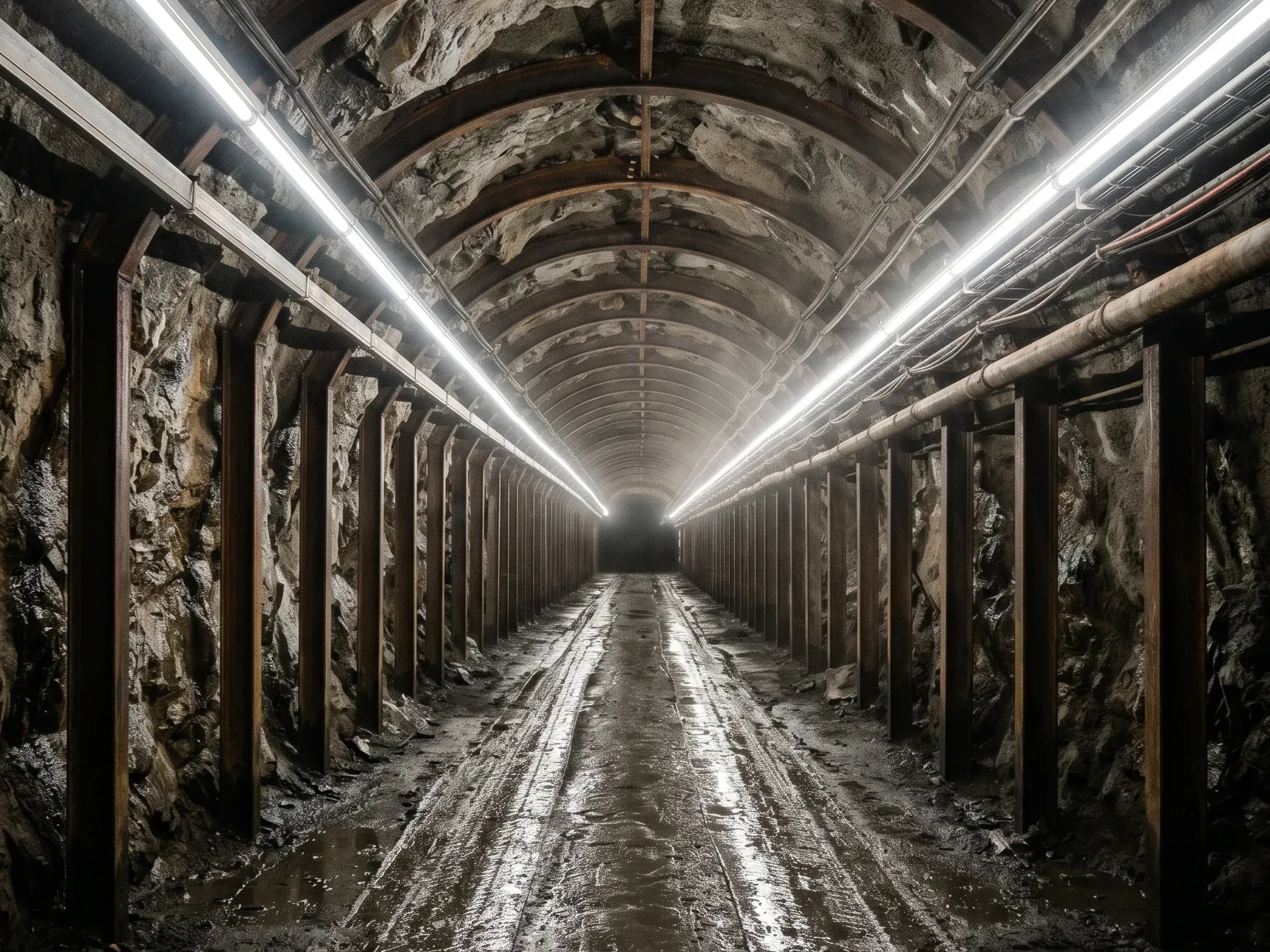
Read the Ex marking, not the phrase "explosion-proof"
A search for explosion proof LED light returns thousands of products, and almost none of those pages name a protection type. Explosion-proof is a defined term in North American practice — Class I Division 1 equipment, tested to UL 1203 — and it is not a term in the IEC or ATEX vocabulary at all, where the same idea is a flameproof enclosure, Ex d. Either way, the phrase names a protection concept. It is not a certificate, and no authority issues one for a phrase.
What is issued is a marking, and a marking is a sentence you can read. A Group I fixture for a gassy mine reads something like Ex eb I Mb, with an ambient range beside it. Every token in that string is a claim the certificate has to support.
Token | What it says | What to match on site |
|---|---|---|
| This equipment is marked to the IEC 60079 / ATEX scheme at all | Nothing yet — the rest of the string carries the content |
| Increased safety: no sparking contacts, defined creepage and clearance, surface temperature limited | A flameproof variant reads |
| Equipment group I: underground mines, and surface plants liable to firedamp (methane) or combustible dust | Group II is surface gas, Group III is dust — a Group II certificate is not a mining certificate |
| Equipment protection level. Ma may stay energised with an explosive atmosphere present; Mb must be de-energised when one is detected | ATEX uses the parallel labels category M1 and M2 |
| Maximum surface temperature at the rated ambient — T4 is 135 °C, T6 is 85 °C | The ambient the class was established at, and the output you intend to run |
The string still leaves two things out, and both matter underground. The first is the ambient temperature behind the T-class: T4 at 40 °C is not T4 at 55 °C, and a fixture run harder needs a derating table rather than a copy of the same label. The second is the variant.
Flameproof protection is a mechanical argument, and it is easier to trust once you can picture the hardware. The housing is built to contain an internal explosion and to let the hot gas escape through a joint machined to a controlled gap, long enough and tight enough to cool it below ignition temperature on the way out. Every bolt in that flange is part of the certification. Lose one, paint over the joint, or replace the glass with a thicker sheet, and the certificate no longer describes the object.
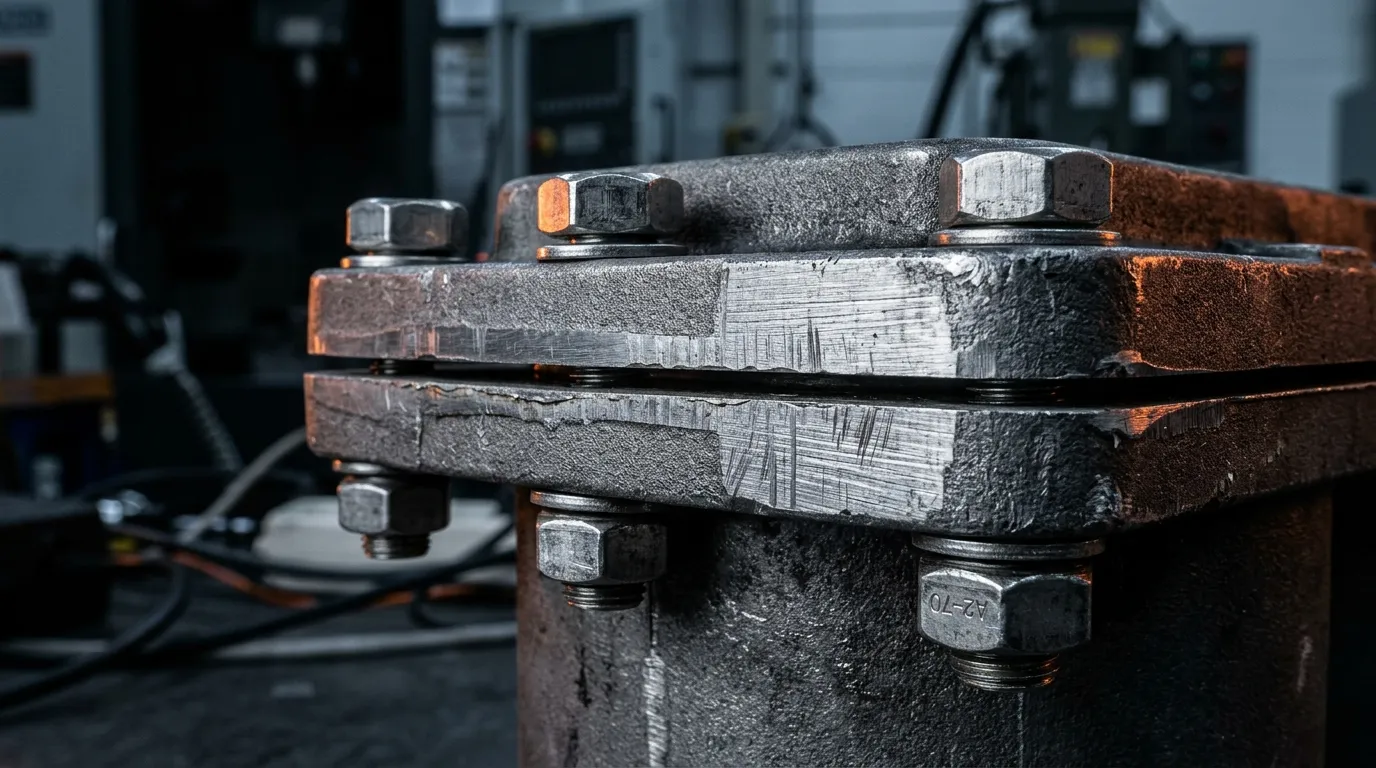
Illustration: the machined joint gap a flameproof certificate is really about — not the housing, the gap.
A flexible strip is rarely the certified enclosure on its own. The protection concept belongs either to the housing it sits inside or to the encapsulation moulded around it. That is why LED mining light certification is a question about the assembly you are buying, and the certificate has to name it — not just the strip inside it.
Which regime is your site held to: ATEX, IECEx, MSHA or GB/T 3836
There is no global mining certificate: some schemes recognise each other's test evidence, and national approvals do not. The difference decides what you can accept.
Regime | Where it governs | The document that proves it | Where to verify |
|---|---|---|---|
ATEX (Directive 2014/34/EU) | EU and EEA market | EU-type examination certificate from a notified body, EU Declaration of Conformity, production quality assurance | The notified body's four-digit number against the European Commission's NANDO list, and the directive number on the declaration |
IECEx | Widely used internationally | Certificate of Conformity, backed by an ExTR and a QAR | The public IECEx certificate database |
MSHA permissibility | US underground coal mines | Approval under 30 CFR Part 18, with an approval number | The approval number on the equipment, against MSHA records |
GB/T 3836 (formerly GB 3836) and the MA mark | China | GB/T 3836 series certificate, plus the MA mark for coal-mine equipment | The MA certificate, the register entry behind it, and the marking on the unit |
UL 844 / NEC Class-Division | North America, surface industry | Listing to UL 844 under the Class/Division system | The listing mark; not a mining scheme |
ATEX certification and IECEx certification are not the same document, although both point at the same IEC 60079 standards. IECEx is a scheme built on test reports and factory audits; ATEX is a directive with legal force in the EU, and an EU site needs the ATEX route whatever else the fixture holds. Many manufacturers test once and hold both — worth asking for, but one does not substitute for the other in front of an authority.
Sites often require two regimes at once, because a copper mine in Chile, a coal mine in Queensland and a road tunnel in Norway each answer to a different regulator or insurer. The question at tender is not which certificate is best, but which one the accepting authority will sign off — so ask it in writing before the purchase order.
The baseline marks are a separate matter. CE, RoHS, EMC, UKCA and BIS are what a fixture needs to enter export markets — one market at a time, not all at once; the LED lighting export certification and compliance guide covers them properly. They belong in the file, and none of them addresses an explosive atmosphere.
MSHA permissible lighting and the voltage rule most buyers miss
If the site is a US underground coal mine, the requirement is not an Ex certificate at all. The rule is short and unhedged:
"Lighting fixtures shall be permissible." — 30 CFR 75.1719-2
Permissible is a tested status granted to specific equipment under 30 CFR Part 18 — the approval attaches to the equipment that was examined, not to a product family and not to a strip that resembles it.
The same section then does something most datasheets ignore: it regulates the supply.
- Alternating current feeding stationary lighting fixtures must have conductors energised at not more than 70 volts to ground.
- Circuits at 100 volts or more are permitted, but only from a transformer whose centre or neutral tap is grounded through a resistor limiting fault current to no more than 5 amperes, with a grounding conductor run alongside the power conductors.
- Direct current for stationary fixtures is capped at a nominal 300 volts.
- Cables feeding stationary fixtures are classified as trailing cables, with the overload and short-circuit protection that follows from that classification.
Read those four lines together and the fixture choice stops being a matter of taste. 36 V AC sits below the 70 V line as arithmetic. 110 V or 220 V does not, and pulls in a grounding-resistor supply architecture, an earth-fault protection scheme and a longer inspection conversation. Voltage in a coal mine is part of the compliance case, not a line in the spec sheet — the engineering argument for mains AC on long tunnel runs is set out in why tunnel LED strip runs on mains AC, not low-voltage DC.
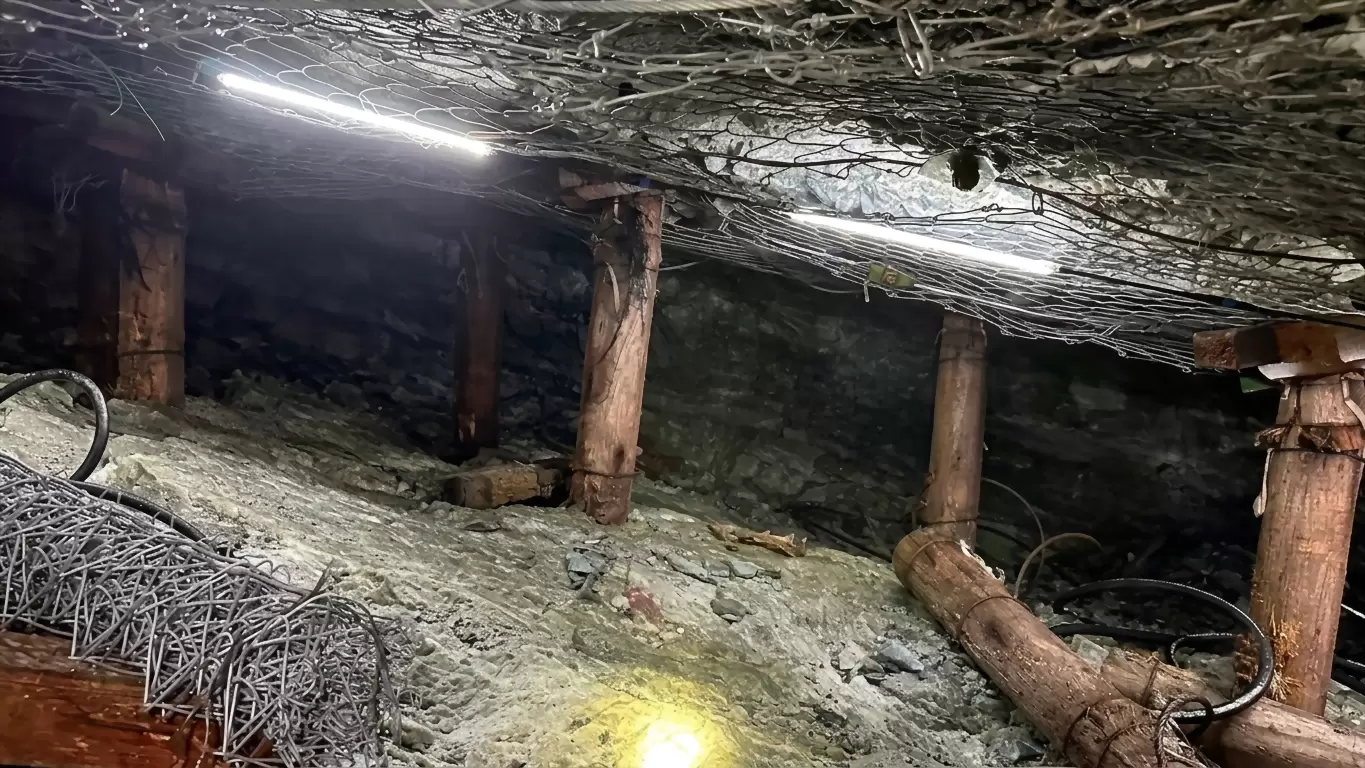
That installation is the argument in physical form: long strip runs at 36 V AC, sealed against the water coming off the roof, threaded between props that move as the ground shifts. The voltage choice is what allows the run to be that long without the supply becoming the hazard.
One caveat: MSHA governs US coal. Metal and non-metal mines answer to other parts of 30 CFR, and other countries set their own limits, some below 70 V. What travels is the habit — read the rule governing the supply at your site, not only the rule governing the fixture.
Ingress protection in a wet, dust-laden tunnel
Ingress protection is the second half of mining LED certifications, and it is the half most often reduced to a number on a line. IP68 mining LED strip is a strong selling phrase and a weak specification. IP is two digits and a test. The first digit covers solids on a scale from 0 to 6, where 6 means dust-tight: no ingress of dust at all, verified with talc in a chamber. The second covers liquids from 0 to 8, and 8 means continuous immersion — at which point the standard hands the detail back to the manufacturer and the user, because the conditions of an IPX8 test are agreed between them.
That single sentence is the whole argument for refusing the number on its own. IP68 on a datasheet can mean 1.5 metres for 30 minutes or 10 metres for a week. The rating does not say which, so the test report has to.
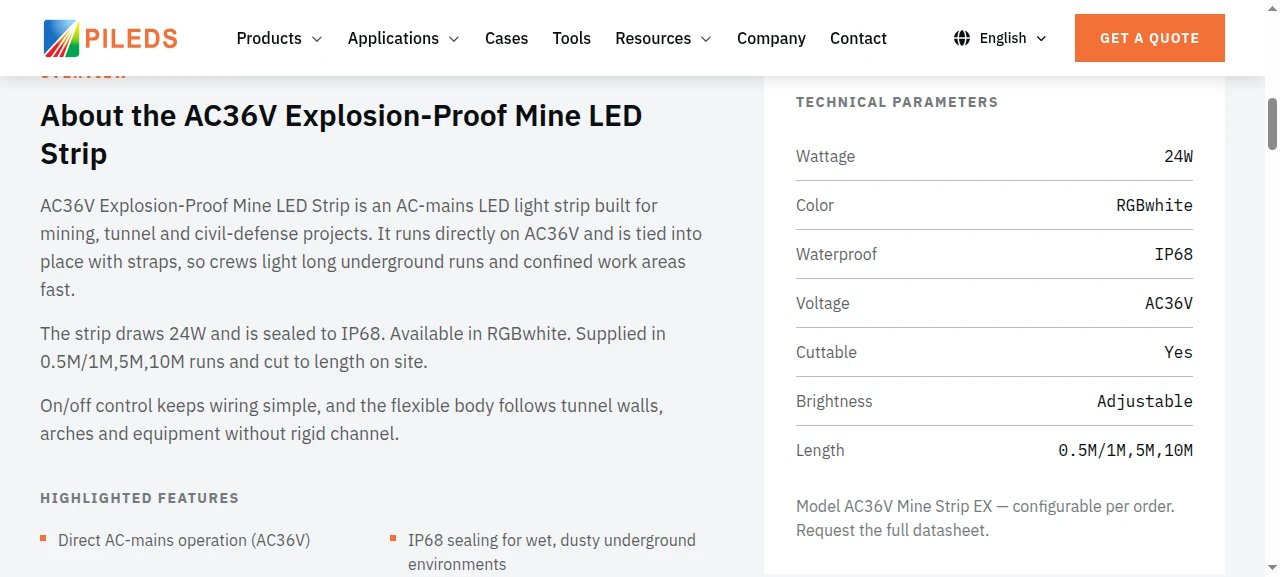
The page in that screenshot states the strip is sealed to IP68 and lists it under Waterproof. That claim is the start of the conversation, not the end of it. Our own published IP certificate for the strip range is IP66 to EN 60529; where a project specifies IP68, we quote the tested conditions for the assembly, because that is the only form in which the two digits mean anything.
The second limit is where the seal stops. A strip that leaves the factory with moulded ends and a rated connector carries an IP rating on that assembly. The moment the run is cut on site, jointed, or terminated into a gland that was not part of the tested assembly, that section holds whatever protection the installer achieved. Usually that is nothing. Sealing field joints and keeping the IP67 rating is the maintenance-side version of this problem; at procurement it is a question about who owns the joints and what evidence comes with them.
Heat does the rest. A strip that cycles between a warm shift and a cold night pulls a small pressure differential through every imperfect boundary, and condensation forms inside the lens rather than outside. The first symptom is a dark segment three months later, where nobody wants to send a crew. Impact ends the argument faster: a cracked polycarbonate lens on an otherwise sealed fixture settles it, whatever the label says.
The document pack to demand before the purchase order
A certificate is a page. A pack is a case, and it is what procurement should hold before releasing payment.
Document | What it proves | The trap |
|---|---|---|
EU-type examination certificate (ATEX) | A notified body examined the design against the declared protection concept | It certifies a family; find your model in the scope list |
EU Declaration of Conformity | The manufacturer's own statement of which directives the product meets | A declaration citing only 2014/30/EU is EMC, not ATEX |
IECEx Certificate of Conformity | A sample was type-tested and the factory assessed against the scheme | It is only as current as the QAR behind it |
IECEx ExTR | The test report: thermal, impact and ingress evidence for that design | Rarely offered unprompted, and the most informative page in the file |
IECEx QAR | The factory's quality system was audited, and is re-audited on a cycle | A lapsed QAR means surveillance stopped, whatever the CoC date says |
MSHA approval (30 CFR Part 18) | This equipment is permissible for US coal | The approval covers the examined equipment, not a lookalike |
IP test report to IEC/EN 60529 | The water and dust test, with the conditions written down | "IP68" with no conditions is a claim, not a result |
Nameplate photograph | The paper and the object carry the same marking | Compare it character by character with the certificate |
The IECEx trio is worth understanding as a set rather than a pile. The scheme describes itself as a type 5 certification scheme: a sample is selected from the factory and type-tested, producing an ExTR; the factory is assessed and periodically surveilled, producing a QAR; and only when both results are satisfactory is a Certificate of Conformity issued and kept valid. Read that way, the three documents answer three different fears — does the design work, does the factory keep building it that way, and is the certificate still alive. The IECEx certified equipment scheme overview states the sequence, and the ATEX directive text sets out what the EU route adds.
Match the model number to the certificate before you pay
This is our own product page for the AC36V mine strip — a fixture whose name contains explosion-proof. Its certification line reads CE, RoHS and BIS.
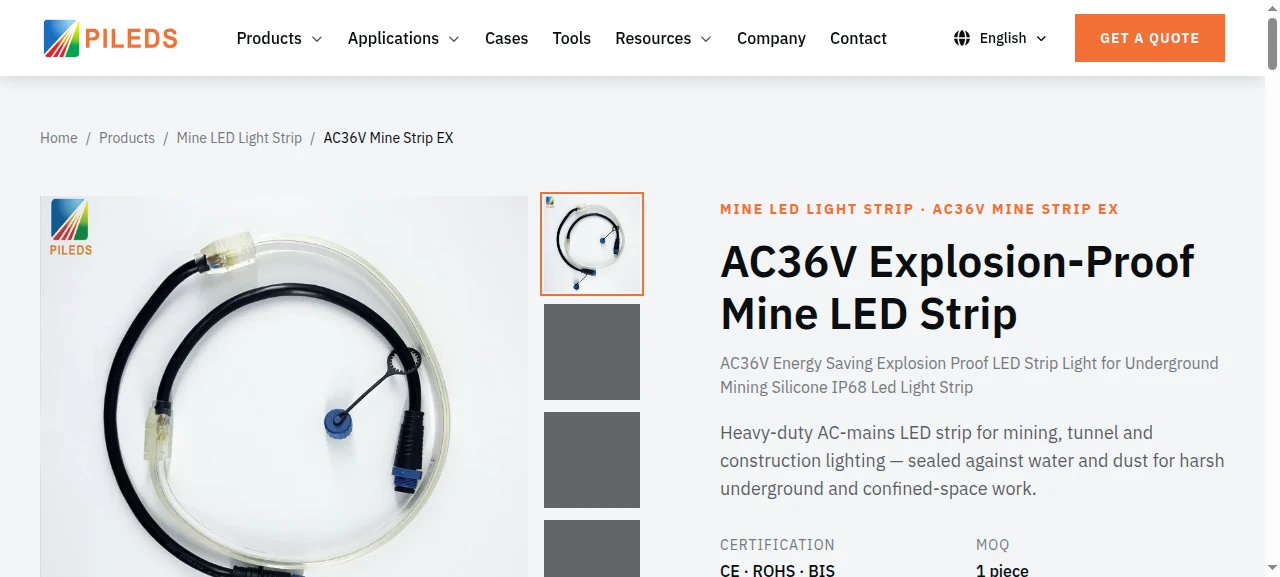
None of those three is an Ex scheme, and the page does not claim otherwise. That is the point of the exercise: the name on the box is a description, the certificate is the claim, and the buyer's job is to notice that the second question is still open. Pages like this are useful — they tell you which schemes to stop expecting.
Scope drift is the failure that survives a good certificate. A family certificate lists several model suffixes, and the tested configuration is one of them: a different driver, LED loading or lens can put your variant outside the tested envelope while the same certificate number stays on the quotation. The certificate holder may also be an exporter rather than the factory, which matters when you need the QAR or a replacement batch in two years.
The verification routine takes about ten minutes. It is the mining-specific version — the generic check that works across schemes is on the linked page at the end of this section.
- Photograph the nameplate on the unit you will actually receive, not the one in the brochure.
- Write down the marking string: group, category or EPL, protection type, temperature class, ambient.
- Take the certificate number and the issuer's identifier — an IECEx ExCB, or the four-digit notified body number for ATEX.
- Look the number up in the public database. IECEx maintains one searchable register for every current certificate it has issued.
- Open the scope and find your model, or the suffix that covers it.
- Check the dates: issue, revision, and for IECEx the QAR surveillance cycle.
If a supplier cannot survive those six steps with you on the phone, the answer is not a longer email. The mechanics of checking a number across schemes are covered in how to verify an LED certificate number for procurement if you want the reference version.
And if the check fails, you have four honest options — none of which involves hoping. Change the fixture or the supplier for one that holds the certificate. Buy the certified enclosure or assembly and have the strip installed inside it by whoever holds the certification for that assembly. Ask the accepting authority, in writing, whether the location is actually classified, because plenty of tunnel sections are not. Or re-plan the zone, which is an engineering decision that can cost less than the certificate. What does not work is proceeding on the strength of the product name, because that is the one option with no evidence behind it.
What to write into the purchase order
Clauses beat conversations. These are the seven that do the work on mine lighting orders:
- Certificate number and scheme, per line item. Not "certified" — the number, the scheme and the issuing body, written against each model ordered.
- Marking on the delivered nameplate. The marking string must be legible on the unit as shipped and must match the certificate; a photograph of the nameplate is part of pre-shipment inspection.
- Scope statement. The supplier confirms in writing that the ordered variant falls inside the certificate scope, naming the variant.
- IP evidence, with conditions. The IP test report states the test conditions and the assembly tested, and the supplier states who is responsible for joints and terminations made on site.
- Temperature class and ambient. The T-class is quoted at your site's maximum ambient, with a derating table if the fixture will run above the tested loading.
- Full pack with the shipping documents. ExTR and QAR travel with the invoice, not "available on request".
- Change notification. Any change to driver, LED, lens or housing restarts the certification question, and the buyer may reject a batch that arrives with a different BOM.
The clause that saves the most money is usually the last one. First batches get scrutinised because the file is fresh; the second batch is where a substituted driver quietly becomes a compliance problem, two years after everyone stopped looking.
If you want the wider interrogation set — factory or trader, supply system, cut lengths, delivered references — the five questions worth putting to a mining lighting supplier collects them, and the environmental case for the hardware itself is in what underground lighting has to survive.
The certificate is a claim; the number is the check
Three proofs, one habit. The marking tells you what the fixture claims to be; the certificate number tells you whether anyone tested that claim; the scope and the dates tell you whether it still applies to the unit in front of you. Everything else in the folder — the CE declaration, the IP68 line, the word explosion-proof — is context.
Tunnel and mine work concentrates all three questions in one place, which is why the AC36V mining and tunnel lighting buyer's guide treats them as one decision rather than three.
PILEDS builds AC36V IP68 mine strip for tunnels and underground workings, and we would rather answer the certification question before the order than after it. Tell us the site, the gas group if there is one, the ambient range and the run length; we will tell you which certificate we hold for that model and which market-specific approval we do not. A fixture that is honest about its paperwork is easier to maintain than one that is confident about it.
Send us the site conditions and we will send back the certificate list for the model that fits.
Specifying pixel LED for a real project?
Send the spec — pitch, IC, IP class, run length, voltage — and you get an engineer's answer, not a catalogue. Samples and OEM/ODM quotes from the Shenzhen factory floor.