
5 Questions to Ask a Mining Lighting Supplier
Five questions that decide a mining lighting order: the supply system, where the IP68 seal ends, cut lengths, verifiable certificates, and delivered references.
The five questions to ask a mining lighting supplier
Mining lighting orders rarely fail on price. They fail on the details nobody asked about before the purchase order went out — a run supplied in the wrong cut lengths, a seal that stops thirty centimetres short of the connector, a certificate that covers a different model than the one on the pallet. By then the strip is underground and a maintenance crew is improvising around a decision that was made in an office.
The five questions below are the supplier vetting questions worth asking before you commit to an underground mine lighting order. Each has an answer a competent mining lighting supplier gives without checking with anyone — and a document that settles it, whether or not you believe the answer.
The question | A credible answer contains | The document that settles it |
|---|---|---|
| Named production steps, who owns the tooling, output in metres per month | Business licence fields, plus a live walk-through of the line |
| The supply voltage your site's rules allow, and questions back about hazard zone and run geometry | A voltage and cut-length schedule matched to your drawings — not a catalogue |
| Which part carries the seal, what happens at a field cut, how a damaged segment is replaced | IP test report, termination drawing, cut plan with a sealing step |
| The regime that applies to your site, and which model each certificate covers | Certificate numbers you can look up with the issuing body |
| Metres delivered, site type, environment, the standard the installation had to meet | A reference you can call, plus photographs from the site |
If you are still working out what the fixture itself has to survive, start with the overview of AC36V mining and tunnel LED lighting and come back — the questions here assume you already know you need a fixed, mains-fed run rather than a cap lamp or a light tower. What follows is the buyer's side of that order.
1. Are you buying from the factory, or from a layer on top of one?
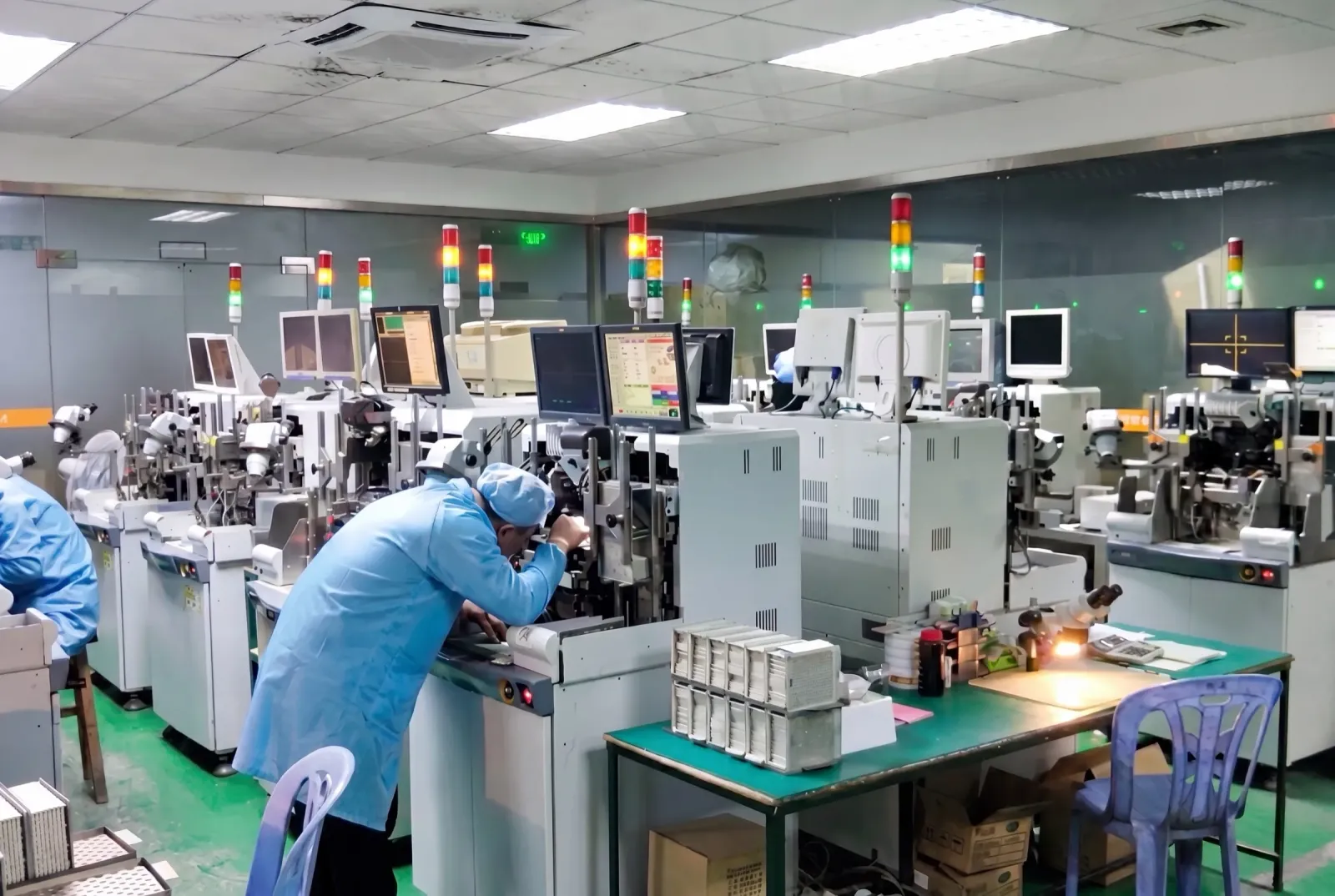
This is the question that decides how much of everything else a mining lighting supplier actually controls. Ask for the production steps by name: which SMT lines are on the floor, how many metres a month come off them, who owns the moulds for the profile and the connector, and what happens between assembly and packing. A factory answers immediately, because those are the people the salesperson eats lunch with. A trading company defers to "the production department" and comes back tomorrow with a number.
For a mine strip specifically, the answer matters more than it does for commodity lighting. A heavy-duty AC mains strip is a low-volume product where the sealing and the connector moulding are the manufacturing. If the party quoting you does not own those steps, the seal on your run is outside their control, and so is the answer to every question that follows.
Two checks settle it, both cheap. First, the business licence: the registered name, the registered address, and the establishment date should all agree with the story you have been told. Second, a live video walk-through with the line running and the aging racks visible — a pre-recorded factory tour is marketing, and a supplier who cannot spare ten minutes for a call has told you something useful.
The generic version of this check — company identity, capacity arithmetic, payment terms — is covered in our guide to vetting a China LED supplier. Keep it separate from this one: identity checks are the same for any LED product, while which plant capability matters is not.
2. Which lighting system does my site actually need — and what will you ask me back?
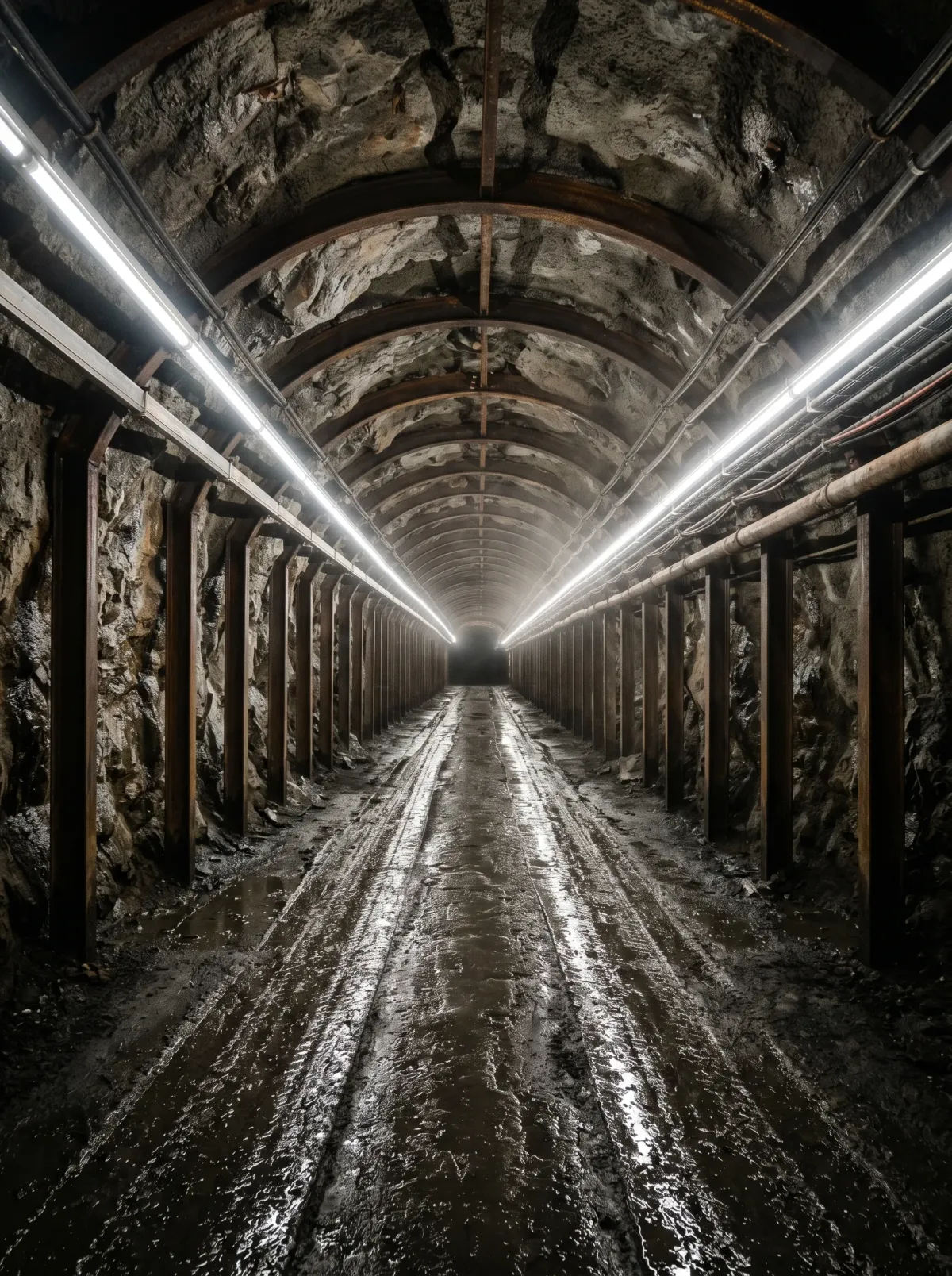
Underground lighting is three different product worlds wearing one name. Personal lighting is a cap lamp. Mobile lighting is a light tower. Fixed lighting is a mains-fed fixture bolted or strapped to the wall — the world this article is about, and the only one where voltage distribution, cut lengths and sealing are engineering decisions rather than packaging choices.
A supplier worth shortlisting will not price the job until they know which world you are in. Ask them directly what the supply arrangement will be, and listen for voltage drop. On a run measured in hundreds of metres, low-voltage DC loses energy faster than the cable can carry it economically, which is why long tunnel and mine runs are fed from AC mains distribution at a low voltage rather than from a DC driver at one end — the reasoning is worked through in why tunnel LED strip runs on mains AC, not low-voltage DC.
Then ask which voltage-to-ground limit your site's rules impose, because this is where a generic answer becomes a wrong one. In US underground coal mines, for example, alternating-current circuits supplying stationary lighting fixtures must have conductors energised at not more than 70 volts to ground, circuits at 100 volts or more need a transformer with a grounded centre or neutral tap limiting fault current to five amperes, and the fixtures themselves must be permissible (30 CFR 75.1719-2). That single rule explains why a low-voltage AC mains fixture exists at all. Your jurisdiction may say something else — the point is that a supplier who has supplied underground work before will ask you which regime applies, instead of quoting a product and hoping.
What a supplier should ask you back, at minimum:
- Is the atmosphere potentially explosive anywhere on the run? Hazardous-area classification changes both the fixture and the certification.
- What does the roof and wall look like — drift height, arch or timber supports, mounting method, junctions?
- What feeds the circuit, and what is the voltage-to-ground limit?
- How is the run cut? Which lengths, how many, and where are the joints?
- On/off only, or does anything need dimming or control?
- What is the environment — water inflow, dust, ambient temperature, vibration from machinery?
- How will your crew reach a failed unit, and how fast do they need to?
The document that answers this question is a schedule: lengths, voltage, joint positions, mounting spacing. A catalogue with five models and no schedule is not an answer to question two, however thick it is.
3. Where does the IP68 boundary end, and who repairs it underground?
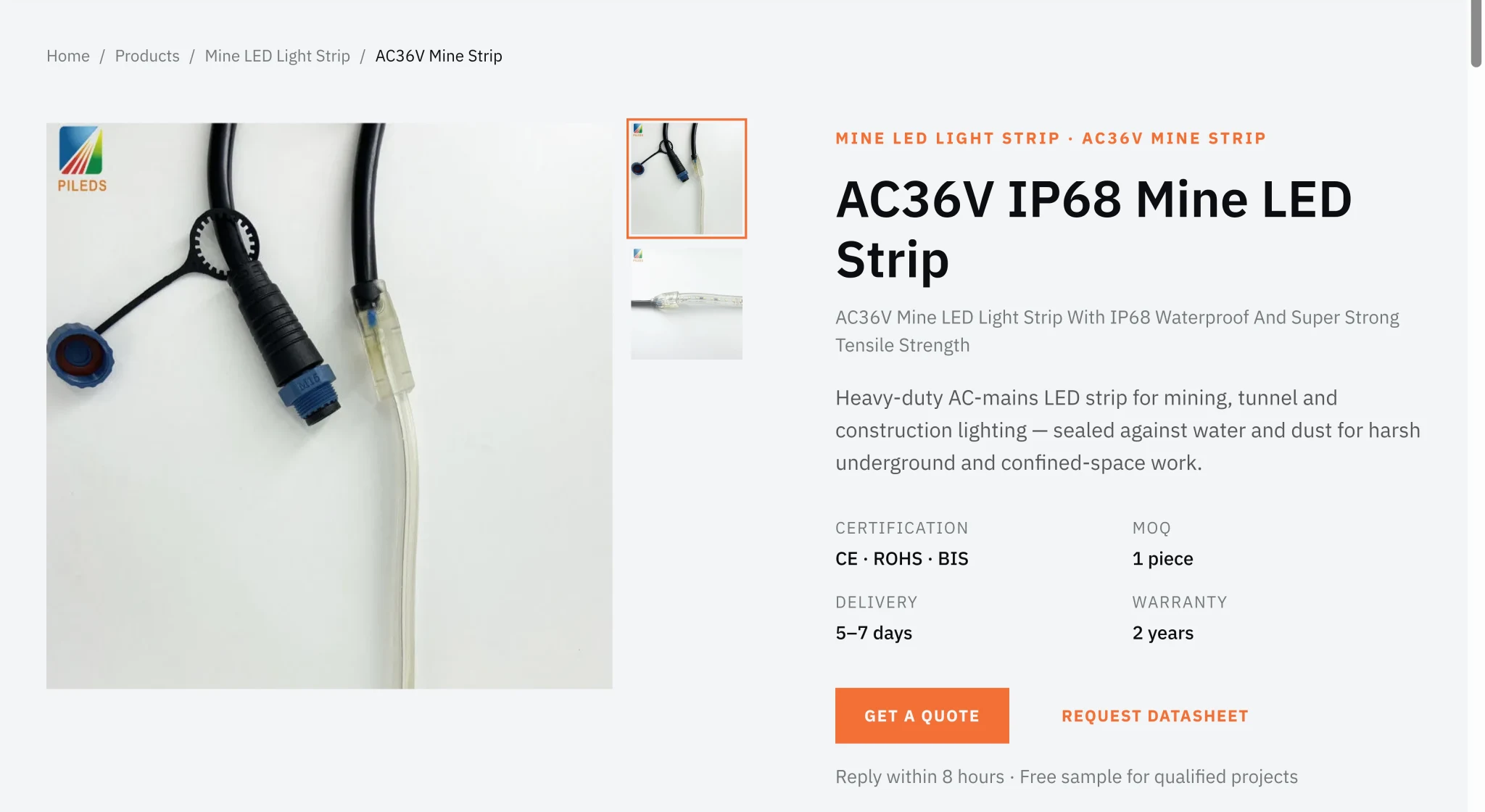
Every supplier will say IP68, and almost none will define what is inside it. The rating is tested on an assembled product under defined conditions — the international standard for the ingress-protection code is IEC 60529 — so the useful question is not the number, it is the boundary. An IP68 mine strip is only as sealed as its least-sealed joint, and your run is not a product: it is the strip, the connectors, the end caps, and every cut your crew makes on site.
Ask three things:
- Which component carries the rating? A moulded strip body, a cable connector and an end cap are three different assemblies. A sealed strip joined by an unsealed connector is an unsealed run.
- What happens at a field cut? Cut-to-length is standard on mine strip, and every cut is a new termination. Ask for the jointing method and whether the sealing material and instructions arrive with the goods — or whether your electrician is expected to invent one.
- How fast is a damaged segment replaced? In practice something always gets hit. Ask how a five-metre section is swapped out without replacing a hundred-metre run, whether joints can be re-made underground, and what the spare-parts lead time is. Compare that answer with the impact environment: falling rock and dragging cable are the impact and vibration half of the three things underground lighting has to survive — the other two being water and dust, and heat with dirty power (the three survival tests).
The documents that settle it: an IP test report rather than a datasheet claim, a termination drawing showing where the seal actually ends, jointing instructions, and a spares list with lead times. If a supplier cannot produce the first two, the third question will be answered by your own maintenance budget.
4. Which certificates does my site require — and can I verify each number?
The wrong question is "what certificates do you have", because every supplier has all of them in a folder. The right question is which regime applies to your site, and whether the paperwork in that folder covers the model you are buying.
Four regimes come up constantly in underground work. In the European Union, CE marking applies to the fixture and hazardous-area equipment is governed by Directive 2014/34/EU, under which equipment for potentially explosive atmospheres must bear the CE marking and be accompanied by an EU declaration of conformity. Internationally, the IECEx scheme is the route many buyers ask for, though it is not the only one — North America approves hazardous-area equipment through its own Class/Division system, and your market's own regime still applies. In US underground coal mines, lighting fixtures must be permissible. In India, the route runs through BIS registration under the Compulsory Registration Scheme, and it covers only the LED categories the government order names — so whether BIS applies to your product in India is a per-SKU question.
Then apply the three-level test to whatever you are shown:
- A claim — "IP68", "explosion-proof" — is a word on a page.
- A document — a test report, a declaration of conformity — is evidence of a test.
- A number you can look up with the issuing body is the only level that survives a check you perform yourself.
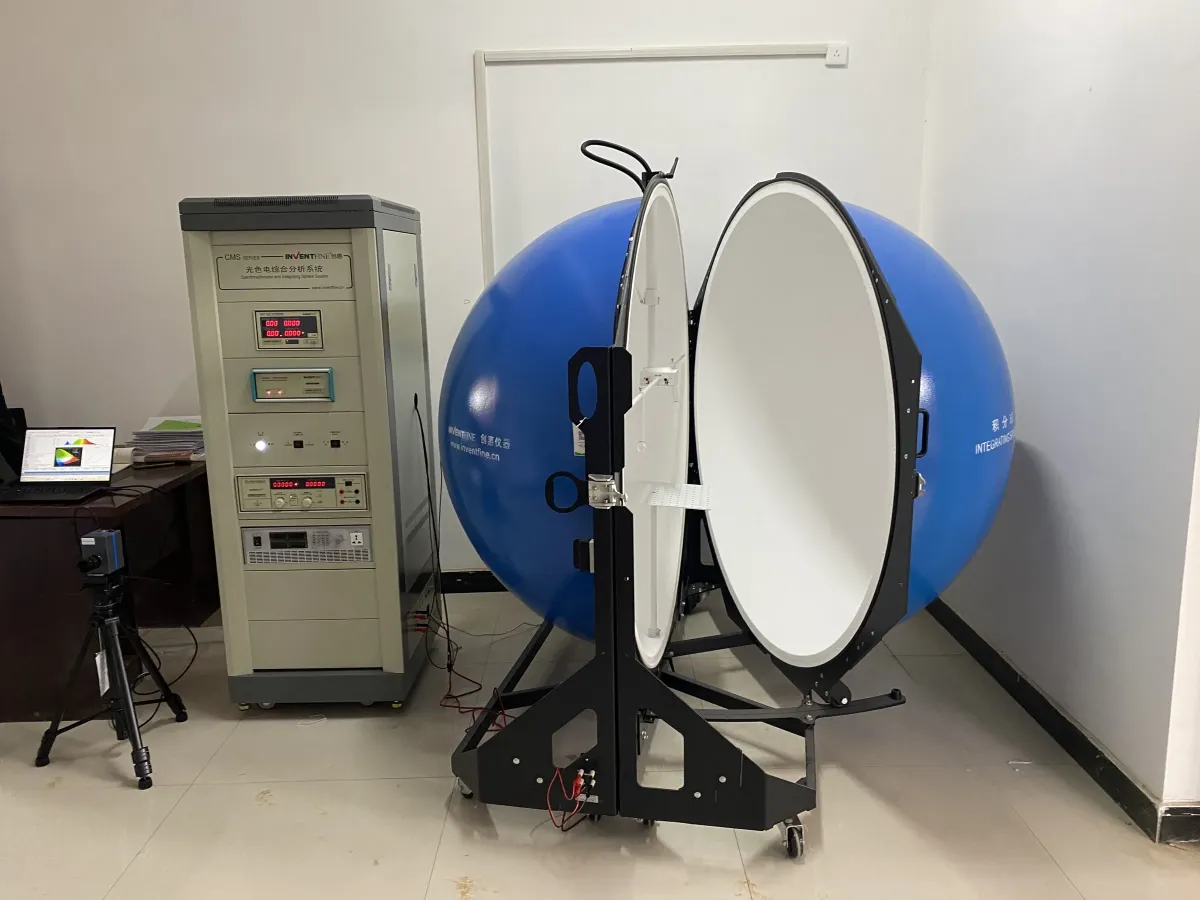
That third level is where mining orders get separated, because a mining LED strip supplier who sells both a standard IP68 strip and an explosion-proof variant has to be able to say which certificate covers which SKU — and the marking on the nameplate has to match. Ask for the certificate number and issuer, the IP test report, the declaration of conformity, and a photograph of the nameplate on the unit that will ship. If you are designing to a measured illumination level, ask for the photometric file too. The mechanics of verifying a number — which database to search, what a recycled certificate looks like — are covered in our walkthrough of verifying an LED certificate number for procurement.
None of this tells you which regime your site falls under. That comes from your site engineer and your regulator, and it should be written into the inquiry before the quote, not discovered at handover.
One more question belongs in this section: what produced the numbers in the report you were sent. A photograph of a test bench is not a certificate, but a supplier who can describe the measurement behind a claim — and show the bench it was taken on — is a different proposition from one who forwards a PDF.
5. What delivered underground work can you put in front of me?
"We have done mines" costs a supplier nothing to say. A reference that survives three follow-up questions is a different object: how many metres were delivered, what the site and environment were, what standard the installation had to satisfy, and who you can call about it.
Quantity is the part buyers skip and shouldn't. A mine or tunnel strip is usually a product you buy again, and the risk on the second order is consistency — the same sealing, the same colour and output, the same cut lengths. A supplier who has delivered in thousands of metres has run the sealing, moulding and aging steps at scale, which is the only evidence that the process, not the sample, is what works.
If your site has to meet a numeric standard, ask whether the reference did too. That converts a friendly case study into a comparable project: a supplier whose reference was commissioned under a statutory illumination requirement — US underground coal, for instance, sets a minimum surface brightness and requires permissible fixtures — has already solved the documentation problem you are about to hand them.
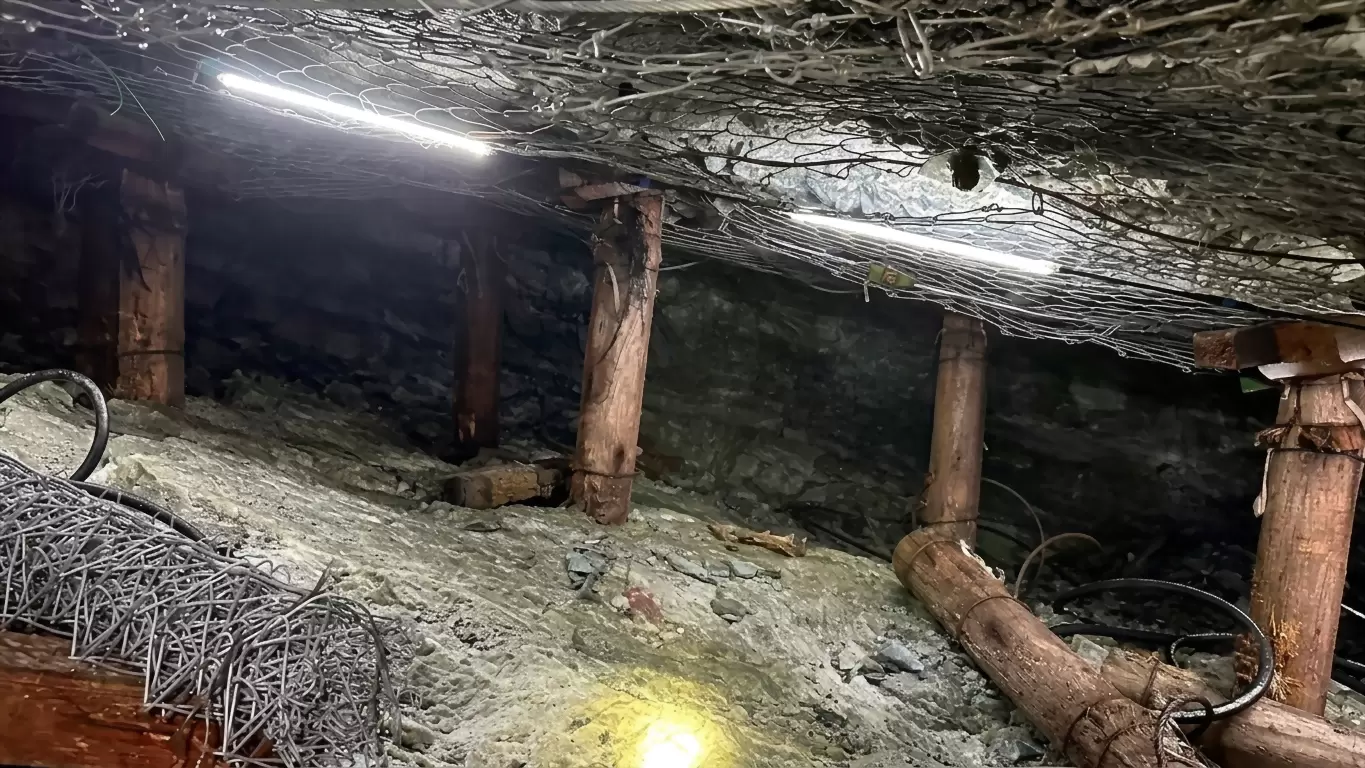
For our own answer to question five: we supplied 10,000 m of AC36V IP68 strip for the workings of an underground mine in South Africa, mounted beneath wire mesh and timber props across a working shaft — the project record is here. A useful reference list should also let you ask for acceptance records: the aging and QC documents for the batch that would ship to you, not just for the project it came from.
How to score the answers — and when to walk away
Five questions, five verdicts — the short version of how to choose a mining lighting supplier. An answer that arrives after a document request is not the same as an answer that arrives with one.
Question | Passing answer | Warning sign |
|---|---|---|
| Names the lines, the output and the QC steps; offers a live call | "Our factory…" with no detail, or a pre-recorded tour |
| Asks you about hazard zone, supply and cut plan before pricing | A price per metre before a single question |
| Shows where the seal ends and how a cut is sealed | IP68 on the datasheet, nothing about connectors or joints |
| Numbers you can verify, matched to the shipping SKU | A certificate with no number, or one naming another company |
| Metres, site type, standard, referee | "Various projects" and stock photography |
Walk away if the answers stay vague after you have asked specifically — the same vagueness will be the answer to the warranty claim. Three more red flags are worth naming: a single lead-time number with no breakdown into component sourcing, production and testing; a warranty length quoted without a claim route or a responsible entity; and a quote with no Incoterm, which quietly moves freight risk back to you.
Before you sign, get four commercial items in writing: the sample or trial order terms and MOQ, the lead time broken into stages, payment terms and Incoterms, and the warranty term with the claim process, spares availability and who supports commissioning. Then compare the whole-life cost rather than the unit price — a cheaper strip with a shorter rated life, no spares route and no repair method is the expensive option once a crew has to reach it underground.
Turning the answers into an inquiry
An engineer can answer a specification in one pass. Send the run drawing with the cut lengths, the voltage available and the site's voltage-to-ground limit, the hazard classification, the IP requirement, the quantity in metres, the destination, and the standard the installation has to meet. Anything you cannot answer yet is worth flagging: a supplier who tells you which of those fields change the design before quoting is the one to shortlist.
We make AC-mains mine and tunnel strip — AC36V silicone-sealed and explosion-proof variants, IP68, supplied cut to length from a Shenzhen factory — alongside the pixel LED lines for stage and architecture. The mine LED light strip range lists the models and the configuration choices; send your spec and you get an engineer's answer rather than a catalogue.
Specifying pixel LED for a real project?
Send the spec — pitch, IC, IP class, run length, voltage — and you get an engineer's answer, not a catalogue. Samples and OEM/ODM quotes from the Shenzhen factory floor.