
Programmable Signage: Addressable vs Static
Addressable LED strip pays only when the sign must change without re-fabrication. A guide to when programmable signage earns its hardware, and when static wins.
Two Different Products Are Called a Programmable Sign
Search for a programmable LED sign strip and half the results sell you a box with a dot-matrix face that scrolls text. That product is real, it has its own specification language — P5 and P10 modules, dot pitch, viewing distance, Wi-Fi or app programming — and it is not what this page is about. A message board is a display in a cabinet. Its job is to show characters.
The other product is a sign whose lighting is programmable: addressable LED strip or modules built into channel letters, halo-lit letters, edge-lit acrylic, back-lit faces and brand walls, where "programmable" means every segment of the strip can be given its own colour and brightness by a controller. The sign still reads as a sign. What changes is that the light behind it is no longer one colour for the whole run.
If you searched for a programmable LED sign strip with addressing set per segment rather than per sign, the second reading is the one this page is about. If you want a scrolling message board, you are on the wrong page and the rest of this will waste your time.
What you are buying | Message board (P5/P10) | Addressable strip in a sign | What decides it |
|---|---|---|---|
What the customer sees | characters formed by pixels | a lit letter, logo or face | the brand, not the technology |
How content changes | new text on a controller app | new show file or mapping | who owns the content after hand-over |
What sets legibility | dot pitch and viewing distance | letter depth, diffusion, brightness | how far away the reader stands |
Where the money goes | the display module | strip, driver ICs and control | how much of the sign must animate |
The practical difference is where the cost lands. A message board concentrates cost in the display. An addressable sign spreads it across strip, driver ICs, a controller, an address map and the labour to commission it. That spread is what this article is about, because it is the reason most signs should not be addressable — and the reason a few must be.
What "Addressable" Changes in a Programmable LED Sign Strip
Static strip is one electrical circuit. You feed it voltage, it lights along its whole length, and brightness is set by the supply or a dimmer. Every metre of it is the same colour at the same moment. For a huge share of signage that is the entire requirement: a white halo behind brushed stainless, a warm-white wash behind an acrylic fascia, a red edge on a retail logo.
Addressable strip breaks that single circuit into segments, each with a driver IC that takes its own slice of the stream by its position in the chain. The controller sends a serial data stream down the strip; each IC keeps the bits that belong to it and passes the rest on, driving its own LEDs. The common parts you will meet in sign work are WS2811 and its integrated cousins: a three-channel part driving red, green and blue; UCS1903 and SM16703, which are also three-channel RGB on a single data line but run their own bit timing — a WS2811 output profile will not drive either of them correctly, so each needs a decoder or controller that speaks its own protocol and the timing table has to be matched per chipset before you order; SK6812, whose RGBW variant adds a fourth channel for white and is the common RGBW pixel IC; and WS2815, a 12 V part that carries a backup data line so one failed pixel does not blank everything downstream of it.
Three consequences follow, and all three are cost.
- The sign now contains a data path. Power is forgiving — a few tenths of a volt of drop shows up as a slightly dimmer end. Data is not. It is a timing-sensitive serial signal that has to survive being routed around aluminium returns, past switching power supplies, and through connectors that a fitter crimped on a ladder.
- Colour becomes a channel count. A three-channel IC gives you RGB. A four-channel IC gives you RGBW, which matters on a white face because mixing white from RGB costs you brightness and gives you a slightly violet cast that a brand manager will notice. The trade-offs between these types are the subject of RGB vs RGBW vs RGBIC.
- Someone has to define the addresses. Pixel one is not automatically the bottom-left of the letter A. Address order is assigned by wiring and, in some systems, written into the ICs — and it only matches the artwork if someone documented it. That document is the pixel map, and its absence is the most common reason we see a programmable sign become unmaintainable two years later.
The IC you choose also fixes your protocol options. A WS2811-family strip speaks what the trade calls SPI — a single clockless data line at a fixed bit rate, cheap and short-range by nature. Getting it to DMX512 or Art-Net, the languages a lighting console speaks, means putting a decoder in between. DMX512 carries 512 channels per universe and a full-colour pixel eats three of them, so one universe covers 170 pixels; that limit is DMX512's own 512-channel universe, not a property of the strip. Art-Net puts those same universes on Ethernet. Which of the two belongs in a sign box is a longer argument, made in DMX512 vs Art-Net; the short version is that a sign with a few hundred pixels does not need Ethernet, and a facade with forty thousand does.
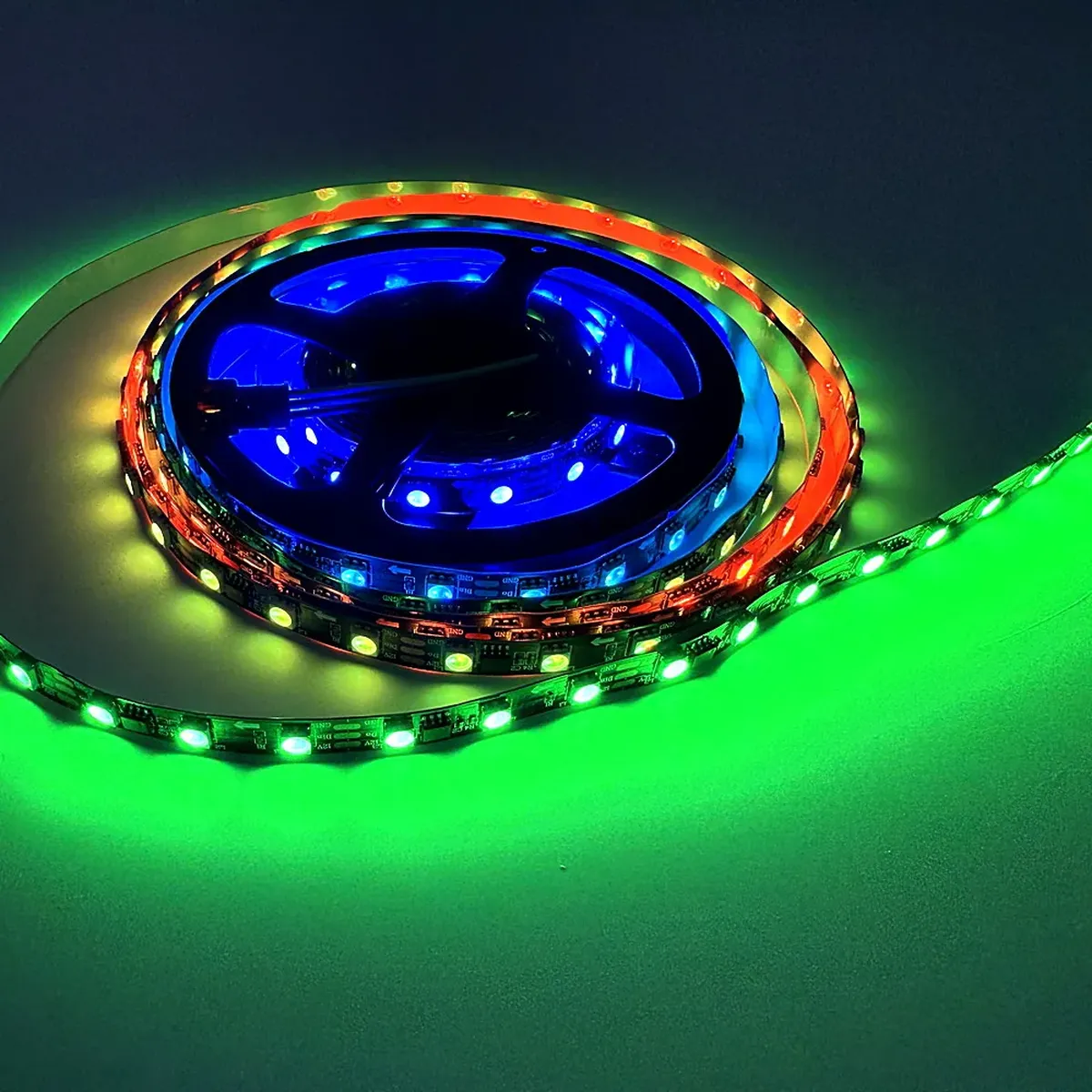
The hardware the mechanism lives in: LED groups on a flexible PCB, each group with its own driver IC. The IC spacing, not the LED spacing, is what sets how finely the sign can be divided.
Four Sign Jobs Where Addressable Beats Static
Programmability is not a feature you add tastefully. It either changes what the sign does or it adds a control cabinet nobody asked for. These are the four jobs where it changes what the sign does — and for each, what static would cost you.
1. Content that changes on a calendar. A retail fascia that runs a seasonal campaign, a venue entrance that changes its palette nightly, a brand wall that gets a new product every quarter. With static lighting, a content change means new strip, new diffusion or a new face. With addressable LED strip, it means a new file. The test is not "will it ever change" — everything changes eventually — but how many times per year, and who does the changing. Twice a year and never without a fabricator on site: static. Monthly, by the client's marketing team: addressable.
2. A moving brand asset. A chase along a letter stroke, a wipe that follows a logo's contour, a slow gradient that reads as motion from forty metres away. A static face cannot do this at all, and no amount of diffusion fakes it. If the creative depends on movement, the decision is already made — the only remaining question is whether the movement survives the diffusion. Heavy acrylic and deep returns blur a chasing effect into a soft pulse, which is worth knowing before the design is signed off.
3. Depth effects in halo and reverse-lit letters. Halo letters are read through the light spill on the wall behind them, so the falloff is the design. Addressable strip lets you set the falloff per segment: brighter at the letter's edge, dimmer at the return, so the halo reads evenly on a wall that is not evenly lit. On a deep return, tight spacing and per-segment dimming can also flatten the "hot spot" that single-colour strip produces where the run doubles back. This is the least visible and most defensible use of the technology in signage, because it is solving a photometric problem rather than decorating one.
4. The message set is the product. A multi-tenant pylon where each tenant's band is a separate addressable zone; a directory that highlights a different unit each week; an event fascia that has to say something different on Saturday than it did on Wednesday. Here the strip is not lighting a sign, it is the sign's content layer, and static strip would force a mechanical solution — interchangeable faces, a rotator, a printed insert — that costs more to operate than the control hardware did to install.
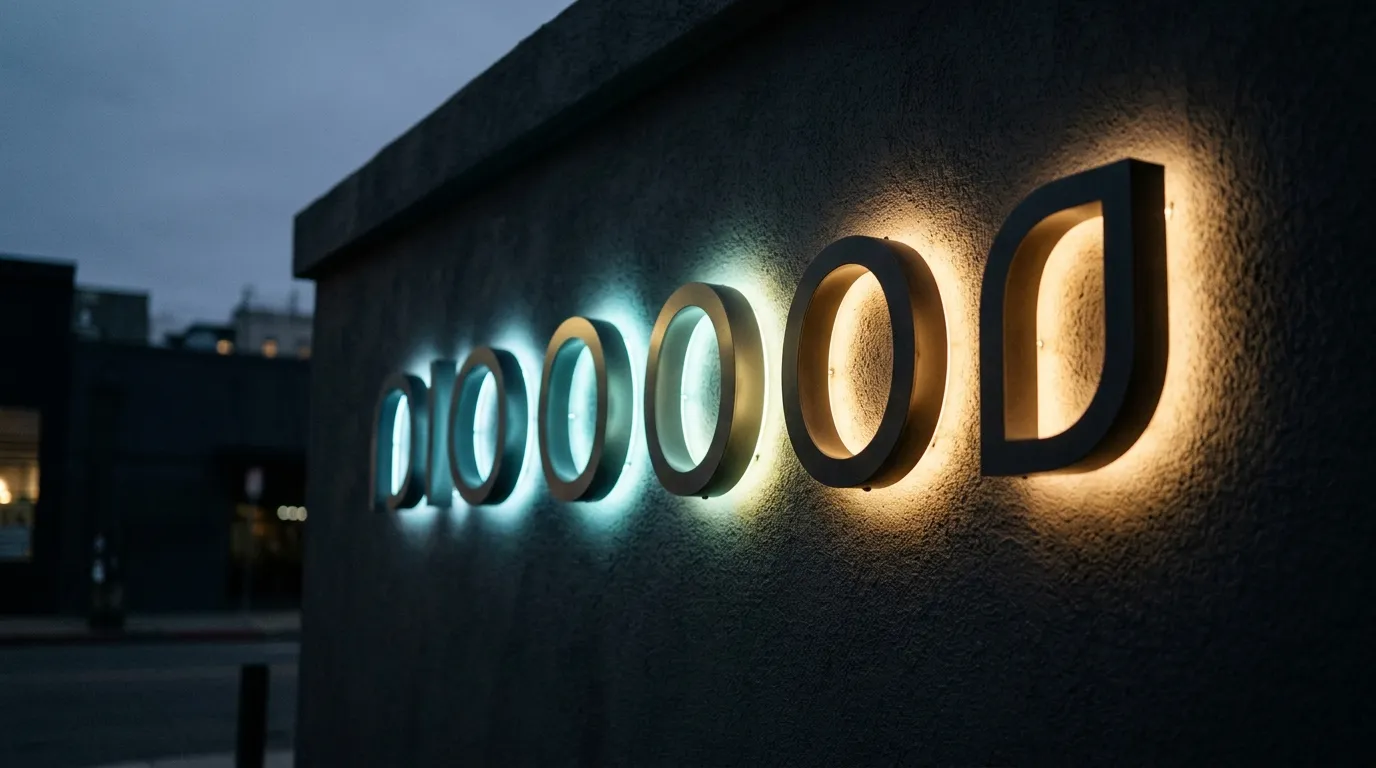
A halo letter is judged by its falloff on the wall, not by the brightness of the strip. Per-segment control is how that falloff gets set deliberately instead of by accident. Illustrative image.
Where Static Still Wins
This is the part the vendors on page one leave out, and it is the part that decides most jobs.
Static wins when the message is fixed. A single-colour fascia, an illuminated address number, a permanent logo, a pharmacy cross that has been the same green since 1998 — these are not under-served by static lighting, they are served by it. Static strip is cheaper to buy, has no controller to fail, needs no address map, can be swapped by any fitter, and does not care whether the client's marketing department exists.
It also wins on three practical grounds:
- Nobody will own the program. A programmable sign needs a person who can load a file, and a machine that can still talk to the controller in five years. If that person is the fabricator, you have sold a service contract with the sign. If it is the client's facilities team, ask what happens when the laptop with the software is replaced.
- The enclosure is small and hot. A sealed letter can has almost no convection. Adding a controller and a switching supply inside it adds heat sources next to the LEDs, and heat is what shortens their life. On a shallow letter, the honest answer is often to keep the electronics outside the can.
- Service access is a lift. Anything that fails in a programmable sign can require a second visit after the hardware fix, because the replacement segment has to be re-addressed and re-mapped. A static segment is a swap.
One practical note on what static looks like in a letter. For short, shallow or tightly curved cans, LED modules for channel letters are usually the better build than strip: they mount on the back plate instead of the return, they sit more easily around a tight radius, and they are almost always single-colour — which is this section's case. Programmable LED strip earns its place when the run is long enough that a continuous line of light matters, or when the effect needs a segment-by-segment gradient. When you are buying LED strip for signs, that is a geometry question before it is an electrical one.
There is also a permit question. Animated and flashing signage is restricted in many jurisdictions and by many landlords, and the restriction often applies to the effect, not the fixture — which means a sign designed to animate may pass electrical review and still be refused at the sign permit stage. Confirm that before the design is fixed. If the answer comes back static, buying addressable hardware "in case" buys you a control system you can never legally use.
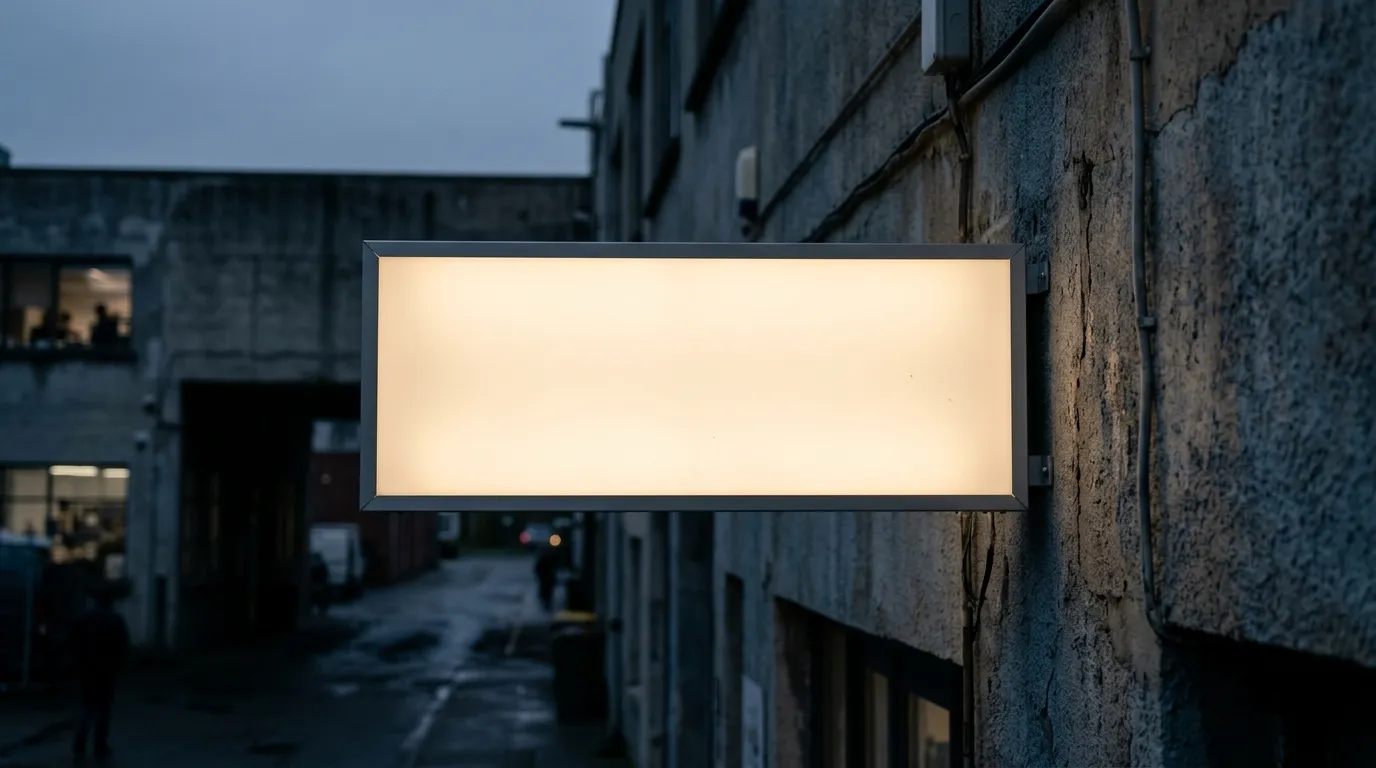
The most common sign in the world: one colour, lit evenly, nothing to program. Most signage jobs are exactly this — and a controller added to one of them buys nothing the customer can see.
Situation | Static | Addressable |
|---|---|---|
Message fixed for the life of the sign | the right answer | unnecessary cost and a controller to fail |
Content changes 1-2× per year, by the fabricator | usually still static | justified only if the change is expensive mechanically |
Client has no one to operate it | the right answer | a service dependency disguised as a feature |
Sealed, shallow letter can | easier to keep cool | electronics want to live outside the can |
Animated effects are permit-restricted | the only compliant option | hardware you cannot switch on |
The Five Numbers That Decide Whether It Works
Most programmable signage failures are specification failures, not product failures. Five numbers carry almost all of the risk.
Number | What it sets | What goes wrong when it is wrong |
|---|---|---|
Watts per metre | supply size, heat load, cable gauge | supply runs hot or trips on inrush; letters cook |
Voltage and run length | how far one feed reaches | far end dims or shifts colour at full brightness |
Pixel density and IC | effect resolution, data volume | visible banding in gradients; controller overloaded |
IP class | where the strip may live | condensation path into a sealed can; failures after a season |
Control protocol | what can drive it, and by whom | console cannot address it; mapping software does not match |
Watts per metre is the number the whole electrical design hangs from. Take a 60-LED-per-metre addressable neon strip at 14.4 W/m — a real figure from our own range, not a rounded example. An eight-metre run is 115 W. At 12 V that is 9.6 A; at 24 V it is 4.8 A. The strip draws the same power either way, but the current halves, and current is what makes copper loss. That single relationship explains why 24 V is the usual default for long runs and why 48 V long-run strip exists at all.
Voltage and run length is where signs differ from linear lighting. A sign is not one straight run — it is a letter, a return, a jump to the next letter, a run down the side of a can. Every one of those transitions adds conductor, and voltage drop is current times resistance, so a 12 V run that looks fine on the bench can lose visible brightness by the time it reaches the far end of a long word. The fix is power injection: feed the run at more than one point so no segment draws its current through a long stretch of copper. The physics and the arithmetic are worked through in voltage drop in pixel runs, and supply sizing gets its own method in sizing a power supply for pixel LED strip.
Pixel density and IC decide what the sign can express. Sixty LEDs per metre gives you a soft gradient and a chase that reads as movement; a hundred and forty-four gives you a wipe that follows a letter stroke. But density is also data: every three-channel pixel is three bytes of a frame, and the controller has to push the whole frame at video rate. On a large brand wall this is what forces the move from one controller to distributed controllers with local decoders.
IP class is not a marketing grade, it is a two-digit code — first digit solids, second liquids — and its meaning is defined in the IP code's two digits. For sign work the relevant point is not which number is higher, it is that the rating applies to the strip as it left the factory. A field cut with a hand-sealed end is no longer an IP67 assembly unless the seal is done to the same standard; that is the subject of keeping the IP67 rating after a joint.
Control protocol decides who can operate the sign. SPI — the trade's loose name for a clockless single-wire signal — is what the strip speaks natively; DMX512 and Art-Net are what consoles and media servers speak; an SD-card controller is what a site with no operator speaks. Getting this wrong does not show up until commissioning, when the client's programmer discovers the pixel order in the software does not match the pixel order on the wall.
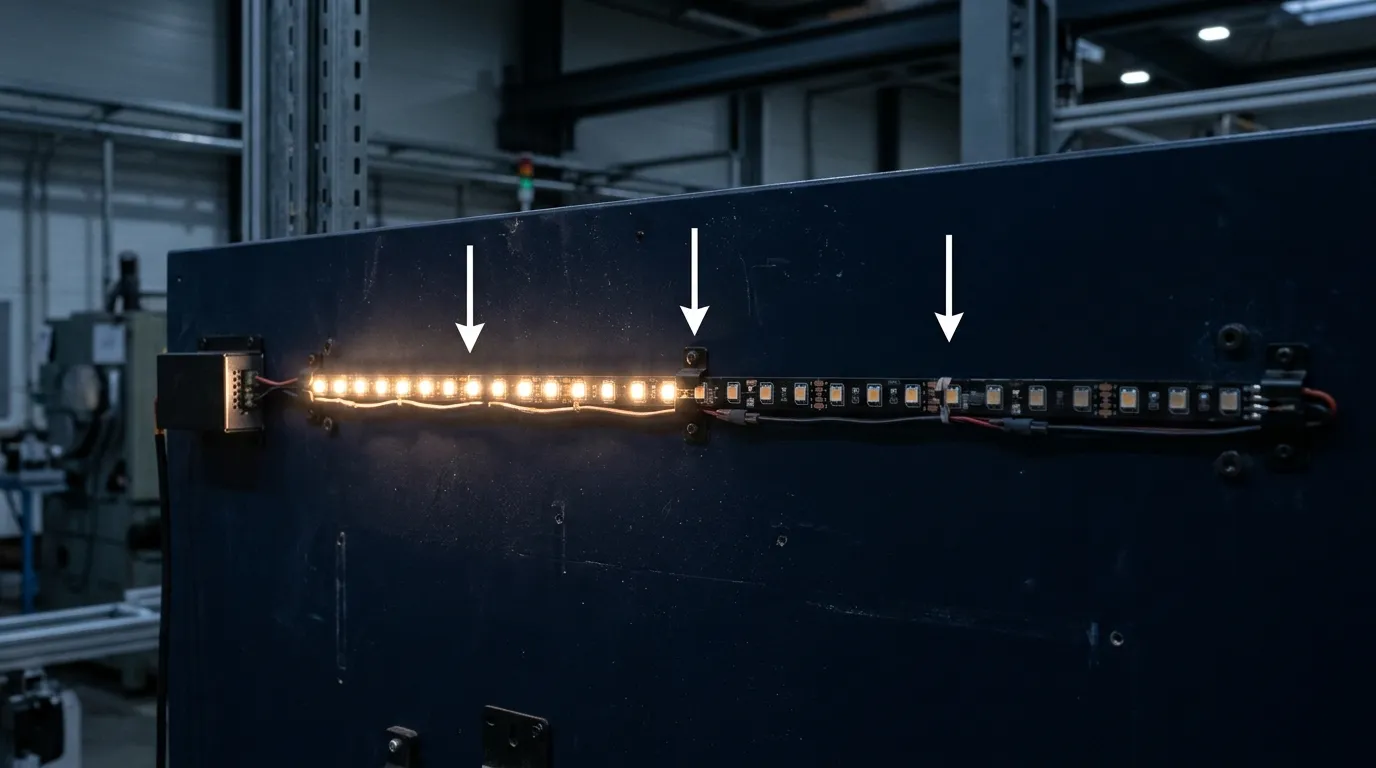
A bench run with three injection points marked: brightness falls away along the run toward its far end, which is the falloff a customer reads as a colour shift in a sign. Illustrative image.
Building It Into the Sign: Heat, Sealing and Addresses
The drawing is the easy part. Three things decide whether the sign is still right in year three.
Heat. A channel letter is a sealed box with LEDs inside it. There is no convection current to carry heat away, so the strip's own wattage raises the temperature of everything in the can, including the driver ICs. Two practical consequences: mount strip on the aluminium return or a metal spine so the letter body acts as a heatsink rather than an insulator, and never leave a coil of spare strip powered inside the can. On a deep letter with high wattage, the honest engineering answer may be to run fewer watts per metre and use more strip, because a cooler strip at the same total lumens lasts longer than a hot one.
Sealing. Every cut is a new ingress path. The factory end of an IP67 strip is potted or sleeved; the end you cut on site is bare until you seal it. Silicone, adhesive-lined heat-shrink and mechanical end caps all work when done properly, and all three fail when done on a ladder in the rain. If a sign has twenty field cuts, you have twenty opportunities to lose the rating — which is an argument for ordering cut-to-length from the factory where the geometry allows it. The technique for getting a clean cut and a durable reseal is in cut points on addressable strip; the same discipline applies to any jacketed strip.
Addresses. A programmable sign is a mapping problem before it is a lighting problem. Write the map down: which physical segment is address one, how the letters are grouped, what the universe boundaries are, and which spare segment is pre-programmed to match which letter. Hand a copy to the client and keep one. When a segment fails in year four, the map is the difference between a two-hour repair and a re-commissioning exercise.
Then there is the data path between letters. Long SPI chains are fragile — they ask one signal to travel the length of a word, past power wiring, through several connectors, without picking up noise. The robust pattern in signage is short data runs and distributed decoders: each letter, or each group of letters, gets its own decoder close to its load, and the long distance is covered by DMX or Art-Net over a cable that was designed for it.
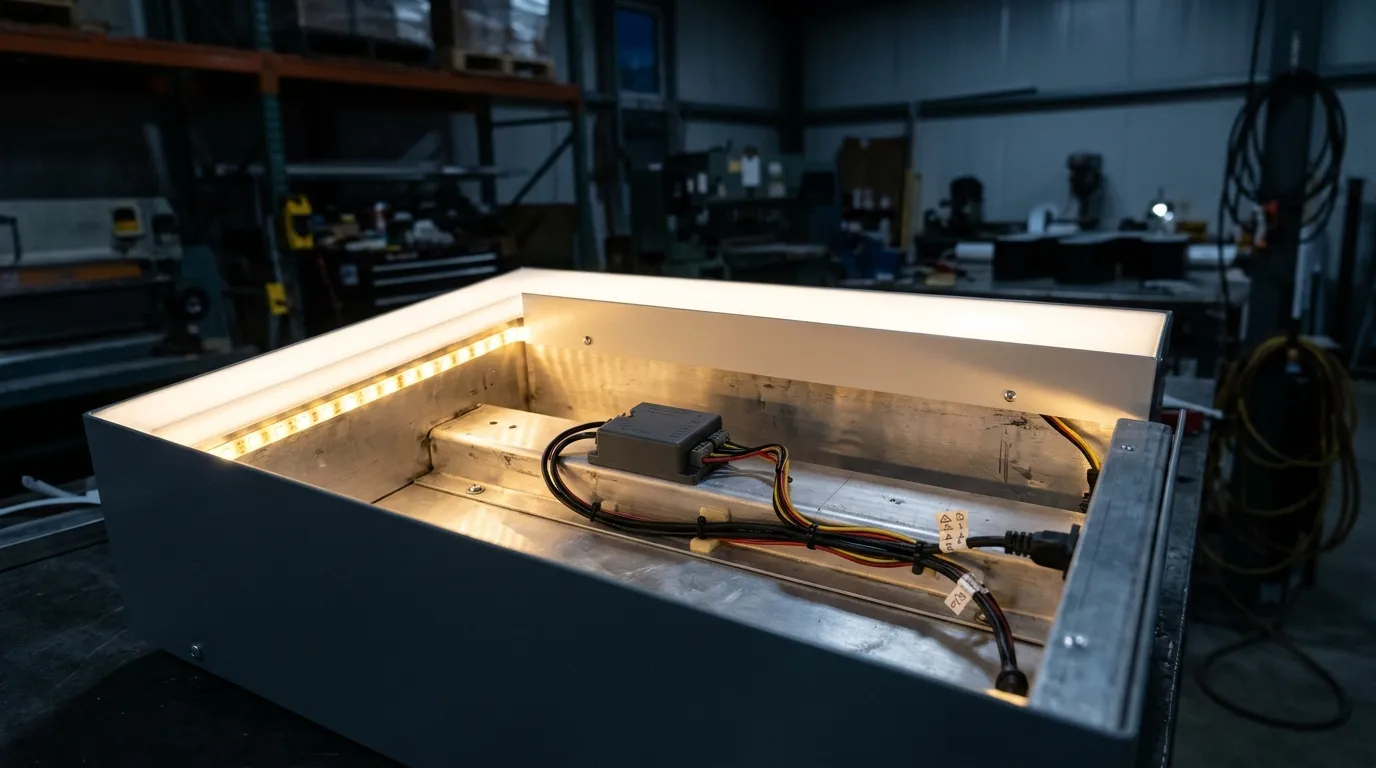
Inside a sign housing: strip on the return so the metal body carries heat away, electronics on the spine, and a loom kept away from the mains side. The same layout serves a letter can — it is just smaller. Illustrative image.
What You Are Actually Buying After the Invoice
The purchase order covers addressable LED strip, controllers, decoders and power supplies. What the sign needs for the next five years is different: a content owner, a spare controller, a spare pre-programmed segment, an address map, and somebody who can re-map the wall if a letter is replaced.
Ask for those five things as line items before you sign, and the cost comparison changes shape. A static sign's service model is "replace the failed segment" — a fitter, a van, an hour. A programmable sign's service model is "replace the failed segment and re-address it", which needs the map, the software, and someone who has done it before. Neither model is wrong; they are just not interchangeable, and pricing the hardware without pricing the second model is how programmable signage gets a reputation it does not deserve.
This is also where the supplier question becomes concrete. A factory that ships a sign strip without an address map has shipped a component, not a system. We build strip and the controllers that drive it, and the questions that come back from sign shops are consistently the same three: what is the pixel order out of the box, what decoder do I need to get from SPI to my console, and what happens to the rest of the run when one IC dies. Those three answers should be on the quotation, not discovered on site.
Choosing: A Short Decision Path
Work down this list and stop at the first line that describes your job.
If your job is | Choose | Because |
|---|---|---|
A fixed message, one colour, no operator | static strip or modules | cheapest to buy, nothing to program, any fitter can service it |
Fixed message, but the client wants a colour change seasonally | static strip in two zones, switched | two circuits cost less than a control system |
Content that changes several times a year, by someone competent | addressable, SD-card controller | no network on site, content frozen and swapped on a card |
Movement that is part of the brand asset | addressable, mapped, distributed decoders | the effect is the deliverable; nothing else produces it |
Halo or reverse-lit letters on an uneven wall | addressable, per-segment dimming | even falloff is a photometric requirement, not decoration |
Animated signage that the sign code may prohibit | confirm the permit first, then decide | hardware you cannot legally run is not an option |
Two closing checks that cost nothing and prevent most of the failures in this article. Write the five numbers into the purchase order — W/m, voltage and run length, pixel density and IC, IP class, protocol — because a supplier who cannot restate them has not specified your sign. And ask who owns the address map, in writing, because the day the first segment fails is the day the answer matters.
If you are specifying one now, send the five numbers and the letter geometry to our engineers and you will get an answer about your sign rather than a catalogue. For the parts themselves, start from the addressable and pixel strip range and the controllers and decoders that drive them, or from the signage and channel letter lighting guide if you have not chosen a strip type yet.
Specifying pixel LED for a real project?
Send the spec — pitch, IC, IP class, run length, voltage — and you get an engineer's answer, not a catalogue. Samples and OEM/ODM quotes from the Shenzhen factory floor.