
Touring Stage Lighting with LED: 3 Hard Specs
Three specs decide whether LED pixel fixtures survive a tour: driver IC, voltage and power budget, and IP rating. Check all three before you spec your rig.
What "Touring-Grade" Means for Stage Lighting with LED
The most expensive mistake in stage lighting isn't a fixture that fails on stage. It's a fixture whose spec was wrong from the day you ordered it — and you only find out in week three of a tour, after the load-ins, the bump-outs, and the outdoor festival date nobody mentioned in the brief.
When a production company or integrator searches "stage lighting with led," the results are retail catalogs and beginner primers. None of them answer the question that actually matters: which numbers on the spec sheet decide whether the rig survives?
This guide is written for lighting designers, production companies, and integrators specifying addressable LED fixtures for stage and touring work. Three specs decide the outcome:
- Driver IC and pixel density — what each pixel is, how it's addressed, and how it holds color.
- Voltage and power budget — whether the run holds up over cable distance, and how much power you actually carry.
- IP rating and mechanical durability — whether the fixture survives dust, rain, and the abuse of repeated load-in and load-out.
Everything else — beam angle, housing shape, brand name — is negotiable. Get these three right and the rig does what the show file asks. Get them wrong and no amount of software, gel, or good intentions fixes it.
Before we get into the specs themselves, one definition: when this article says pixel LED, it means individually addressable LED fixtures — strips, bars, tubes, and point lights where each pixel (or small group) is driven by its own driver IC and can be controlled independently, rather than conventional fixture families — PAR, ellipsoidal, fresnel, wash, and moving-head units, or gobo projectors — each of which throws a single beam across the stage. If you're new to the category, our stage and touring pixel LED guide covers the full landscape — this article is the decision layer on top of it.
Hard Spec #1: Driver IC and Pixel Density
The driver IC is the chip on the strip or bar that decides how each pixel behaves. It sets the addressing scheme, the data signal voltage, the refresh behavior, and — critically for stage work — how the fixture reacts when a pixel dies mid-show.
The ICs you'll actually see in touring-grade pixel hardware:
IC | Typical voltage | Why it shows up on stage |
|---|---|---|
WS2811 | 12 V typical (chip logic 5 V) | The classic addressable IC. Cheap, everywhere, and in 12 V/24 V builds it handles long runs, not just short indoor strips. |
WS2815 | 12 V | 12 V signal path and a redundant data line — if one pixel dies, the signal continues past it. Built for longer, more punishing runs. |
SK6812 | 5 V / 12 V | RGBW-capable — adds a white channel, which matters for stage work where you need clean white segments between color effects. |
UCS1903 / SM16703 | varies by build | Alternatives with different timing and drive characteristics; both appear in commercial-grade pixel products. |
For touring specifically, the redundant-data-line behavior is the spec to chase. A pixel dying in a conventional rig means one dark spot; a pixel dying in an SPI chain without signal redundancy can take out every pixel after it. ICs with built-in failover keep the run alive until the fixture is swapped — which, on a tour, means the show continues and the spare goes in during the next changeover. Our WS2811 vs WS2812B comparison explains the family differences in practical terms, and the addressable LED driver IC guide covers the full IC spectrum.
Pixel density is the second half of this spec. Density is expressed in pixels per meter (px/m), and it's a decision about viewing distance and resolution, not quality:
- 16 px/m — bars and strips meant to be viewed from a distance: stage backdrops, truss lines, architectural accents where individual pixels blur into a smooth line.
- 30–60 px/m — fixtures that carry video content or sit close to the audience: low-res video walls, floor effects, photo-call backdrops where the pixel grid is part of the look.
- 168 LED/m and up — 360° tubes and dense neon-style products for close-up, high-resolution color texture.
A 16 px/m bar at 20 meters reads as a clean colored line. The same bar at 3 meters looks like a dotted line. Choose density from the closest viewing distance, not from the spec sheet's maximum. In our own build, the pixel bar range spans exactly this decision — 16 px/m linkable bars for truss lines up to 60 px/m video bars — and the tubes go to 168 LED/m for 360° effects. The right choice is the one matched to the rig's geometry.
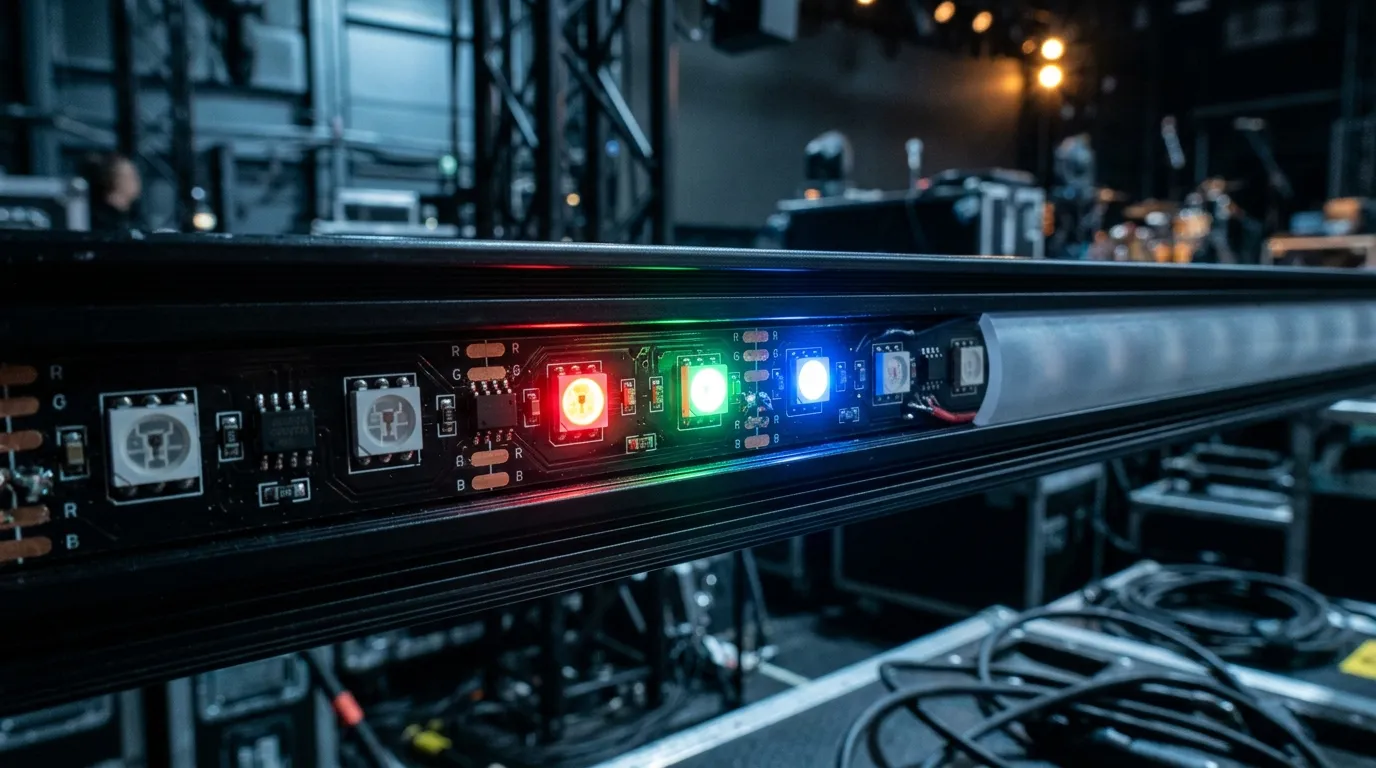
The third thing the IC determines is the control path: SPI-native parts talk to a decoder, while DMX-native products take DMX512 directly. That feeds straight into the control layer later in this guide — but the decision starts here, because you can't retrofit a different IC family into a fixture after it's manufactured.
Hard Spec #2: Voltage and Power Budget
Voltage is where touring rigs come unstuck, because the failure is invisible on the bench and brutal on site. Every meter of cable and every meter of strip has resistance. At 12 V, a long run loses enough voltage that pixels at the far end dim, flicker, or drop out entirely — while the first meter looks perfect.
The math is simple: for the same power, doubling the voltage halves the current, and halving the current quarters the resistive losses across the run. That's why 24 V and 48 V systems exist — not because the LEDs want more voltage, but because the cable wants less current. A 48 V long-run strip is a legitimate touring answer when you need one continuous feed over tens of meters without intermediate injection points.
Power budget is the second number. Every pixel product has a power-per-meter figure (W/m), and the budget is that figure multiplied by total length, plus headroom:
Fixture class | Typical draw | Implication for the budget |
|---|---|---|
60 px/m video bar, 12 V | ~14 W/m | Cheap to run, many meters per PSU |
60 px/m video bar, 24 V | ~15–18 W/m | Heavier; plan injection every few meters |
90 LED/m long-run strip, 48 V | ~21.6 W/m | High density over long runs, fewer injection points |
360° pixel tube, 168 LED/m, 24 V | ~40 W/m | The hungry end of the range; budget generously |
Carry 20–25% headroom over the calculated draw — PSUs derate when they run hot in road cases, and the last thing a tour needs is a power supply sitting at 100% for four hours a night. Count the injection points before you sign the cable order: for 12 V runs, plan power injection every 2–3 meters of high-density strip; 24 V roughly doubles the acceptable segment; 48 V long-run products are designed to minimize injection points entirely.
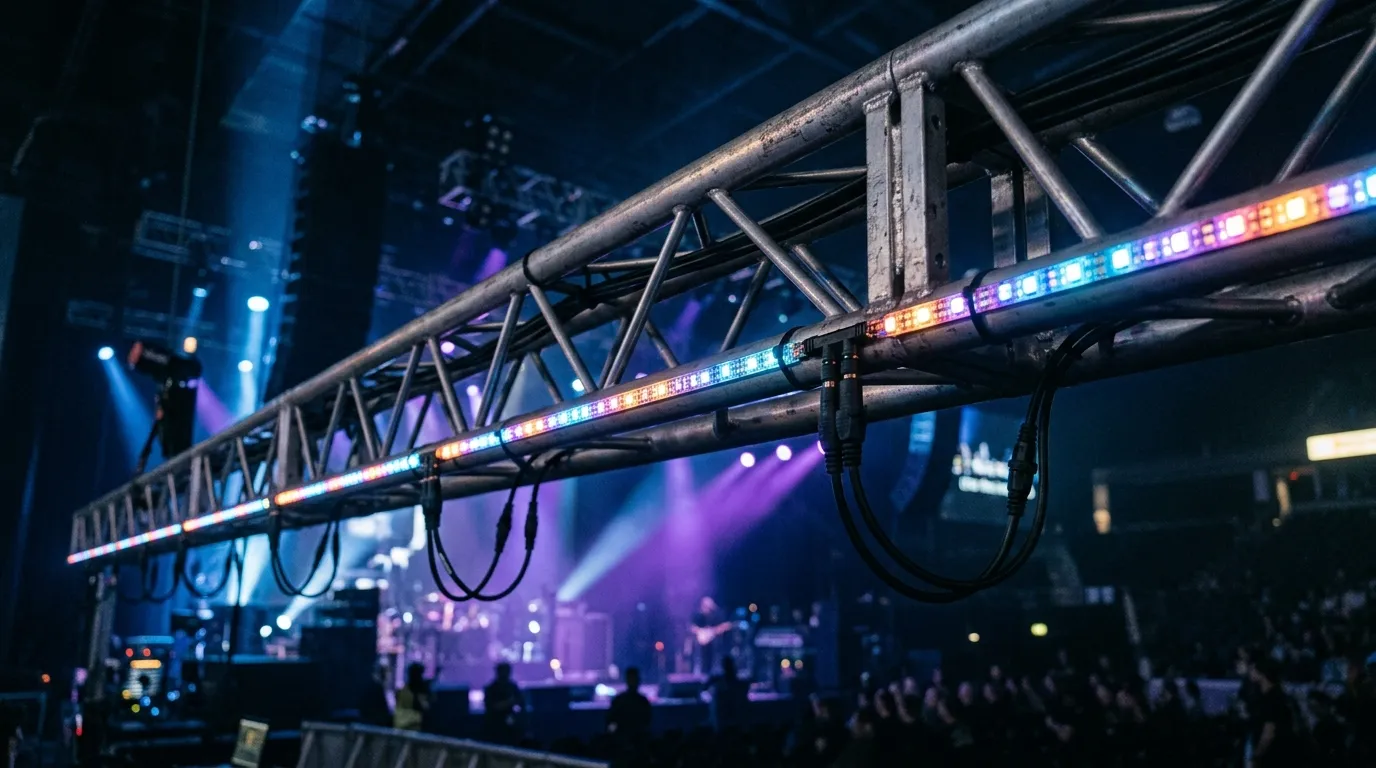
Two more touring realities on power: spare PSUs are cheaper than spare shows, so spec the power supply count with one spare per system. And label everything — a bump-out in the dark is not the time to identify which feed goes where. Our pixel strip accessories guide covers power supplies, profiles, and connectors in more depth.
Hard Spec #3: IP Rating and Mechanical Durability
The IP rating is the number that separates a venue fixture from a touring fixture. IP ratings are defined by the international IEC 60529 standard: the first digit is solid-particle protection, the second is water protection.
- IP20 — indoor only. Fine for a club ceiling, wrong for anything that sees weather or dust.
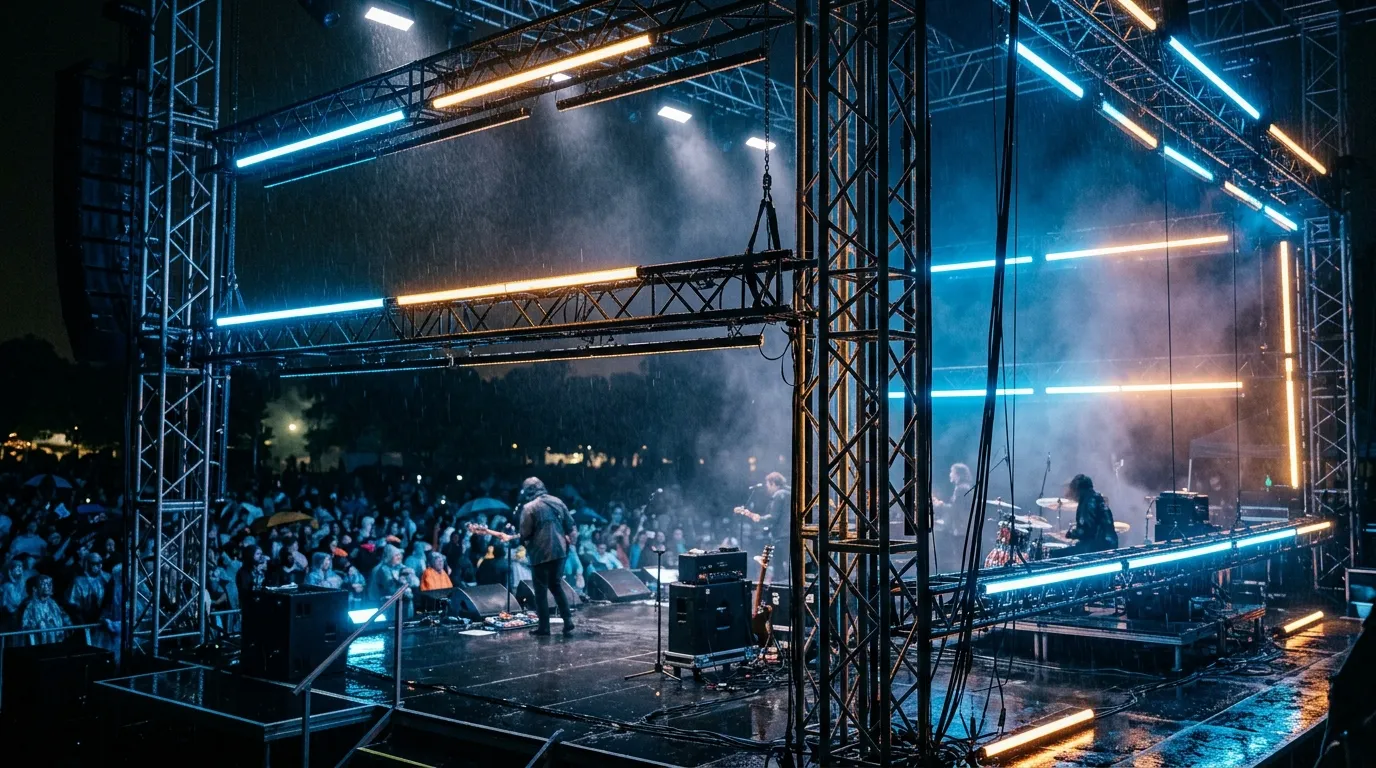
- IP65 — dust-tight and protected against water jets. The festival-stage baseline.
- IP66 — dust-tight and protected against powerful water jets, the middle step between IP65 and IP67 for rigs that face hosing but never immersion.
- IP67 — dust-tight and protected against temporary immersion. For deck-level fixtures that get hosed down, rain-swept stages, and anything that lives near the ground.
- IP68 — continuous immersion. Overkill for most stage work, but the right call for ground-level outdoor installations in standing water.
For a tour, the calculation is about the worst venue on the routing, not the average one. One outdoor festival date with an IP20 rig means taping, wrapping, and praying — or renting a replacement rig. Spec IP65 as the floor for anything that might leave an indoor venue, and IP67 where fixtures sit at floor level. Our IP65 vs IP67 comparison spells out the practical difference in the field.
Mechanical durability is the half of this spec that never makes it onto a marketing slide: connectors, strain relief, and housing. Touring hardware gets plugged and unplugged hundreds of times, coiled wet, thrown into road cases, and rigged at speed. That's where the build quality shows:
- Connectors — XLR data connectors (3-pin and 5-pin) are the touring norm for DMX, and locking connectors beat friction fits for anything that vibrates on a truck.
- Cable strain — the weakest point on any pixel product is where the cable meets the PCB. Reinforced tails and proper strain relief are the difference between a fixture that survives a season and one that dies in the first week.
- Housing — aluminum-profile bars and silicone-encapsulated tubes survive the road better than bare PCBs. A pixel tube with a 360° silicone jacket is a different product class from a naked strip.
The standard for sealing is verified by testing, not by the rating on the datasheet — a rating is only as good as the test that proved it. Manufacturers with in-house IP testing (rather than a certificate bought for the brochure) can show you the test procedure. We run IP/waterproof verification as one of six QC checkpoints at our factory — a rating that's been tested on the actual production line, not just on a sample.
The Control Layer: DMX, Art-Net and Pixel Mapping
The three hard specs get you hardware that survives. The control layer decides whether it performs. This is the integration step where pixel fixtures become a stage lighting system.
- DMX512 — the touring standard for theatrical control, maintained as ANSI E1.11 by ESTA. One universe carries 512 channels of dimmer, color, and position data; a RGB pixel consumes three of those channels, so a 170-pixel bar eats an entire universe. Multiply that by a rig with hundreds of meters of pixels and you run out of universes fast.
- Art-Net — the Ethernet-based protocol originally defined by Artistic Licence, designed to move thousands of DMX universes over standard network infrastructure. This is what large pixel rigs actually run on — one network link into the controller rack instead of a wall of DMX cables.
- Pixel mapping software — packages like MADRIX take a video or media input and map it onto the pixel layout: each bar, tube, and point light becomes a region of the output image. The show file defines the map; the hardware follows it.
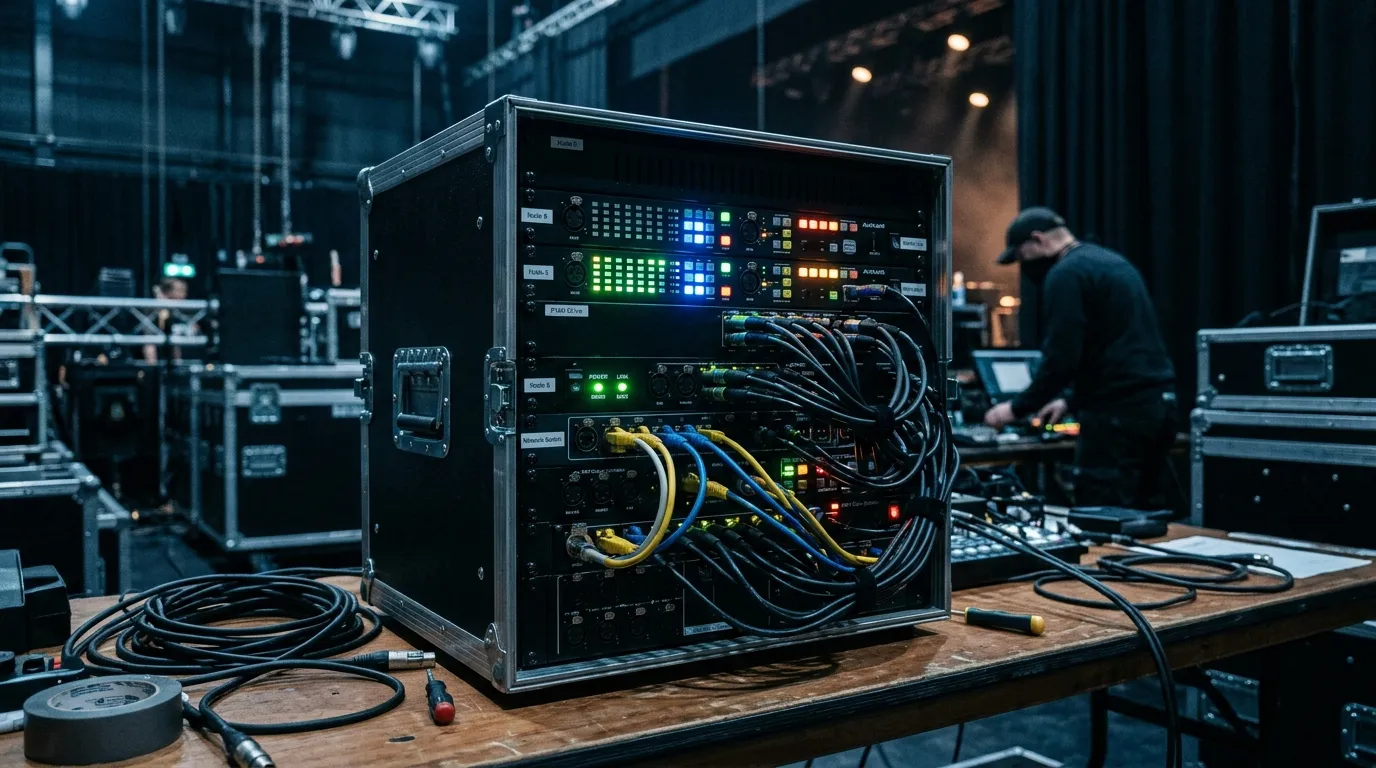
- Decoders and controllers — the hardware that translates DMX/Art-Net into the SPI signals the driver ICs speak, handles addressing, and can run the show from offline media when the network isn't there.
For touring, two control features matter more than the brand of console: offline playback (an SD-card or embedded show file that runs the look without a laptop or network — invaluable when the media server stays home) and addressing tooling (a way to set DMX addresses on fixtures quickly during changeover). The Art-Net and DMX pixel controllers in this category cover exactly this: multi-port Art-Net controllers with SD-card playback, DMX-to-SPI decoders, and address writers — the touring control chain end to end.
How to Spec a Touring Pixel Rig: 6-Point Checklist
Use this when the brief lands. Each line is a question to answer before you send the order:
- Driver IC and density — Which IC family, and what pixel density matches the closest viewing distance? Do I need redundant-signal failover for the long chains?
- Voltage and power — 12 V, 24 V, or 48 V for the run lengths involved? What's the total W/m × length, and where are the injection points?
- IP and durability — What's the worst environment on the routing? IP65 floor for anything outdoor, IP67 at deck level. Which connectors, and how much abuse will the tails take?
- Control — How many DMX universes does the pixel count demand? Art-Net for the big rigs? Offline playback for repeat shows? Who supplies the decoders and address tooling?
- QC and spares — What does the factory actually test (color-point verification, aging, IP)? How many spare meters and spare PSUs ride in the case?
- Sourcing — MOQ, lead time, sample policy, and certifications for the markets you'll play in. A factory that can't show certificate numbers has nothing to hide behind.
That last line matters more than it looks: on a tour, "certified" isn't a badge, it's the difference between clearing customs and sitting at the border. The certs themselves — CE, RoHS, EMC, IP66, and BIS with published certificate numbers — are the paperwork side of the same discipline that drives the three hard specs.
Choosing a Manufacturer: What the Spec Sheet Doesn't Tell You
The spec sheet tells you the numbers. It doesn't tell you whether the numbers are true, or whether they'll still be true on the third production run. That's what the factory audit is for — and in an unattended sourcing process, these are the questions that separate a partner from a vendor:
- Where is the factory? A manufacturer with an in-house SMT line, reflow, and assembly under one roof controls quality differently from a trading company that buys from whoever's cheapest this quarter.
- What does QC actually test? Color consistency across batches is the make-or-break for stage work — fixtures that look different side by side are a nightmare on camera. A factory with integral-sphere testing (color point and lumen output verified per batch) and aging tests has evidence, not claims.
- What's the track record? Real installs with real quantities: 600 m of pixel bar on a launch stage in India, 750 meteor tubes and 3,500 globe lights in a US club, 86,500 pixel points on the Singapore observation wheel, 46,000 globe points at a French immersive exhibition. Ask for comparable projects, then verify. The case studies on the site document fifteen delivered installs across nine countries.
- How flexible is the order? Low MOQs, OEM/ODM builds, and free samples for qualified projects are the practical signals that a factory wants the relationship, not just the invoice.
None of this appears in the three hard specs. But the specs are only as good as the factory that makes them — which is why the six-step checklist ends with sourcing, not with the fixture.
Quick Answers: Common Stage Lighting with LED Questions
Are stage lights LED now? Yes — LED has replaced conventional sources for most stage applications. Conventional fixtures (PAR, ellipsoidal, fresnel) still exist and still get used, but LED versions cover the same jobs with lower power draw, less heat, and instant color change. Pixel LED goes further: it replaces whole walls of conventional fixtures with individually addressable surfaces.
How do LED stage lights work? A conventional LED fixture mixes red, green, and blue (or white) channels to produce color. A pixel LED fixture adds individual addressing: each pixel has its own driver IC, so software can control every point independently — which is what makes video content, chase effects, and pixel mapping possible on fixtures rather than screens.
What type of light is used for stage lighting? The main families are washes (PAR, ellipsoidal, fresnel), moving heads, and — increasingly — pixel fixtures: strips, bars, tubes, and point lights that carry addressable color. For touring-grade LED rigs, the three specs in this article determine which of those families actually survives the routing.
What are the best lights for a stage? The right answer depends on the stage: distance to the audience sets pixel density, run lengths set voltage, and the worst venue on the routing sets the IP rating. Work the six-point checklist above and the "best" fixture is the one whose numbers match your brief.
What to Do Next
Take the show file and the venue list, and answer the six checklist lines: pixel density from viewing distance, voltage from run length, IP from the worst venue, control from the pixel count, QC from the factory audit, and sourcing from the sample order. Send the resulting list to your shortlisted suppliers and compare the answers — the factory that answers all six with numbers, certificates, and a comparable project is the one to spec.
At Pileds, every pixel fixture we build — pixel bars, tubes, strips, point lights, and the controllers that drive them — is built in-house from SMT through aging test, and we'll confirm your spec against our production line before you commit. Qualified projects get free samples, and the MOQ is low enough that the sample order and the real order can be the same conversation. Send the checklist — we'll send back numbers.
Specifying pixel LED for a real project?
Send the spec — pitch, IC, IP class, run length, voltage — and you get an engineer's answer, not a catalogue. Samples and OEM/ODM quotes from the Shenzhen factory floor.