
US Nightclub Builds: 750 Tubes, 3,500 Globes
A US nightclub build delivered: 750 meteor tubes and 3,500 globe lights on one addressable ceiling — the geometry, control, power and colour behind it.
A US Club Ceiling Built to Be the Room
A US nightclub build starts with a room, not a fixture list. The club behind this ceiling asked for something that stops people at the door: not accent lighting, not a logo picked out in white, but a showpiece you look up at from the dance floor and cannot immediately explain. What we delivered was 750 3D meteor tubes and 3,500 full-colour globe lights, rigged into concentric rings, mapped as one addressable show surface, all driven from a Pileds controller.
Those are the numbers, and they are the least interesting part of the job. A nightclub lighting installation of this shape is decided long before anyone hangs a fixture. Four decisions set whether the ceiling reads as designed or as decorated: which geometry sits where (a tube and a globe point are not interchangeable), how 4,250 light points are addressed, how power reaches a ceiling that closes once, and how one colour is held across thousands of points.
This article walks through those four, using the delivered project — documented on its own project record — as the worked example.
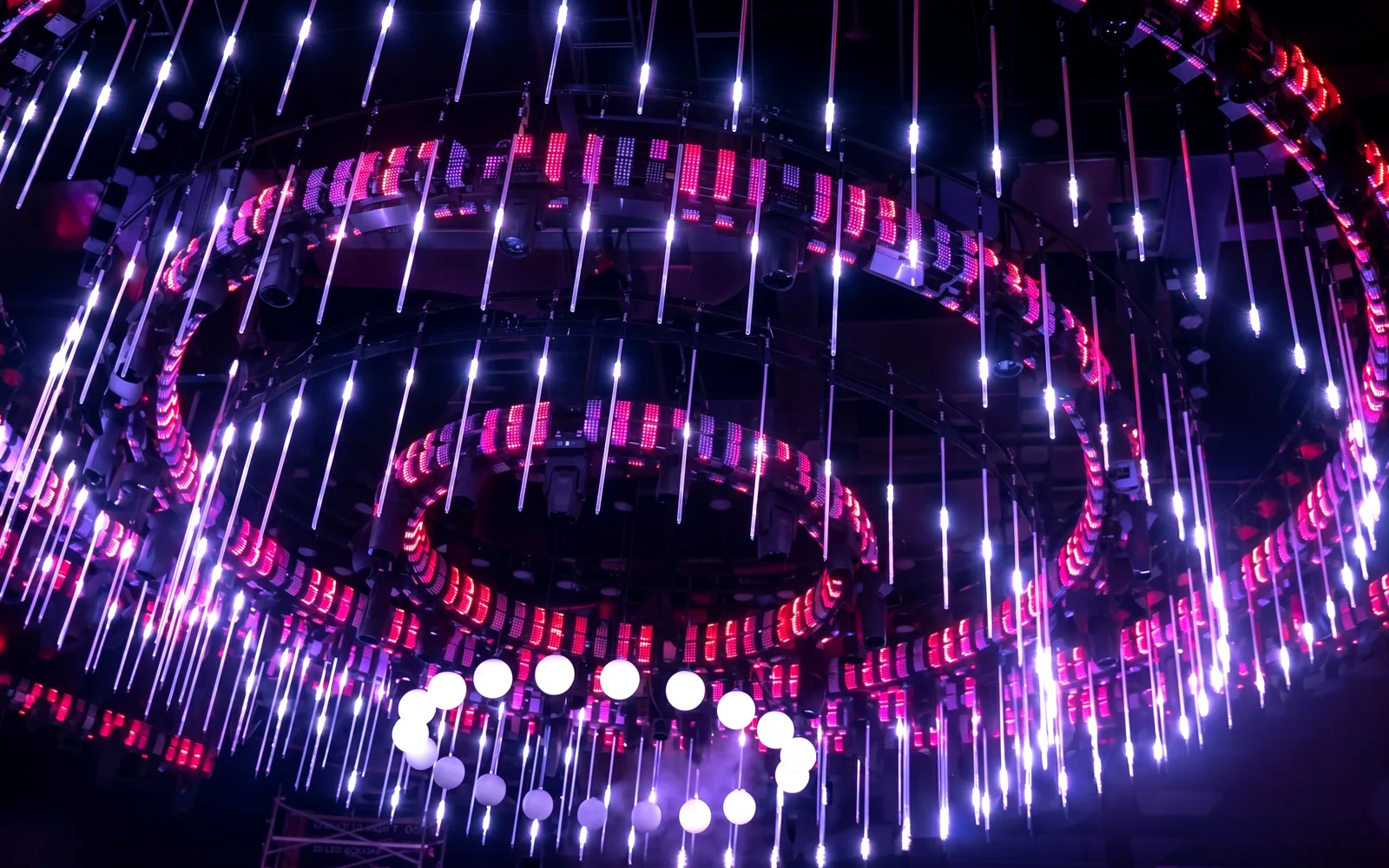
The delivered build: rings of suspended pixel tubes radiating outward, with the globe-point cluster below them. Photo from the project record.
Where the Delivered Record Stops
Every project write-up should draw its own boundary, because you will be handed dozens of glossy case pages that do not.
Documented in the project record | Deliberately not claimed here |
|---|---|
Country: United States · venue type: club | The venue's name, the client's name, or the city |
750 3D meteor tubes + 3,500 full-colour globe lights | Individual tube lengths, tube diameters, or globe diameters |
Mounted as concentric rings; tubes run cascading falling-light effects, globes carry deep colour washes beneath them | The exact ring count, spacing schedule, or rigging drawing |
One addressable show surface under a single controller | The controller model, port allocation, or the as-built channel map |
Products: pixel tube, point light, LED control | Contract value, delivery dates, installation duration |
The client was pleased with how the finished ceiling reads | Any quotation, testimonial, or guest numbers |
Two conventions run through the rest of this page. Where a number is arithmetic on the documented counts — total points, channel count, universe count — it is labelled as arithmetic, because the as-built drawing is not in the record. Where a figure describes the product family rather than this project, it says so. A page you can quote in a tender and one you cannot are separated by exactly this line.
Why This Ceiling Needed Both Tubes and Globes
The delivered ceiling uses two geometries on purpose, and the reason is optical rather than decorative.
A pixel tube is built to be looked at. A 360° tube emits around its whole circumference, so it reads as a rod of light from the floor, from the mezzanine and from the stairs — no dark back face to hide. That is what makes a cascade work: the tube carries a bright head travelling down a defined length, and the eye reads falling light rather than a row of lamps. The 30 mm meteor tube is the family built for exactly this effect — SMD5050 RGB, 96 or 120 individually addressable LEDs in a 1 m fixture, DC12/24V, 360° emission, driven over DMX512 or SPI (30 mm meteor RGB pixel tube).
A globe point light is built to fill volume. A frosted sphere with an LED inside emits in every direction, so a field of them reads as a cloud of colour with depth instead of a plane of dots. Its resolution is not a datasheet value at all — it is the spacing you design, which is why globe arrays are settled on the drawing and not at commissioning. The family runs from 12 mm nodes to 100 mm globes, at roughly 0.3 to 2 W per node across the small and mid sizes and around 9 W on the 100 mm globe (globe point lights).
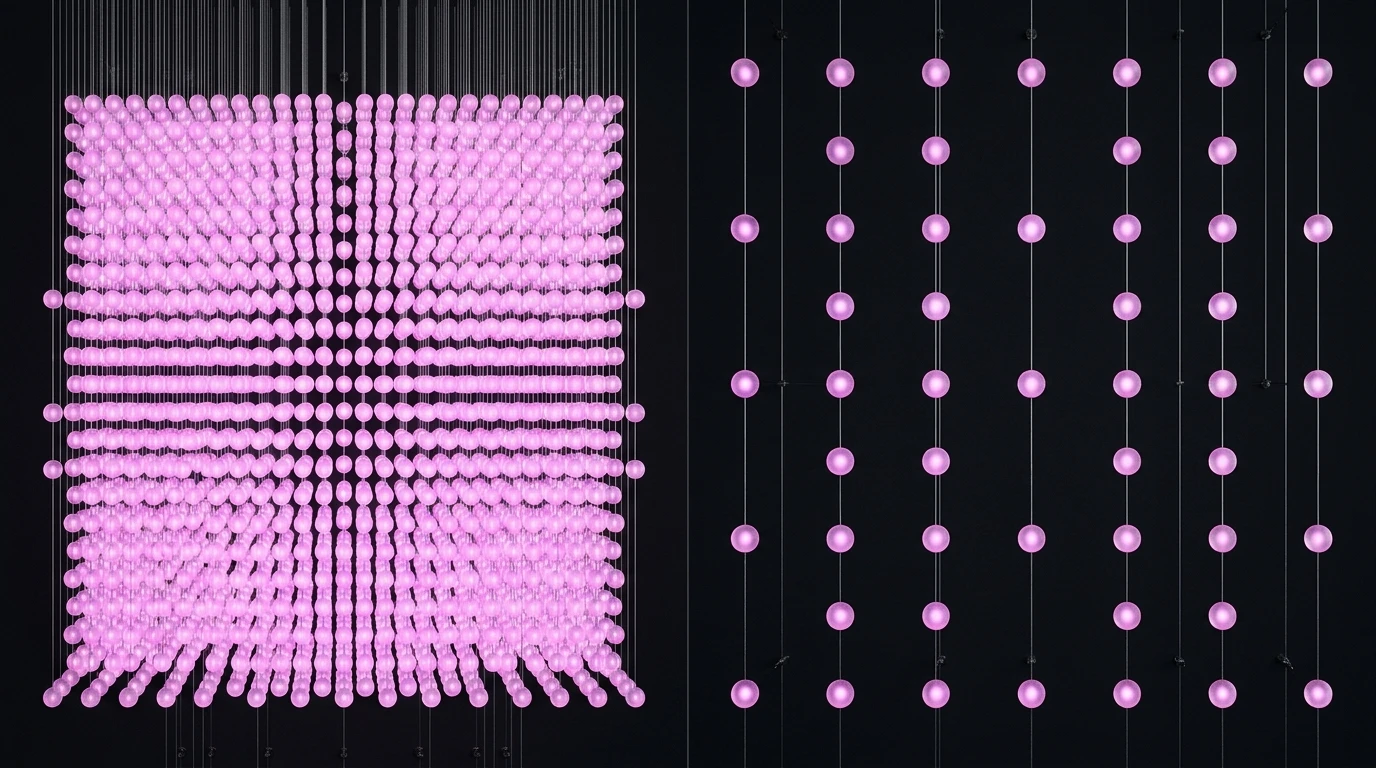
Scale illustration: the same spheres at close spacing (left) read as one surface; at wide spacing (right) each point is countable. Both are valid effects — the drawing decides which one you get.
Why not a flat pixel bar throughout? A bar concentrates output into a defined angle, which is right when one side of a surface is the audience — a coffer, a step face, a booth backdrop. On a ceiling people look up at from every angle, a directional fixture gives you a bright face and a dark edge, and the surface turns into a grid of visible hardware. The trade-off between the two linear geometries is in pixel bars vs pixel tubes; the shape of the light decides the choice, not the budget.
There is a third path you will meet in club ceilings: acrylic light-guide panels, where a diffusing sheet turns each pixel into a soft block of colour instead of a point. It is a different optical system again — worth pricing against both of the above before the concept is fixed, because it changes the rigging weight, the service access and the colour behaviour all at once.
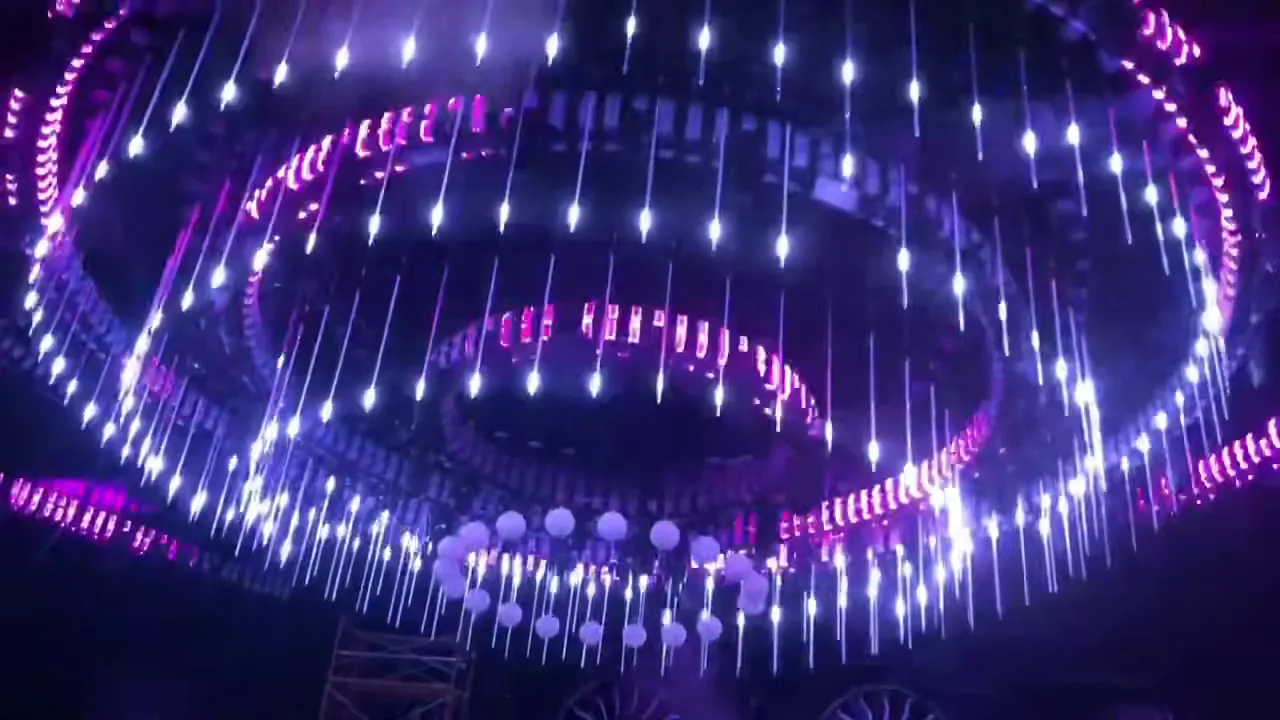
The same ceiling running: tube rings mid-cascade, globe cluster below. Frame from the project's on-site video.
One consequence worth flagging: mixing two families on one surface is a colour-matching problem before it is a design problem. Two product families means two production streams, and the seam between them is where a venue notices a mismatch first.
Mapping 4,250 Light Points as One Surface
Add the two documented quantities — 750 tubes, 3,500 globe nodes — and the ceiling is 4,250 individually controlled light points. That is the number the control design has to survive, and it is a fixture count, not a pixel count.
A full-colour pixel consumes three channels — red, green and blue. A DMX512 universe carries 512 channels, a limit fixed by ANSI E1.11, the DMX512-A standard, which works out to 170 RGB pixels per universe.
Two readings of the same ceiling, both arithmetic on documented counts:
Reading | Pixels | Channels (× 3) | Universes (÷ 512) |
|---|---|---|---|
Conservative: one pixel per fixture | 750 + 3,500 = 4,250 | 12,750 | ≈25 |
LED-level, 96 LEDs per tube | 750 × 96 = 72,000, plus 3,500 = 75,500 | 226,500 | ≈442 |
LED-level, 120 LEDs per tube | 750 × 120 = 90,000, plus 3,500 = 93,500 | 280,500 | ≈548 |
The lower reading treats each tube as one RGB fixture; the upper one counts what the tube is built from — 96 or 120 individually addressable SMD5050 LEDs per 1 m fixture. Which reading this ceiling ran is not in the record: a cascade can be driven either way, per-pixel or per-tube. That is why the gap matters — between 25 universes and roughly 450 to 550 sit the network, the port count and the media-server output. Settle the channel map in writing before the ceiling closes.
Either way it is not a dimmer-rack problem; it is a network problem. Art-Net and sACN both carry many universes over one Ethernet cable, and every media server and pixel-mapping application speaks one or the other. The practical choice, and when a club can stay on plain DMX, is covered in DMX512 vs Art-Net; for a ceiling of this density the rule is blunt — plan the network.
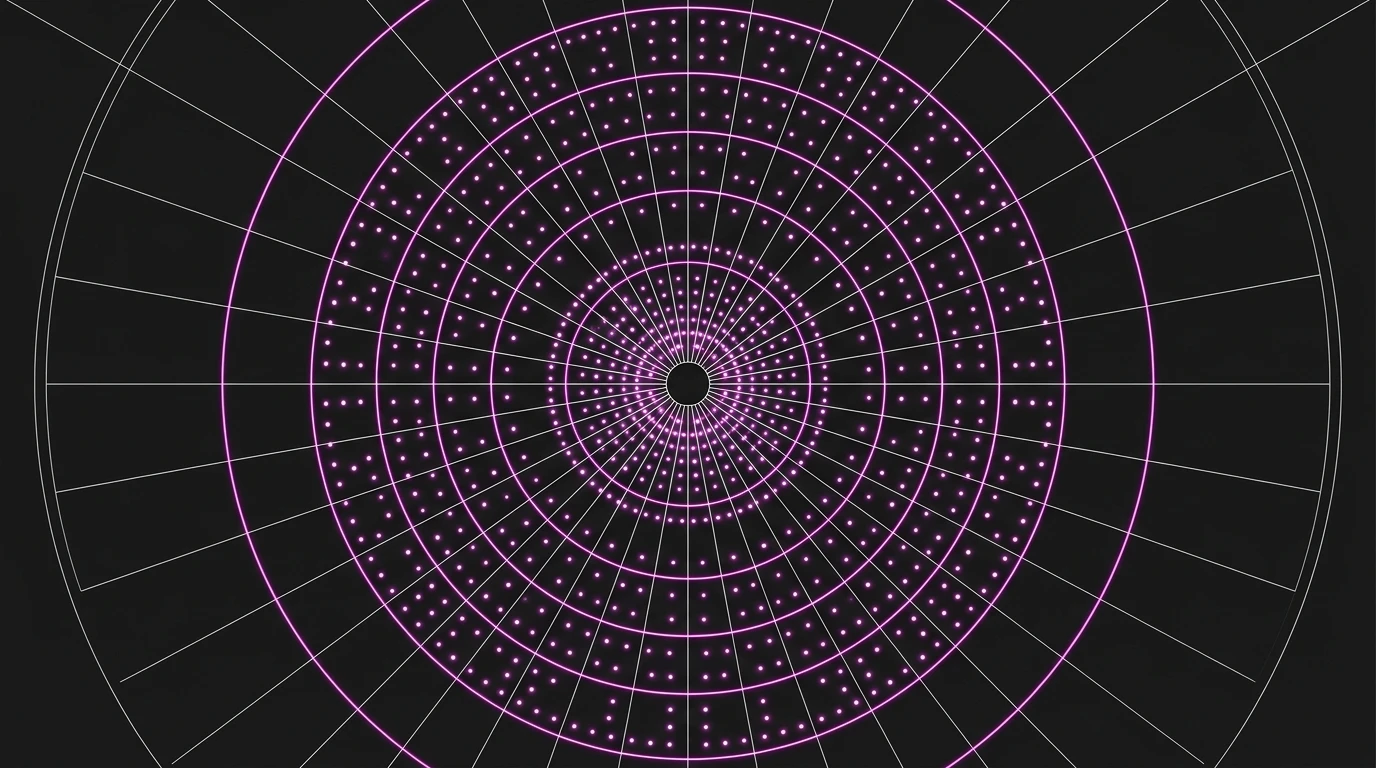
Scale illustration, not the project drawing: a ceiling divided into concentric rings and radial segments the way a mapping application sees it. The rings are not decoration — they are the routes a chase travels along.
Then size the ports, and write the per-port pixel rating down while you do it. The 16-port Art-Net DMX/SPI controller we build is rated at 16 × 512 pixels over DMX and 16 × 1,024 over SPI, so one unit carries 8,192 pixels in DMX mode and 16,384 in SPI. On the conservative reading the ceiling lands at about 266 pixels per port — one unit covers it. On the LED-level reading, 75,500 to 93,500 pixels needs 10 to 12 units at the 512 rating, or 5 to 6 at 1,024. The port count is printed on the box; the per-port pixel rating is the number to demand in writing.
Two things decide whether the ceiling reads as one surface rather than 25 independent strips. The first is frame alignment: a one-frame lag in one universe shows up as a seam travelling around a ring, more conspicuous on a circle than on a rectangle. The second is the map — the physical position of every pixel has to be described to the software, which is what lets a single chase travel outward through the whole ceiling as one movement. Our controller datasheet lists MADRIX and MadMapper as compatible (MADRIX); which package a show runs is the designer's call, but any controller you buy should be Art-Net-native and MADRIX-compatible, with its port count and pixel limit stated rather than implied.
Power in a Ceiling That Will Not Open Again
Pixel load is heavier than it looks, and on a club ceiling it sits in the worst possible place: a sealed void with no airflow and no maintenance walkway.
Put an order of magnitude on it from each family's catalogue draw, not one blended average. The 30 mm meteor tube is catalogued at 23 W (96 LEDs) and 28.8 W (120 LEDs) per 1 m fixture; the globe family runs 0.3 to 2 W per node, with the 50 mm globe at 1.68 W.
Load | Count | Catalogue draw | Watts |
|---|---|---|---|
30 mm meteor tube, 96 LEDs | 750 | 23 W | 17,250 |
30 mm meteor tube, 120 LEDs | 750 | 28.8 W | 21,600 |
50 mm globe node | 3,500 | 1.68 W | 5,880 |
Ceiling total | 4,250 | — | ≈23.1–27.5 kW |
At 24 V that is 23,130 ÷ 24 ≈ 960 A at the low end and 27,480 ÷ 24 ≈ 1,145 A at the high end — and roughly 29 to 34 kW of supply nameplate once the drivers are derated to 80 %. Arithmetic on catalogue values, not a measurement of this project, but the class is not in doubt: a four-figure-amp, multi-supply ceiling, with the supplies sitting in the hot zone. Three consequences follow.
24 V is the working voltage. It halves the current of a 12 V system at the same wattage, which halves the voltage drop and the copper on long ceiling runs. Settle the 12 V / 24 V / 48 V trade-off before the drawing is issued.
Feed long runs at more than one end. Voltage drop appears first as a colour shift at the far end of a run — the reds go pink, the whites go warm — and then as flicker when the run is driven hard. The cadence of injection points, not the thickness of the copper alone, is what keeps the far end matching the near end; the diagnosis path is in voltage drop in pixel LED runs.
Keep the power supplies out of the hot zone. An LED driver's electrolytic capacitors follow a rule of thumb repeated across power-supply engineering rather than printed in any single datasheet: life halves for roughly every 10 °C above rated temperature. Treat it as design margin, not a guarantee. A sealed void above a packed dance floor runs hot and stays hot, so derate the supplies to roughly 80% of rated output — and where the void is genuinely hot, put the PSUs in a ventilated plant space and run 24 V to the fixtures. A little more cable is cheaper than a ceiling that has to be opened.
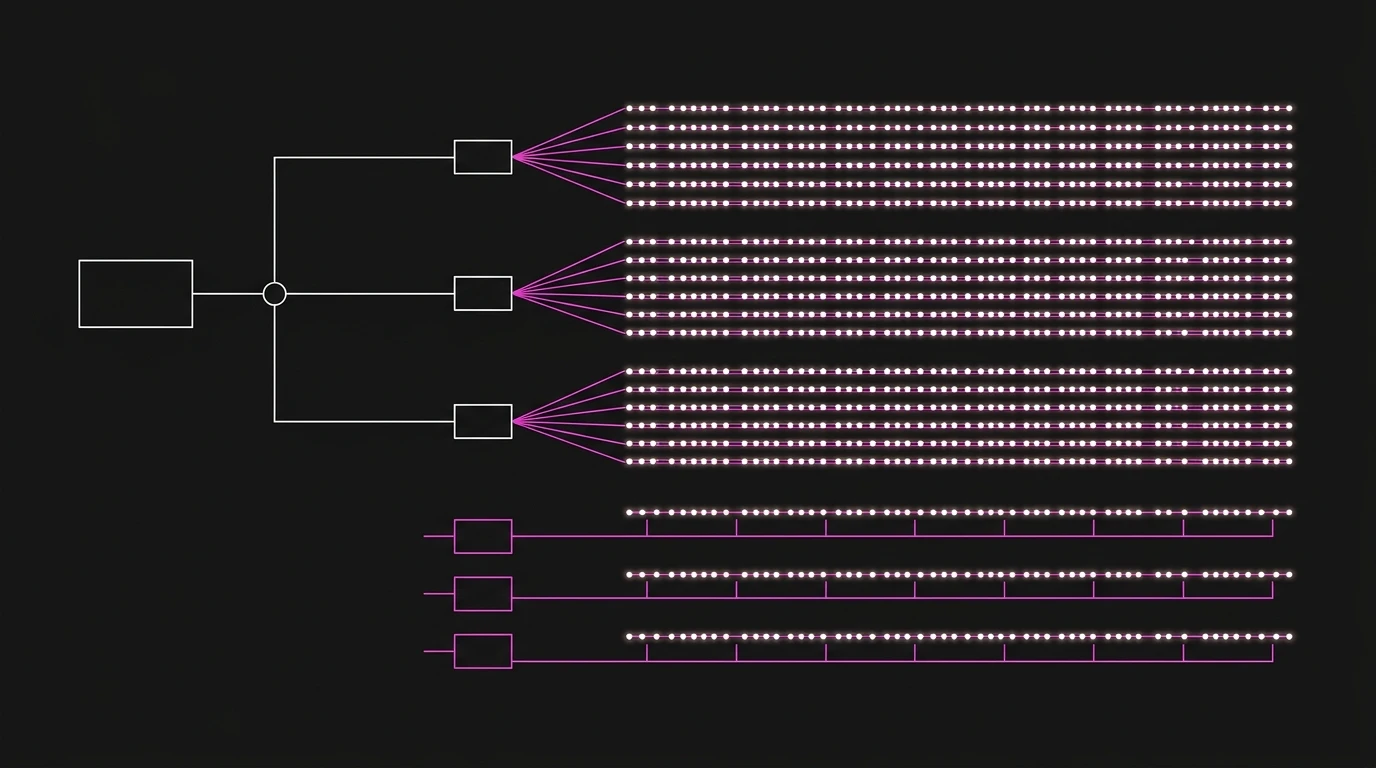
Scale illustration: control and power take different routes. Ethernet runs to the decoders; 24 V comes from a cool plant space to injection points along each run.
Ingress protection is the easy part indoors — a ceiling is IP20 territory by default, and the IP code is worth reading once so the numbers mean something. What is not easy is access. Assume you will lose pixels; the question is whether replacing one costs ten minutes or a scaffold. Design access panels per ring, keep a labelled spare length of each tube type on site, and write down where pixel address 2,741 physically is. That record outlives everyone who built the system.
Holding One Colour Across 3,500 Globes
A club runs saturated colour at low brightness, which is precisely the condition where production differences become visible. Two suppliers' "RGB red" are rarely the same red, and on a 3,500-point field a batch difference does not read as a slightly different light — it reads as a patch, or a seam where two rings meet.
The control that matters is per batch, not per sample box. Every batch that goes into a project like this one passes six checkpoints on our line — incoming QC, in-line AOI, integral-sphere test, aging, IP test on sealed variants, pre-ship function test — and the third is the one that decides how the ceiling looks. An integrating sphere measures total output and colour from all directions at once, which is the right question for a diffused sphere: how much light leaves it, and what colour is it. Measuring that per batch, rather than trusting a bin code, is how the first ring and the last ring end up the same colour.
Two practical tests follow, and both are worth asking a supplier to support:
- Approve a mixed sample on the actual surface. A colour card under shop lighting proves nothing; two fixtures side by side against the material they will sit on proves the thing you care about.
- Ask what happens in year four. When one globe in 3,500 fails, the replacement has to match its neighbours. A factory that retained each batch's colour point can pull a matching one; one that did not will hand you a visible repair. The wider version of this problem is in LED colour consistency and binning.
And because every club is filmed nightly by guests, treat the camera as a second audience: a fixture with a low colour-rendering index turns skin tones grey on a phone, which is one more reason to ask for a measured white rather than an assumed one.
What to Ask Before You Sign a Club Ceiling Build
Bring these to any supplier and the answers will separate them quickly. They are the questions this project forced.
- A drawing with a geometry per surface. Which surfaces get tubes, which get points, which get bars — and why, in terms of where the guest sees them from.
- A point count and a spacing schedule, not a mood board. "About 3,500 globes" is a design; "3,500 globes at 200 mm spacing over these two zones" is a specification.
- A channel budget and the pixel-per-port rating in writing. Universes per zone, and the number that decides how many controllers you are buying.
- An injection cadence and a PSU location. Where the power supplies physically sit, how hot that space gets, and who services them.
- A batch colour method and a sample approval step. Per batch, on the real surface, before the ceiling closes.
- An access and spares plan. Panels per zone, spare lengths on site, pixel addresses recorded.
- A defined fallback state. A club runs nightly for years; the ceiling needs a behaviour after a power cut that is not "black until an operator arrives".
The project behind this article is documented alongside the fixtures that carried it, and the rest of our delivered pixel LED projects can be read the same way — including a 46,000-point globe field for a French exhibition, which is this problem at ten times the count. For the design layer above the fixtures — zones, density, universes, commissioning — our club lighting guide covers the room as a whole.
If you are at the drawing stage, send us the ceiling plan with the point count you are targeting. We will come back with a fixture list, the universe and power budget, and samples for a camera test.
US Nightclub Builds: Questions Buyers Ask
How long does a club ceiling build take? The record for this project does not carry a timeline, so we will not invent one. What decides it is boring and predictable: sample and colour approval, fabrication, and the commissioning the mapping needs. A ceiling of this density needs mapping and colour calibration as a real line item — skilled hours a fixtures-only quotation quietly omits.
Is a pixel ceiling worth it compared with moving heads and lasers? They are different layers, not competitors. Moving heads, washes, lasers and haze carry the energy of the room; the pixel ceiling is the architecture that gives it an identity between drops. Most clubs run both, and the constraint between them is the network and the mapping, not the console.
How many fixtures do I need? Nobody can answer that from a photograph. Globe resolution is your spacing, tube density is your pitch, and both follow viewing distance and the coarsest content the surface must show legibly — a wordmark needs far more density than a chase. Fix the geometry per zone first; the count falls out of the drawing.
Can a pixel ceiling run every night, all year? Yes, if it is specified for it. Club duty is commonly planned at 2,000 to 5,000 operating hours a year — a planning assumption here, not a figure from this project's record — several times a touring fixture's. That is why thermal design, PSU placement and service access matter more here than on a stage rig.
What does a ceiling like this cost? We do not publish pricing, and a number quoted without a point count would be fiction. What drives it: point count, the universe and port count behind it, the geometry mix, the access design, and commissioning hours. Those are the five lines to ask any supplier to break out.
Specifying pixel LED for a real project?
Send the spec — pitch, IC, IP class, run length, voltage — and you get an engineer's answer, not a catalogue. Samples and OEM/ODM quotes from the Shenzhen factory floor.