
COB vs SMD LED Strip: Which Hides the Dots?
COB hides the dots by removing the gap between emitters; SMD hides them with diffuser depth. What each choice really costs in pixels, cut points and profile.
COB and SMD strips can both give you a line of light with no visible dots. What separates them is where the money goes: COB packs emitters roughly 2 mm apart and charges for it on the reel; SMD spaces them roughly 17 mm apart and charges for it in the depth of the profile. One difference is not a trade at all — COB has no pixels, so any run you want to address light by light belongs to SMD.
That is the comparison in three sentences. The rest of this page is the arithmetic behind it, the construction details that decide whether the strip survives the install, and the list of numbers to put in the specification — because the COB LED vs SMD LED decision is a spec-sheet decision, not a taste one. One warning about the search itself: most "COB light vs LED" pages you will land on are about studio and film lamps, where a COB fixture stands in for a softbox. This page is about strip, and on strip the same two letters describe a packaging choice.
PILEDS builds both — a single-colour COB reel and the addressable SMD ranges — so this is not a page arguing for one catalogue line over another. Where COB loses for our own customers, it says so below, including the two things our COB range simply does not do. If your open question is still colour type rather than packaging, the pixel LED strip selection guide takes that fork instead.
COB LED vs SMD LED at a glance
COB strip | SMD strip | |
|---|---|---|
Emitter | Bare dies bonded to the board, one continuous phosphor layer | Individual packaged LEDs soldered to the board |
Typical density | 320–896 LEDs/m | 30–180 LEDs/m |
Emitter pitch | 1.1–3.1 mm | 5.5–33 mm |
Visible dots | None at any practical channel depth | Depends on pitch and the gap to the diffuser |
Beam | Wide, close to 180° — light leaves a flat surface | 120–160° per package |
Per-LED control | Not available; one zone, or a few zones on RGBIC reels | Available (WS2811, WS2812B, SK6812, WS2815) |
Cut pitch | Typically 25–50 mm | 50 mm at 12 V, 100 mm at 24 V on 60 LED/m |
Repair | Replace the section | Repackage a single LED on uncoated strip |
What you pay for | Density on the reel | Diffuser depth in the profile |
The last three rows are the ones that decide budgets, and none of them shows up on a product photo.
The dots are a geometry problem, not a chip problem
An SMD strip is a row of self-contained packages soldered to a flexible circuit board — each one a discrete light source with bare board between it and its neighbour. A COB strip skips the package entirely: the dies are bonded straight onto the substrate and covered with a single phosphor layer, so light leaves a continuous surface rather than a row of windows (chip-on-board packaging, surface-mount packaging).
That structural difference is why COB is dot-free and SMD is not. But the more useful question for a specifier is what "dot-free" actually depends on, because SMD strips can be made dot-free too — with distance. A diffuser does not switch light off; it scatters each emitter into a disc. If the discs overlap before they reach your eye, the line reads as continuous. If they do not, you see a row of discs, and the client calls it a row of dots.
How much distance that takes is geometry, not opinion. For an emitter with a beam angle θ sitting a clearance h below the diffuser, the lit footprint on the diffuser is about 2·h·tan(θ/2) across. For the footprints to overlap, that has to exceed the pitch. At the 120° beam of a typical SMD package:
h ≥ pitch ÷ 3.46
Run the numbers for real densities and the whole argument falls out:
LEDs per metre | Pitch | Minimum clearance to diffuser (120° emitter) | With 1.5× margin |
|---|---|---|---|
60 | 16.7 mm | 4.8 mm | 7.2 mm |
90 | 11.1 mm | 3.2 mm | 4.8 mm |
120 | 8.3 mm | 2.4 mm | 3.6 mm |
144 | 6.9 mm | 2.0 mm | 3.0 mm |
320 (COB) | 3.1 mm | 0.9 mm | 1.4 mm |
480 (COB) | 2.1 mm | 0.6 mm | 0.9 mm |
Read the 60 LED/m row against a typical shallow channel. A 10 mm deep profile with a 2 mm diffuser wall and 1 mm of adhesive leaves about 7 mm of clearance — right at the margin, which is exactly why installers see dots in "10 mm" profiles and reach for a 17 mm one. Read the COB row instead: 480 LEDs per metre needs under a millimetre, so a 6 mm channel is comfortable.
Two caveats before anyone specs off this table. A thin opal diffuser is not a Lambertian scatterer, so the real footprint is smaller than the ideal circle, and the ends of a run are always worse than the middle. Glossy surfaces also matter more than people expect: on polished stone or glass, the reflection of a 60 LED/m strip shows the pitch even when the diffuser hides it in direct view. Mock up one metre on the actual substrate before committing a kilometre.
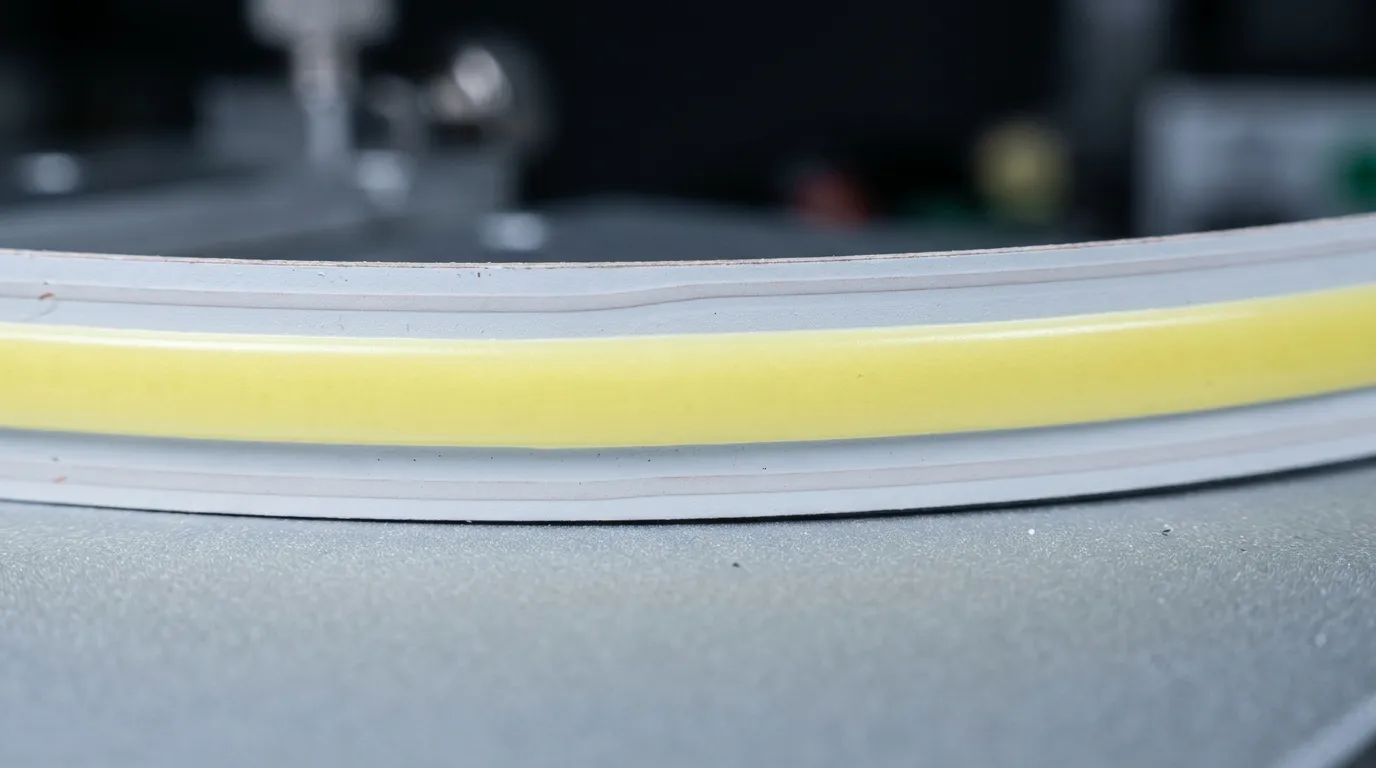
The COB surface is the light source. There is no board visible between emitters because there is no gap to show.
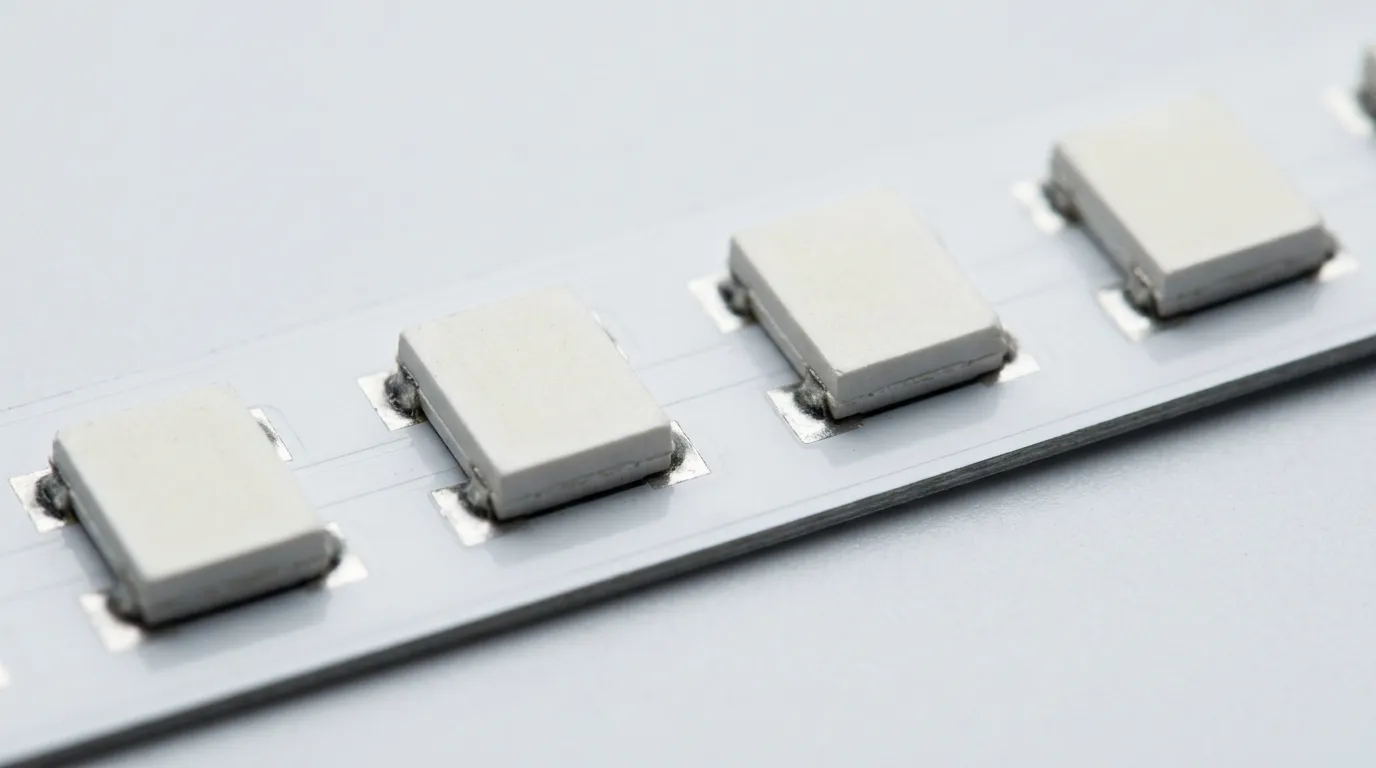
The same job done with packages: every bright rectangle is a light source, and the board between them is what a diffuser has to cover.
What COB gives up: the pixel
The SMD package is not just a container. It is the place where control can live. A WS2812B puts the driver die inside the 5050 package, next to the three LED dies; an SK6812 adds a fourth die for white in the same footprint. That is what makes a strip addressable per package — every package can be told a different colour, which is the entire basis of pixel mapping, chase effects and video-to-light.
COB removes the package, and with it that option. The dies are bonded to the substrate and wired in series and parallel groups under one phosphor layer. A group switches together or not at all. So a standard COB reel is one zone: one colour, one brightness, the whole run. Some reels marketed as RGBIC add controller ICs at intervals — and that interval is the real specification, not the emitter count. A COB reel with an IC every 100 mm gives you 10 controllable segments per metre, not 480 pixels. Ask for the segment length in millimetres before you plan anything.
This is the line most comparisons blur. "COB is the newer technology" is true in strip form and irrelevant to the decision, because COB is a packaging choice optimised for uniformity, not for control. If the job needs per-light resolution — a mapped facade, a chase, a 12 mm pixel pitch effect on camera — the answer is the addressable SMD range, and the choice inside that range is its own question: SK6812 vs WS2812B covers white channel versus three-channel colour, and WS2815 covers the backup-data variant for long runs.
If the job needs an even band of light and nothing else, one zone is not a limitation. It is one channel on the controller instead of 480, and a fraction of the wiring.
Cut points, connectors and the repair you can actually do
Neither type can be cut anywhere, and the reason is the same for both: the cut has to fall at the end of a series string.
On a 12 V strip, three dies sit in series per channel, so the smallest electrically complete section is three packages. At 60 LEDs/m that is 50 mm. At 24 V it is six dies and 100 mm. COB reels usually land at 25–50 mm because the series groups are shorter, which sounds like a straight win until you look at the joint: the pads are a fraction of the size, often under the phosphor coating, and solderless connectors for COB are their own part number. Cutting a COB reel in the wrong place does not just kill one segment — it breaks a string with no return path, same as any other strip.
Cut pitch | The joint | Field repair | |
|---|---|---|---|
SMD 12 V, 60 LED/m | 50 mm | Two pads, easy to solder or clip | Single package can be replaced on uncoated strip |
SMD 24 V, 60 LED/m | 100 mm | Two pads | Same |
COB 12/24 V | 25–50 mm | Tiny pads, often coated | Section replaced, not a single emitter |
Any potted IP65+ | As above | Sealed | Run replaced |
Repair economics follow from that last column. A failed COB section takes out 25–50 mm and gets replaced with a connector; a failed SMD package on bare strip can be reworked by someone with hot air and a steady hand. But once either type is potted for IP65 or better, nobody is reworking anything on site — you replace the run. That is why the spare allowance matters more than the repair method: order 5% extra from the same production batch and store it with the project, not in a van.
Heat, profile depth and the cost that is not on the reel
Thermally the two behave differently but neither is exempt. SMD concentrates heat at each package's thermal pad, which is why the 2835 and 3014 packages build a pad into the housing while older 3528 and 5050 parts rely on the copper underneath. COB spreads the load across the substrate because the dies are bonded over a continuous area — better spreading, not less heat. Watts per metre still decides what the aluminium has to do, and a 480 LED/m reel can run anywhere from about 8 to 15 W/m depending on how hard it is driven.
The cost difference that matters is not the reel. It is the profile, and the pitch table above gives you the number. To hide dots on a 60 LED/m SMD strip you need roughly 7 mm of clearance with margin, and once the 2 mm diffuser wall and 1 mm of adhesive are subtracted, that is what a 10 mm profile only just delivers — which is why specifiers end up at 15–17 mm, and why the rebate has to be deep enough to bury it. The same visual result from a 480 LED/m COB reel needs under a millimetre, so a 6–8 mm profile does the job. Profiles are sold by the metre, rebates are cut by a carpenter, and both prices are real. Depth is not the only thing a profile does to your clearance, either: ribs, diffuser wall thickness and how the strip sits on the channel floor all eat into the h the table assumes, which is what choosing an aluminium profile that does not block the light works through.
That is why "COB costs more per metre" is only half a sentence. Price the strip, the profile, the diffuser and the labour together and the gap narrows or reverses, depending on the channel you already have. On a retrofit where the rebate is fixed at 8 mm, it does not narrow at all — SMD simply cannot get there.
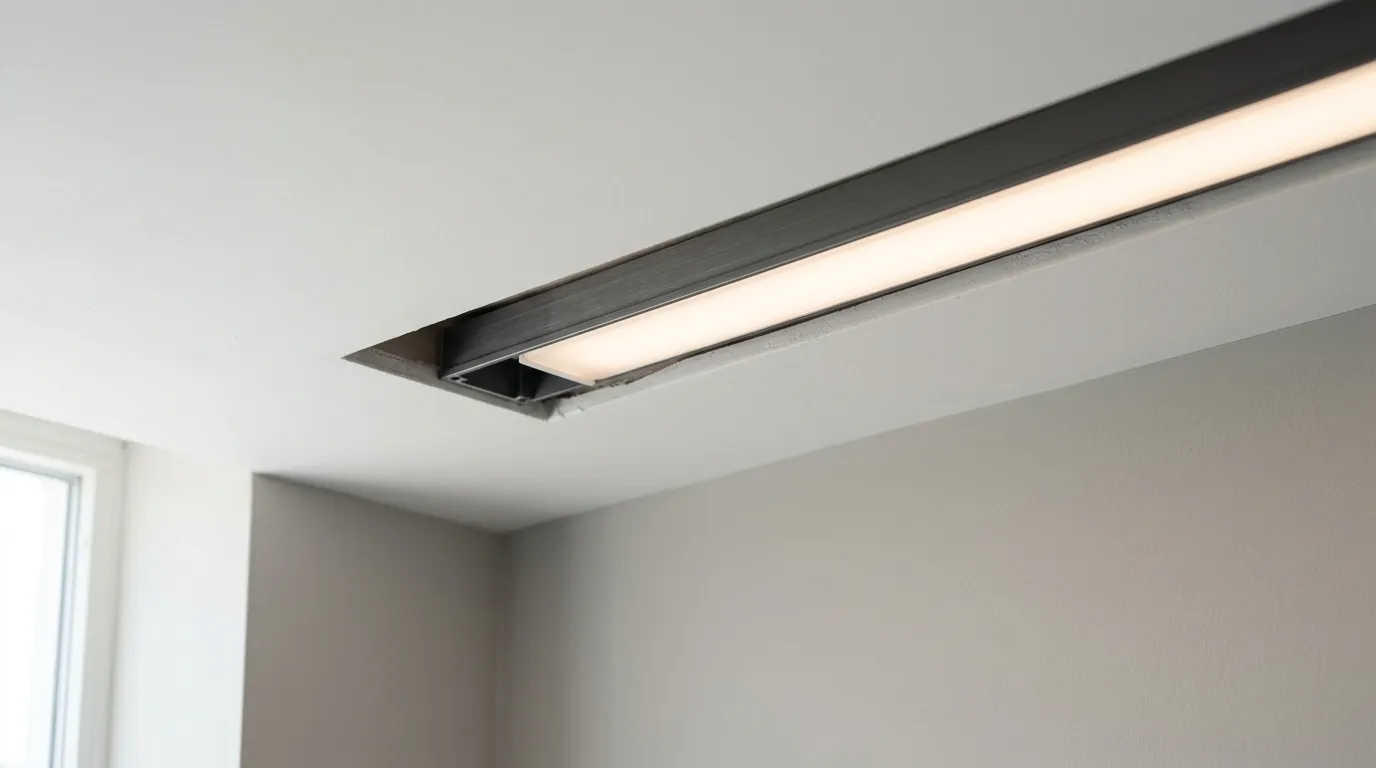
The deep channel is what an SMD reel buys instead of dense emitters: 15–17 mm of aluminium and a rebate to bury it. That cost sits in the joinery, not on the LED invoice.
Efficacy is where the marketing gets loose. Claims of "40% more light per watt" appear in this category with no test conditions attached, and at least one comparison page argues both directions in two of its own sections. The only defensible approach is to ask for lumens per metre and watts per metre at the exact colour temperature you are buying, then divide. That is the same quantity as luminous efficacy and it is the only version of the claim that survives a spreadsheet. Add CRI and, if the reel will be visible in a premium interior, the bin code.
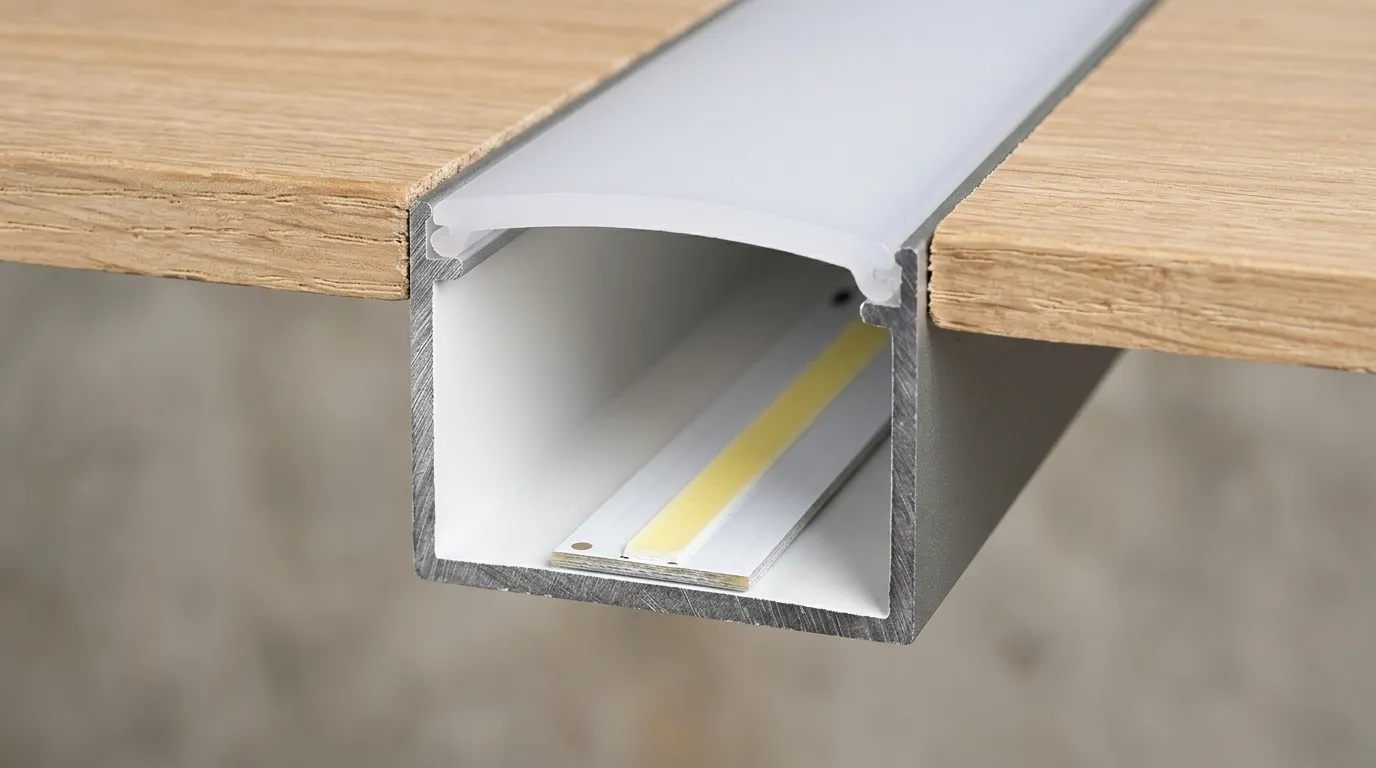
The gap labelled h in the formula is the space an SMD strip needs and a COB strip mostly does not. Buying that gap is buying milled aluminium.
Run length and voltage: the rail decides, not the package
Current per metre is watts per metre divided by the rail, and nothing about the package enters that division: a 10 W/m reel draws the same amps whether its emitters are bare dies under phosphor or packaged LEDs, because the copper only sees amps. Voltage drop along the run is proportional to that current, so what decides how far one feed reaches is the watts per metre, not COB versus SMD.
Take a 24 V rail. A 10 W/m reel pulls about 0.42 A per metre; a 14.4 W/m reel pulls 0.60 A. Because the load is spread along the run rather than lumped at its end, the drop accumulated by the far end grows roughly with current × length squared, so the length one feed can carry scales with 1 ÷ √current. The 10 W/m reel therefore reaches about 20% further: where the 14.4 W/m reel is already sagging at 8 m, the 10 W/m reel still holds its far end at 9.6 m. That is the whole mechanism, and it is blind to format — a 10 W/m SMD reel and a 10 W/m COB reel draw the same 0.42 A and run the same distance.
COB still changes the number you end up speccing, just not by drawing less at equal watts. In a channel too shallow for a diffuser to hide the pitch, an SMD reel cannot buy its way out of a geometry shortfall with more watts, so there is no current comparison to make at all: the COB reel is the only one of the two that reaches an even line there, and it does it at the 8–15 W/m a 480 LED/m reel is typically driven at. Where both formats are genuinely on the table, run length is a W/m question — pick the reel with fewer watts per metre, not the denser package.
The limit is the rail, not the packaging. 48 V long-run strip exists and is the better answer for very long single feeds, but in most catalogues it is an SMD product — our DC48V range is a 90 LED/m SMD reel at 21.6 W/m — while COB reels sit at 12 V and 24 V. So voltage and packaging are two separate decisions: pick the rail from the run length with 12 V vs 24 V vs 48 V, then pick the packaging from whether the source will be seen. Both packages are available at 12 V and 24 V from the same factory, which is the useful part — you are not forced into a rail by the format.
Whichever way you go, size the feed from the current at that tap rather than the terminal, leave 20% headroom on the driver, and check the arithmetic with an actual voltage drop calculation instead of a rule of thumb. If the run needs more than two injection points, sizing the power supply properly usually costs less than the cable it saves.
Where each one wins on a real job
The job | Pick | Why |
|---|---|---|
Hidden ceiling cove with a deep profile | SMD | Dots are already covered by a channel you need anyway; lowest cost per metre |
Shallow reveal, 6–10 mm, source visible | COB | No room for a diffuser trick, and none needed |
Polished stone, glass, mirror surrounds | COB | Reflections show pitch; a continuous source has none |
Outdoor facade, IP66 or better | SMD | Potted addressable ranges go further on ingress than COB reels |
Stage, pixel mapping, video-to-light | SMD | Per-package control is the whole requirement |
Light box or channel letter face | COB | Even face, no hot spots behind acrylic |
Very long linear run, few feeds | Either — pick the lower W/m | Injection spacing follows from amps per metre, which the package does not change |
Two of these are worth arguing about, because they are where the decision usually gets made badly.
The first is the reflective surface. Clients do not complain about dots in the diffuser; they complain about the row of bright dots they can see in the polished floor two metres away. That is a pitch problem, and a deeper profile in the ceiling does not fix it. If the substrate is reflective and the strip is anywhere near it, COB is doing work that no diffuser can do.
The second is the light box. A channel letter face is usually 30–60 mm from the light source, which is plenty of clearance for SMD — but the face is translucent, so the pitch reads through it as banding rather than as dots. A COB reel at 320–480 LEDs/m removes the banding without adding depth, which is why the format turns up in so much channel-letter work.
When two answers point in different directions, the pixel requirement wins. You cannot add addressability to a COB reel later; you can always add a deeper profile.
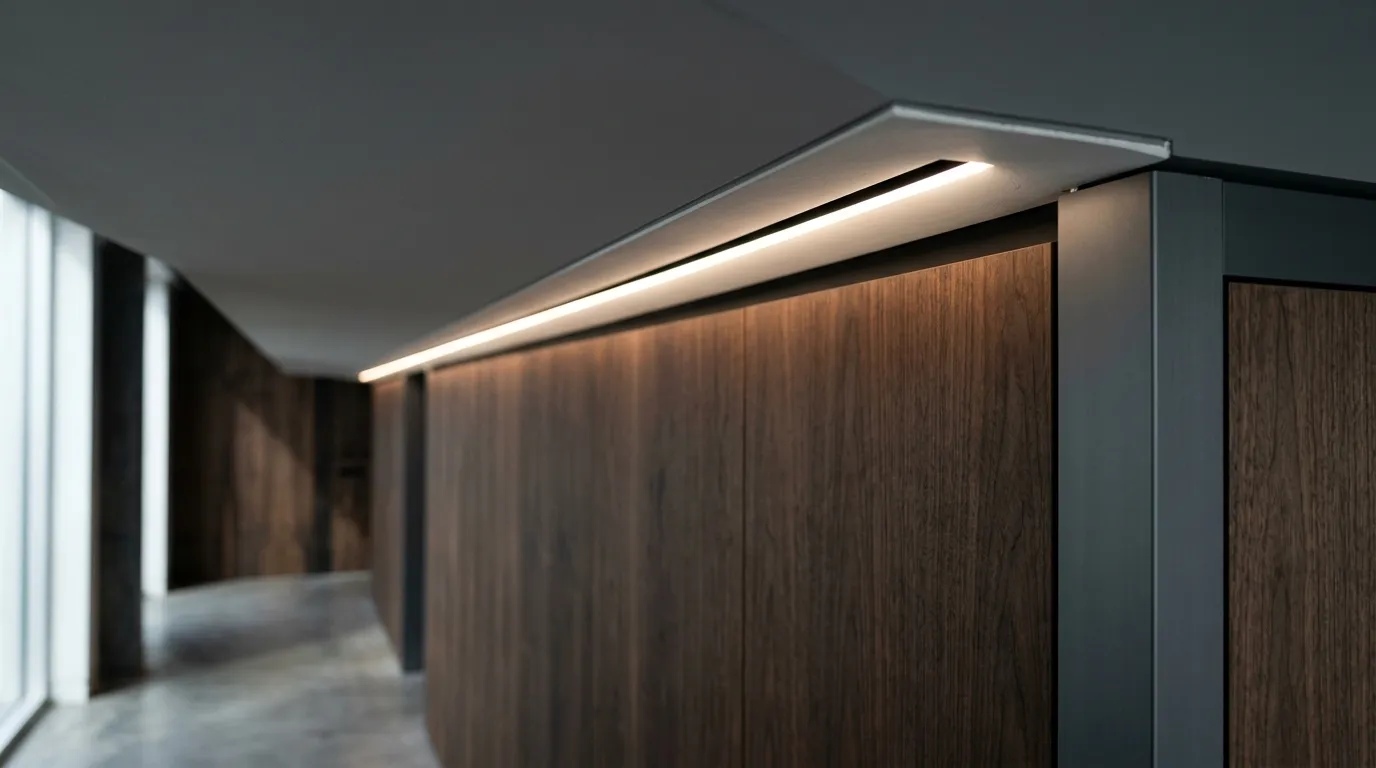
A 10 mm reveal with no diffuser depth to work with. This is the case COB was made for, and the case where SMD needs a profile twice as deep.
What to write into the specification
Nine lines decide whether the reel you receive matches the drawing you approved. None of them are on a typical product photo.
- LEDs per metre and pitch in millimetres. "High density" means nothing; 480 LEDs/m and 2.1 mm pitch is a specification.
- Cut pitch in millimetres, and the tolerance. If a segment has to land at 137 mm, a 50 mm cut pitch cannot do it.
- W/m and lm/m at the colour temperature you are buying. Efficacy claims without a CCT and a test basis are marketing. Divide one by the other yourself.
- Bin code and step size, plus a single-batch commitment per elevation. COB is sorted after the phosphor is applied, so variation between batches is the real risk on a long run — the same principle as binning and colour consistency, with more riding on batch identity.
- IP of the assembled fixture, not of the strip. A strip rated IP65 inside a poorly sealed profile is an IP20 installation. Decide which face is sealed and how the ends are terminated — IP65 vs IP67 is the relevant fork.
- Adhesive and substrate. Tape on painted MDF in a 40 °C ceiling void is a call-back; the same strip in a mechanical channel is not.
- Driver type, location and headroom. Constant voltage for 12 V and 24 V reels, 20% spare capacity, and an accessible driver position — not one buried above a fixed ceiling.
- Life-test basis and warranty terms. L70 hours are table stakes; L80 and the test temperature tell you about the slope rather than the endpoint. Ask what voids the warranty, because cutting outside a mark usually does.
- If it will be on camera: dimming method and PWM frequency. Banding is a controller and PWM question, not a chip-format question, and the only reliable test is your own shutter speed on your own camera.
Where COB genuinely loses — including on our own range
Our COB reel is a single-colour product, and that is the honest boundary. It runs 320 or 480 LEDs per metre at DC12 V or DC24 V, IP20 or IP65, rated 50,000 hours. There is no per-pixel COB in the range and no IP68 COB. If a project needs RGB pixel mapping or a potted fixture for a facade, the answer is the addressable SMD line, not a COB reel with a longer datasheet.
Three other places SMD wins outright: any requirement for individual light control, any outdoor installation where the ingress rating has to survive a connector, and any budget-driven cove where a deep profile is already in the ceiling schedule. Add a fourth: if the client wants to change colour temperature after handover, the tunable and RGBCCT options live on the SMD side of most catalogues, ours included.
Where COB wins is narrower than the marketing suggests and more durable than it sounds: a visible source, a shallow channel, a reflective substrate, a translucent face, and any run where the even line it produces also happens to be the lower-W/m option — because lower watts per metre is what buys the longer feed.
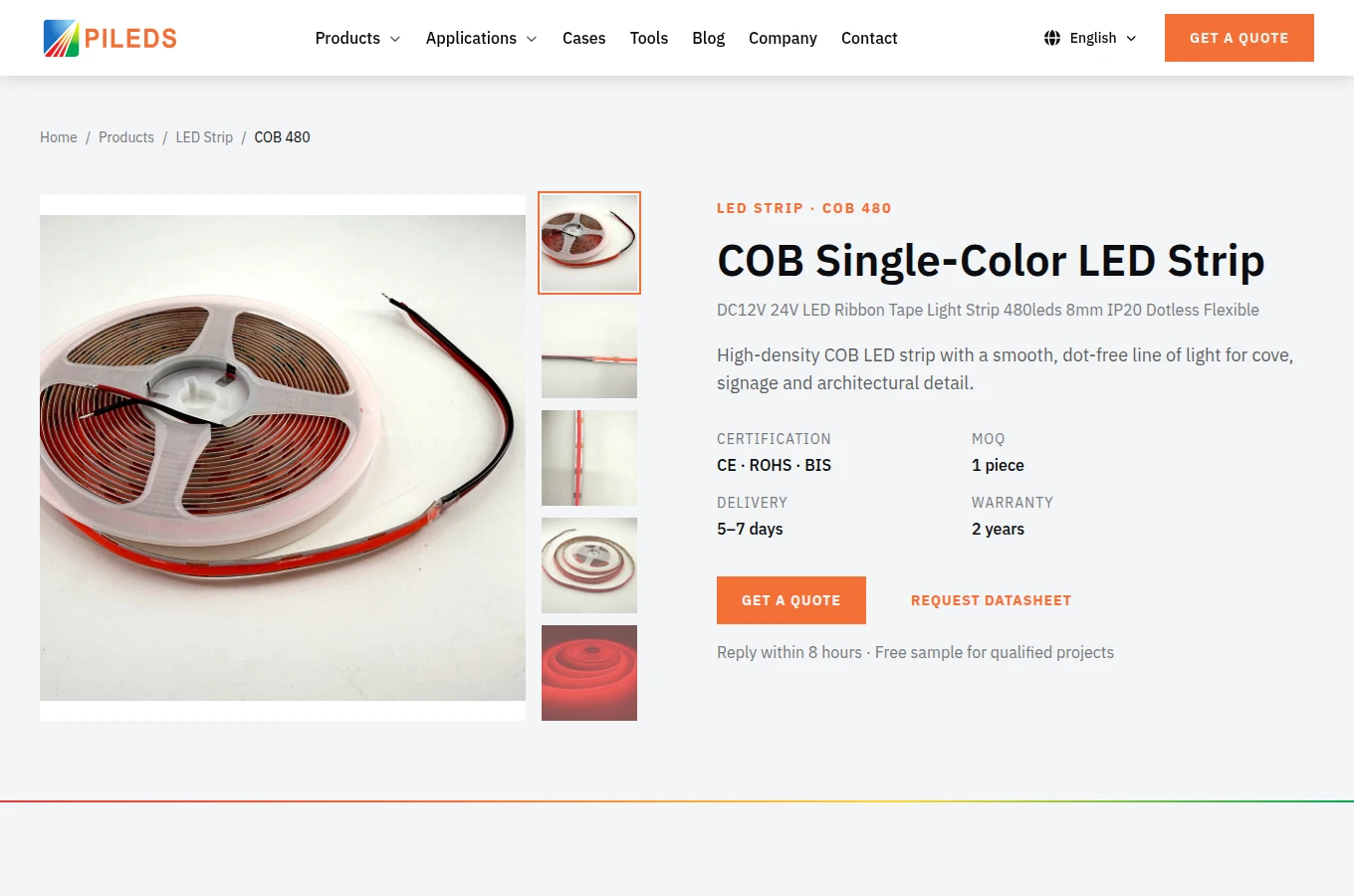
The reel's own spec sheet: 320 or 480 LEDs/m, 12 or 24 V, IP20 or IP65. No pixel version exists, and the page does not pretend otherwise.
COB vs SMD FAQ
Which is better, COB or SMD LED? Neither, in the abstract. COB is better when the source is visible or the channel is shallow; SMD is better when you need per-LED control, a potted IP66+ assembly, or the lowest cost behind a deep diffuser. Decide with two questions: will anyone see the strip, and does anything need to be addressable?
Are COB lights better than LED lights? The question contains a category error: COB is a way of packaging LEDs, not a competitor to them. What people usually mean is COB versus SMD strip, which is the comparison on this page, or COB versus LED panel in film and studio lighting, which is a different product category with different rules. The pages that rank for "COB light vs LED" are almost all about that second case, where the numbers that matter are CRI, beam angle and colour temperature rather than dots per metre.
Does COB LED strip need a driver? Yes. A standard COB reel is a constant-voltage product and wants a 12 V or 24 V supply sized for watts per metre times length, plus headroom. Some COB modules are constant-current and need a matching driver instead. The packaging does not change the driver requirement — the datasheet does.
Can you cut COB LED strip anywhere? No. It cuts at the marked points, typically every 25–50 mm, because the cut has to fall at the end of a series string. Cutting between marks breaks the return path for the remaining dies, and on a coated reel the joint is small enough that a poor cut shows as a dark section rather than an obvious failure.
Is COB brighter than SMD? Not inherently. Brightness is watts per metre multiplied by efficacy, and both formats span a wide range. COB's advantage is that it gets to a given visual result without relying on how close the packages sit before the dots disappear — a uniformity argument, not a brightness one and not a current one either: amps per metre follow from watts per metre and the rail, whatever the package.
Do COB strips still need an aluminium profile? Yes, for heat and physical protection. The profile's job changes: with COB it is a heat sink and a mechanical guard rather than a diffusion chamber. Skipping it because "there are no dots to hide" is one of the quickest ways to shorten a COB reel's life.
Send the drawing, not the buzzword
The five numbers that decide this before price enters the conversation: channel depth in millimetres, cut lengths, run length per feed, the ingress rating the assembly has to hold, and whether anything needs per-light control. Send those with a section drawing and the answer is usually obvious — and sometimes it is not the format you expected.
If you are still at the stage of choosing between colour types, start with the pixel LED strip selection guide. If you already know the format and need the reel, the COB single-colour strip page carries the current specifications, MOQ and lead time.
Specifying pixel LED for a real project?
Send the spec — pitch, IC, IP class, run length, voltage — and you get an engineer's answer, not a catalogue. Samples and OEM/ODM quotes from the Shenzhen factory floor.