
3,600 m of Pixel String for a US Holiday Plaza
Commercial holiday lighting, delivered: a 3,600 m addressable pixel-string plaza build — control paths, DC power, weatherproofing and the questions buyers ask.
A Commercial Holiday Lighting Brief That Has to Change Every Year
A US holiday event planner came to us with a plaza centerpiece to build. The requirement was not "a big tree with lights on it" but a tree that could stop being the same tree: something that plays changing effects night after night, is built to carry the venue's seasonal branding, and gives people a reason to come back late in the season.
That is a different brief from most commercial holiday lighting work, which is still sold as a design-install-maintain-takedown package built around C9 bulb strings and pre-built props. What Pileds delivered was 3,600 m of full-color addressable pixel string, mapped over the cone of the tree and the cluster of smaller trees around it as one programmable surface, with two control paths: Art-Net live from a PC for show programming, and SD-card offline playback at the fixture for the nights when nobody is on site.
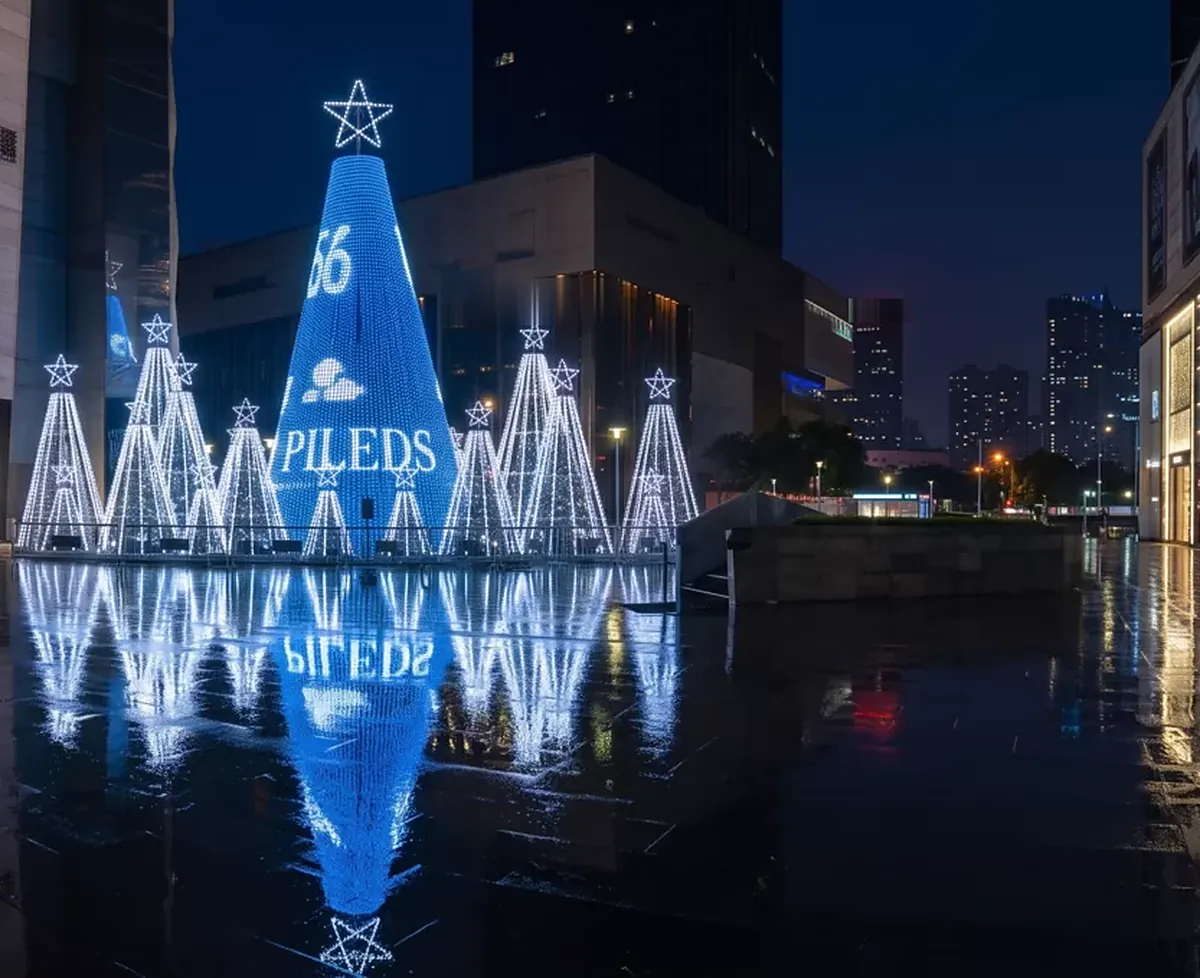
The image the case record carries for this project: one mapped surface covering the cone and the ring of smaller trees around it. The mark lit on the cone here is our own brand, used as content.
It is also worth being exact about what this page can and cannot tell you.
Documented in the project record | Deliberately not claimed here |
|---|---|
Country: United States · venue type: holiday plaza display | The venue's name, the planner's name, or the city — and the project photograph above is cropped so the surrounding storefront signage is not in frame |
3,600 m of addressable pixel string delivered | The pixel count, pitch schedule, or mapping grid used |
Mapped over the cone and the surrounding cluster of smaller trees as one programmable surface | The show's running order, or how the branding content was designed |
Control: Art-Net live from a PC and SD-card offline playback at the fixture | Contract value, delivery dates, install duration, or warranty terms |
Content played: snowfall, color chases, a lit-out brand mark | Any testimonials — the delivery record carries none |
Products: addressable LED strip (the pixel string) + LED controller | Certification claims specific to this installation |
That table is the difference between a page you can put in front of a procurement committee and one you cannot. The rest of this article is the engineering behind the delivery — the part that decides whether your own plaza project survives its first January.
What 3,600 m of Pixel String Buys on a Tree
Most of what ranks for commercial holiday lighting assumes a bulb string: one circuit, a fixed color, a fixed pattern, and a controller that does little more than switch and dim. The trade still quotes a commercial Christmas tree by the bulb count — for a bulb string the count is all there is.
An addressable pixel string is a different animal. Every LED — or LED group, depending on the strip — has its own driver chip and its own address, so the string is not a light: it is a low-resolution display that happens to be shaped like a tree. We build these as addressable LED strip and drive them from our LED controllers.
That property is what makes a re-programmable centerpiece possible. Snowfall down the cone, a color chase from base to star, a brand mark resolving out of a color field: the same 3,600 m of hardware running different data. Nothing gets rewired between shows, so next December can run a different show on the same tree — the entire argument for addressable string over bulb string on a venue that intends to reuse the asset.
Then there is the number itself. Three thousand six hundred meters is a geometry statement, not a brightness one. On a cone, the runs converge toward the apex, so an evenly spaced design has more string per square meter near the top than at the base, and the run lengths vary from base to tip. Over a cluster of smaller trees, the same string has to wrap trunks, spiral canopies and drop in verticals — each with a different string length per unit of visible surface.
Which is exactly why this project's record states meters and not pixels: the pixel count is a consequence of the pitch you choose, not a property of the string. For scale, if the same 3,600 m were laid at a 100 mm pitch, that is roughly 36,000 individually controlled points and about 211 DMX universes of data; at 50 mm it doubles to about 72,000 points and 422 universes; at a coarse 150 mm it drops to about 24,000 points and 141 universes. Those figures are illustrative arithmetic on the delivered length, not the schedule used on this job — but the spread is the point. A 3,600 m order at 50 mm and a 3,600 m order at 150 mm are different products, different controllers and different budgets, and a supplier who quotes only the meters has not quoted your project.
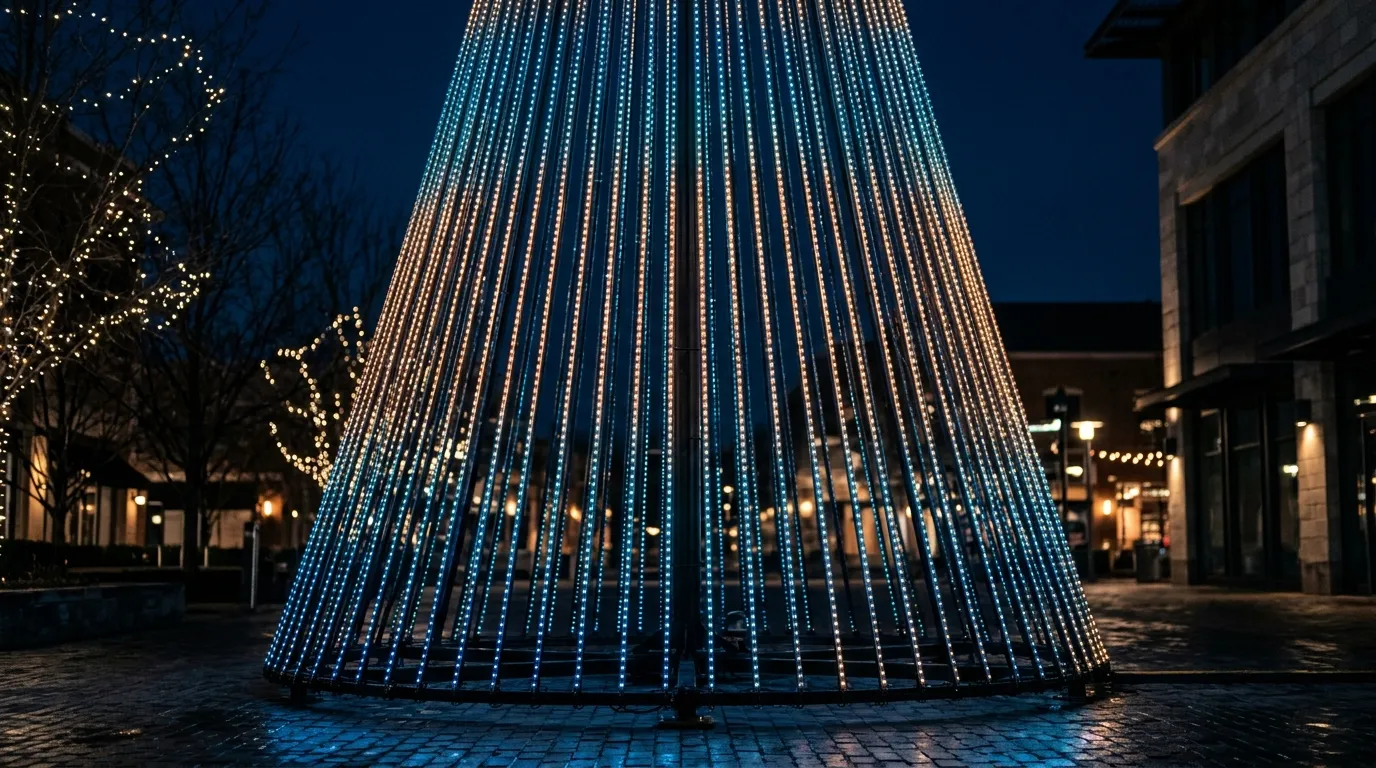
Rendered illustration, not project photography: what the string geometry looks like up close — vertical runs converging on the cone, individual addressable points visible on each run.
Two consequences for a buyer. First, ask for the pitch and the mapping grid in writing, not just the length; the pitch is what your designer's effect depends on and what your controller count is derived from. Second, ask who owns the mapping. The moment the surface is one programmable canvas, someone has to produce a pixel map — which run sits at which address — and hand it to whoever programs the show. If that document does not exist at hand-over, the next programmer starts from zero.
Two Control Paths: Art-Net Live and SD-Card Offline
This installation runs both. A show controller speaks Art-Net to node-level controllers over Ethernet while a show is being programmed or run live; the same fixtures also play content from an SD card at the controller, with no computer in the loop. That is not redundancy — it is what a public plaza needs.
The arithmetic is worth doing once, because it explains why the control rack is not an afterthought. A full-color pixel consumes three channels, and a DMX universe carries 512 of them, a limit set by the DMX512 standard. That is 170 pixels per universe. On a 36,000-point field you are distributing more than 200 universes in the same frame; on a 72,000-point field, more than 400. Serial DMX cannot do that economically, which is why Art-Net — DMX over Ethernet — is the transport, and why the universes fan out to distributed controllers rather than crawling down one chain. We compare the two protocol families, and where each stops being the right answer, in DMX512 vs Art-Net.
The division of labor between the two paths is the part buyers underestimate:
- Live (Art-Net) is for making the show. Programming, rehearsal, a one-off event, a sponsor night, a last-minute change the day before opening. Someone is present, with a timeline and a media server.
- Offline (SD card) is for running the show. It starts on a timer or a switch, plays the same content every night, and needs no PC, no network and no operator — which matters when the crew on site is not a lighting crew.
- The card is a content operation, not a programming environment. Content gets frozen before the season, written to a card, and versioned. Keep a second card programmed identically; swapping a card is a two-minute fix, re-programming a show on site is not.
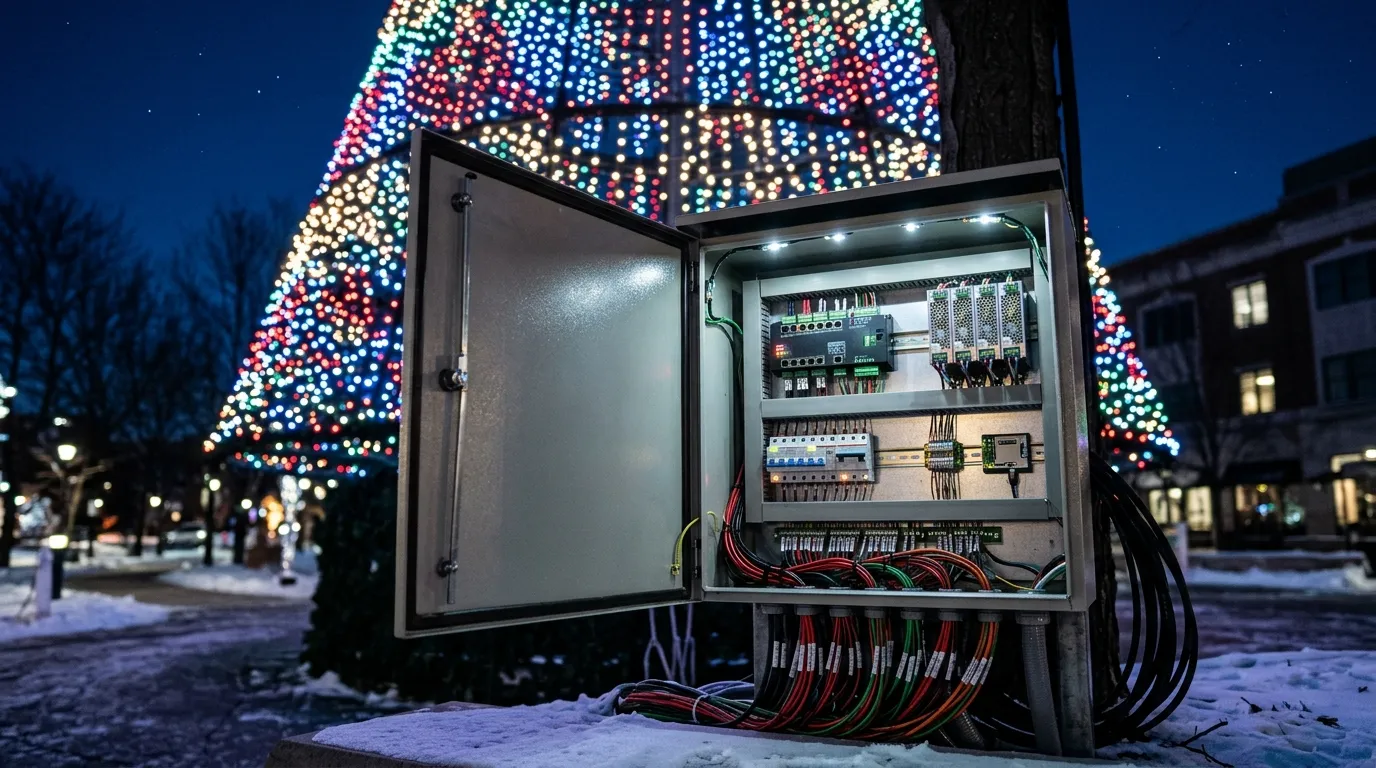
Rendered illustration, not project photography: the control and power stage at the base of a plaza tree — controller, supply bank, breakers and the looms heading out to the strings.
Three questions worth asking any supplier before you sign: What plays if the controller loses power mid-show? A defined restart state is not a luxury; a black plaza at 18:05 on opening night is a very public failure. How many pixels per controller, and what happens when one controller fails? Too few controllers multiplies the cabinet count; too many makes a single failure blank a whole tree. How is content loaded, by whom, and in what format? If the answer is "the programmer's laptop", you have bought a dependency rather than a system.
Power Across a Plaza, Not a Facade
On a facade, power is a long linear problem. On a plaza it is a distance problem: the centerpiece, the ring of smaller trees and the cable routes between them are tens of meters apart, and every meter of DC conductor costs voltage. Feed a run from one end and the far end sees less than the near end — dim tips, whites that drift pink at full brightness, or flicker as the drivers hunt for their set point. The mechanics are in voltage drop in pixel LED runs, and the fix is structural: inject power at multiple points along each run so no segment draws current through a long stretch of copper.
On a plaza-scale build that means distributed supplies, outdoors, close to their loads, in enclosures you can actually reach. Three things change at this scale:
- Sizing follows the load, not the fixture count. Total wattage is the starting point; a correct layout adds headroom for inrush when a large pixel population boots at once, for supply derating inside a sealed enclosure, and for an enclosure sitting in ambient winter conditions rather than a rack room. The method is in sizing a power supply for pixel LED strip.
- Cold is a design condition, not a footnote. Driver start-up behavior, cable jacket flexibility and connector sealing all change below freezing, and a temporary winter installation lives entirely in that range. Ask what ambient range the assembly is specified for rather than assuming the strip's headline rating covers it.
- Service access is a siting decision. A supply you cannot reach from a maintenance walkway becomes a cherry-picker, a closure and a lost show night. On a plaza build, every enclosure has to be reachable without scaffolding.
Cable routes are the unglamorous half of the same problem: ramps, conduit and a route that survives foot traffic and snow clearing. None of it appears on a fixture quotation, and all of it is on the critical path in the week before opening.
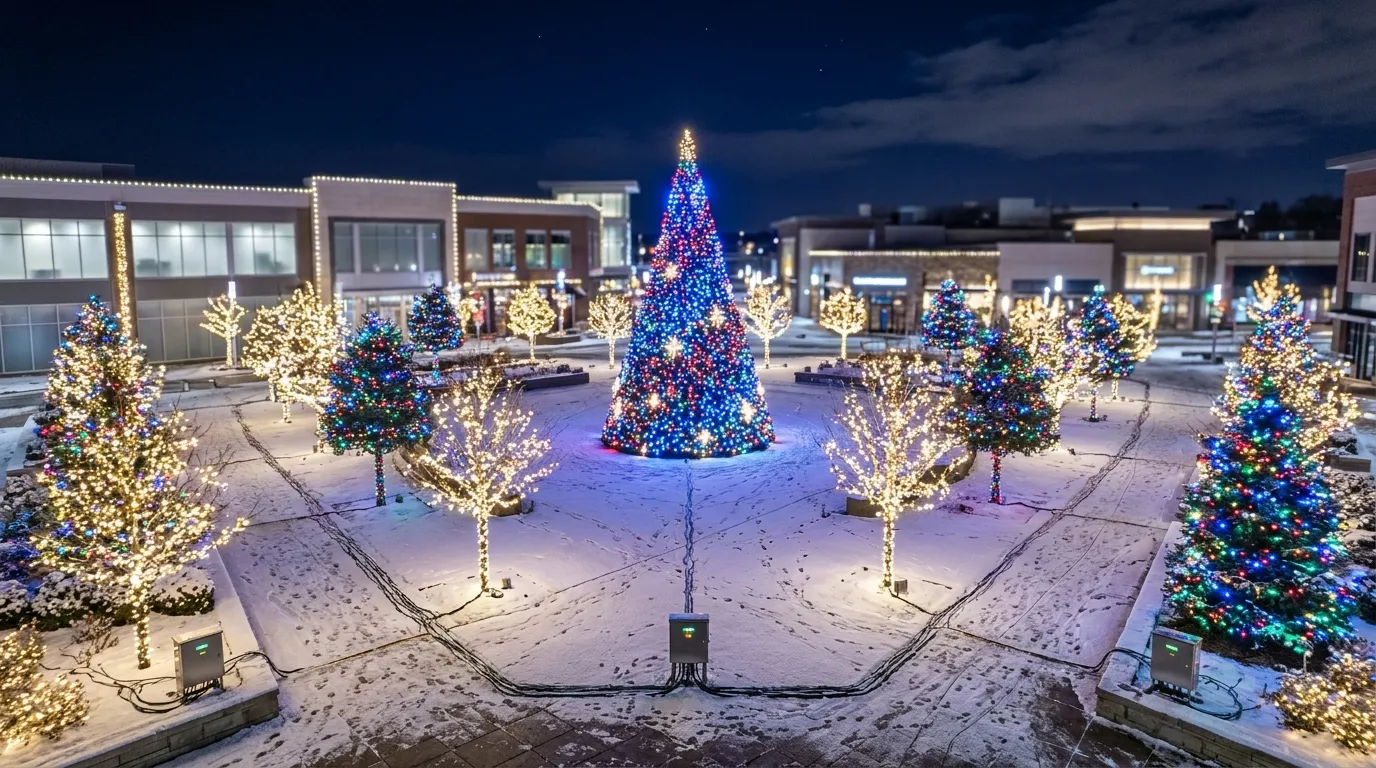
Rendered illustration, not project photography: plaza-scale distribution — supplies sited near their loads, cable runs between trees, and one mapped surface across the whole cluster.
Weather, Water and a Temporary Season
A holiday plaza installation is a temporary outdoor build with a brutal duty cycle: typically six to eight weeks of nightly operation through freeze, thaw, rain and snow, then a strike and a year in storage. That cycle, not the light output, separates a display that survives the season from one that starts losing sections in week three.
Ingress protection is where the conversation usually goes, and the IEC 60529 IP code is the only honest way to have it: two digits, solids then water, with the second digit deciding whether a joint survives standing water or only dripping. The trap is that the rating belongs to the assembly, not to the strip. A sealed strip with an unsealed joint is an unsealed strip, and the joint is usually the weakest point in an outdoor run — the detail is in our guide to IP ratings for outdoor strip.
Three more things that only show up in seasonal work:
- Condensation inside enclosures. Thermal cycling pulls moisture in through glands and breathes it through seals. Desiccant packs and correctly rated glands are cheap; a corroded controller in week four is not.
- Mechanical load. Ice, wind and the weight of wet string change the tension on runs dressed over a cone. Strain relief at the top of each run is a design item, not an install detail.
- The re-dress problem. Every run needs a physical label that matches its data address, or next November's install maps differently from last year's show and the content stops lining up. Labeling runs is the cheapest thing you can do for year two.
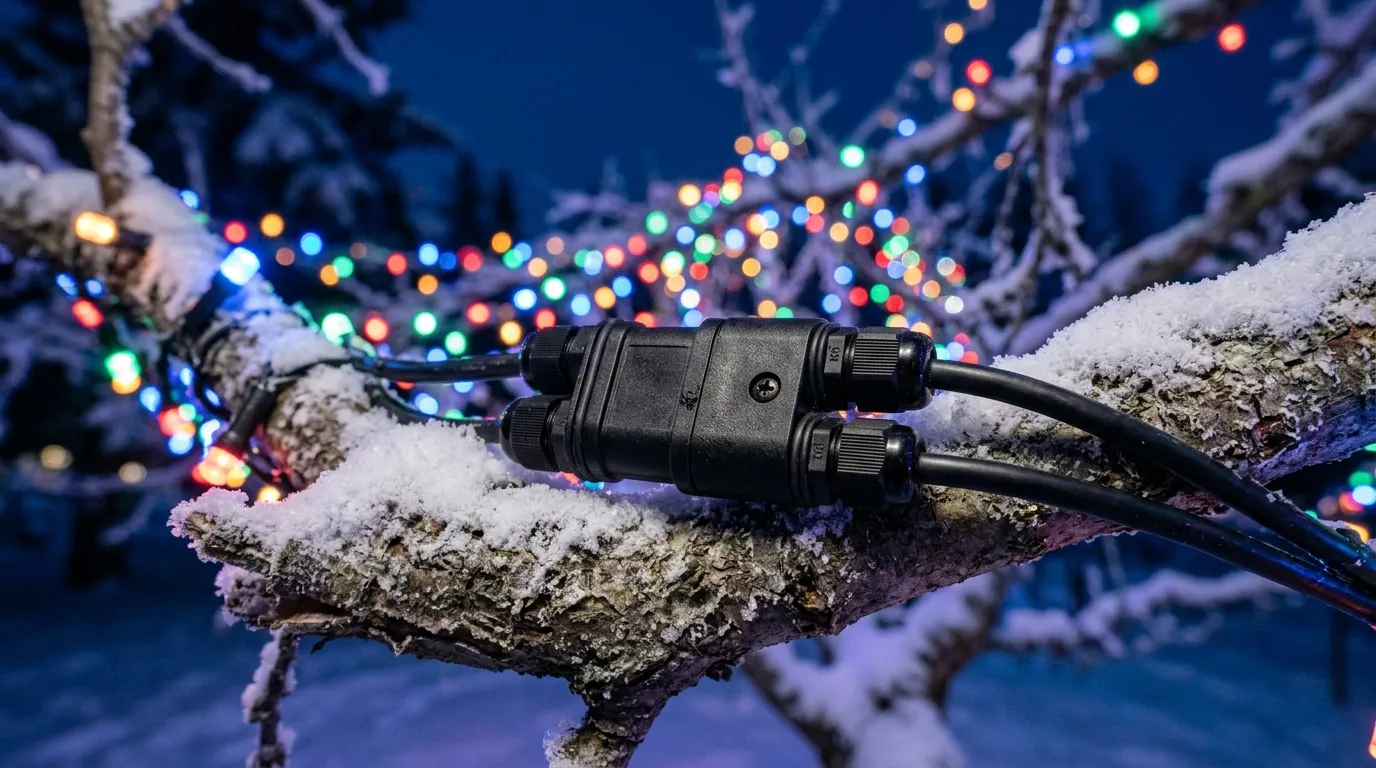
Rendered illustration, not project photography: a sealed inline connector between two runs — on seasonal outdoor work the joint, not the LED, is usually what fails first.
Then the question nobody puts in a proposal: how does a technician reach a failed pixel high up on the cone in December? On a plaza display, spares and access are the same decision. Keep spare string from the same production batch, keep a spare controller and a spare programmed card, and design the access method before the tree goes up — not after the first dark spot appears.
What to Ask Before You Order 3,600 m of Pixel String
A 3,600 m order for a commercial holiday lighting installation is a factory order, not a retail one: commercial-grade supply against a fixed opening date, where the questions that matter decide whether the hardware is right the first time.
Ask | An answer that should worry you | An answer that should not |
|---|---|---|
What is the quantity basis? | "3,600 m" and nothing else | Meters plus pitch, pixel count and mapping grid |
What is the minimum order, and can a trial run come off the same batch? | "Whatever you need" with no batch language | A stated MOQ and a trial that is color-matched to the production run |
Who produces the pixel map? | "The programmer does that on site" | A delivered map document, in a stated format, at hand-over |
Which control paths? | One mode, and "we can add the other later" | Live and offline both specified, with the fallback state defined |
How is color held across batches? | A bin code and nothing more | Per-batch color-point measurement, plus a tolerance statement for any brand color |
How many spares? | "You can order extra" | A stated spare percentage, a spare controller and a spare card, color-matched to the batch |
Who commissions it? | "It's plug and play" | A named sequence: hang, level, verify injection, power in stages, map, calibrate |
Certification? | A logo on a web page | A certificate number whose scope names the product family |
Which NRTL listing — UL or ETL — and on which assembly? | "UL" with no file number, or a mark that belongs to the driver rather than the assembly | An NRTL file number whose scope names the installed assembly, and a named holder for the mains boundary |
When does it ship? | A lead time in weeks | The last ship date that still makes your install window |
What happens in year two? | Silence | A stated warranty and a service route for replacements |
Three rows deserve expansion.
Color across batches. A 3,600 m order does not come off one reel, and the visible failure mode on a plaza tree is a section that is subtly cooler or greener than its neighbors. The measurement that answers this is a color point taken per batch on an integrating sphere — total output and chromaticity from all directions at once — with the tolerance expressed the way color science expresses it, as a MacAdam ellipse around the target. Ask for the numbers, not the bin code — the difference is a measured delivery versus a lottery. Our own process for holding color across production runs is in LED color consistency and binning.
Commissioning and spares. Mapping and color-calibrating a large addressable surface is skilled hours — the line item a fixtures-only quotation omits. The same is true of spares: a spare percentage is not padding; it is the difference between a two-minute card swap and a lost week mid-season. And when a point does fail in year three, the replacement has to match the strings beside it — which only works if the factory kept that batch's color point.
Certification, and the NRTL question a US plaza will ask. On a US installation the inspector is not looking for a logo on a web page but for a listing on the assembly that is actually installed: a UL or ETL mark from an OSHA-recognized NRTL, against a file number whose scope names that product family. It is the one row on this table a supplier can fail before anyone has discussed a pixel, so it is answered here about us rather than left to be discovered. We do not hold a UL listing — not UL Listed, not UL Recognized, not ETL, not CSA. Our certificates are CE (EMC), RoHS, an EMC test report, IP66 and a BIS registration for India, all with numbers you can check. On a US project that makes the listing on the installed assembly a scope item to settle with the installing contractor and the authority having jurisdiction before the order ships, not something to assume from a strip datasheet. Which marks we do and do not carry, and what that gap costs on a US job, is set out in UL Certified vs UL Listed.
Where This Project Sits in the Delivery Record
This plaza display is one of 15 projects in our delivery record, spread across nine countries. The same engineering problems appear at very different scales: 46,000 globe points for a French exhibition is the volumetric version of the mapping problem, 86,500 pixel points on a Singapore observation wheel is the moving-structure version, and the 3,600 m here is the version where the constraint is a public plaza, a fixed opening date and a season that ends. Some of these records are written up on the delivered pixel LED projects hub.
What this page is: one delivery, documented to the level the record allows — country, venue type, quantity, product lines, control modes, content played. The project also has its own page, the US holiday plaza pixel-tree project, alongside the fixtures that carried it.
What it is not: a claim that we install in the United States. We manufacture the string and the control and we support whoever puts it up — which means the person answering your questions about universes and injection cadence is the person who builds the hardware, and somebody else is accountable for the crane.
If you are specifying a plaza centerpiece, the useful next step is a layout review rather than a price: send the geometry, the viewing distances, the pitch you want and the content you intend to run, and the questions above become a bill of materials. An engineer scopes it with you. Send it to our team and we will tell you what the installation needs — including where the honest answer is that a smaller, coarser display would serve the venue better.
Specifying pixel LED for a real project?
Send the spec — pitch, IC, IP class, run length, voltage — and you get an engineer's answer, not a catalogue. Samples and OEM/ODM quotes from the Shenzhen factory floor.