
Is IP65 Waterproof? What IP65 vs IP67 vs IP68 Does Not Cover
IP65 blocks water jets, not immersion or pressure washing. What each of IP65, IP67 and IP68 really tests, what none of them covers, and how to verify a claim.
No — IP65 is not waterproof in the sense the word is used on a carton. It is dust-tight and it survives a water jet: a 6.3 mm nozzle delivering 12.5 litres a minute from about three metres for at least three minutes. That is a real test and it comfortably covers rain, spray and a garden hose. It does not cover immersion (IP67), and it does not cover continuous immersion at a declared depth (IP68) — and none of the three covers pressure washing, salt water, or a seal that has spent five years heating and cooling.
The useful way to read IP65 vs IP67 vs IP68 is not as three grades of the same thing. It is as three different test conditions, only one of which is likely to resemble your site. Below: what each test actually does with its published parameters, the four things IP65 leaves uncovered, and the point at which the higher number becomes the wrong buy.
This page is from PILEDS, which supplies pixel strip in IP20 through IP68 — so we sell all three of the ratings compared here. That is the reason most of this article is spent on where IP65 stops rather than on why you should buy the higher grade.
IP65 vs IP67 vs IP68: the short answer
All three carry the same first digit: 6, dust-tight, the highest solid-particle class in the code. The grade below it, 5, is only dust-protected — some dust may enter as long as it does not interfere with operation — so the 6 is not a formality, it is the top of the dust scale. The comparison between these three is therefore entirely about water, and the three water digits answer three different questions.
- IP65 — can it be hit by water? Yes: jets from any direction, six and a half millimetres wide, at pressure low enough to be delivered by an ordinary hose.
- IP67 — can it be briefly under water, then drain? Yes: one metre of fresh water for thirty minutes.
- IP68 — can it stay under water? Yes, at whatever depth and duration the manufacturer puts in writing — the number alone does not say.
So the decision rule is about water behaviour, not about ranking: water that arrives and leaves is IP65 territory; water that pools but drains inside the thirty-minute test window is IP67; water that does not drain at all is IP68, with the depth and duration in writing.
The three-second version: water arrives and leaves — IP65. Water pools and then drains — IP67. Water stays — IP68, with the depth and duration in writing.
What the test is | What it proves | What it does not cover | |
|---|---|---|---|
IP65 | Water jets, 6.3 mm nozzle, 12.5 L/min, ≥3 minutes, 2.5–3 m away | Rain, spray, hosing, wet cleaning at low pressure | Immersion of any kind; pressure washers; salt, chlorine or solvent exposure; anything beyond the sample as built |
IP67 | Immersion, 1 m, 30 minutes, fresh water | Survives a short dunk, a flood, a puddle that drains | Longer or deeper immersion; jets (a 7 does not include a 5); the joints you make on site |
IP68 | Continuous immersion, depth and duration declared by the maker | Whatever the declaration says — and no more | Everything the declaration does not name; and it is not a jet or washdown rating either |
Two of those cells are where most specification errors happen, and both are counter-intuitive enough to deserve their own sections below: the pressure inside an IPX5 jet is higher than the pressure at the bottom of the IPX7 tank, and a higher water digit does not include the tests beneath it. The full IP20→IP68 ladder, gathered article by article, is in the IP rating guide for outdoor pixel LEDs.
What the IPX5 test actually does
The IP code is defined by IEC 60529, the ingress-protection standard maintained by the International Electrotechnical Commission. The IEC's own IP ratings explainer keeps the public description deliberately short: two numerals, the first for solids and access on a scale to 6, the second for liquids on a scale to 9, with the full test conditions living in the standard itself.
Those test conditions are what make the digits comparable, so here they are from a laboratory that runs them. India's Central Water and Power Research Station publishes its NABL-accredited ingress-protection test parameters for testing to IEC 60529: IPX5 is 12.5 litres per minute through a 6.3 mm nozzle; IPX6 is 100 litres per minute through a 12.5 mm nozzle; IPX7 is a 30-minute immersion; IPX8 runs for a duration agreed between manufacturer and user. Both jet tests run for one minute per square metre of surface, with a three-minute minimum. The depth in the IPX7 condition is one metre, set by the standard; the lab's tank is built to two metres because the same rig also has to run the deeper IPX8 declarations.
Pressure is the number almost nobody publishes, and it is the one that decides whether your cleaning crew is inside or outside the rating. A German test-house summary of the same tests puts the IPX5 jet at roughly 0.3 bar and the IPX6 jet at roughly 1 bar, with the automotive IPX6K variant at about 10 bar from the smaller nozzle, and places the nozzle 2.5 to 3 metres from the surface (iTS GmbH). For scale: one metre of water — the whole of the IPX7 test — is a static head of about 0.1 bar.
That ordering surprises people, so it is worth stating plainly. The immersion test is gentler in pressure than the jet test. What IPX7 adds is not force but duration and enclosure: thirty minutes with water on every face at once, including the back of the board and every seam, instead of a three-minute stream that is moved to cover one face at a time.
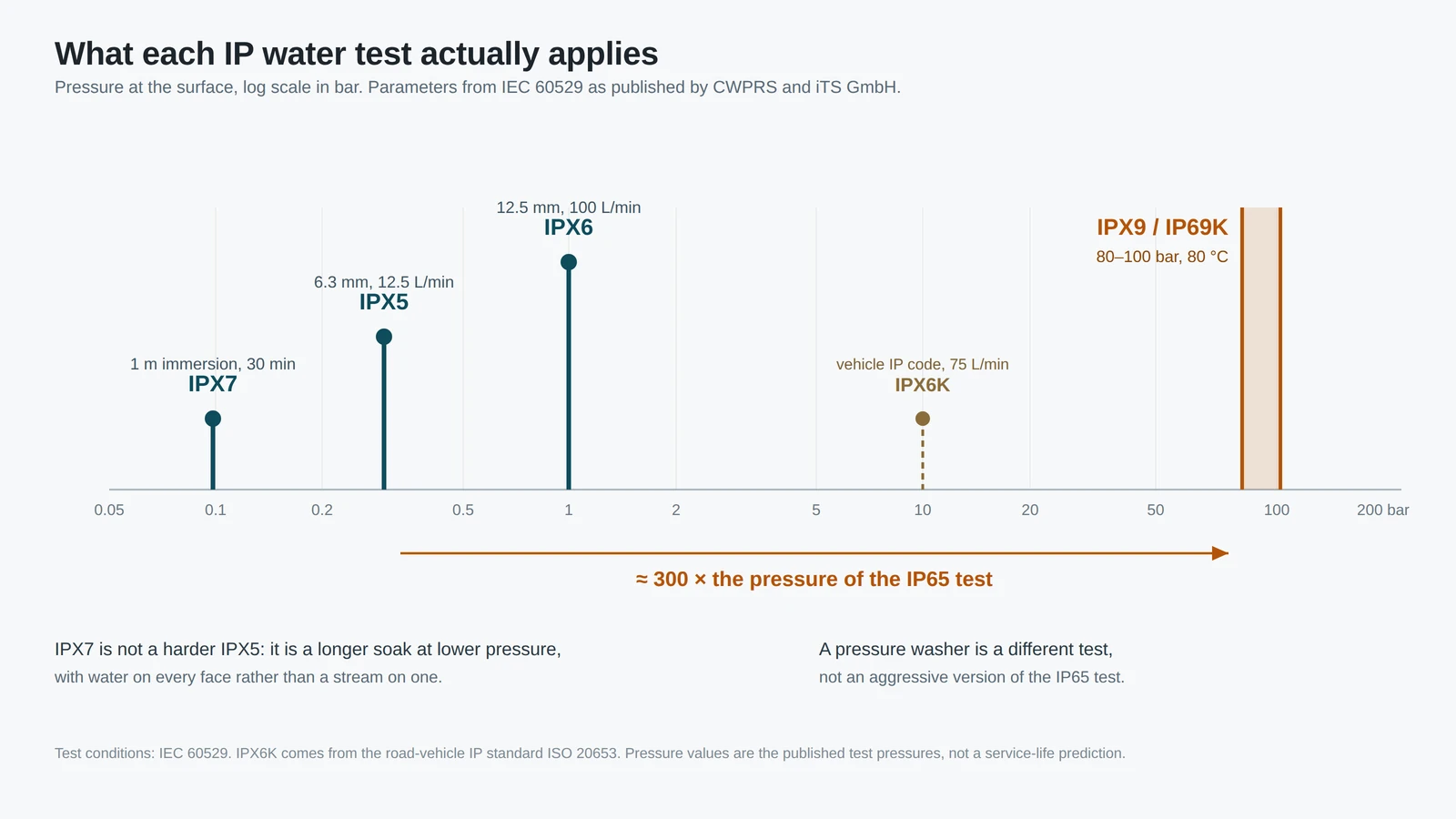
The tests plotted by the pressure they apply. IPX7 is not a harder version of IPX5 — it is a longer soak at lower pressure, which is why neither digit substitutes for the other.
The same table is also the answer to "can I pressure-wash it". The standard has a test for high-pressure, high-temperature cleaning, and it is not the 5 or the 6. IPX9 runs at 80 to 100 bar and 80 °C, according to the same laboratory table — roughly 300 times the pressure of the IPX5 jet. The K variants that appear on vehicle-component datasheets (IPX6K, IPX9K) come from a different standard, ISO 20653, which applies the IP code to road vehicles and defines those higher-pressure tests.
A pressure washer is therefore not an aggressive version of the IP65 test. It is a different test the product was never asked to pass.
The four things IP65 does not cover
Rain is not the problem IP65 fails at. A square metre of the heaviest rain a site will see delivers a small fraction of what the IPX5 nozzle puts on a single hand-sized area — which is exactly why IP65 is genuinely adequate for exposed facades, and why the failures come from the other four directions.
Pressure: a hose is inside the rating, a washer is not
A garden hose with a trigger nozzle sits in the same order of magnitude as the 0.3 bar test jet: same water, similar delivery. A pressure washer is two orders of magnitude above it. The failure it causes is not dramatic — the coating lifts at a pinhole, water tracks under it along the copper, and the strip keeps working for a season before the corrosion reaches a pad.
If the site gets pressure-washed, the specification you want is the jet rating at the pressure used, which in practice means IP66 for heavy hosing and IPX9 (IEC 60529) or IP69K (ISO 20653) where steam and 80–100 bar lances are routine. Writing "IP65" and telling the maintenance contractor to be careful is not a specification; it is a hope. The number of pressure-washer-damaged runs we see is small compared with connector failures, but they are the ones that cannot be fixed in place.
Duration: three minutes, once, on a new sample
The IPX5 test lasts at least three minutes. The IPX7 test lasts thirty. Neither asks what happens when water sits on the same spot for a week, or when a low point in a run holds a permanent film of water against an end cap.
That is the case that catches out horizontal and ground-level runs, and it is not covered by any of the three digits in the way people assume. A puddle is not a jet and it is not a submerged test either: it is standing water at zero pressure with unlimited time. The discriminator is drainage. If the water that lands on the run is gone within half an hour — a planter that percolates, a channel with a fall, a deck with gaps — the IP67 condition covers it. If it is still there the next morning, the run is outside every one of these three ratings and the honest answer is IP68 with a declared duration, or a change of detail so that water drains away from the strip. IP67 and IP68 compared takes that boundary apart in more detail, including how to read a declared depth.
Chemistry: the tank holds fresh water
Every number above comes from a fresh-water test. Salt, chlorine, acidic rain, alkaline washdown chemicals, oils and solvents are outside the rating entirely. A coastal facade receives chloride spray, a fountain runs treated water, a food-production area gets caustic cleaner — and in each case the strip passed a test that says nothing about that exposure.
The physical consequences are specific. Chloride attacks stainless fittings first, then the plating on connectors, then any exposed copper at a field joint. Chlorinated water attacks some silicone additives and hardens the surface. Neither effect shows in a 30-minute dunk, and both show within two or three seasons — and the construction sets how much surface there is to attack, which is why the build, not the digit, decides a coastal specification: a coating leaves a path for chloride to track along, a sleeve reduces it to the ends, and a potted block removes it. If the site is coastal, ask about the metal parts of the assembly, not just the polymer: the strip's jacket will usually outlast the connector shell screwed to it.
Age: a seal is pumped, not just wetted
This is the mechanism behind most "it was IP65 when we installed it" failures, and it is the one the test cannot reproduce at all.
A sealed strip is not inert. It runs warm in the evening and cools at night; the air inside the tube or under the coating expands and contracts, and every cycle pushes a little air out and pulls a little moisture-laden air back in through the same path — usually the end, a gland, or a poorly bonded connector. Over a few hundred cycles the inside of the enclosure is wetter than the outside, and the water has arrived without ever being sprayed.
Add the other slow effects and the picture is complete: UV hardens and yellows the polymer, repeated flexing opens micro-cracks at a bend, thermal expansion works a rigid end cap against a soft tube, and any mechanical abrasion of the coating removes the sacrificial layer. An IP65 sample tested in a laboratory at room temperature has not been asked about any of this. The related question of how hot the strip runs in service belongs in the same conversation — it is why operating temperature belongs in your LED spec sheet, not in an appendix.
The no-stacking trap: why a 7 does not include a 5
The second digit looks like a ladder. It is not. The code designates a product for the tests it has passed, and a submersion result is not evidence of a jet result. That is why manufacturers who have passed both print both, as in IP66/IP68 or IP67/IP69K.
The practical consequences run in both directions:
- An IP67-only strip has not been tested against jets. Put it where a hose is used and you are relying on an untested property. If the site both pools water and gets hosed — a service yard, a vehicle bay, a planter beside a wash-down point — specify the dual marking and expect to see both digits on the datasheet.
- An IP68-only strip has not been tested against jets either, which is the more expensive mistake of the two: the most sealed product in the catalogue is not automatically the safest for a facade that gets cleaned twice a year.
- IP65 alone answers neither immersion question. A strip that sits in a puddle after a storm has left the test conditions, however well it handles the rain that put the puddle there.
The distinction between neighbouring grades matters less than people expect: IP65 vs IP66 is a jet against a stronger jet, IP66 vs IP67 is a stronger jet against a 30-minute soak, and neither substitutes for the other. Where it does matter is washdown: 100 litres a minute from a 12.5 mm nozzle is eight times the flow of the IPX5 test, and it is the grade to ask for when heavy hosing is routine. IP65 and IP67 compared covers the digit-ladder definition side of this cluster.
Where each grade is honestly enough
The reverse error — buying protection you cannot use — is a real cost: a thicker jacket resists bending, and a permanently sealed assembly cannot be re-entered for a repair. Here is where each grade is the right answer rather than the safe one.
Site | Honest specification | Why |
|---|---|---|
Cove, soffit, deep canopy, indoor signage | IP20 or IP30 | Water never arrives; the money belongs in the driver and the control |
Exposed facade, eaves, parapet, sign face, vertical and draining | IP65 | Every water event is a jet or spray, and it leaves; add IP66 if hosing is routine |
Ground-level, planters, decking, channels, flood-risk paving | IP67 | Water pools, but the detail drains within the half-hour test window |
Fountains, water features, below-grade wells, buried sections | IP68 with a declared depth and time | Water never drains; the number alone is not a specification |
Washdown floors, food areas, steam cleaning | IP66, plus IPX9 or IP69K (two separate standards) where lances are used; IP68 for the submerged parts | Cleaning method, not weather, sets the requirement |
What the jacket can support, and what it cannot
The rating is produced by a construction, and only three families produce these grades. A conformal or dipped coating seals the top face and the components: it is the IP65 build, the cheapest and the most flexible, and it leaves the back of the board and the cut edges exactly as they were. A silicone sleeve or tube covers both faces; with its ends open it is still jet-class, and the end seal is what turns it into the IP67 build — the same sleeve, two different ratings. Full extrusion or potting embeds the board with no air gap, which is what makes a declared IP68 figure credible, and it is also the build that traps heat against the LEDs and cannot be re-entered for a repair.
The construction also decides how the assembly ages. A coating abrades at a mounting clip and lifts at a pinhole; a sleeve survives abrasion and fails at its ends; potting survives both and cannot be repaired. Waterproof LED strip ratings for outdoor work sets the build methods against the grades in more detail.
Two counterweights, because over-specifying is a real cost and the honest answer is sometimes the smaller number. For the rain-and-hose case the build is a coated strip, or a sleeved strip whose ends stay open, with factory terminations. The waterproof DMX RGBW pixel strip sits in that class, and at this grade the connector decides more than the coating does. On a facade run the sealing difference between IP65 and IP68 is paid per metre, on every metre, for a condition that occurs at the bottom two metres of the building — and the practical fix is usually to use IP65 for the field of the run and IP68 for the wet sections, with a sealed transition between them. The IP68 addressable RGBW strip exists in that role: one strip design across IP20 to IP68, configured to order, so the end treatment and connector grade are specified rather than improvised on site.
The exception worth naming: if a client asset standard, an insurer, or a maintenance contract names a grade, the decision has already been made upstream. In that case the engineering work moves from choosing a grade to sealing and documenting the one you were given.
Where an IP65 pixel run loses its rating on site
On a single-colour strip the list of entry points is short. On an addressable run it is not: every power-injection point, every data joint, and every cut is a new opening in the same jacket, and the jacket is usually a coating that seals the top face and leaves the back and the cut edges exposed.
- Cut ends. Every cut is a new opening, and a cut end sealed with heat-shrink and hope is an IP20 end on an IP65 run. Seal it with the materials and method that match the grade, and treat a field cut as a specification event rather than a site decision — the process for sealing strip joints and keeping the IP67 rating applies to IP65 joints as well.
- Connectors and glands. This is where most wet runs fail, and it is not the strip's fault. A connector rated for the grade, a gland that grips the jacket rather than the conductors, and a drip loop before the entry do more for the installation than another digit on the strip. Waterproof connectors for outdoor pixel strip covers the part selection; the rule is that the assembly is only as protected as its least protected interface.
- Power injection and data. A 20-metre pixel run has several injection points, each with its own cable entry. Plan them inside a dry enclosure or above the water line, and never at the low end of a run where water collects.
- The driver. A protected strip on an unprotected driver is an unprotected system. Either the supply is rated for the location, or it lives in a dry space with low-voltage cable running out to the strip.
- Condensation inside a profile. An aluminium profile can carry the strip, spread its heat and diffuse its light, and it does not create an IP rating by itself. A closed profile that heats by day and cools at night will collect water on the inside of the lens, in a run whose strip is perfectly sealed.
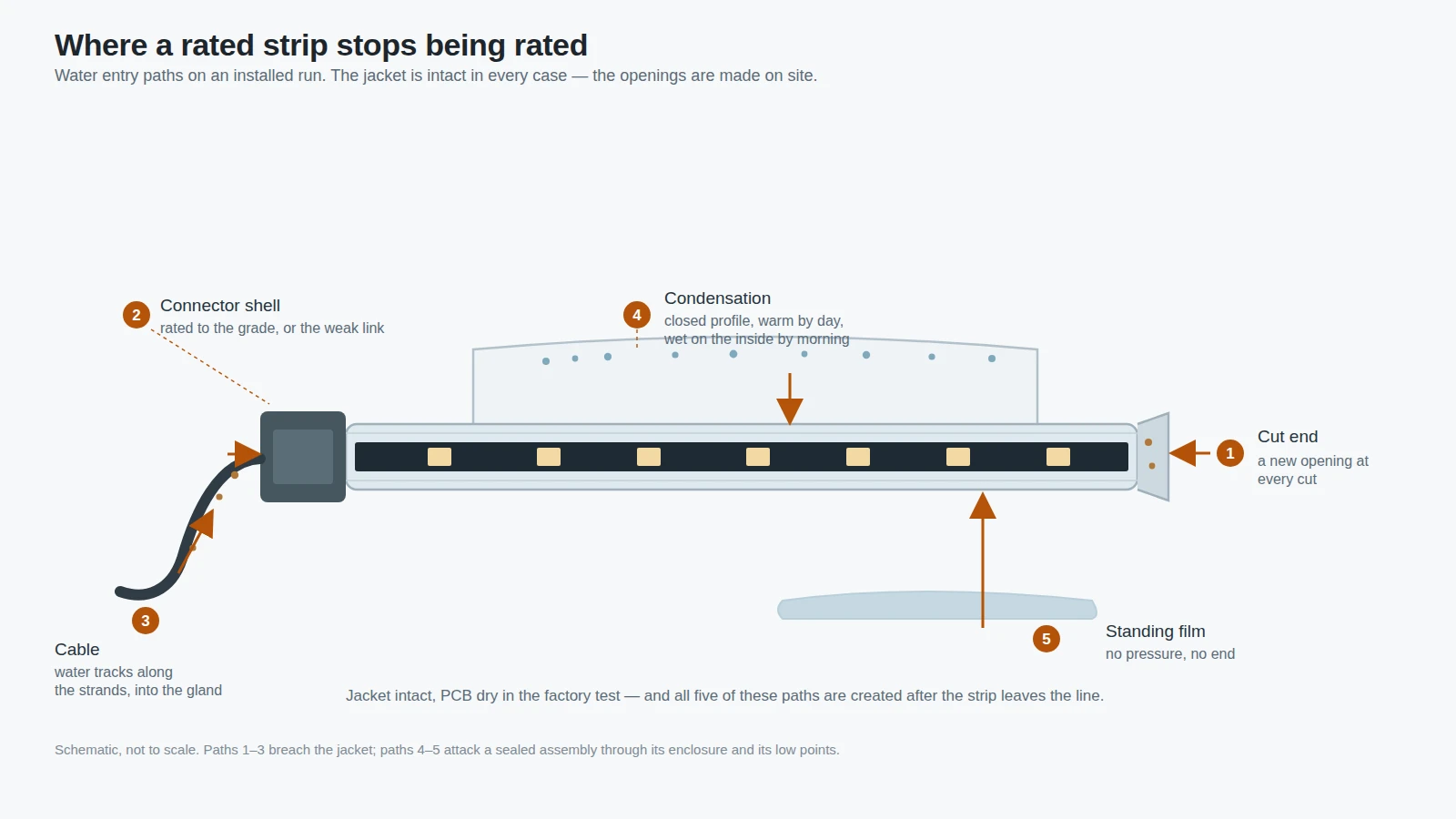
Where water actually arrives on a rated strip. None of these five paths is a defect in the coating: three are created by field work, one by the enclosure, one by the site.
How to verify an IP65 claim before you buy
An IP rating is a laboratory result on a sample, and it becomes a purchasing document only if you can trace it. Four things make it checkable, and all four are documents you can request before placing an order.
Ask for | What good looks like | Why it changes your order |
|---|---|---|
The standard and edition | IEC 60529 named on the datasheet, ideally with the edition, or the EN equivalent | Two digits with no standard cannot be checked against anything |
The test report or certificate | A reference number that traces to a test house, not a logo in a brochure | Separates a tested construction from a claimed one |
The tested object | A statement of whether the sample included connectors, end caps and the finished termination | Decides whether the number covers the assembly you are buying |
For IP68, the declared figures | Depth and duration in writing | Without both, the label carries no engineering content |
Then test the claim yourself, cheaply, on the sample you were sent: fit the connectors and end caps the way the installation will, submerge a 30 cm section about a metre below the surface — a length of plastic pipe does the job — for thirty minutes, dry the outside, and power it up. Dark spots, flicker or water visible inside the jacket means the assembly you received is not the assembly that was certified.
To be concrete about our own position rather than leaving it abstract: we hold an IP66 certificate, number JAT24101202622IC-1, tested to EN 60529:2013, and sealing to the rated grade is one of the six checkpoints in our production QC. The certificate covers the sample as tested. Your cut ends, gland entries and injection points are the other half of the seal, and no supplier can certify those for you — which is also why a warranty that excludes water damage is not bad faith, but a normal reading of what a type test covers. If you are sourcing for the US, the same logic applies to listing marks, and we are explicit about which ones we do and do not hold in our position on UL listing. How to check any certificate number independently is covered in verifying an LED certificate for procurement.
FAQ
Is IP65 waterproof? Not in the everyday sense. It is dust-tight and it survives water jets from any direction at roughly 0.3 bar. It is not rated for immersion, and it is not rated for pressure washing. "Water-resistant to jets" is the accurate phrase.
IP65 vs IP67 vs IP68 — which do I need for my site? Ask what the water does after it lands. Runs off immediately: IP65. Pools and then drains within half an hour: IP67. Never drains: IP68, with a declared depth and duration. The three are different tests rather than three grades of one, so the answer is set by the mounting detail, not by the budget.
Does IP67 include IP65? No. A product is designated for the tests it passed, so an IP67-only strip has not been tested against jets. Where a site both pools water and gets hosed, specify the dual marking, for example IP66/IP67, and check that both digits appear on the datasheet.
Can I pressure-wash IP65 strip? No. The IPX5 jet is about 0.3 bar; high-pressure cleaning is tested separately at roughly 80–100 bar and 80 °C. If washing is routine, specify IPX9 (IEC 60529) or IP69K (ISO 20653) for the washdown and keep the low-pressure strip out of the lance's reach.
Does an IP65 rating still hold after a few years outdoors? The certificate describes a new sample. In service the seal is worked by thermal cycling — warm by day, cool at night — and by UV, flexing and cleaning, so the year-five assembly is not the year-zero sample. Budget an inspection of end seals and glands whatever the digit says, and prefer a construction whose ends can be opened and resealed.
What does IP65 not cover on an addressable run? The parts you add. Every cut end, connector, gland, power-injection point and data joint is a new opening in a jacket that was tested as it left the factory. On a long pixel run the injection points are the ones most often forgotten, and they are usually at the low end of the run, which is where water collects.
Bottom line
IP65 answers one question — can water hit it — and answers it well. It does not answer whether water can sit on it, whether it will be washed at pressure, what is dissolved in the water, or what the seal will be like in year five. Choose the grade by how water behaves at your mounting point: arrives and leaves, pools, or stays. Then spend the remaining effort on the parts the digit does not cover — sealed ends, rated connectors, drainage, and a test report you can read.
If you would rather not adjudicate it from a datasheet, send the environment rather than the length: mounting surface, whether water drains or stands, cleaning method, run length, how many injection points, and whether the site is coastal. That is enough to answer with a construction and a grade rather than a number — send those details to our team and we will come back with the specification, the connectors and the declared figures.
Specifying pixel LED for a real project?
Send the spec — pitch, IC, IP class, run length, voltage — and you get an engineer's answer, not a catalogue. Samples and OEM/ODM quotes from the Shenzhen factory floor.