
Pixel LED Projects Delivered in 9 Countries
Fifteen delivered pixel LED projects across 9 countries, indexed by application: what each venue type demanded of control, IP rating, pitch, power and service.
Pileds has fifteen pixel LED projects delivered across 9 countries, and every one of them is recorded in the same four fields: country, venue type, delivered quantity, product families. That is a thinner record than most manufacturers publish. There are no client names, no contract values, no quote from a facilities manager saying the room looks wonderful.
For a buyer, it is the more useful kind of record. A named client proves a relationship existed. A delivered quantity proves a number can be met. And the number is where the engineering actually lives: 86,500 points on an observation wheel and 10,000 m of strip in a mine are not the same achievement twice, they are two different problems that happen to be solved with LEDs.
Six of the fifteen have a full write-up on this blog, and the case-studies hub collects those six. The other nine exist only in the project records — no article, no blog post. This page is the index that puts all fifteen side by side, and then reads them by application: what each venue type demanded of control protocol, IP rating, pixel pitch, power and voltage, and serviceability.
All 15 delivered pixel LED projects, in one index
# | Country | Venue | Delivered | Application group |
|---|---|---|---|---|
1 | Malaysia | Nightclub | 1,500 m pixel strip | Club interior |
2 | India | Live event stage | 600 m pixel bar | Stage |
3 | United States | Club | 900 light-guide panels | Club interior |
4 | United States | Club | 750 meteor tubes + 3,500 globe lights | Club interior |
5 | China | Commercial plaza | 800 m pixel tube | Facade |
6 | Germany | Commercial plaza | 1,200 m DMX wall washer | Facade |
7 | United States | Creative exhibition | 1,800 m of 3D globe light | Exhibition |
8 | China | Bar / club | 1,300 m digital tube backdrop | Club interior |
9 | Vietnam | Club | 650 triangle panels | Club interior |
10 | United States | Club facade | 760 m pixel bar | Facade |
11 | United States | Holiday plaza display | 3,600 m pixel string | Holiday |
12 | Singapore | Observation wheel | 86,500 pixel points | Attraction |
13 | France | Immersive light exhibition | 46,000 globe points | Exhibition |
14 | United States | Bar / nightlife | 2,600 m pixel + neon facade | Facade |
15 | South Africa | Underground mine | 10,000 m AC36V strip | Mine |
Compiled from Pileds' delivered project records; quantities are as shipped, not as designed.
Nine countries, seven application types. The spread is worth noting before the analysis: six of the fifteen are in the United States, two in China, and the remaining seven are single projects in Malaysia, India, Germany, Vietnam, Singapore, France and South Africa. A record set shaped like that tells you the buyer base is international but the sample is not evenly distributed — which matters when someone asks "have you done this in my market".
Every delivered number forces one of five decisions
A case record quotes meters, panels or points. None of those is a specification. Each is a load placed on one axis of the design, and the axis is what you should be interrogating when you read a project page:
What the record counts | What it forces | Where it bites |
|---|---|---|
Pixel points | Control load — channels, universes, data path | Attractions, exhibitions, dense club ceilings |
Meters of run | Power distribution — feed points, voltage drop | Facades, mines, holiday displays |
Panels or fixtures | Optics — pitch, diffusion, viewing distance | Club ceilings, light-guide walls |
Outdoor placement | IP class, enclosure, UV, service access | Facades, plazas, rooftops |
Any permanent install | Serviceability — how a failed section is reached in year five | Everything that closes up |
That last row is the one buyers forget, and the one that costs the most later. A ceiling that reads beautifully on opening night and needs a scissor lift and four people to change one dead meter is a different product from the one in the photograph.
There is also a distinction the record set itself makes: delivered, not designed. Each quantity in the table is what shipped, not what was drawn. A designed 1,200 m facade and a delivered 1,200 m facade differ by every meter somebody had to re-cut, joint and re-test on site.
Clubs and nightclubs: five rooms, one ceiling that closes once
Five of the fifteen are club or bar interiors — 1,500 m of pixel strip in a Malaysian nightclub, 900 acrylic light-guide panels and a 750-tube plus 3,500-globe ceiling in two United States clubs, 1,300 m of digital tube on a Chinese bar backdrop, and 650 triangle panels tiled into a Vietnamese club ceiling. Across all five, the venue buys the same thing: a surface that stops people at the door and can be reprogrammed on a Tuesday.
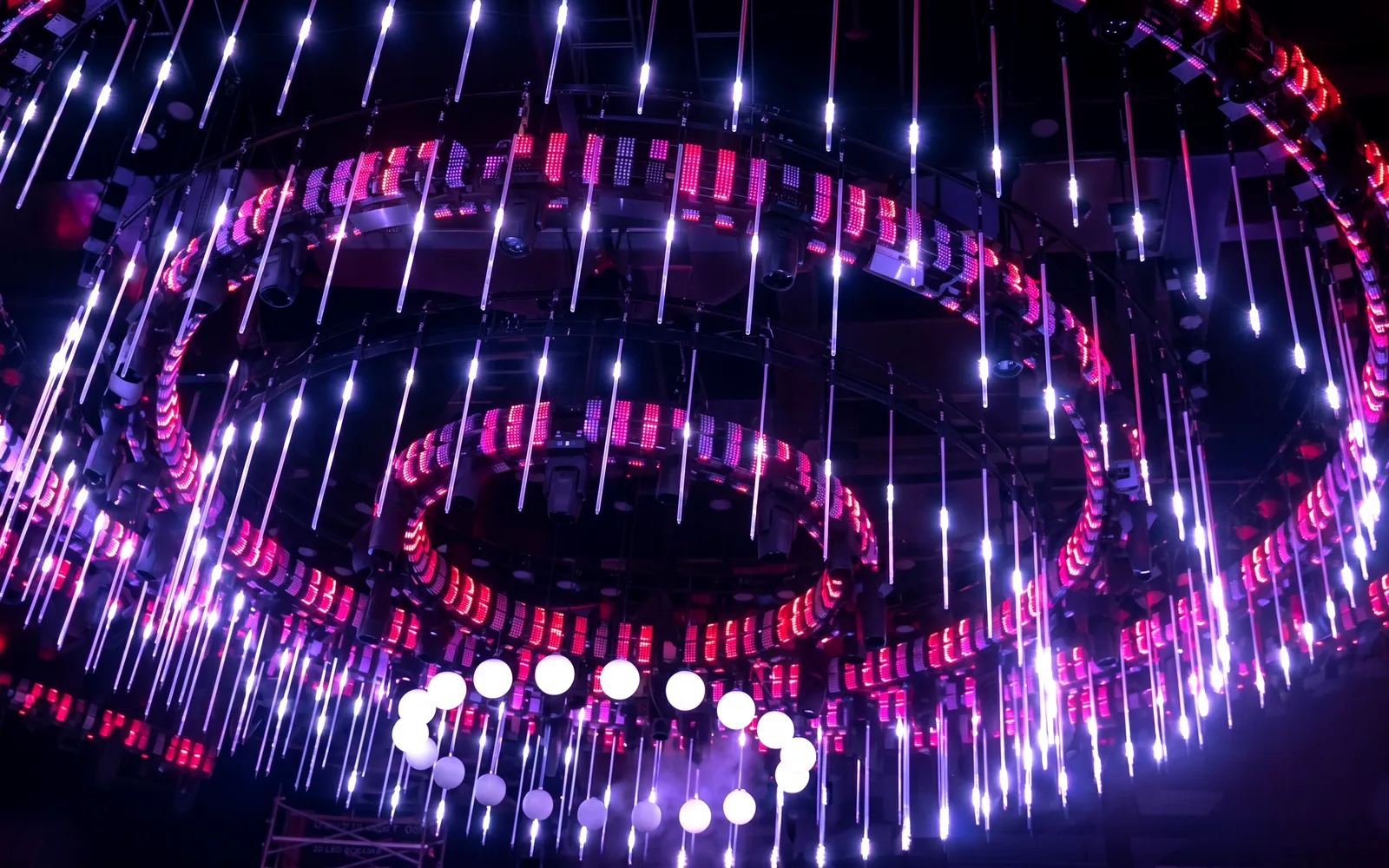
The United States club ceiling: concentric rings of suspended pixel tubes with a globe point-light cluster beneath them. The full build is documented in the US nightclub case.
Pitch is set by sightline, not by budget. A dance floor ceiling is looked at from 3 to 8 m away at a steep angle; a bar backdrop is looked at from 1 m. Those are different products. The light-guide panels in records 3 and 9 exist because a diffusing sheet turns each pixel into a soft block of color: at close range you see a clean gradient instead of a grid of dots. Put the same panel 7 m up and you have paid for diffusion nobody can resolve. The tube-and-globe ceiling in record 4 solves the opposite problem — it is designed to be read from below, which is why the record describes 3D meteor tubes and globe point lights carrying the effect rather than flat panels.
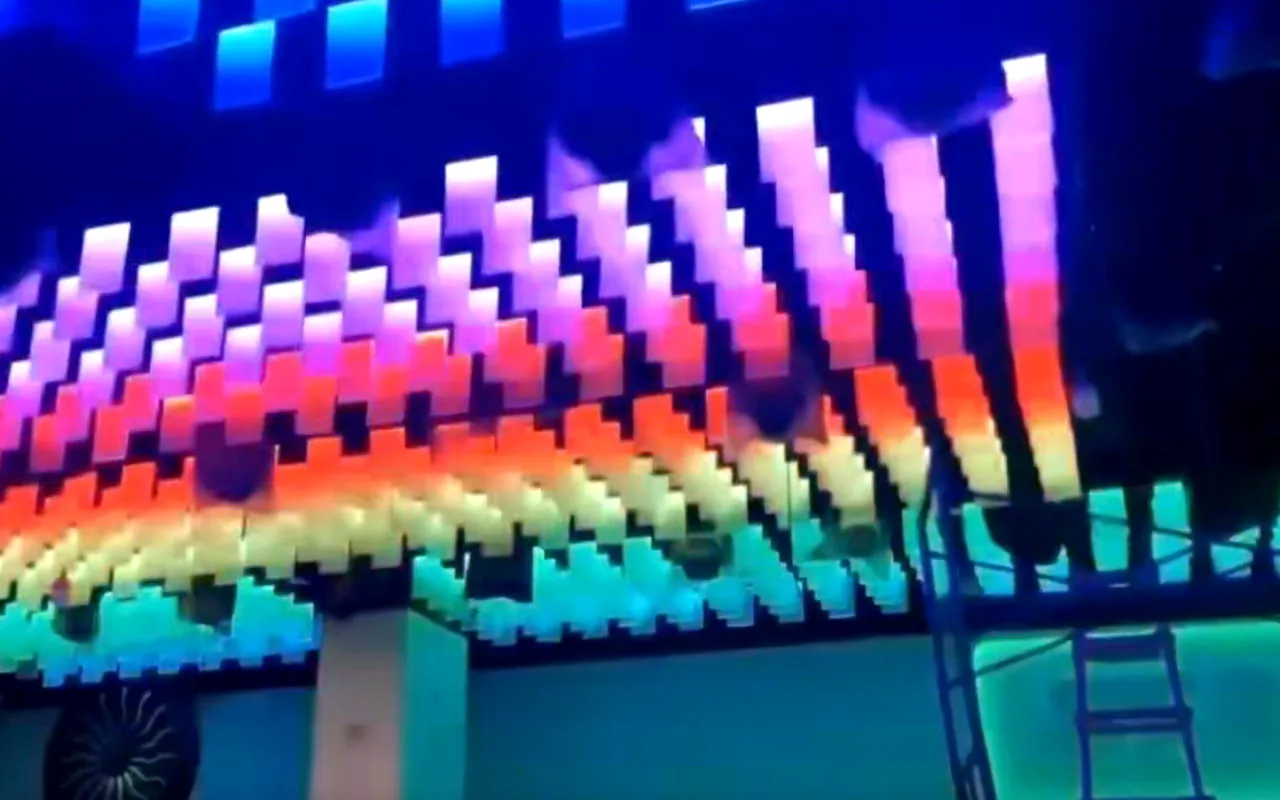
The United States light-guide ceiling (record 3): 900 acrylic panels arranged as a stepped wave, each pixel diffused into a block of color.
The control mode is a venue decision. The Malaysian record runs multi-protocol, Art-Net and DMX console modes, so the operator drives chases and color washes live and switches effects mid-set. That rules out a fixed-content controller. Where the look is fixed instead — a bar backdrop that runs the same loop every night — the same fixtures are commonly driven over SPI from a single hard-wired controller, with no network in the ceiling at all. The question worth asking any supplier is not "is it DMX" but "can my operator change the look while the room is full, without a laptop on the bar, and what happens on the nights nobody is driving it".
Power and service are decided before the plasterboard. A club ceiling is a one-time access event: it goes up, and then it is someone else's problem in five years. That argues for short addressable segments, feeds zoned so a fault is isolated to a panel, and connectors placed where a person can reach them — not for one long chain with a single injection point at the expensive-to-reach end. This is the least visible part of a club specification and the one that determines whether year five costs a service call or a strip-out.
Color has to hold across thousands of points in a dark room. At low output in a dark venue, bin-to-bin variation is visible as a mottled wash — the reason a per-batch color and lumen check matters more here than on a bright facade, where daylight masks it.
Two choices that recur in club work — a directional bar versus an omni-directional tube, and how the two get mapped together — are covered in the wider club lighting design overview.
Stage and live events: 600 m on a deadline measured in hours
One record in the set is a live event rather than a permanent room: 600 m of full-color pixel bar rigged into a radiating canopy over a product-launch stage in India, driven over Art-Net and DMX console modes, pixel-mapped as a single surface so the show operator can cue chases and color moves with the program.
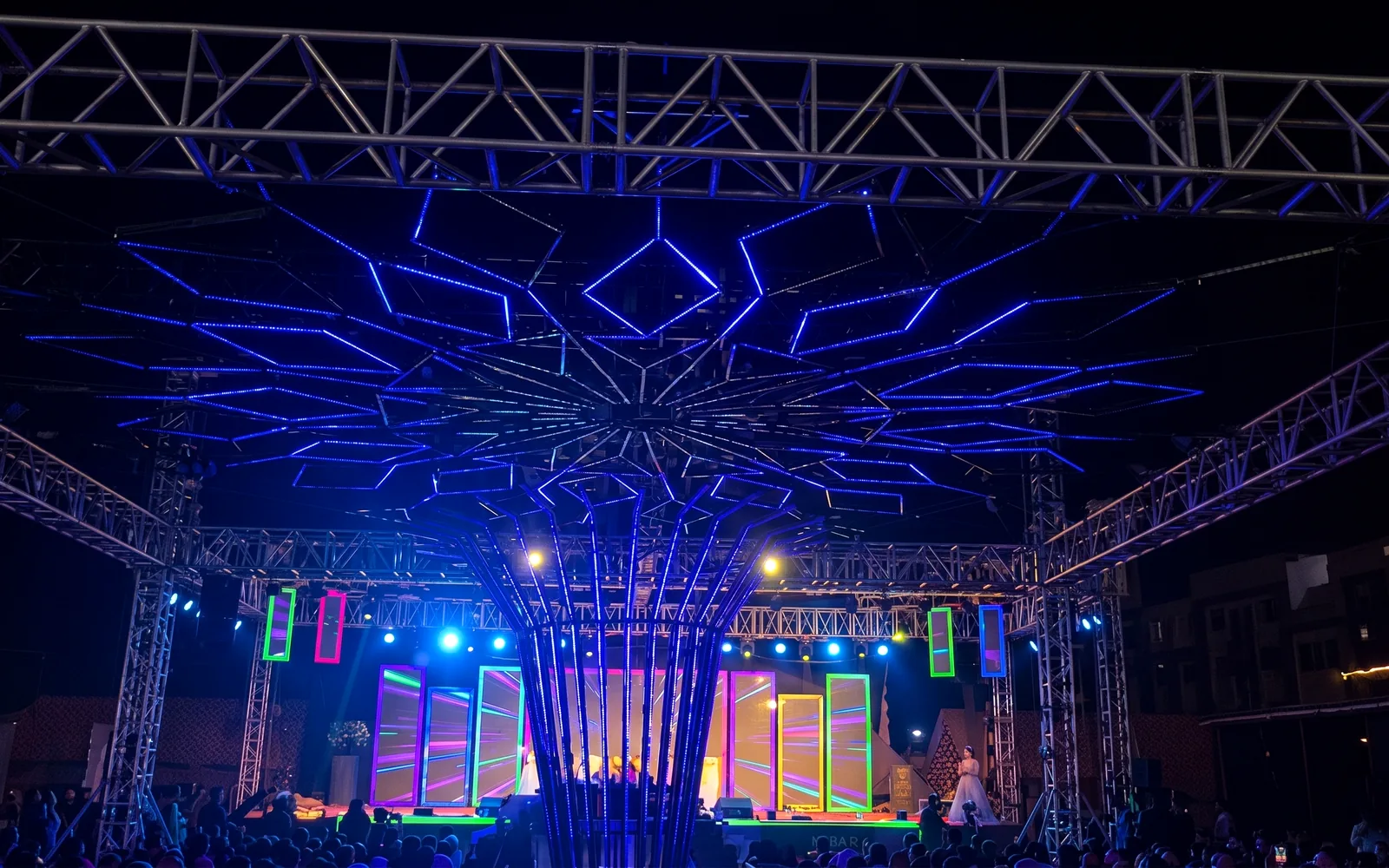
The Indian launch-stage canopy. The bars radiate from a central point and map as one surface — the geometry is the effect, and the mapping is what makes it readable.
Weight and rigging come first. An overhead canopy is flown from truss, and every meter of bar is mass plus cable plus a safety bond. A stage fixture that is cheap per meter and heavy per truss position is not cheap, because the grid is the constraint.
Mapping irregular geometry is the real work. A radiating pattern is not a rectangle, so the pixel map has to describe the actual physical order of every bar. If the map is written by whoever wrote the layout, the effect lands first time; if it is reverse-engineered on site by a console op at 2 a.m., it lands eventually and costs a rehearsal.
De-rig speed is a product feature. A launch show loads out the same night. Bars that travel in road cases with captive connectors and a known flight-case count survive the second and third event; bars that arrive as loose fixtures with bare tails do not.
The same constraints show up on touring rigs at a different scale, which is what the stage and touring pixel LED material on this site works through.
Facades: four jobs where the IP rating was the design
Four records put light on the outside of a building: 800 m of pixel tube climbing a Chinese commercial plaza in vertical bars, 1,200 m of DMX wall washer running the horizontal lines of a German plaza, 760 m of pixel bar built into a grid-format sign on a United States club front, and 2,600 m of addressable pixel strip with silicone neon masks on a sculpted wave-rib bar facade, also in the United States.
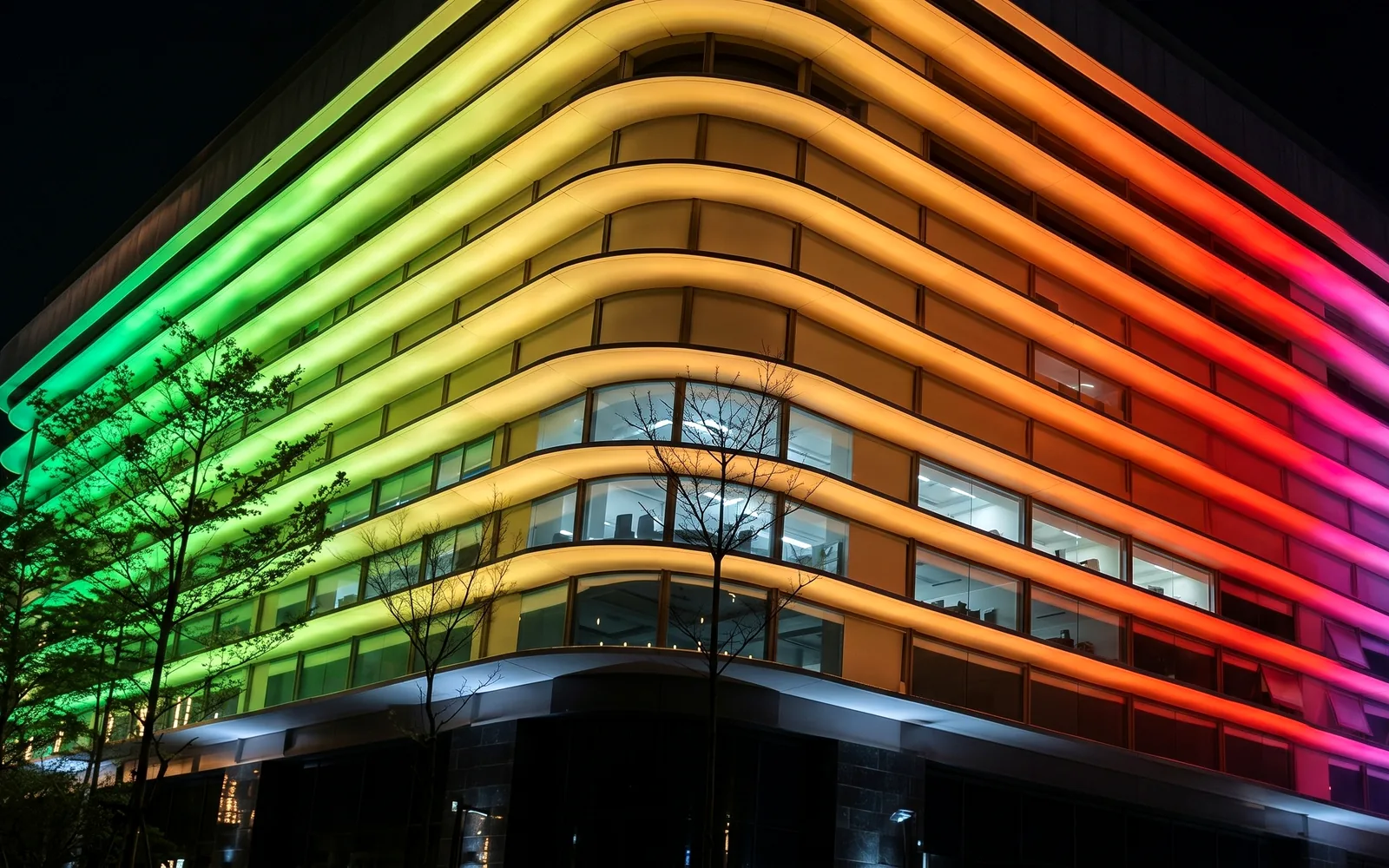
The German plaza: 1,200 m of wall washer running the horizontal facade lines as a single full-spectrum wash. The German plaza wall-washer deep dive covers the mounting and power layout.
The IP number is not a badge, it is an enclosure. Under IEC 60529, the second digit describes water: IP66 means protection against powerful water jets, IP68 means protection against continuous immersion under conditions agreed between manufacturer and user. An outdoor facade lives in the first regime — driving rain, hose-down, and years of ultraviolet. The failure mode is rarely the LED; it is the joint, the end cap and the cable entry. That is why a facade order is mostly an enclosure order with a strip inside it.
Voltage is a distance decision. A 1,200 m run cannot be fed from one end. Resistive loss scales with current, and for the same wattage a 48 V line carries half the current of a 24 V line — a quarter of the loss per meter. Doubling the supply voltage is the cheapest way to extend the distance between injection points, and fewer injection points means fewer penetrations through the building envelope, each of which is a future leak.
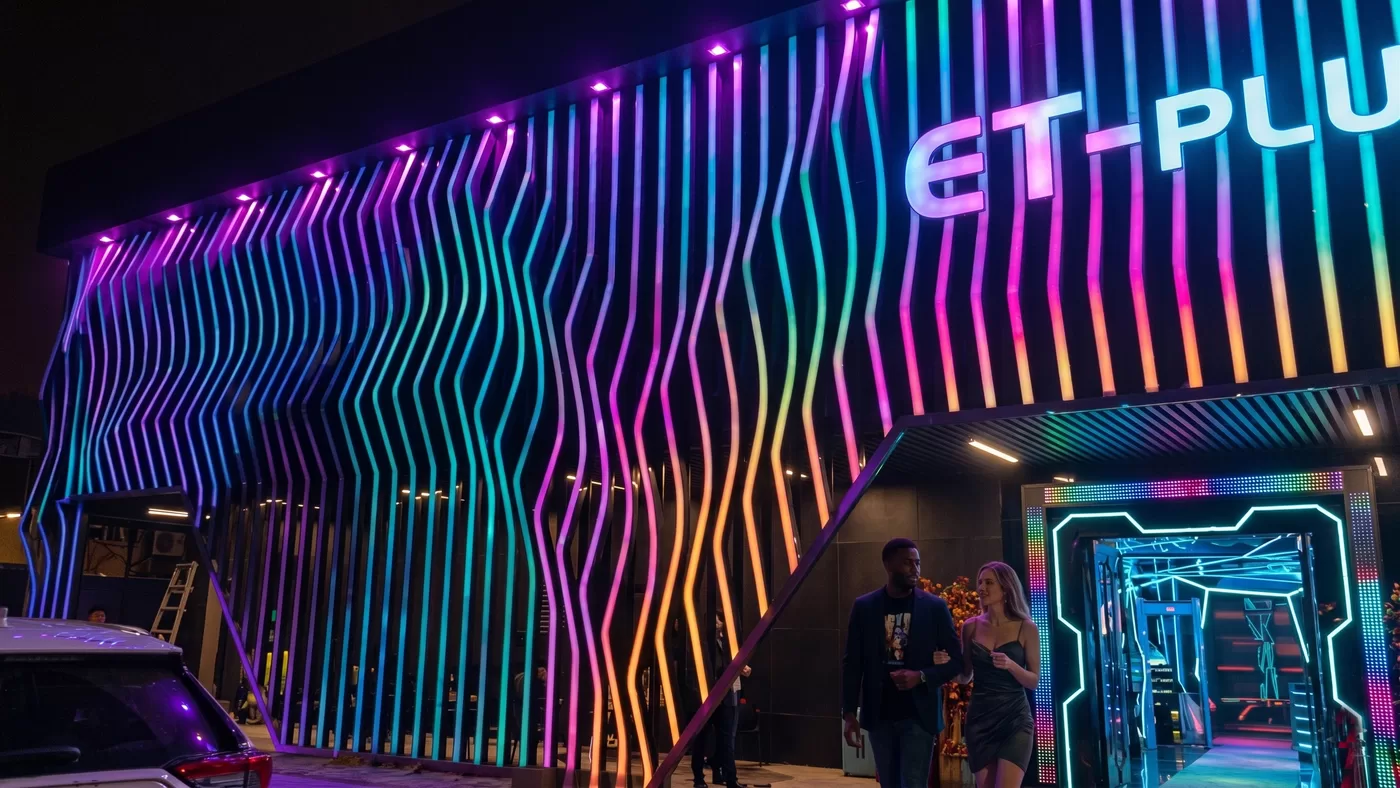
The United States bar facade: addressable pixel strip set into vertical ribs, with silicone neon outlining the entrance and signage, all mapped as one animated front.
An elevation is a mapping problem before it is a lighting problem. Vertical bars and horizontal bands animate in different directions. On the Chinese plaza the addressable run climbs the elevation; on the German plaza the wash sweeps sideways. Choosing which is "better" is a designer's call — the constraint is that the fixture's addressing order has to match the geometry, or every effect has to be built as a workaround.
Service access decides the mounting detail. Facade maintenance is rope access or a scaffold license, so the unit of replacement matters more than the unit of installation. A module that unplugs and drops out of a profile is a different cost over ten years from a run that has to be cut and re-sealed in place.
And in the EU, the driver is part of the compliance story. CE marking for a facade system includes EMC under EN 55015 and EN 61547 — switching power supplies on a long facade are exactly the kind of load that radiates. The CE, EMC and RoHS certificates Pileds holds at company level, covering the product families used in the German and French records, are listed further down.
Facade specification, mounting and handover are covered in more depth on the facade and architectural lighting pages.
Exhibitions and art: 1,800 m and 46,000 points are volume problems
Two records are temporary-feeling but technically permanent: 1,800 m of 50 mm 360° globe lights hung as a floor-to-ceiling field for a United States cultural exhibition, and 46,000 globe points built into volumetric columns and a mirrored room for a French light-art exhibition.

The French exhibition: 46,000 50 mm globe points in volumetric columns, with a visitor inside the field. Scale is the material here — the visitor is the only reference.
360° emission is a structural choice. A globe emits in every direction, so a visitor walking through the field never meets a dark back face. That is what makes the space read as volume rather than as a wall of dots. It also doubles the visible hardware: twice the mounting, twice the cable, and in the mirrored room, twice the reflections of both.
Density is a design variable, not a datasheet value. There is no "correct" spacing for a globe field; there is the spacing that makes the intended effect. Close enough and the spheres merge into a surface; wide enough and each point is countable. On a fixed hardware budget, changing the spacing changes the piece.
At this size the control load becomes the project. 46,000 points at three channels each is 138,000 channels, which is about 270 DMX universes; 86,500 points on the wheel below is roughly 507. If the fixtures were RGBW — four channels — the same point counts become about 359 and 676 universes. That is arithmetic on the documented counts, not an as-built figure, and it is enough to make the point: past a few hundred universes you are not running a lighting rig, you are running a network. Art-Net exists precisely because DMX512's 512 channels per universe (ANSI E1.11) stop being a practical unit at that scale, and mapping software such as MADRIX is where the pixel order gets described.
The full French exhibition record covers the mirrored room and the column layout.
An observation wheel: 86,500 points on a structure that moves
The largest single deployment in the set is 86,500 full-color addressable pixel points mapped across the spokes and rim of an observation wheel in Singapore, delivered with on-site commissioning and technical support through the program. It is the record this page is illustrated with at the top, because it is the one that shows most clearly what scale looks like.
A wheel is a moving structure, and that changes the data path. Points on the rim travel. Everything that reaches them has to be either carried on the rotating assembly or transferred across a rotating joint, and every decision about where the controllers sit is a trade between weight on the rim and signal integrity. A static facade with the same point count is an easier job.
Wind and water are the environment, not an incident. An 86,500-point installation on a wheel is exposed to rain, wind load and vibration continuously. Mounting hardware, cable routing and strain relief are specified for movement, not for a still photograph.
Commissioning at height is a schedule item. The record includes on-site commissioning and support through the program — which on a structure of this type means access windows, a mapping pass that has to happen after dark, and a punch list that cannot be worked through from a desk. Budget the commissioning time in the same line as the hardware.
Service happens in windows, not on demand. If a section fails, the fix waits for the next planned access. That is an argument for modular replacement and for spares held on site rather than shipped.
The full record, including the commissioning scope, is on the Singapore wheel page.
Holiday displays: 3,600 m that has to run without a laptop
One record is a seasonal plaza display: 3,600 m of addressable pixel string mapped over the cone of a large holiday tree and the cluster of smaller trees around it, as one programmable surface.
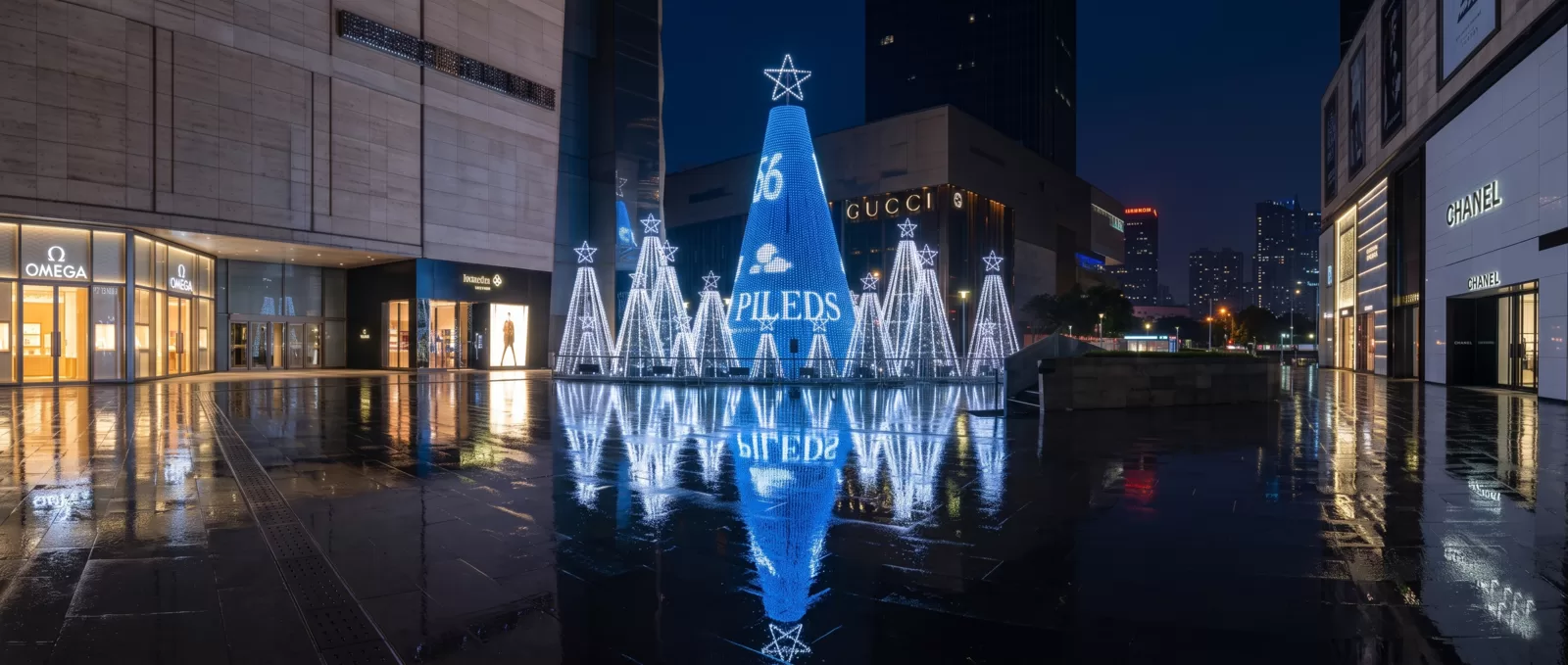
The United States holiday plaza: 3,600 m of pixel string mapped over the tree cone and the surrounding cluster.
Two control modes, one installation. The record runs Art-Net live from a PC for show programming and SD-card offline playback at the fixture. That is not redundancy for its own sake: a plaza display has to run every night for six weeks whether or not anyone is on site with a laptop, and it also has to accept a new animation when marketing changes its mind. A design that only does one of those two is a design that fails in week three.
Seasonal means install and strike, every year. String that is coiled, stored and re-hung annually takes a different kind of abuse from a permanent install. Connector retention, cable memory and a labeling scheme that survives eleven months in a crate are part of the specification.
Weather plus scheduling. An unattended outdoor run needs a controller that starts and stops itself, not one that needs a person at dusk.
The project write-up is on the holiday light-tree page.
A mine: 10,000 m where the voltage is a safety decision
The one industrial record in the set is 10,000 m of AC36V LED strip lighting underground workings at a South African mine — a sealed, high-tensile build specified to resist pulling, crushing and impact, threaded along timbered shaft and back under the support netting.
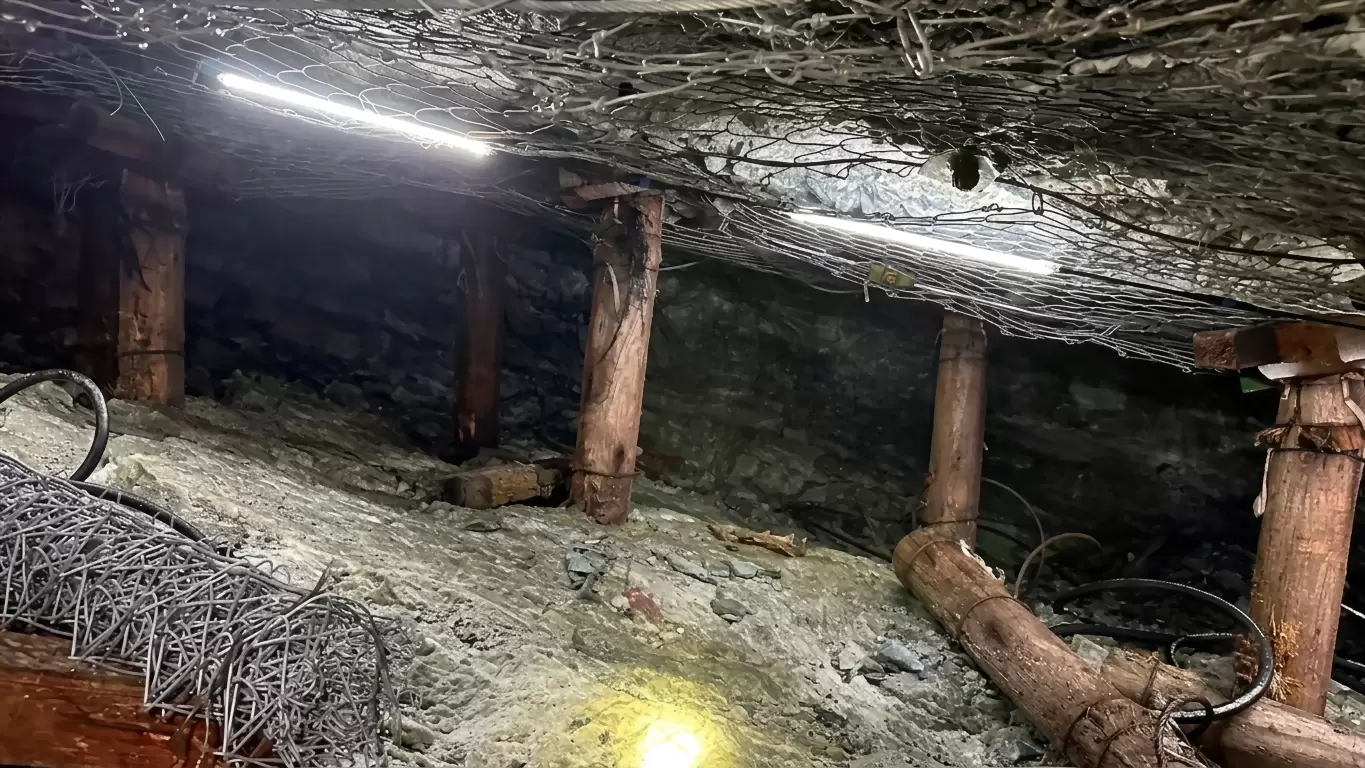
The South African mine: sealed AC36V strip along the tunnel roof, with the timber props and mesh that the run has to live with.
The voltage class is the first decision, not the last. AC36V sits below the 50 V AC threshold that commonly defines extra-low voltage, which is why it appears in workings where a damaged conductor is a realistic event rather than a hypothetical one. The trade is that low voltage means higher current for the same wattage, so runs need more injection points than the equivalent mains-voltage system. The two requirements pull against each other and the layout is where they get reconciled.
A sealed body is the entry ticket, not the differentiator. Wet, dusty, abrasive and occasionally struck — the record describes the strip as a sealed waterproof body, and the enclosure plus the tensile construction is what survives. The strongest protection Pileds holds a certificate for is IP66, the powerful-jet enclosure class certified for the outdoor product families in this set; the record itself stops at "sealed waterproof body" and claims no continuous-immersion rating. A standard outdoor strip with a coating does not survive either way.
Long runs reduce hardware, and hardware in a mine is a risk. Ten thousand meters of continuous run means far fewer feed points, junctions and drivers underground, which is both a cost and a safety argument: every connection in a working is something that can be damaged, inspected and logged.
Cut-to-length capability is a planning requirement. Workings advance and change; strip is cut on site. Where the cut marks are, what happens to the IP rating after a cut, and how much spare is ordered per 100 m are as much part of the order as the meters.
The South African mine record covers the enclosure, the cable support and the cut marks.
What the nine countries add: certificates, not adjectives
"Shipped to 90+ countries" is a logistics claim. What actually changes between markets is the compliance file and the environment.
Market these records shipped into | Compliance document held at company level | What it covers |
|---|---|---|
India (record 2) | BIS R-41220418 | Registration against IS 10322, the Indian standard for the relevant luminaire class |
Germany, France (records 6, 13) | CE XDH0723574011130418EC, EMC KEYS240815047001EM-02, RoHS XDH0923574011130419CC | EMC Directive 2014/30/EU; EN 55015 / EN 61547 emissions and immunity; RoHS (EU) 2015/863 |
Outdoor work anywhere (records 5, 6, 10, 14) | IP66 JAT24101202622IC-1 | Sealing to EN 60529:2013 — the enclosure claim, not the word "waterproof" |
Malaysia, Vietnam, Singapore (records 1, 9, 12) | No separate certificate | Humidity and salt-laden air: enclosure and hardware finish matter more than IP class alone |
South Africa (record 15) | No separate certificate | Dust, abrasion and impact: enclosure plus tensile construction |
One scope note, because it is the first thing a procurement engineer checks: these are Pileds' company- and product-line-level documents, not certificates filed against individual projects. The delivered-project records carry no certificate of their own — what the documents establish is that the product families shipped into those markets were type-tested to the standards named. Every number in that table is a document number a procurement team can check with the issuing body — not a marketing claim. The two rows without a document are engineering requirements rather than certifications, and they are labeled that way rather than padded with a badge.
None of this makes a case record honest on its own. It makes it checkable.
How to audit any pixel LED case record in ten minutes
The method below works on any supplier's case page, including this one. It is the reason the fifteen rows above are published as a table rather than as fifteen separate stories.
- Separate delivered from designed. "Up to 10,000 m" and "10,000 m delivered" are different claims. Look for the past tense and a quantity, not a capability.
- Run one arithmetic check. Take the headline number and divide. 86,500 points is about 507 DMX universes at three channels per point. If the page describes a single DMX line and one controller, the number and the architecture do not agree.
- Ask which axis the number loads. A facade record should lead with IP class and feed spacing. A mine record should lead with voltage class and enclosure. If a page's technical detail is identical across five different venue types, it was written by a copywriter, not a project engineer.
- Count the photographs. One hero shot per project is normal. A gallery that shows the same frame from two angles is one photograph sold twice. Look for the unflattering views — the back of the panel, the cable entry, the joint.
- Look for what the record refuses to say. Client name, exact quantity, product family, country, venue type, year, and the constraint that shaped the job. A page with a hundred adjectives and no quantities has told you nothing.
- Ask for the project record. A supplier who has actually delivered the job can send the page, the product list and the control scheme. One who has not will send a brochure.
What these fifteen records do not contain, stated plainly: no client names, no contract values, no delivery dates, no testimonials, and no as-built drawings. The record set was built that way — the source data is un-branded by design. Any page that fills those gaps with invented detail is worth less than one that admits them.
Where to look next
Six of the fifteen have a full write-up on this blog — the United States club ceiling, the German facade wash, the French exhibition, the Singapore wheel, the United States holiday tree and the South African mine — and all six are linked from the sections above.
If a project of this shape is on your desk, the useful thing to send is not a request for a catalogue. Send the venue type, the delivered scale you are working to and the environment, and ask for the matching product family plus the control and power plan. Pileds answers inquiries within 8 business hours; the contact page has the form, the email address and the WhatsApp number.
Specifying pixel LED for a real project?
Send the spec — pitch, IC, IP class, run length, voltage — and you get an engineer's answer, not a catalogue. Samples and OEM/ODM quotes from the Shenzhen factory floor.